
A French Word to Live By
How to Conjugate Caner in French
/ka.ne/
Caner means to funk, to chicken out (fam.) — to back out at the last moment because courage has quietly left the room.
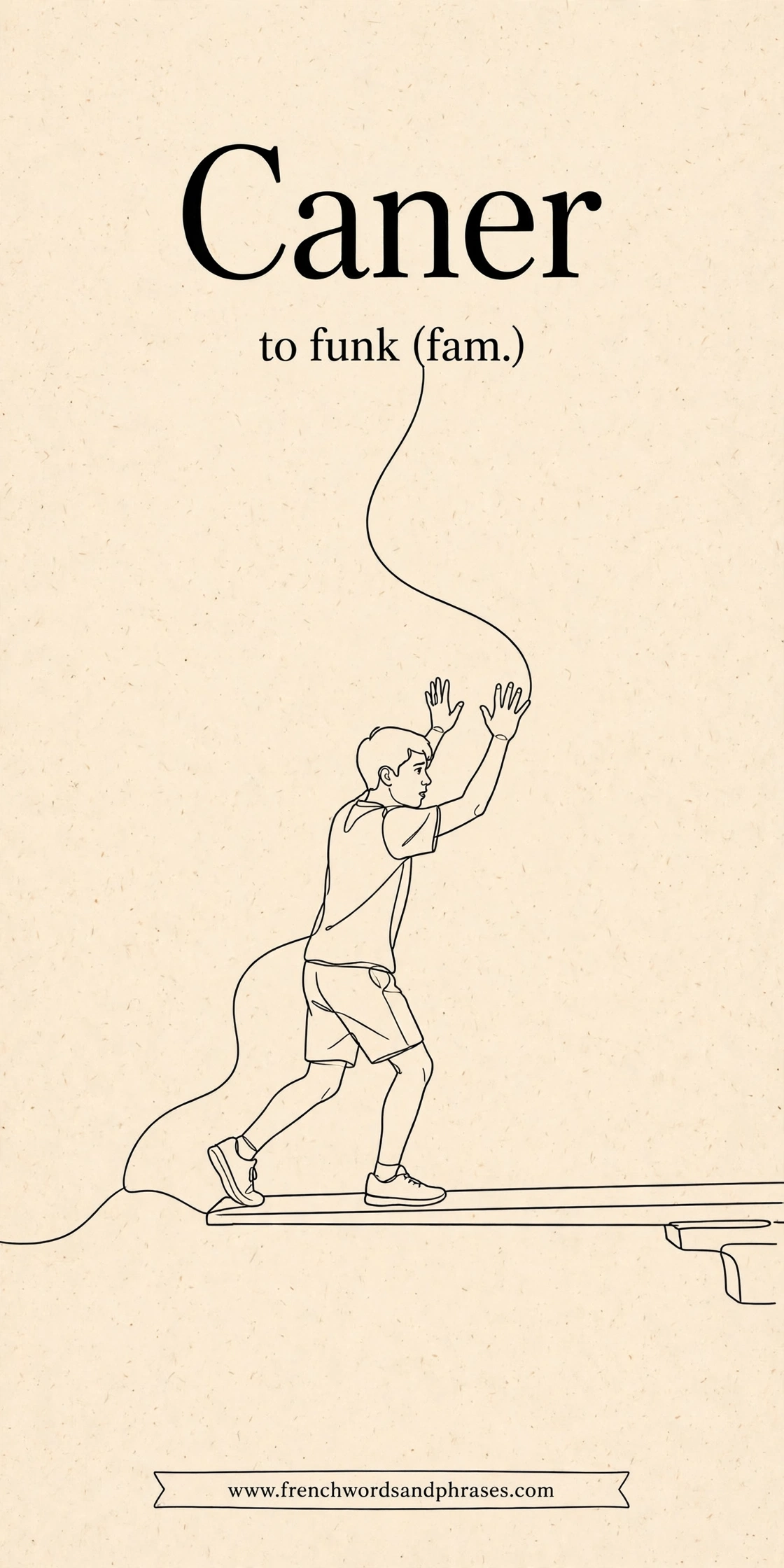
A boy at the top of the high diving board who climbs back down the ladder, a speaker who suddenly ‘forgets’ his speech — caner is the familiar verb of the last-minute retreat: the moment was there, the nerve was not.
In this guide, you’ll learn how to conjugate caner in all the major French tenses and moods. Explore complete conjugation tables, French examples, English translations, and practice quizzes.
Understanding the French Verb Caner
Caner is a regular French verb belonging to the first group of verbs, those ending in-er.
It means to funk, to chicken out (fam.). It is almost always used with a hint of teasing: a friend who canes out of a jump, a promise or a difficult conversation gets caner thrown at him, smiling. Expect it in speech, dialogue and comics rather than in print journalism.
Verb classification: First group (-er)
Auxiliary verb: Avoir
Past participle: cané
Present participle: canant
English equivalents: To funk, to chicken out, to back out (all familiar); caner au dernier moment — to chicken out at the last moment; caner devant l’obstacle — to funk the jump; il a cané — he chickened out; ne cane pas ! — do not chicken out!
One important detail: caner is familier — informal, spoken French, the word of playgrounds and friends, not of essays or offices; the neutral verbs are reculer and renoncer. Its picture is probably the dog — le chien was once can in old French — slinking off with its tail down. The conjugation itself is perfectly regular: je cane, nous canons, ils canent, past participle cané. Do not confuse it with its near-twin canner, with two n’s, which means to cane a chair.
Experience the Word
Caner is the verb of the ladder climbed back down — the dive was possible, the diver decided otherwise.
Imagine the swimming pool on the last day of summer. Karim has boasted all week about the five-metre board; now he stands at the top, toes curled on the edge, the whole pool watching — et il cane: he smiles, shrugs, and climbs down every step of the ladder to the sound of friendly laughter.
He has not fallen and he has not jumped. He has chickened out — il a cané, at the very last moment.
How to Conjugate Caner: Complete French Conjugation Guide
Let’s explore every major conjugation of caner, beginning with the indicative mood.
How to Conjugate Caner in the Indicative Mood
The indicative mood is used to express facts, observations, actions, and events.
How to Conjugate Caner in the Present Tense (Présent)
Used for actions happening now, habitual actions, and general truths.
| Subject | Conjugation |
|---|---|
| je | cane |
| tu | canes |
| il / elle | cane |
| nous | canons |
| vous | canez |
| ils / elles | canent |
Example
Il cane toujours au moment de téléphoner au directeur.
He always chickens out when it is time to phone the director.
Quick Quiz 1
Complete the sentence:
Nous ne ______ jamais devant un défi.
Reveal the answer
canons
>
Nous ne canons jamais devant un défi.
We never chicken out in front of a challenge.
How to Conjugate Caner in the Passé Composé
Used for completed actions in the past. Caner takes the auxiliary verb avoir.
| Subject | Conjugation |
|---|---|
| j’ | ai cané |
| tu | as cané |
| il / elle | a cané |
| nous | avons cané |
| vous | avez cané |
| ils / elles | ont cané |
Example
Elle a cané juste avant de sauter du grand plongeoir.
She chickened out just before jumping off the high board.
How to Conjugate Caner in the Imparfait (Imperfect Tense)
Used for habitual past actions, descriptions, and ongoing situations in the past.
| Subject | Conjugation |
|---|---|
| je | canais |
| tu | canais |
| il / elle | canait |
| nous | canions |
| vous | caniez |
| ils / elles | canaient |
Example
Enfant, il canait devant chaque aiguille du médecin.
As a child, he used to funk every doctor’s needle.
Quick Quiz 2
Choose the correct form:
She chickened out before the jump.
Elle ______ avant le saut. (a cané / est canée)
Reveal the answer
a cané
Elle a cané avant le saut.
Caner takes avoir.
How to Conjugate Caner in the Plus-que-parfait
Used to describe an action that had already been completed before another past event.
| Subject | Conjugation |
|---|---|
| j’ | avais cané |
| tu | avais cané |
| il / elle | avait cané |
| nous | avions cané |
| vous | aviez cané |
| ils / elles | avaient cané |
Example
Ils avaient cané une première fois, mais pas deux.
They had chickened out once, but not twice.
How to Conjugate Caner in the Passé Simple
Primarily used in formal writing, literature, and historical narratives. It is rarely used in everyday conversation.
| Subject | Conjugation |
|---|---|
| je | canai |
| tu | canas |
| il / elle | cana |
| nous | canâmes |
| vous | canâtes |
| ils / elles | canèrent |
Example
Le soldat ne cana pas et monta le premier à l’assaut.
The soldier did not funk it and went first into the attack.
How to Conjugate Caner in the Passé Antérieur
A literary tense used to express an action completed immediately before another past action, generally in the passé simple.
| Subject | Conjugation |
|---|---|
| j’ | eus cané |
| tu | eus cané |
| il / elle | eut cané |
| nous | eûmes cané |
| vous | eûtes cané |
| ils / elles | eurent cané |
Example
Quand il eut cané trois fois, ses amis cessèrent de l’inviter.
When he had chickened out three times, his friends stopped inviting him.
How to Conjugate Caner in the Future Tense (Futur Simple)
Used to describe actions that will take place in the future.
| Subject | Conjugation |
|---|---|
| je | canerai |
| tu | caneras |
| il / elle | canera |
| nous | canerons |
| vous | canerez |
| ils / elles | caneront |
Example
Tu verras, il canera au moment de signer.
You will see, he will chicken out when it is time to sign.
How to Conjugate Caner in the Futur Antérieur (Future Perfect)
Used for an action that will have been completed before a particular point in the future.
| Subject | Conjugation |
|---|---|
| j’ | aurai cané |
| tu | auras cané |
| il / elle | aura cané |
| nous | aurons cané |
| vous | aurez cané |
| ils / elles | auront cané |
Example
À la fin de la journée, elle aura cané ou elle aura sauté.
By the end of the day, she will have chickened out or she will have jumped.
How to Conjugate Caner in the Near Future (Futur Proche)
Used to describe something that is going to happen soon. Formed with aller + infinitive.
| Subject | Conjugation |
|---|---|
| je | vais caner |
| tu | vas caner |
| il / elle | va caner |
| nous | allons caner |
| vous | allez caner |
| ils / elles | vont caner |
Example
Ne me dis pas que tu vas caner maintenant !
Do not tell me you are going to chicken out now!
How to Conjugate Caner in the Conditional Mood
The conditional mood expresses what would happen under certain circumstances. It is also frequently used to make polite requests or express wishes.
How to Conjugate Caner in the Present Conditional
| Subject | Conjugation |
|---|---|
| je | canerais |
| tu | canerais |
| il / elle | canerait |
| nous | canerions |
| vous | caneriez |
| ils / elles | caneraient |
Example
Sans ses amis pour le pousser, il canerait à chaque fois.
Without his friends to push him, he would chicken out every time.
How to Conjugate Caner in the Past Conditional
| Subject | Conjugation |
|---|---|
| j’ | aurais cané |
| tu | aurais cané |
| il / elle | aurait cané |
| nous | aurions cané |
| vous | auriez cané |
| ils / elles | auraient cané |
Example
Elle aurait cané si on ne l’avait pas encouragée.
She would have chickened out if nobody had encouraged her.
Caner in the Literary Past Conditional Form
This less common literary form uses the imperfect subjunctive of avoir.
| Subject | Conjugation |
|---|---|
| j’ | eusse cané |
| tu | eusses cané |
| il / elle | eût cané |
| nous | eussions cané |
| vous | eussiez cané |
| ils / elles | eussent cané |
Example
Le héros eût cané que le roman n’aurait plus d’histoire.
Had the hero chickened out, the novel would have had no story left.
How to Conjugate Caner in the Subjunctive Mood
The subjunctive is used to express wishes, emotions, doubts, necessity, and uncertainty. It frequently follows expressions such as il faut que (it is necessary that) or bien que (although).
How to Conjugate Caner in the Present Subjunctive
| Subject | Conjugation |
|---|---|
| que je | cane |
| que tu | canes |
| qu’il / qu’elle | cane |
| que nous | canions |
| que vous | caniez |
| qu’ils / qu’elles | canent |
Example
Je ne crois pas qu’il cane devant un si petit saut.
I do not believe he would chicken out over such a small jump.
Quick Quiz 3
Complete the sentence using the subjunctive:
Il est peu probable que vous ______ après tant d’entraînement.
Reveal the answer
caniez
Il est peu probable que vous caniez après tant d’entraînement.
It is unlikely you would chicken out after so much training.
How to Conjugate Caner in the Imperfect Subjunctive
A literary tense, rarely encountered in modern spoken French.
| Subject | Conjugation |
|---|---|
| que je | canasse |
| que tu | canasses |
| qu’il / qu’elle | canât |
| que nous | canassions |
| que vous | canassiez |
| qu’ils / qu’elles | canassent |
Example
Il était peu probable qu’elle canât après tant d’entraînement.
It was unlikely she would funk it after so much training.
How to Conjugate Caner in the Pluperfect Subjunctive
A literary construction used to express an action completed before another past action.
| Subject | Conjugation |
|---|---|
| que j’ | eusse cané |
| que tu | eusses cané |
| qu’il / qu’elle | eût cané |
| que nous | eussions cané |
| que vous | eussiez cané |
| qu’ils / qu’elles | eussent cané |
Example
On raillait qu’il eût cané devant une simple piqûre.
People teased that he had chickened out over a simple injection.
How to Conjugate Caner in the Past Subjunctive
| Subject | Conjugation |
|---|---|
| que j’ | aie cané |
| que tu | aies cané |
| qu’il / qu’elle | ait cané |
| que nous | ayons cané |
| que vous | ayez cané |
| qu’ils / qu’elles | aient cané |
Example
Je suis étonné qu’elle ait cané, elle qui est si courageuse.
I am amazed she chickened out, brave as she is.
How to Conjugate Caner in the Imperative
The imperative is used to give commands, instructions, invitations, or suggestions. Subject pronouns are omitted.
How to Conjugate Caner in the Present Imperative
| Person | Conjugation |
|---|---|
| (tu) | cane |
| (nous) | canons |
| (vous) | canez |
Example
Ne cane pas, saute, on te regarde !
Do not chicken out, jump, everyone is watching!
Quick Quiz 4
How would you say Do not chicken out (tu form)?
Reveal the answer
Ne cane pas !
French Participles of Caner
Participles are verb forms that can be used in compound tenses and other grammatical constructions.
Present Participle of Caner
canant
En canant au dernier moment, il a perdu son pari.
By chickening out at the last moment, he lost his bet.
Past Participle of Caner
cané
Cané au pied du mur, le grimpeur a préféré redescendre.
Having funked it at the foot of the wall, the climber preferred to climb back down.
Caner in Everyday French: Real-Life Examples
Now that you know the conjugations, let’s see how caner appears in everyday French.
Example 1 — Present
Il cane toujours au dernier moment.
He always chickens out at the last moment.
Example 2 — Passé composé
Elle a cané avant le grand saut.
She chickened out before the big jump.
Example 3 — Imparfait
Enfant, il canait devant les aiguilles.
As a child, he used to funk needles.
Example 4 — Future
Il canera au moment de signer, tu verras.
He will chicken out when it is time to sign, you will see.
Example 5 — Conditional
Sans nous, elle canerait à chaque fois.
Without us, she would chicken out every time.
Example 6 — Imperative
Ne cane pas, saute !
Do not chicken out, jump!
Beyond Translation: The Meaning of Caner
English to funk is old school slang for exactly this flinch, and French caner matches it register for register — familier, teasing, never official.
Both languages keep a back door for courage that fails.
French even built a noun from the family: un cancre is a dunce, and the whole little tribe of can- words carries the same smell of the dog slinking away from the fight.
How to Remember the French Verb Caner
Remember it this way: Caner is about the boy climbing back down the diving-board ladder.
- Register first: caner is familier — say reculer or renoncer in polite or written French.
- One n only: caner (chicken out) is not canner (to cane a chair).
- Regular -er: je cane, nous canons, past participle cané.
The key idea is the boy climbing back down the diving-board ladder.
Test Your Knowledge of Caner
Let’s see how much you’ve learned. Try answering these questions before revealing the answers.
Question 1
What register is caner, and what are its neutral equivalents?
Reveal the answer
Familier (informal) — neutral French says reculer or renoncer.
Question 2
How do you say She chickened out just before the jump in French?
Reveal the answer
Elle a cané juste avant le saut.
Question 3
Translate: He always chickens out at the last moment.
Reveal the answer
Il cane toujours au dernier moment.
Question 4
What is the past participle of caner?
Reveal the answer
Cané.
Question 5
Complete the sentence:
Je ne crois pas qu’il ______ devant un si petit saut.
Reveal the answer
cane
Je ne crois pas qu’il cane devant un si petit saut.
I do not believe he would chicken out over such a small jump.
Your Final Challenge
Can You Use It?
How would you say this in French?
He looked at the drop, he smiled, and for once he did not chicken out: he jumped.
Reveal the answer
Il a regardé le vide, il a souri, et pour une fois, il n’a pas cané : il a sauté.
He looked at the drop, he smiled, and for once he did not chicken out: he jumped.
A little French. A little curiosity. A richer everyday life.
LEARN FRENCH ONE WORD AT A TIME




