
A French Word to Live By
How to Conjugate Candir in French
/kɑ̃.diʁ/
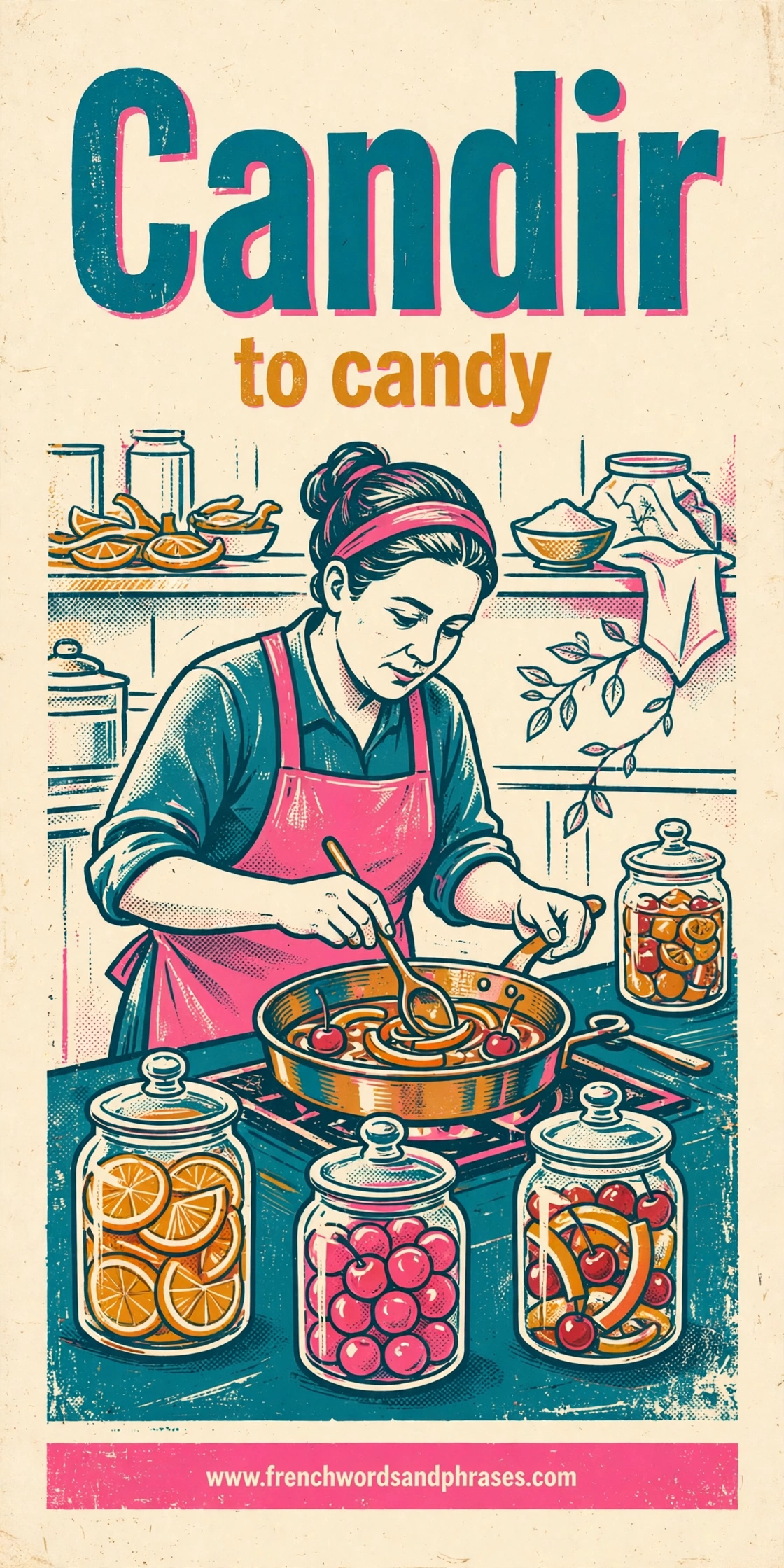
Candir means to candy — to preserve fruit, peel or petals in sugar until they turn translucent, glossy and sweet through and through.
Orange peel simmering slowly in syrup, violets crystallised one by one for a cake — candir is the patient verb of the confectioner’s kitchen: sugar, time and gentle heat, until the fruit itself becomes a jewel of sugar.
In this guide, you’ll learn how to conjugate candir in all the major French tenses and moods. Explore complete conjugation tables, French examples, English translations, and practice quizzes.
Understanding the French Verb Candir
Candir is a regular French verb belonging to the second group of verbs, those ending in -ir.
It means to candy. It is a kitchen and confectionery verb: the cook candit fruit, peel, ginger or flowers by soaking them in ever-stronger syrup. The result, les fruits candis, fills the cakes of Provence and the Christmas tables of France, and the verb is rarely heard outside this sweet world.
Verb classification: Second group (-ir)
Auxiliary verb: Avoir
Past participle: candi
Present participle: candissant
English equivalents: To candy, to crystallise in sugar; candir des fruits — to candy fruit; candir des écorces d’orange — to candy orange peel; des fruits candis — candied fruit; candir des violettes — to candy violets.
One important detail: candir is a regular second-group verb, conjugated exactly like finir — watch the double s in the plural present and throughout the imperfect: je candis, tu candis, il candit, nous candissons, vous candissez, ils candissent, past participle candi. Its name comes from le candi, crystallised sugar — the same word English borrowed for candy itself.
Experience the Word
Candir is the verb of patience in syrup — nothing is rushed, and the sugar does the work day after day.
Imagine a confectioner’s workshop in Apt, the candied-fruit capital of Provence. Great copper pans of apricots rest in syrup; each day the syrup is stronger, each day the fruit grows clearer, until the master lifts out an apricot that glows like amber — il a candi les fruits selon la méthode de son grand-père.
The apricot is still an apricot. But it has been candied — candi, preserved in sugar to shine for a year.
How to Conjugate Candir: Complete French Conjugation Guide
Let’s explore every major conjugation of candir, beginning with the indicative mood.
How to Conjugate Candir in the Indicative Mood
The indicative mood is used to express facts, observations, actions, and events.
How to Conjugate Candir in the Present Tense (Présent)
Used for actions happening now, habitual actions, and general truths.
| Subject | Conjugation |
|---|---|
| je | candis |
| tu | candis |
| il / elle | candit |
| nous | candissons |
| vous | candissez |
| ils / elles | candissent |
Example
Le confiseur candit les écorces d’orange dans un sirop léger.
The confectioner is candying the orange peel in a light syrup.
Quick Quiz 1
Complete the sentence:
Nous ______ les écorces dans un sirop léger.
Reveal the answer
candissons
Nous candissons les écorces dans un sirop léger.
We are candying the peel in a light syrup.
How to Conjugate Candir in the Passé Composé
Used for completed actions in the past. Candir takes the auxiliary verb avoir.
| Subject | Conjugation |
|---|---|
| j’ | ai candi |
| tu | as candi |
| il / elle | a candi |
| nous | avons candi |
| vous | avez candi |
| ils / elles | ont candi |
Example
Nous avons candi des cerises pour le gâteau de Noël.
We candied some cherries for the Christmas cake.
How to Conjugate Candir in the Imparfait (Imperfect Tense)
Used for habitual past actions, descriptions, and ongoing situations in the past.
| Subject | Conjugation |
|---|---|
| je | candissais |
| tu | candissais |
| il / elle | candissait |
| nous | candissions |
| vous | candissiez |
| ils / elles | candissaient |
Example
Autrefois, on candissait les violettes à Toulouse.
In the old days, people used to candy violets in Toulouse.
Quick Quiz 2
Choose the correct form:
We candied some cherries.
Nous ______ des cerises. (avons candi / sommes candis)
Reveal the answer
avons candi
Nous avons candi des cerises.
Candir takes avoir.
How to Conjugate Candir in the Plus-que-parfait
Used to describe an action that had already been completed before another past event.
| Subject | Conjugation |
|---|---|
| j’ | avais candi |
| tu | avais candi |
| il / elle | avait candi |
| nous | avions candi |
| vous | aviez candi |
| ils / elles | avaient candi |
Example
Elle avait candi le gingembre avant de le vendre au marché.
She had candied the ginger before selling it at the market.
How to Conjugate Candir in the Passé Simple
Primarily used in formal writing, literature, and historical narratives. It is rarely used in everyday conversation.
| Subject | Conjugation |
|---|---|
| je | candis |
| tu | candis |
| il / elle | candit |
| nous | candîmes |
| vous | candîtes |
| ils / elles | candirent |
Example
L’atelier candit mille abricots cet été-là.
The workshop candied a thousand apricots that summer.
How to Conjugate Candir in the Passé Antérieur
A literary tense used to express an action completed immediately before another past action, generally in the passé simple.
| Subject | Conjugation |
|---|---|
| j’ | eus candi |
| tu | eus candi |
| il / elle | eut candi |
| nous | eûmes candi |
| vous | eûtes candi |
| ils / elles | eurent candi |
Example
Quand il eut candi les écorces, il les mit à sécher.
When he had candied the peel, he set it out to dry.
How to Conjugate Candir in the Future Tense (Futur Simple)
Used to describe actions that will take place in the future.
| Subject | Conjugation |
|---|---|
| je | candirai |
| tu | candiras |
| il / elle | candira |
| nous | candirons |
| vous | candirez |
| ils / elles | candiront |
Example
Demain, nous candirons les marrons pour les fêtes.
Tomorrow, we will candy the chestnuts for the festive season.
How to Conjugate Candir in the Futur Antérieur (Future Perfect)
Used for an action that will have been completed before a particular point in the future.
| Subject | Conjugation |
|---|---|
| j’ | aurai candi |
| tu | auras candi |
| il / elle | aura candi |
| nous | aurons candi |
| vous | aurez candi |
| ils / elles | auront candi |
Example
À la fin de la semaine, elle aura candi toutes les oranges.
By the end of the week, she will have candied all the oranges.
How to Conjugate Candir in the Near Future (Futur Proche)
Used to describe something that is going to happen soon. Formed with aller + infinitive.
| Subject | Conjugation |
|---|---|
| je | vais candir |
| tu | vas candir |
| il / elle | va candir |
| nous | allons candir |
| vous | allez candir |
| ils / elles | vont candir |
Example
Le pâtissier va candir des pétales de rose pour le dessert.
The pastry chef is going to candy rose petals for the dessert.
How to Conjugate Candir in the Conditional Mood
The conditional mood expresses what would happen under certain circumstances. It is also frequently used to make polite requests or express wishes.
How to Conjugate Candir in the Present Conditional
| Subject | Conjugation |
|---|---|
| je | candirais |
| tu | candirais |
| il / elle | candirait |
| nous | candirions |
| vous | candiriez |
| ils / elles | candiraient |
Example
Avec un sirop plus riche, on candirait mieux ces citrons.
With a richer syrup, one would candy these lemons better.
How to Conjugate Candir in the Past Conditional
| Subject | Conjugation |
|---|---|
| j’ | aurais candi |
| tu | aurais candi |
| il / elle | aurait candi |
| nous | aurions candi |
| vous | auriez candi |
| ils / elles | auraient candi |
Example
Il aurait candi les figues si la récolte avait été bonne.
He would have candied the figs if the harvest had been good.
Candir in the Literary Past Conditional Form
This less common literary form uses the imperfect subjunctive of avoir.
| Subject | Conjugation |
|---|---|
| j’ | eusse candi |
| tu | eusses candi |
| il / elle | eût candi |
| nous | eussions candi |
| vous | eussiez candi |
| ils / elles | eussent candi |
Example
Le confiseur eût candi les plus beaux abricots du verger.
The confectioner would have candied the finest apricots in the orchard.
How to Conjugate Candir in the Subjunctive Mood
The subjunctive is used to express wishes, emotions, doubts, necessity, and uncertainty. It frequently follows expressions such as il faut que (it is necessary that) or bien que (although).
How to Conjugate Candir in the Present Subjunctive
| Subject | Conjugation |
|---|---|
| que je | candisse |
| que tu | candisses |
| qu’il / qu’elle | candisse |
| que nous | candissions |
| que vous | candissiez |
| qu’ils / qu’elles | candissent |
Example
Il faut que le sucre candisse lentement les fruits.
The sugar must candy the fruit slowly.
Quick Quiz 3
Complete the sentence using the subjunctive:
Il faut que vous ______ les fruits lentement.
Reveal the answer
candissiez
Il faut que vous candissiez les fruits lentement.
You must candy the fruit slowly.
How to Conjugate Candir in the Imperfect Subjunctive
A literary tense, rarely encountered in modern spoken French.
| Subject | Conjugation |
|---|---|
| que je | candisse |
| que tu | candisses |
| qu’il / qu’elle | candît |
| que nous | candissions |
| que vous | candissiez |
| qu’ils / qu’elles | candissent |
Example
Je doutais que l’on candît encore les violettes à la main.
I doubted that violets were still candied by hand.
How to Conjugate Candir in the Pluperfect Subjunctive
A literary construction used to express an action completed before another past action.
| Subject | Conjugation |
|---|---|
| que j’ | eusse candi |
| que tu | eusses candi |
| qu’il / qu’elle | eût candi |
| que nous | eussions candi |
| que vous | eussiez candi |
| qu’ils / qu’elles | eussent candi |
Example
On disait que les religieuses eussent candi les angéliques du couvent.
People said the nuns had candied the convent’s angelica.
How to Conjugate Candir in the Past Subjunctive
| Subject | Conjugation |
|---|---|
| que j’ | aie candi |
| que tu | aies candi |
| qu’il / qu’elle | ait candi |
| que nous | ayons candi |
| que vous | ayez candi |
| qu’ils / qu’elles | aient candi |
Example
Je suis ravi que tu aies candi ces écorces toi-même.
I am delighted that you candied this peel yourself.
How to Conjugate Candir in the Imperative
The imperative is used to give commands, instructions, invitations, or suggestions. Subject pronouns are omitted.
How to Conjugate Candir in the Present Imperative
| Person | Conjugation |
|---|---|
| (tu) | candis |
| (nous) | candissons |
| (vous) | candissez |
Example
Candis ces oranges doucement, sans les briser !
Candy these oranges gently, without breaking them!
Quick Quiz 4
How would you say Candy these oranges gently (tu form)?
Reveal the answer
Candis ces oranges doucement !
French Participles of Candir
Participles are verb forms that can be used in compound tenses and other grammatical constructions.
Present Participle of Candir
candissant
En candissant les fruits, on les conserve pour tout l’hiver.
By candying fruit, you preserve it for the whole winter.
Past Participle of Candir
candi
Candies dans le sucre, les écorces brillent comme des bijoux.
Candied in sugar, the peel shines like jewels.
Candir in Everyday French: Real-Life Examples
Now that you know the conjugations, let’s see how candir appears in everyday French.
Example 1 — Present
Le confiseur candit les écorces d’orange.
The confectioner is candying the orange peel.
Example 2 — Passé composé
Nous avons candi des cerises pour le gâteau.
We candied cherries for the cake.
Example 3 — Imparfait
On candissait les violettes à Toulouse.
People used to candy violets in Toulouse.
Example 4 — Future
Nous candirons les marrons pour les fêtes.
We will candy the chestnuts for the festive season.
Example 5 — Conditional
Il candirait les figues avec un meilleur sucre.
He would candy the figs with a better sugar.
Example 6 — Imperative
Candis ces oranges doucement !
Candy these oranges gently!
Beyond Translation: The Meaning of Candir
English candy and French candir are the same word travelling — Arabic qand, crystallised sugar, passed through Italian and French before English borrowed it back.
France kept the verb of the craft.
In Apt, where whole streets smell of syrup, candir is not a dictionary word but a trade: the confiseur candit, the fruit devient candi, and a year’s patience ends up glittering in a Christmas cake.
How to Remember the French Verb Candir
Remember it this way: Candir is about apricots glowing like amber in the syrup.
- Like finir in every form: nous candissons with the double s — if you can finir, you can candir.
- Le sucre candi is crystallised sugar — the word English turned into candy.
- The classic objects: des fruits, des écorces d’orange, des violettes — candied fruit, peel and violets.
The key idea is apricots glowing like amber in the syrup.
Test Your Knowledge of Candir
Let’s see how much you’ve learned. Try answering these questions before revealing the answers.
Question 1
Which famous verb is candir conjugated exactly like?
Reveal the answer
Finir — je candis, nous candissons, ils candissent, past participle candi.
Question 2
How do you say We candied some cherries in French?
Reveal the answer
Nous avons candi des cerises.
Question 3
Translate: The confectioner is candying the orange peel.
Reveal the answer
Le confiseur candit les écorces d’orange.
Question 4
What is the past participle of candir?
Reveal the answer
Candi — as in les fruits candis, candied fruit.
Question 5
Complete the sentence:
Il faut que le sucre ______ lentement les fruits.
Reveal the answer
candisse
Il faut que le sucre candisse lentement les fruits.
The sugar must candy the fruit slowly.
Your Final Challenge
Can You Use It?
How would you say this in French?
The confectioner candies his apricots day after day, and each fruit becomes a little lamp of sugar.
Reveal the answer
Le confiseur candit ses abricots jour après jour, et chaque fruit devient une petite lampe de sucre.
The confectioner candies his apricots day after day, and each fruit becomes a little lamp of sugar.
A little French. A little curiosity. A richer everyday life.
LEARN FRENCH ONE WORD AT A TIME




