A French Word to Live By
How to Conjugate Calciner in French
/kal.si.ne/
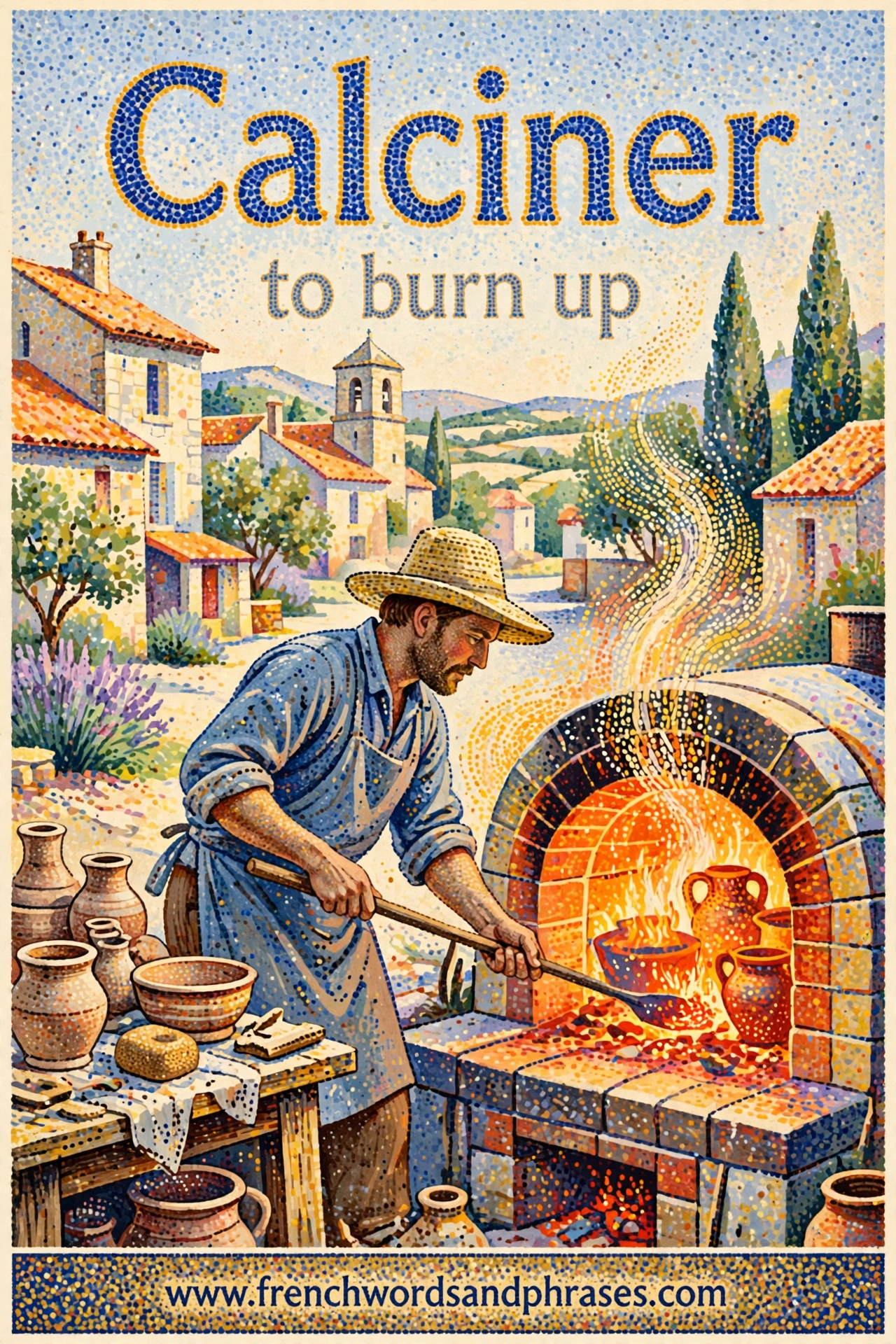
Calciner means to burn up — to burn something so completely and fiercely that only ash, lime or a blackened shell remains.
A summer sun cracking the fields of Provence, bones whitening in a furnace, a forest reduced to grey powder — calciner is the verb of total burning: not a gentle flame, but a fire that finishes the job.
In this guide, you’ll learn how to conjugate calciner in all the major French tenses and moods. Explore complete conjugation tables, French examples, English translations, and practice quizzes.
Understanding the French Verb Calciner
Calciner is a regular French verb belonging to the first group of verbs, those ending in-er.
It means to burn up. It is used of fierce, complete burning — by furnaces, by forest fires, and figuratively by a merciless sun that calcine the fields. In chemistry and industry, calciner is a precise operation: heating a material to drive off water and leave the mineral behind.
Verb classification: First group (-er)
Auxiliary verb: Avoir
Past participle: calciné
Present participle: calcinant
English equivalents: To calcine, to burn up, to burn to ashes; calciner des os — to calcine bones; calciner la terre — to scorch the earth dry; un soleil qui calcine — a scorching sun; des restes calcinés — charred remains.
One important detail: calciner comes from the Latin calx, lime — calcining is burning a substance down to its mineral skeleton, the way limestone is burned to make lime. The verb is a perfectly regular -er: je calcine, nous calcinons, ils calcinent, past participle calciné. Its adjective calciné is the everyday word for anything charred or burnt to a cinder: une voiture calcinée, des terres calcinées.
Experience the Word
Calciner is burning carried to the end — flame is only the beginning; what matters is the ash that remains.
Imagine a hillside in August after the wildfire has passed. The pines stand black and leafless, the earth is grey powder under your boots, and even the stones have split in the heat. Le feu a tout calciné — nothing here merely burned; it was consumed to the bone.
A normal fire leaves charcoal and hope. A fire that calcine leaves only minerals — the landscape’s skeleton.
How to Conjugate Calciner: Complete French Conjugation Guide
Let’s explore every major conjugation of calciner, beginning with the indicative mood.
How to Conjugate Calciner in the Indicative Mood
The indicative mood is used to express facts, observations, actions, and events.
How to Conjugate Calciner in the Present Tense (Présent)
Used for actions happening now, habitual actions, and general truths.
| Subject | Conjugation |
|---|---|
| je | calcine |
| tu | calcines |
| il / elle | calcine |
| nous | calcinons |
| vous | calcinez |
| ils / elles | calcinent |
Example
Le soleil de juillet calcine la terre sèche du Midi.
The July sun scorches the dry earth of the South.
Quick Quiz 1
Complete the sentence:
Nous ______ les os dans ce four spécial.
Reveal the answer
calcinons
Nous calcinons les os dans ce four spécial.
We calcine the bones in this special furnace.
How to Conjugate Calciner in the Passé Composé
Used for completed actions in the past. Calciner takes the auxiliary verb avoir.
| Subject | Conjugation |
|---|---|
| j’ | ai calciné |
| tu | as calciné |
| il / elle | a calciné |
| nous | avons calciné |
| vous | avez calciné |
| ils / elles | ont calciné |
Example
L’incendie a calciné trois cents hectares de forêt.
The fire burned up three hundred hectares of forest.
How to Conjugate Calciner in the Imparfait (Imperfect Tense)
Used for habitual past actions, descriptions, and ongoing situations in the past.
| Subject | Conjugation |
|---|---|
| je | calcinais |
| tu | calcinais |
| il / elle | calcinait |
| nous | calcinions |
| vous | calciniez |
| ils / elles | calcinaient |
Example
Chaque été, la chaleur calcinait les champs de blé.
Every summer, the heat used to scorch the wheat fields.
Quick Quiz 2
Choose the correct form:
The fire burned up the forest.
L’incendie ______ la forêt. (a calciné / est calciné)
Reveal the answer
a calciné
L’incendie a calciné la forêt.
Calciner takes avoir.
How to Conjugate Calciner in the Plus-que-parfait
Used to describe an action that had already been completed before another past event.
| Subject | Conjugation |
|---|---|
| j’ | avais calciné |
| tu | avais calciné |
| il / elle | avait calciné |
| nous | avions calciné |
| vous | aviez calciné |
| ils / elles | avaient calciné |
Example
Le four avait calciné les os avant l’analyse.
The furnace had calcined the bones before the analysis.
How to Conjugate Calciner in the Passé Simple
Primarily used in formal writing, literature, and historical narratives. It is rarely used in everyday conversation.
| Subject | Conjugation |
|---|---|
| je | calcinai |
| tu | calcinas |
| il / elle | calcina |
| nous | calcinâmes |
| vous | calcinâtes |
| ils / elles | calcinèrent |
Example
Le feu calcina le village entier en une nuit.
The fire burned the whole village up in one night.
How to Conjugate Calciner in the Passé Antérieur
A literary tense used to express an action completed immediately before another past action, generally in the passé simple.
| Subject | Conjugation |
|---|---|
| j’ | eus calciné |
| tu | eus calciné |
| il / elle | eut calciné |
| nous | eûmes calciné |
| vous | eûtes calciné |
| ils / elles | eurent calciné |
Example
Quand la fournaise eut calciné la pierre, on retira la chaux.
When the kiln had calcined the stone, they took out the lime.
How to Conjugate Calciner in the Future Tense (Futur Simple)
Used to describe actions that will take place in the future.
| Subject | Conjugation |
|---|---|
| je | calcinerai |
| tu | calcineras |
| il / elle | calcinera |
| nous | calcinerons |
| vous | calcinerez |
| ils / elles | calcineront |
Example
Sans pluie, ce soleil calcinera les récoltes.
Without rain, this sun will scorch the crops.
How to Conjugate Calciner in the Futur Antérieur (Future Perfect)
Used for an action that will have been completed before a particular point in the future.
| Subject | Conjugation |
|---|---|
| j’ | aurai calciné |
| tu | auras calciné |
| il / elle | aura calciné |
| nous | aurons calciné |
| vous | aurez calciné |
| ils / elles | auront calciné |
Example
À la fin de l’été, la sécheresse aura calciné toute la plaine.
By the end of summer, the drought will have scorched the whole plain.
How to Conjugate Calciner in the Near Future (Futur Proche)
Used to describe something that is going to happen soon. Formed with aller + infinitive.
| Subject | Conjugation |
|---|---|
| je | vais calciner |
| tu | vas calciner |
| il / elle | va calciner |
| nous | allons calciner |
| vous | allez calciner |
| ils / elles | vont calciner |
Example
Cette chaleur va calciner le jardin si nous n’arrosons pas.
This heat is going to scorch the garden if we do not water it.
How to Conjugate Calciner in the Conditional Mood
The conditional mood expresses what would happen under certain circumstances. It is also frequently used to make polite requests or express wishes.
How to Conjugate Calciner in the Present Conditional
| Subject | Conjugation |
|---|---|
| je | calcinerais |
| tu | calcinerais |
| il / elle | calcinerait |
| nous | calcinerions |
| vous | calcineriez |
| ils / elles | calcineraient |
Example
Un été plus chaud calcinerait même les oliviers.
A hotter summer would scorch even the olive trees.
How to Conjugate Calciner in the Past Conditional
| Subject | Conjugation |
|---|---|
| j’ | aurais calciné |
| tu | aurais calciné |
| il / elle | aurait calciné |
| nous | aurions calciné |
| vous | auriez calciné |
| ils / elles | auraient calciné |
Example
Le feu aurait calciné la grange sans l’intervention des pompiers.
The fire would have burned the barn up without the firefighters’ intervention.
Calciner in the Literary Past Conditional Form
This less common literary form uses the imperfect subjunctive of avoir.
| Subject | Conjugation |
|---|---|
| j’ | eusse calciné |
| tu | eusses calciné |
| il / elle | eût calciné |
| nous | eussions calciné |
| vous | eussiez calciné |
| ils / elles | eussent calciné |
Example
La fournaise eût calciné la pierre en quelques heures.
The kiln would have calcined the stone in a few hours.
How to Conjugate Calciner in the Subjunctive Mood
The subjunctive is used to express wishes, emotions, doubts, necessity, and uncertainty. It frequently follows expressions such as il faut que (it is necessary that) or bien que (although).
How to Conjugate Calciner in the Present Subjunctive
| Subject | Conjugation |
|---|---|
| que je | calcine |
| que tu | calcines |
| qu’il / qu’elle | calcine |
| que nous | calcinions |
| que vous | calciniez |
| qu’ils / qu’elles | calcinent |
Example
Je crains que le soleil ne calcine les jeunes pousses.
I fear the sun may scorch the young shoots.
Quick Quiz 3
Complete the sentence using the subjunctive:
Je crains que la chaleur ne ______ le jardin.
Reveal the answer
calcine
Je crains que la chaleur ne calcine le jardin.
I fear the heat may scorch the garden.
How to Conjugate Calciner in the Imperfect Subjunctive
A literary tense, rarely encountered in modern spoken French.
| Subject | Conjugation |
|---|---|
| que je | calcinasse |
| que tu | calcinasses |
| qu’il / qu’elle | calcinât |
| que nous | calcinassions |
| que vous | calcinassiez |
| qu’ils / qu’elles | calcinassent |
Example
Il fallait que le four calcinât complètement les os.
The furnace had to calcine the bones completely.
How to Conjugate Calciner in the Pluperfect Subjunctive
A literary construction used to express an action completed before another past action.
| Subject | Conjugation |
|---|---|
| que j’ | eusse calciné |
| que tu | eusses calciné |
| qu’il / qu’elle | eût calciné |
| que nous | eussions calciné |
| que vous | eussiez calciné |
| qu’ils / qu’elles | eussent calciné |
Example
On racontait que l’incendie eût calciné tout le quartier.
People said the fire had burned the whole district up.
How to Conjugate Calciner in the Past Subjunctive
| Subject | Conjugation |
|---|---|
| que j’ | aie calciné |
| que tu | aies calciné |
| qu’il / qu’elle | ait calciné |
| que nous | ayons calciné |
| que vous | ayez calciné |
| qu’ils / qu’elles | aient calciné |
Example
Je regrette que la sécheresse ait calciné vos champs.
I am sorry the drought scorched your fields.
How to Conjugate Calciner in the Imperative
The imperative is used to give commands, instructions, invitations, or suggestions. Subject pronouns are omitted.
How to Conjugate Calciner in the Present Imperative
| Person | Conjugation |
|---|---|
| (tu) | calcine |
| (nous) | calcinons |
| (vous) | calcinez |
Example
Calcine bien la pierre avant de la réduire en poudre !
Calcine the stone well before grinding it to powder!
Quick Quiz 4
How would you say Calcine the stone well (tu form)?
Reveal the answer
Calcine bien la pierre !
French Participles of Calciner
Participles are verb forms that can be used in compound tenses and other grammatical constructions.
Present Participle of Calciner
calcinant
En calcinant les os, le laboratoire obtient une poudre blanche.
By calcining the bones, the laboratory obtains a white powder.
Past Participle of Calciner
calciné
Calciné par le soleil, le sol se fendillait de partout.
Scorched by the sun, the soil was cracking everywhere.
Calciner in Everyday French: Real-Life Examples
Now that you know the conjugations, let’s see how calciner appears in everyday French.
Example 1 — Present
Le soleil calcine la terre sèche.
The sun scorches the dry earth.
Example 2 — Passé composé
L’incendie a calciné la forêt.
The fire burned up the forest.
Example 3 — Imparfait
La chaleur calcinait les champs chaque été.
The heat used to scorch the fields every summer.
Example 4 — Future
Ce soleil calcinera les récoltes sans pluie.
This sun will scorch the crops without rain.
Example 5 — Conditional
Un été plus chaud calcinerait les oliviers.
A hotter summer would scorch the olive trees.
Example 6 — Imperative
Calcine bien la pierre avant de la broyer !
Calcine the stone well before crushing it!
Beyond Translation: The Meaning of Calciner
English calcine survives in chemistry, but French calciner walks out of the laboratory and into the landscape: a whole hillside can be calcinée.
It is burning with nothing left to burn.
Brûler is the general word; calciner is its final degree — the fire, the furnace or the sun has taken everything combustible and left the mineral truth behind.
How to Remember the French Verb Calciner
Remember it this way: Calciner is about the grey hillside after the wildfire — burned down to the bone.
- From Latin calx, lime: calciner is burning a thing down to its mineral skeleton.
- The classic subjects are fierce ones: le feu, le four, le soleil, la sécheresse.
- Regular -er: je calcine, nous calcinons, past participle calciné — the everyday adjective for charred.
The key idea is the grey hillside after the wildfire — burned down to the bone.
Test Your Knowledge of Calciner
Let’s see how much you’ve learned. Try answering these questions before revealing the answers.
Question 1
How does calciner differ from brûler?
Reveal the answer
Calciner is total — it burns a thing down to ash or its mineral remains; brûler is the general word for burning.
Question 2
How do you say The fire burned up three hundred hectares of forest in French?
Reveal the answer
L’incendie a calciné trois cents hectares de forêt.
Question 3
Translate: I fear the sun may scorch the young shoots.
Reveal the answer
Je crains que le soleil ne calcine les jeunes pousses.
Question 4
What is the past participle of calciner?
Reveal the answer
Calciné — as in une voiture calcinée, a burnt-out car.
Question 5
Complete the sentence:
Sans pluie, ce soleil ______ les récoltes.
Reveal the answer
calcinera
Sans pluie, ce soleil calcinera les récoltes.
Without rain, this sun will scorch the crops.
Your Final Challenge
Can You Use It?
How would you say this in French?
The sun scorched the plain all summer, and the first September rain smells of wet earth.
Reveal the answer
Le soleil a calciné la plaine tout l’été, et la première pluie de septembre sent la terre mouillée.
The sun scorched the plain all summer, and the first September rain smells of wet earth.
A little French. A little curiosity. A richer everyday life.
LEARN FRENCH ONE WORD AT A TIME