
A French Word to Live By
How to Conjugate Cahoter in French
/ka.ɔ.te/
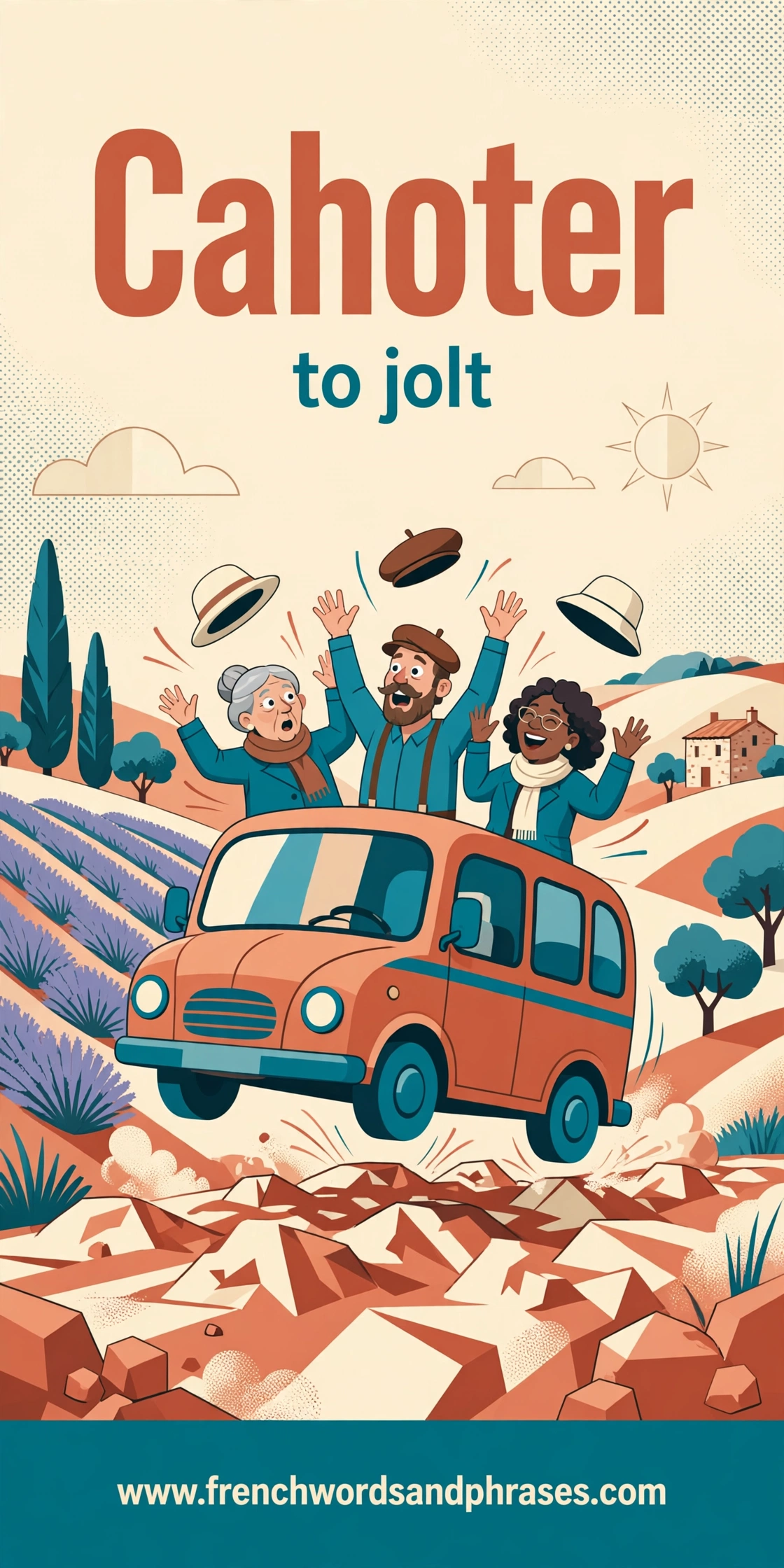
Cahoter means to jolt, to jerk — to bounce and shake along a rough road, rattling passengers, cargo and teeth alike.
A farm cart on a cobbled lane, a bus lurching over potholes on a mountain road, a pram rattling down a gravel path — cahoter is the verb of the bumpy ride: every stone in the road arrives, faithfully, in your spine.
In this guide, you’ll learn how to conjugate cahoter in all the major French tenses and moods. Explore complete conjugation tables, French examples, English translations, and practice quizzes.
Understanding the French Verb Cahoter
Cahoter is a regular French verb belonging to the first group of verbs, those ending in-er.
It means to jolt, to jerk. It belongs to carts, lorries, old cars, wheelbarrows and prams — anything with wheels on a bad surface. Figuratively, a life or a career can cahoter along from jolt to jolt: avancer en cahotant is to make bumpy, uncomfortable progress.
Verb classification: First group (-er)
Auxiliary verb: Avoir
Past participle: cahoté
Present participle: cahotant
English equivalents: To jolt, to jerk, to bump along; cahoter sur les pavés — to jolt over the cobbles; un chemin qui cahote — a road that shakes you about; être cahoté — to be jolted about; les cahots de la route — the bumps and jolts of the road.
One important detail: cahoter is built on the noun un cahot, a jolt or bump in the road, and it works two ways — the vehicle cahote (jolts along), and the road or the journey cahote the passengers, who end up cahotés, thoroughly shaken. The h is silent and never links: je cahote, nous cahotons, past participle cahoté, present participle cahotant — a plain regular -er verb once you can say the noun.
Experience the Word
Cahoter is the verb your back learns on a country road — every pothole sends up its message, and the whole cart answers.
Imagine a hay cart coming down from a Auvergne farm in 1920, loaded with cheeses and a grandmother. À chaque pierre, la charrette cahote — the cheeses nod, the grandmother grips the side, and the horse, who knows every bump by heart, does not even turn an ear.
They arrived shaken, dusty and laughing. They had been jolted the whole way — cahotés, from the first cobble to the last.
How to Conjugate Cahoter: Complete French Conjugation Guide
Let’s explore every major conjugation of cahoter, beginning with the indicative mood.
How to Conjugate Cahoter in the Indicative Mood
The indicative mood is used to express facts, observations, actions, and events.
How to Conjugate Cahoter in the Present Tense (Présent)
Used for actions happening now, habitual actions, and general truths.
| Subject | Conjugation |
|---|---|
| je | cahote |
| tu | cahotes |
| il / elle | cahote |
| nous | cahotons |
| vous | cahotez |
| ils / elles | cahotent |
Example
La charrette cahote sur le chemin de pierres.
The cart jolts along the stony track.
Quick Quiz 1
Complete the sentence:
Nous ______ sur les pavés depuis une heure.
Reveal the answer
cahotons
Nous cahotons sur les pavés depuis une heure.
We have been jolting over the cobbles for an hour.
How to Conjugate Cahoter in the Passé Composé
Used for completed actions in the past. Cahoter takes the auxiliary verb avoir.
| Subject | Conjugation |
|---|---|
| j’ | ai cahoté |
| tu | as cahoté |
| il / elle | a cahoté |
| nous | avons cahoté |
| vous | avez cahoté |
| ils / elles | ont cahoté |
Example
Le bus a cahoté pendant tout le trajet de montagne.
The bus jolted and bumped for the whole mountain journey.
How to Conjugate Cahoter in the Imparfait (Imperfect Tense)
Used for habitual past actions, descriptions, and ongoing situations in the past.
| Subject | Conjugation |
|---|---|
| je | cahotais |
| tu | cahotais |
| il / elle | cahotait |
| nous | cahotions |
| vous | cahotiez |
| ils / elles | cahotaient |
Example
Autrefois, les diligences cahotaient sur les routes du royaume.
In the old days, stagecoaches jolted along the roads of the kingdom.
Quick Quiz 2
Choose the correct form:
The bus jolted the whole way.
Le bus ______ tout le trajet. (a cahoté / est cahoté)
Reveal the answer
a cahoté
Le bus a cahoté tout le trajet.
Cahoter takes avoir.
How to Conjugate Cahoter in the Plus-que-parfait
Used to describe an action that had already been completed before another past event.
| Subject | Conjugation |
|---|---|
| j’ | avais cahoté |
| tu | avais cahoté |
| il / elle | avait cahoté |
| nous | avions cahoté |
| vous | aviez cahoté |
| ils / elles | avaient cahoté |
Example
La remorque avait cahoté si fort que la vaisselle était brisée.
The trailer had jolted so hard that the crockery was smashed.
How to Conjugate Cahoter in the Passé Simple
Primarily used in formal writing, literature, and historical narratives. It is rarely used in everyday conversation.
| Subject | Conjugation |
|---|---|
| je | cahotai |
| tu | cahotas |
| il / elle | cahota |
| nous | cahotâmes |
| vous | cahotâtes |
| ils / elles | cahotèrent |
Example
Le chariot cahota toute la nuit sur les pavés de la ville.
The wagon jolted all night over the city cobbles.
How to Conjugate Cahoter in the Passé Antérieur
A literary tense used to express an action completed immediately before another past action, generally in the passé simple.
| Subject | Conjugation |
|---|---|
| j’ | eus cahoté |
| tu | eus cahoté |
| il / elle | eut cahoté |
| nous | eûmes cahoté |
| vous | eûtes cahoté |
| ils / elles | eurent cahoté |
Example
Quand la voiture eut cahoté cent mètres, une roue se détacha.
When the car had jolted a hundred yards, a wheel came off.
How to Conjugate Cahoter in the Future Tense (Futur Simple)
Used to describe actions that will take place in the future.
| Subject | Conjugation |
|---|---|
| je | cahoterai |
| tu | cahoteras |
| il / elle | cahotera |
| nous | cahoterons |
| vous | cahoterez |
| ils / elles | cahoteront |
Example
Demain, le camion cahotera sur la piste pendant des heures.
Tomorrow, the lorry will bump along the track for hours.
How to Conjugate Cahoter in the Futur Antérieur (Future Perfect)
Used for an action that will have been completed before a particular point in the future.
| Subject | Conjugation |
|---|---|
| j’ | aurai cahoté |
| tu | auras cahoté |
| il / elle | aura cahoté |
| nous | aurons cahoté |
| vous | aurez cahoté |
| ils / elles | auront cahoté |
Example
Quand nous aurons cahoté jusqu’au village, nous serons épuisés.
By the time we have jolted our way to the village, we will be exhausted.
How to Conjugate Cahoter in the Near Future (Futur Proche)
Used to describe something that is going to happen soon. Formed with aller + infinitive.
| Subject | Conjugation |
|---|---|
| je | vais cahoter |
| tu | vas cahoter |
| il / elle | va cahoter |
| nous | allons cahoter |
| vous | allez cahoter |
| ils / elles | vont cahoter |
Example
Accrochez-vous, la route va cahoter après le pont !
Hold on, the road is going to get bumpy after the bridge!
How to Conjugate Cahoter in the Conditional Mood
The conditional mood expresses what would happen under certain circumstances. It is also frequently used to make polite requests or express wishes.
How to Conjugate Cahoter in the Present Conditional
| Subject | Conjugation |
|---|---|
| je | cahoterais |
| tu | cahoterais |
| il / elle | cahoterait |
| nous | cahoterions |
| vous | cahoteriez |
| ils / elles | cahoteraient |
Example
Avec de meilleurs amortisseurs, la voiture cahoterait moins.
With better shock absorbers, the car would jolt less.
How to Conjugate Cahoter in the Past Conditional
| Subject | Conjugation |
|---|---|
| j’ | aurais cahoté |
| tu | aurais cahoté |
| il / elle | aurait cahoté |
| nous | aurions cahoté |
| vous | auriez cahoté |
| ils / elles | auraient cahoté |
Example
Le landau aurait moins cahoté sur un chemin plat.
The pram would have jolted less on a flat path.
Cahoter in the Literary Past Conditional Form
This less common literary form uses the imperfect subjunctive of avoir.
| Subject | Conjugation |
|---|---|
| j’ | eusse cahoté |
| tu | eusses cahoté |
| il / elle | eût cahoté |
| nous | eussions cahoté |
| vous | eussiez cahoté |
| ils / elles | eussent cahoté |
Example
La diligence eût cahoté de même sur toute autre route.
The stagecoach would have jolted just the same on any other road.
How to Conjugate Cahoter in the Subjunctive Mood
The subjunctive is used to express wishes, emotions, doubts, necessity, and uncertainty. It frequently follows expressions such as il faut que (it is necessary that) or bien que (although).
How to Conjugate Cahoter in the Present Subjunctive
| Subject | Conjugation |
|---|---|
| que je | cahote |
| que tu | cahotes |
| qu’il / qu’elle | cahote |
| que nous | cahotions |
| que vous | cahotiez |
| qu’ils / qu’elles | cahotent |
Example
Il est normal que la remorque cahote sur cette piste.
It is normal for the trailer to jolt on this track.
Quick Quiz 3
Complete the sentence using the subjunctive:
Il est normal que la voiture ______ sur cette piste.
Reveal the answer
cahote
Il est normal que la voiture cahote sur cette piste.
It is normal for the car to jolt on this track.
How to Conjugate Cahoter in the Imperfect Subjunctive
A literary tense, rarely encountered in modern spoken French.
| Subject | Conjugation |
|---|---|
| que je | cahotasse |
| que tu | cahotasses |
| qu’il / qu’elle | cahotât |
| que nous | cahotassions |
| que vous | cahotassiez |
| qu’ils / qu’elles | cahotassent |
Example
Je craignais que la charrette cahotât jusqu’à perdre son chargement.
I feared the cart might jolt until it lost its load.
How to Conjugate Cahoter in the Pluperfect Subjunctive
A literary construction used to express an action completed before another past action.
| Subject | Conjugation |
|---|---|
| que j’ | eusse cahoté |
| que tu | eusses cahoté |
| qu’il / qu’elle | eût cahoté |
| que nous | eussions cahoté |
| que vous | eussiez cahoté |
| qu’ils / qu’elles | eussent cahoté |
Example
On racontait que le convoi eût cahoté trois jours durant.
People said the convoy had jolted along for three days.
How to Conjugate Cahoter in the Past Subjunctive
| Subject | Conjugation |
|---|---|
| que j’ | aie cahoté |
| que tu | aies cahoté |
| qu’il / qu’elle | ait cahoté |
| que nous | ayons cahoté |
| que vous | ayez cahoté |
| qu’ils / qu’elles | aient cahoté |
Example
Je suis content que le bus ait cahoté sans rien casser.
I am glad the bus jolted along without breaking anything.
How to Conjugate Cahoter in the Imperative
The imperative is used to give commands, instructions, invitations, or suggestions. Subject pronouns are omitted.
How to Conjugate Cahoter in the Present Imperative
| Person | Conjugation |
|---|---|
| (tu) | cahote |
| (nous) | cahotons |
| (vous) | cahotez |
Example
Ne cahote pas trop, conduis lentement sur les pavés !
Do not jolt us about so much, drive slowly over the cobbles!
Quick Quiz 4
How would you say Do not jolt so much (tu form)?
Reveal the answer
Ne cahote pas trop !
French Participles of Cahoter
Participles are verb forms that can be used in compound tenses and other grammatical constructions.
Present Participle of Cahoter
cahotant
En cahotant sur la piste, le camion perdait des caisses.
Jolting along the track, the lorry was losing crates.
Past Participle of Cahoter
cahoté
Cahotée pendant des heures, la cargaison arriva en piteux état.
Jolted for hours, the cargo arrived in a sorry state.
Cahoter in Everyday French: Real-Life Examples
Now that you know the conjugations, let’s see how cahoter appears in everyday French.
Example 1 — Present
La charrette cahote sur les pavés.
The cart jolts over the cobbles.
Example 2 — Passé composé
Le bus a cahoté tout le trajet.
The bus jolted the whole way.
Example 3 — Imparfait
Les diligences cahotaient autrefois.
Stagecoaches used to jolt along in the old days.
Example 4 — Future
Le camion cahotera sur la piste.
The lorry will bump along the track.
Example 5 — Conditional
La voiture cahoterait moins avec de bons amortisseurs.
The car would jolt less with good shock absorbers.
Example 6 — Imperative
Ne cahote pas trop sur les pavés !
Do not jolt about so much on the cobbles!
Beyond Translation: The Meaning of Cahoter
English has no single verb for the whole performance — jolt, bump, rattle along share it between them — while French cahoter keeps the noun inside: un cahot is the bump, and cahoter is to meet them one after another.
It is the honest verb of bad roads.
Before suspension and tarmac, every journey cahotait, and the word still carries the smell of hay carts, stagecoaches and grandmothers holding on with both hands.
How to Remember the French Verb Cahoter
Remember it this way: Cahoter is about the hay cart on cobbles — every stone arriving in your spine.
- Un cahot is a jolt in the road — cahoter is to go from cahot to cahot.
- The vehicle cahote; the passengers are cahotés, jolted about.
- Regular -er, silent h: je cahote, nous cahotons, past participle cahoté.
The key idea is the hay cart on cobbles — every stone arriving in your spine.
Test Your Knowledge of Cahoter
Let’s see how much you’ve learned. Try answering these questions before revealing the answers.
Question 1
What is un cahot?
Reveal the answer
A jolt, a bump in the road — cahoter is to jolt along from bump to bump.
Question 2
How do you say The cart jolts over the cobbles in French?
Reveal the answer
La charrette cahote sur les pavés.
Question 3
Translate: The bus jolted for the whole journey.
Reveal the answer
Le bus a cahoté pendant tout le trajet.
Question 4
What is the past participle of cahoter?
Reveal the answer
Cahoté — être cahoté, to be jolted about.
Question 5
Complete the sentence:
Il est normal que la remorque ______ sur cette piste.
Reveal the answer
cahote
Il est normal que la remorque cahote sur cette piste.
It is normal for the trailer to jolt on this track.
Your Final Challenge
Can You Use It?
How would you say this in French?
The old cart jolts over the cobbles, and the cheeses dance at every bump in the road.
Reveal the answer
La vieille charrette cahote sur les pavés, et les fromages dansent à chaque cahot du chemin.
The old cart jolts over the cobbles, and the cheeses dance at every bump in the road.
A little French. A little curiosity. A richer everyday life.
LEARN FRENCH ONE WORD AT A TIME




