
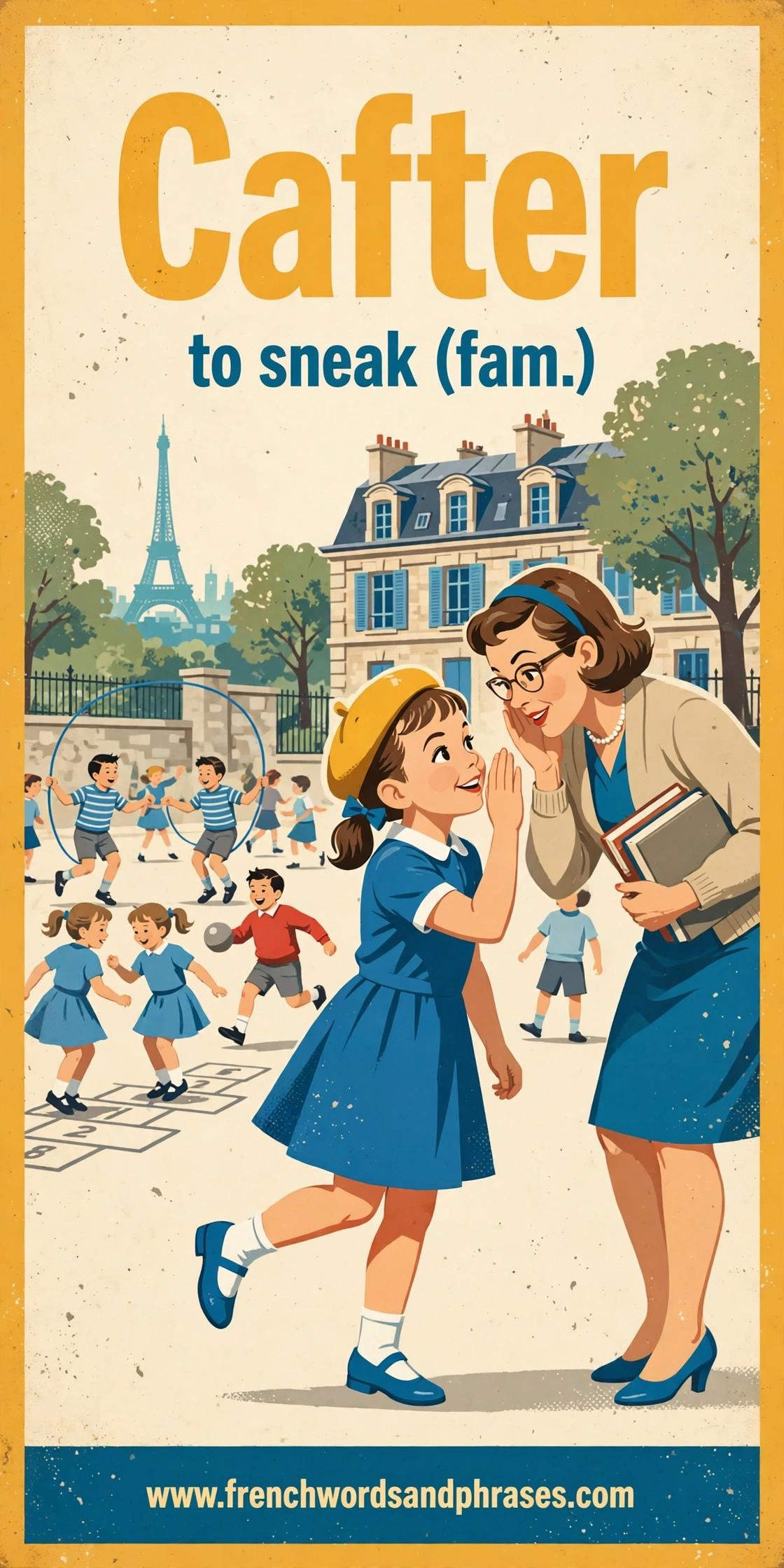
A French Word to Live By
How to Conjugate Cafter in French
/kaf.te/
Cafter means to tell on, to sneak — in playground slang, to run and report someone to authority, exactly like its twin cafarder.
A whisper behind the bike sheds, a name passed to the supervisor, a friend suddenly in trouble — cafter is cafarder’s shorter, sharper slang twin: the verb of the tell-tale, in the French of schoolyards and barracks.
In this guide, you’ll learn how to conjugate cafter in all the major French tenses and moods. Explore complete conjugation tables, French examples, English translations, and practice quizzes.
Understanding the French Verb Cafter
Cafter is a regular French verb belonging to the first group of verbs, those ending in-er.
It means to tell on, to sneak (fam.). You will hear it where cafarder lives — schools, prisons, barracks, workshops — but cafter is punchier and more modern in tone, the word of the playground rather than the novel. The thing reported is usually introduced by the victim’s name alone: on l’a cafté, and everyone understands.
Verb classification: First group (-er)
Auxiliary verb: Avoir
Past participle: cafté
Present participle: caftant
English equivalents: To tell on, to sneak on, to grass on (fam.); cafter quelqu’un — to tell on someone; cafter au pion — to sneak to the supervisor; se faire cafter — to get told on; il m’a cafté ! — he told on me!
One important detail: cafter is familier, even slangy — a clipped twin of cafarder, from the same cafard, the cockroach and tale-bearer. It is usually transitive: cafter quelqu’un, to tell on someone, or the victim’s view, se faire cafter, to get told on. British readers will recognise the exact equivalent of to sneak in its school sense — telling the teacher — not creeping about quietly. A plain regular -er verb: je cafte, nous caftons, past participle cafté.
Experience the Word
Cafter is the verb of the pointed finger — three syllables of French playground law: tu caftes, tu paies.
Imagine a collège courtyard in Lyon. Someone has let down the PE teacher’s bicycle tyres, and by lunchtime Mehdi is standing in the head’s office — un copain l’a cafté pour éviter la punition collective. The class verdict is instant and unanimous: on ne cafte pas.
The tyres were forgiven by Friday. The telling was not — cafté un jour, cafard pour toujours, as the courtyard puts it.
How to Conjugate Cafter: Complete French Conjugation Guide
Let’s explore every major conjugation of cafter, beginning with the indicative mood.
How to Conjugate Cafter in the Indicative Mood
The indicative mood is used to express facts, observations, actions, and events.
How to Conjugate Cafter in the Present Tense (Présent)
Used for actions happening now, habitual actions, and general truths.
| Subject | Conjugation |
|---|---|
| je | cafte |
| tu | caftes |
| il / elle | cafte |
| nous | caftons |
| vous | caftez |
| ils / elles | caftent |
Example
Il cafte ses copains dès qu’il a peur d’être puni.
He tells on his mates as soon as he is afraid of being punished.
Quick Quiz 1
Complete the sentence:
Nous ne ______ jamais un camarade de classe.
Reveal the answer
caftons
Nous ne caftons jamais un camarade de classe.
We never tell on a classmate.
How to Conjugate Cafter in the Passé Composé
Used for completed actions in the past. Cafter takes the auxiliary verb avoir.
| Subject | Conjugation |
|---|---|
| j’ | ai cafté |
| tu | as cafté |
| il / elle | a cafté |
| nous | avons cafté |
| vous | avez cafté |
| ils / elles | ont cafté |
Example
Quelqu’un m’a cafté auprès du surveillant.
Somebody told on me to the supervisor.
How to Conjugate Cafter in the Imparfait (Imperfect Tense)
Used for habitual past actions, descriptions, and ongoing situations in the past.
| Subject | Conjugation |
|---|---|
| je | caftais |
| tu | caftais |
| il / elle | caftait |
| nous | caftions |
| vous | caftiez |
| ils / elles | caftaient |
Example
À l’internat, on ne caftait jamais un camarade de dortoir.
At boarding school, we never told on a dormitory mate.
Quick Quiz 2
Choose the correct form:
Somebody told on me this morning.
Quelqu’un ______ ce matin. (m’a cafté / s’est cafté)
Reveal the answer
m’a cafté
Quelqu’un m’a cafté ce matin.
Cafter takes avoir, and the victim is the object: m’a cafté.
How to Conjugate Cafter in the Plus-que-parfait
Used to describe an action that had already been completed before another past event.
| Subject | Conjugation |
|---|---|
| j’ | avais cafté |
| tu | avais cafté |
| il / elle | avait cafté |
| nous | avions cafté |
| vous | aviez cafté |
| ils / elles | avaient cafté |
Example
Elle avait cafté son frère avant même le dîner.
She had told on her brother before dinner had even begun.
How to Conjugate Cafter in the Passé Simple
Primarily used in formal writing, literature, and historical narratives. It is rarely used in everyday conversation.
| Subject | Conjugation |
|---|---|
| je | caftai |
| tu | caftas |
| il / elle | cafta |
| nous | caftâmes |
| vous | caftâtes |
| ils / elles | caftèrent |
Example
Le plus jeune cafta les autres pour échapper à la corvée.
The youngest told on the others to escape the chore.
How to Conjugate Cafter in the Passé Antérieur
A literary tense used to express an action completed immediately before another past action, generally in the passé simple.
| Subject | Conjugation |
|---|---|
| j’ | eus cafté |
| tu | eus cafté |
| il / elle | eut cafté |
| nous | eûmes cafté |
| vous | eûtes cafté |
| ils / elles | eurent cafté |
Example
Dès qu’il eut cafté, il regretta son geste.
As soon as he had told on them, he regretted what he had done.
How to Conjugate Cafter in the Future Tense (Futur Simple)
Used to describe actions that will take place in the future.
| Subject | Conjugation |
|---|---|
| je | cafterai |
| tu | cafteras |
| il / elle | caftera |
| nous | cafterons |
| vous | cafterez |
| ils / elles | cafteront |
Example
Si tu me caftes encore une fois, nous ne serons plus amis.
If you tell on me once more, we will not be friends any more.
How to Conjugate Cafter in the Futur Antérieur (Future Perfect)
Used for an action that will have been completed before a particular point in the future.
| Subject | Conjugation |
|---|---|
| j’ | aurai cafté |
| tu | auras cafté |
| il / elle | aura cafté |
| nous | aurons cafté |
| vous | aurez cafté |
| ils / elles | auront cafté |
Example
À la fin de la semaine, il aura cafté la moitié de la classe.
By the end of the week, he will have told on half the class.
How to Conjugate Cafter in the Near Future (Futur Proche)
Used to describe something that is going to happen soon. Formed with aller + infinitive.
| Subject | Conjugation |
|---|---|
| je | vais cafter |
| tu | vas cafter |
| il / elle | va cafter |
| nous | allons cafter |
| vous | allez cafter |
| ils / elles | vont cafter |
Example
Tu vas encore cafter, je le sens !
You are going to tell on us again, I can feel it!
How to Conjugate Cafter in the Conditional Mood
The conditional mood expresses what would happen under certain circumstances. It is also frequently used to make polite requests or express wishes.
How to Conjugate Cafter in the Present Conditional
| Subject | Conjugation |
|---|---|
| je | cafterais |
| tu | cafterais |
| il / elle | cafterait |
| nous | cafterions |
| vous | cafteriez |
| ils / elles | cafteraient |
Example
Jamais je ne cafterais un ami, même en danger.
I would never tell on a friend, even in danger.
How to Conjugate Cafter in the Past Conditional
| Subject | Conjugation |
|---|---|
| j’ | aurais cafté |
| tu | aurais cafté |
| il / elle | aurait cafté |
| nous | aurions cafté |
| vous | auriez cafté |
| ils / elles | auraient cafté |
Example
Il aurait cafté tout le monde pour sauver sa place.
He would have told on everyone to save his own place.
Cafter in the Literary Past Conditional Form
This less common literary form uses the imperfect subjunctive of avoir.
| Subject | Conjugation |
|---|---|
| j’ | eusse cafté |
| tu | eusses cafté |
| il / elle | eût cafté |
| nous | eussions cafté |
| vous | eussiez cafté |
| ils / elles | eussent cafté |
Example
Le soldat n’eût jamais cafté ses compagnons d’armes.
The soldier would never have told on his brothers in arms.
How to Conjugate Cafter in the Subjunctive Mood
The subjunctive is used to express wishes, emotions, doubts, necessity, and uncertainty. It frequently follows expressions such as il faut que (it is necessary that) or bien que (although).
How to Conjugate Cafter in the Present Subjunctive
| Subject | Conjugation |
|---|---|
| que je | cafte |
| que tu | caftes |
| qu’il / qu’elle | cafte |
| que nous | caftions |
| que vous | caftiez |
| qu’ils / qu’elles | caftent |
Example
Je ne veux pas qu’il cafte son petit frère.
I do not want him telling on his little brother.
Quick Quiz 3
Complete the sentence using the subjunctive:
Je ne veux pas que vous ______ vos voisins.
Reveal the answer
caftiez
Je ne veux pas que vous caftiez vos voisins.
I do not want you telling on your neighbours.
How to Conjugate Cafter in the Imperfect Subjunctive
A literary tense, rarely encountered in modern spoken French.
| Subject | Conjugation |
|---|---|
| que je | caftasse |
| que tu | caftasses |
| qu’il / qu’elle | caftât |
| que nous | caftassions |
| que vous | caftassiez |
| qu’ils / qu’elles | caftassent |
Example
On craignait que l’élève caftât pour se faire bien voir.
They feared the pupil might tell tales to get into the teacher’s good books.
How to Conjugate Cafter in the Pluperfect Subjunctive
A literary construction used to express an action completed before another past action.
| Subject | Conjugation |
|---|---|
| que j’ | eusse cafté |
| que tu | eusses cafté |
| qu’il / qu’elle | eût cafté |
| que nous | eussions cafté |
| que vous | eussiez cafté |
| qu’ils / qu’elles | eussent cafté |
Example
On disait qu’il eût cafté ses propres cousins.
People said he had told on his own cousins.
How to Conjugate Cafter in the Past Subjunctive
| Subject | Conjugation |
|---|---|
| que j’ | aie cafté |
| que tu | aies cafté |
| qu’il / qu’elle | ait cafté |
| que nous | ayons cafté |
| que vous | ayez cafté |
| qu’ils / qu’elles | aient cafté |
Example
Je suis furieux qu’elle ait cafté toute l’équipe.
I am furious that she told on the whole team.
How to Conjugate Cafter in the Imperative
The imperative is used to give commands, instructions, invitations, or suggestions. Subject pronouns are omitted.
How to Conjugate Cafter in the Present Imperative
| Person | Conjugation |
|---|---|
| (tu) | cafte |
| (nous) | caftons |
| (vous) | caftez |
Example
Ne cafte pas tes copains, assume tes bêtises !
Do not tell on your mates, own up to your own mischief!
Quick Quiz 4
How would you say Do not tell on your mates (tu form)?
Reveal the answer
Ne cafte pas tes copains !
French Participles of Cafter
Participles are verb forms that can be used in compound tenses and other grammatical constructions.
Present Participle of Cafter
caftant
En caftant ainsi, tu te fais des ennemis partout.
By telling on people like that, you make enemies everywhere.
Past Participle of Cafter
cafté
Cafté par son meilleur ami, il n’a rien dit et a tout pris sur lui.
Told on by his best friend, he said nothing and took all the blame.
Cafter in Everyday French: Real-Life Examples
Now that you know the conjugations, let’s see how cafter appears in everyday French.
Example 1 — Present
Il cafte ses copains au surveillant.
He tells on his mates to the supervisor.
Example 2 — Passé composé
Quelqu’un m’a cafté ce matin.
Somebody told on me this morning.
Example 3 — Imparfait
On ne caftait jamais un camarade.
We never told on a classmate.
Example 4 — Future
Si tu caftes, tu paieras la punition seul.
If you tell tales, you will take the punishment alone.
Example 5 — Conditional
Je ne cafterais jamais un ami.
I would never tell on a friend.
Example 6 — Imperative
Ne cafte pas tes copains !
Do not tell on your mates!
Beyond Translation: The Meaning of Cafter
English school slang has to sneak and to grass; French has cafarder, and its clipped young cousin cafter — both from cafard, the cockroach that also gives its name to the tale-bearer.
Same insect, shorter word, sharper sting.
Where cafarder sounds like the school stories of your grandparents, cafter is the word shouted across today’s courtyards: il m’a cafté ! — three words that end a friendship before lunch.
How to Remember the French Verb Cafter
Remember it this way: Cafter is about the pointed finger in the courtyard — tu caftes, tu paies.
- Cafter is cafarder in short trousers — same cafard, same sneak, punchier slang.
- Usually transitive: cafter quelqu’un, and the victim’s version is se faire cafter.
- Regular -er: je cafte, nous caftons, past participle cafté.
The key idea is the pointed finger in the courtyard — tu caftes, tu paies.
Test Your Knowledge of Cafter
Let’s see how much you’ve learned. Try answering these questions before revealing the answers.
Question 1
What is the longer, older twin of cafter?
Reveal the answer
Cafarder — both come from cafard, the cockroach and tale-bearer.
Question 2
How do you say Somebody told on me in French?
Reveal the answer
Quelqu’un m’a cafté.
Question 3
Translate: He tells on his mates to the supervisor.
Reveal the answer
Il cafte ses copains au surveillant.
Question 4
What is the past participle of cafter?
Reveal the answer
Cafté.
Question 5
Complete the sentence:
Je ne veux pas qu’il ______ son petit frère.
Reveal the answer
cafte
Je ne veux pas qu’il cafte son petit frère.
I do not want him telling on his little brother.
Your Final Challenge
Can You Use It?
How would you say this in French?
A piece of mischief can be forgiven, but in the playground, the one who tells tales is never forgiven.
Reveal the answer
On peut pardonner une bêtise, mais dans la cour, on ne pardonne jamais à celui qui cafte.
A piece of mischief can be forgiven, but in the playground, the one who tells tales is never forgiven.
A little French. A little curiosity. A richer everyday life.
LEARN FRENCH ONE WORD AT A TIME




