
A French Word to Live By
How to Conjugate Caillebotter in French
/kaj.bɔ.te/
Caillebotter means to clot, to curdle — a rare twin of cailler for milk that thickens into curds and blood that sets into clots.
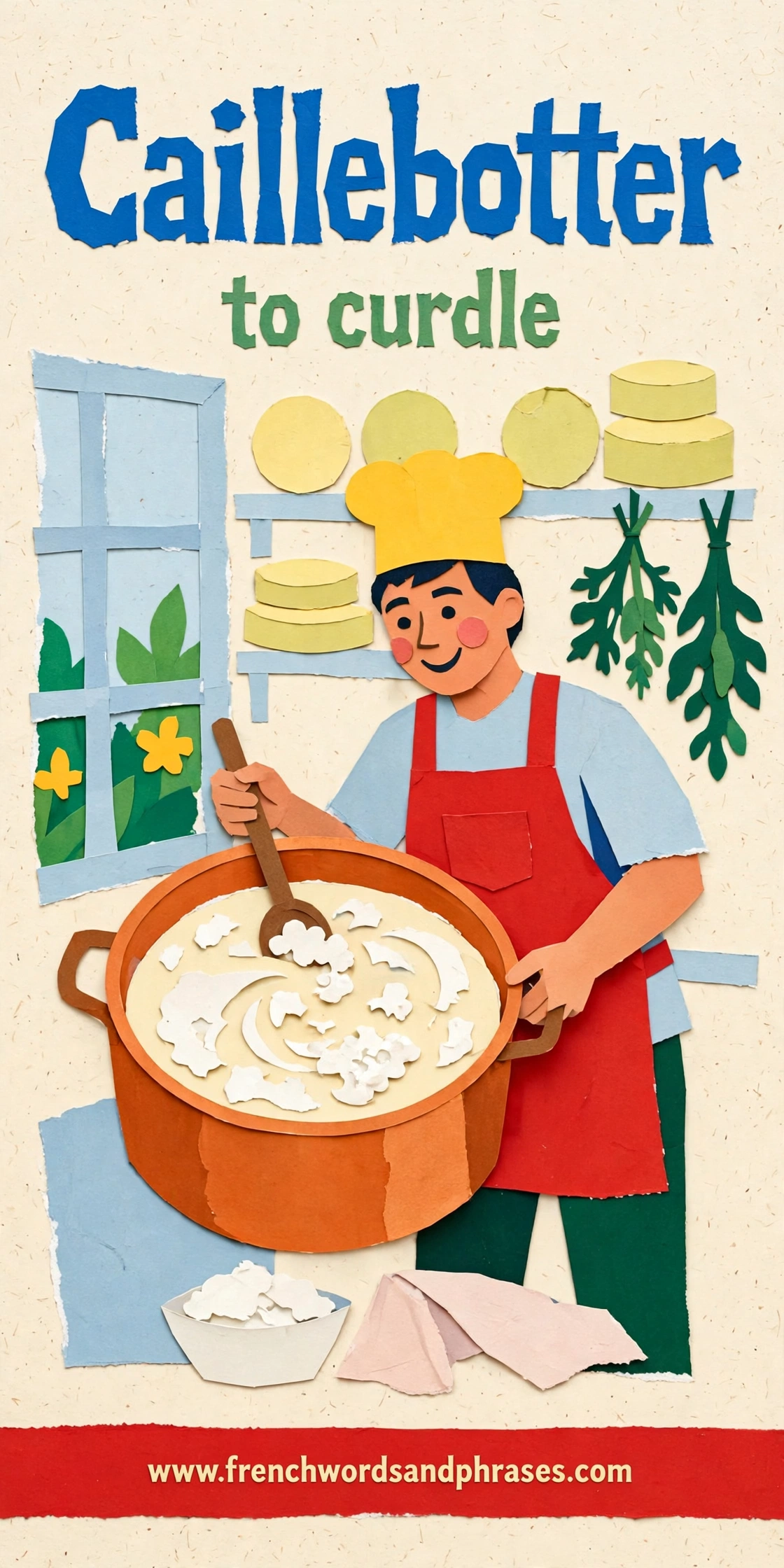
A farmhouse dairy at dawn: the warm milk stands in wide pans, and slowly, silently, it begins to set. Caillebotter is the rare, dictionary-haunting verb for that thickening — the moment a liquid quietly decides to become a solid.
In this guide, you’ll learn how to conjugate caillebotter in all the major French tenses and moods. Explore complete conjugation tables, French examples, English translations, and practice quizzes.
Understanding the French Verb Caillebotter
Caillebotter is a regular French verb belonging to the first group of verbs, those ending in-er.
It means to clot, to curdle. Expect to meet caillebotter in old cookery books, regional writing and dictionaries rather than in speech. Where it appears, it does the same work as cailler — milk setting, blood clotting — with a faintly rustic, old-fashioned flavour that cailler does not have.
Verb classification: First group (-er)
Auxiliary verb: Avoir
Past participle: caillebotté
Present participle: caillebottant
English equivalents: To clot, to curdle, to coagulate (rare); le lait caillebotte — the milk curdles; faire caillebotter le lait — to curdle the milk; la caillebotte — a soft curd cheese; le sang caillebotte — the blood clots.
One important detail: caillebotter is a rarity — most French speakers live and die without using it, because everyday French says cailler for exactly the same thickening. Its family is still on the cheese board, though: la caillebotte is a soft curd cheese from the west of France, named for the curdled milk it is made from. The verb itself is a plain regular -er verb with a double t in the stem: je caillebotte, nous caillebottons, imperfect je caillebottais, past participle caillebotté.
Experience the Word
Caillebotter is the verb of the quiet dairy — no stirring, no noise, just milk thinking its way towards cheese.
Imagine a Vendée farmhouse a century ago. The morning’s milk stands in earthenware pans on the cool stone floor. By evening it has set into trembling curds — le lait a cailleboté tout seul — and tomorrow it will be caillebotte, eaten with a spoon and a little sugar.
No hand has touched it. The milk has curdled itself — caillebotté, slowly, in the cool of the dairy.
How to Conjugate Caillebotter: Complete French Conjugation Guide
Let’s explore every major conjugation of caillebotter, beginning with the indicative mood.
How to Conjugate Caillebotter in the Indicative Mood
The indicative mood is used to express facts, observations, actions, and events.
How to Conjugate Caillebotter in the Present Tense (Présent)
Used for actions happening now, habitual actions, and general truths.
| Subject | Conjugation |
|---|---|
| je | caillebotte |
| tu | caillebottes |
| il / elle | caillebotte |
| nous | caillebottons |
| vous | caillebottez |
| ils / elles | caillebottent |
Example
Le lait caillebotte doucement dans les terrines.
The milk is slowly curdling in the earthenware pans.
Quick Quiz 1
Complete the sentence:
Nous laissons le lait ______ dans les terrines.
Reveal the answer
caillebotter
Nous laissons le lait caillebotter dans les terrines.
We leave the milk to curdle in the pans.
How to Conjugate Caillebotter in the Passé Composé
Used for completed actions in the past. Caillebotter takes the auxiliary verb avoir.
| Subject | Conjugation |
|---|---|
| j’ | ai caillebotté |
| tu | as caillebotté |
| il / elle | a caillebotté |
| nous | avons caillebotté |
| vous | avez caillebotté |
| ils / elles | ont caillebotté |
Example
Le lait a caillebotté pendant la nuit.
The milk curdled during the night.
How to Conjugate Caillebotter in the Imparfait (Imperfect Tense)
Used for habitual past actions, descriptions, and ongoing situations in the past.
| Subject | Conjugation |
|---|---|
| je | caillebottais |
| tu | caillebottais |
| il / elle | caillebottait |
| nous | caillebottions |
| vous | caillebottiez |
| ils / elles | caillebottaient |
Example
Autrefois, le lait caillebottait à la fraîcheur de la laiterie.
In the old days, the milk would curdle in the cool of the dairy.
Quick Quiz 2
Choose the correct form:
The milk curdled during the night.
Le lait ______ pendant la nuit. (a caillebotté / est caillebotté)
Reveal the answer
a caillebotté
Le lait a caillebotté pendant la nuit.
Caillebotter takes avoir.
How to Conjugate Caillebotter in the Plus-que-parfait
Used to describe an action that had already been completed before another past event.
| Subject | Conjugation |
|---|---|
| j’ | avais caillebotté |
| tu | avais caillebotté |
| il / elle | avait caillebotté |
| nous | avions caillebotté |
| vous | aviez caillebotté |
| ils / elles | avaient caillebotté |
Example
Le sang avait caillebotté avant l’arrivée du médecin.
The blood had clotted before the doctor arrived.
How to Conjugate Caillebotter in the Passé Simple
Primarily used in formal writing, literature, and historical narratives. It is rarely used in everyday conversation.
| Subject | Conjugation |
|---|---|
| je | caillebottai |
| tu | caillebottas |
| il / elle | caillebotta |
| nous | caillebottâmes |
| vous | caillebottâtes |
| ils / elles | caillebottèrent |
Example
Le lait caillebotta dans les pots de grès.
The milk curdled in the stoneware pots.
How to Conjugate Caillebotter in the Passé Antérieur
A literary tense used to express an action completed immediately before another past action, generally in the passé simple.
| Subject | Conjugation |
|---|---|
| j’ | eus caillebotté |
| tu | eus caillebotté |
| il / elle | eut caillebotté |
| nous | eûmes caillebotté |
| vous | eûtes caillebotté |
| ils / elles | eurent caillebotté |
Example
Quand le lait eut caillebotté, la fermière le mit en moules.
When the milk had curdled, the farmer’s wife put it into moulds.
How to Conjugate Caillebotter in the Future Tense (Futur Simple)
Used to describe actions that will take place in the future.
| Subject | Conjugation |
|---|---|
| je | caillebotterai |
| tu | caillebotteras |
| il / elle | caillebottera |
| nous | caillebotterons |
| vous | caillebotterez |
| ils / elles | caillebotteront |
Example
Avec cette chaleur, le lait caillebottera avant ce soir.
In this heat, the milk will curdle before this evening.
How to Conjugate Caillebotter in the Futur Antérieur (Future Perfect)
Used for an action that will have been completed before a particular point in the future.
| Subject | Conjugation |
|---|---|
| j’ | aurai caillebotté |
| tu | auras caillebotté |
| il / elle | aura caillebotté |
| nous | aurons caillebotté |
| vous | aurez caillebotté |
| ils / elles | auront caillebotté |
Example
Quand le lait aura caillebotté, nous ferons le fromage.
When the milk has curdled, we will make the cheese.
How to Conjugate Caillebotter in the Near Future (Futur Proche)
Used to describe something that is going to happen soon. Formed with aller + infinitive.
| Subject | Conjugation |
|---|---|
| je | vais caillebotter |
| tu | vas caillebotter |
| il / elle | va caillebotter |
| nous | allons caillebotter |
| vous | allez caillebotter |
| ils / elles | vont caillebotter |
Example
Ce lait va caillebotter si tu le laisses au soleil.
This milk is going to curdle if you leave it in the sun.
How to Conjugate Caillebotter in the Conditional Mood
The conditional mood expresses what would happen under certain circumstances. It is also frequently used to make polite requests or express wishes.
How to Conjugate Caillebotter in the Present Conditional
| Subject | Conjugation |
|---|---|
| je | caillebotterais |
| tu | caillebotterais |
| il / elle | caillebotterait |
| nous | caillebotterions |
| vous | caillebotteriez |
| ils / elles | caillebotteraient |
Example
Le lait caillebotterait mieux dans une pièce fraîche.
The milk would curdle better in a cool room.
How to Conjugate Caillebotter in the Past Conditional
| Subject | Conjugation |
|---|---|
| j’ | aurais caillebotté |
| tu | aurais caillebotté |
| il / elle | aurait caillebotté |
| nous | aurions caillebotté |
| vous | auriez caillebotté |
| ils / elles | auraient caillebotté |
Example
Le lait aurait caillebotté plus vite avec de la présure.
The milk would have curdled faster with rennet.
Caillebotter in the Literary Past Conditional Form
This less common literary form uses the imperfect subjunctive of avoir.
| Subject | Conjugation |
|---|---|
| j’ | eusse caillebotté |
| tu | eusses caillebotté |
| il / elle | eût caillebotté |
| nous | eussions caillebotté |
| vous | eussiez caillebotté |
| ils / elles | eussent caillebotté |
Example
Le lait eût caillebotté de même dans toute autre laiterie.
The milk would have curdled just the same in any other dairy.
How to Conjugate Caillebotter in the Subjunctive Mood
The subjunctive is used to express wishes, emotions, doubts, necessity, and uncertainty. It frequently follows expressions such as il faut que (it is necessary that) or bien que (although).
How to Conjugate Caillebotter in the Present Subjunctive
| Subject | Conjugation |
|---|---|
| que je | caillebotte |
| que tu | caillebottes |
| qu’il / qu’elle | caillebotte |
| que nous | caillebottions |
| que vous | caillebottiez |
| qu’ils / qu’elles | caillebottent |
Example
Il faut que le lait caillebotte avant le soir.
The milk must curdle before evening.
Quick Quiz 3
Complete the sentence using the subjunctive:
Il faut que le lait ______ avant le soir.
Reveal the answer
caillebotte
Il faut que le lait caillebotte avant le soir.
The milk must curdle before evening.
How to Conjugate Caillebotter in the Imperfect Subjunctive
A literary tense, rarely encountered in modern spoken French.
| Subject | Conjugation |
|---|---|
| que je | caillebottasse |
| que tu | caillebottasses |
| qu’il / qu’elle | caillebottât |
| que nous | caillebottassions |
| que vous | caillebottassiez |
| qu’ils / qu’elles | caillebottassent |
Example
Elle attendait que le lait caillebottât dans les terrines.
She was waiting for the milk to curdle in the pans.
How to Conjugate Caillebotter in the Pluperfect Subjunctive
A literary construction used to express an action completed before another past action.
| Subject | Conjugation |
|---|---|
| que j’ | eusse caillebotté |
| que tu | eusses caillebotté |
| qu’il / qu’elle | eût caillebotté |
| que nous | eussions caillebotté |
| que vous | eussiez caillebotté |
| qu’ils / qu’elles | eussent caillebotté |
Example
On racontait que le lait eût caillebotté en une nuit.
People said the milk had curdled in a single night.
How to Conjugate Caillebotter in the Past Subjunctive
| Subject | Conjugation |
|---|---|
| que j’ | aie caillebotté |
| que tu | aies caillebotté |
| qu’il / qu’elle | ait caillebotté |
| que nous | ayons caillebotté |
| que vous | ayez caillebotté |
| qu’ils / qu’elles | aient caillebotté |
Example
Je suis content que le lait ait caillebotté si régulièrement.
I am glad the milk curdled so evenly.
How to Conjugate Caillebotter in the Imperative
The imperative is used to give commands, instructions, invitations, or suggestions. Subject pronouns are omitted.
How to Conjugate Caillebotter in the Present Imperative
| Person | Conjugation |
|---|---|
| (tu) | caillebotte |
| (nous) | caillebottons |
| (vous) | caillebottez |
Example
Ne caillebotte pas trop vite, lait capricieux !
Do not curdle too fast, capricious milk!
Quick Quiz 4
How would you say Leave the milk to curdle in peace (tu form)?
Reveal the answer
Laisse le lait caillebotter en paix !
French Participles of Caillebotter
Participles are verb forms that can be used in compound tenses and other grammatical constructions.
Present Participle of Caillebotter
caillebottant
En caillebottant lentement, le lait donne un caillé fin.
By curdling slowly, the milk gives a fine curd.
Past Participle of Caillebotter
caillebotté
Caillebotté à point, le lait devient un fromage tendre.
Curdled to perfection, the milk becomes a tender cheese.
Caillebotter in Everyday French: Real-Life Examples
Now that you know the conjugations, let’s see how caillebotter appears in everyday French.
Example 1 — Present
Le lait caillebotte dans les terrines.
The milk is curdling in the pans.
Example 2 — Passé composé
Le lait a caillebotté pendant la nuit.
The milk curdled during the night.
Example 3 — Imparfait
Le lait caillebottait à la laiterie.
The milk used to curdle in the dairy.
Example 4 — Future
Le lait caillebottera avant ce soir.
The milk will curdle before this evening.
Example 5 — Conditional
Le lait caillebotterait mieux au frais.
The milk would curdle better in a cool place.
Example 6 — Imperative
Laisse le lait caillebotter en paix !
Leave the milk to curdle in peace!
Beyond Translation: The Meaning of Caillebotter
English curdle and clot share the work; French usually gives it to cailler, and keeps caillebotter as the rare, countrified double — the verb hiding inside a cheese’s name.
La caillebotte keeps the verb alive.
Order the soft white cheese in a Vendée farmhouse and you are eating the past participle of this verb — the milk that caillebota, long before anyone thought to write the word down.
How to Remember the French Verb Caillebotter
Remember it this way: Caillebotter is about the milk setting quietly in the cool dairy, on its way to cheese.
- A rare twin of cailler — same curdling, older and more rustic flavour.
- La caillebotte, the curd cheese, is the verb’s family still on the table.
- Regular -er: je caillebotte, nous caillebottons, past participle caillebotté.
The key idea is the milk setting quietly in the cool dairy, on its way to cheese.
Test Your Knowledge of Caillebotter
Let’s see how much you’ve learned. Try answering these questions before revealing the answers.
Question 1
Which common verb does caillebotter duplicate?
Reveal the answer
Cailler — everyday French curdles and clots with cailler; caillebotter is the rare twin.
Question 2
How do you say The milk curdled during the night in French?
Reveal the answer
Le lait a caillebotté pendant la nuit.
Question 3
Translate: The milk is curdling in the pans.
Reveal the answer
Le lait caillebotte dans les terrines.
Question 4
What is the past participle of caillebotter?
Reveal the answer
Caillebotté.
Question 5
Complete the sentence:
Il faut que le lait ______ avant le soir.
Reveal the answer
caillebotte
Il faut que le lait caillebotte avant le soir.
The milk must curdle before evening.
Your Final Challenge
Can You Use It?
How would you say this in French?
In the cool dairy, the milk curdles in silence, and tomorrow it will be cheese.
Reveal the answer
Dans la laiterie fraîche, le lait caillebotte en silence, et demain il sera fromage.
In the cool dairy, the milk curdles in silence, and tomorrow it will be cheese.
A little French. A little curiosity. A richer everyday life.
LEARN FRENCH ONE WORD AT A TIME




