
A French Word to Live By
How to Conjugate Cadrer in French
/ka.dʁe/
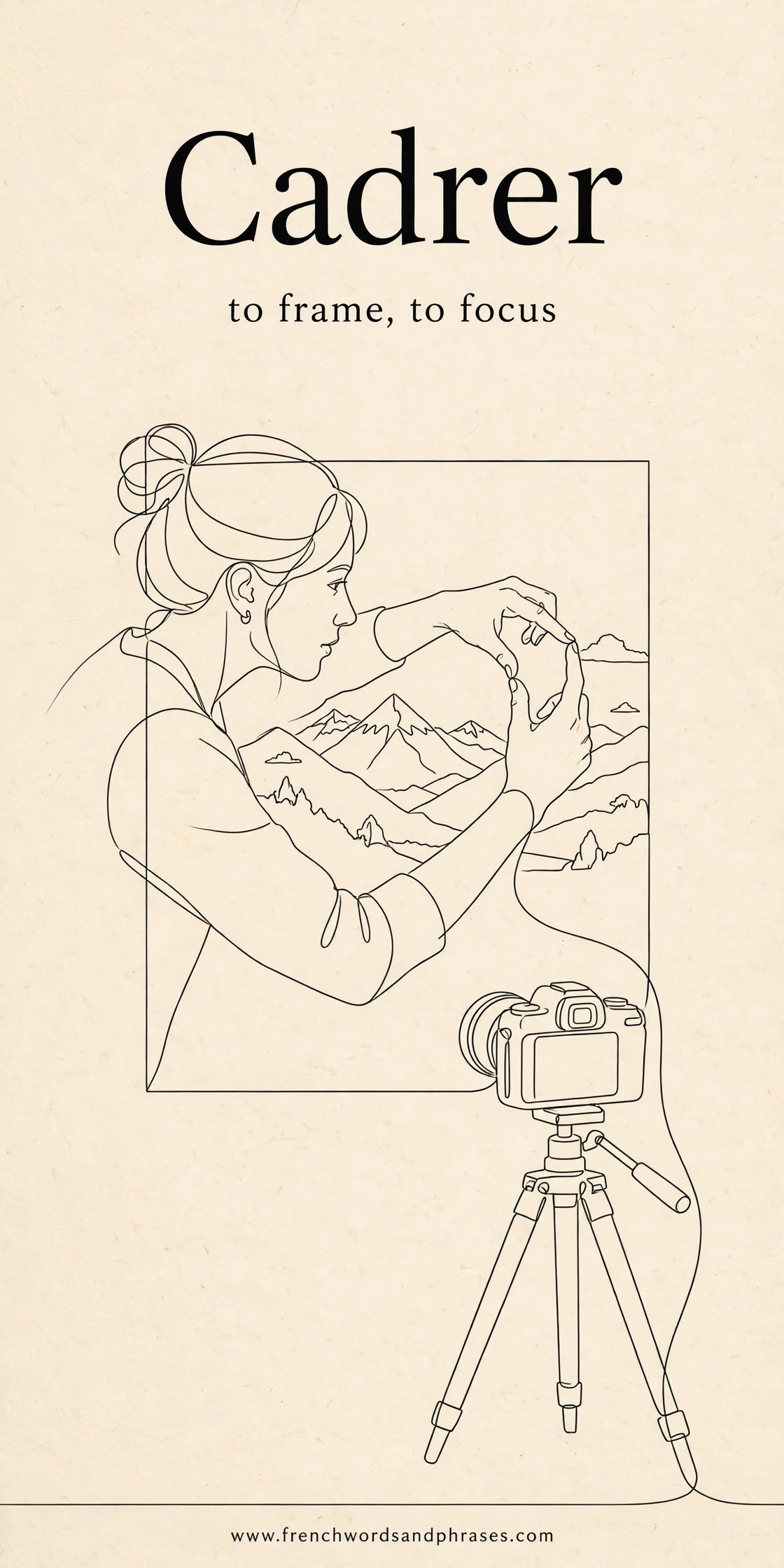
Cadrer means to frame, to focus, to tally — to draw the edges of a picture, a shot or a budget so that everything inside fits exactly.
A photographer stepping back to fit a tower into the viewfinder, an accountant checking that two columns agree to the last centime — cadrer is the verb of the frame: it decides what is in, what is out, and whether the numbers line up.
In this guide, you’ll learn how to conjugate cadrer in all the major French tenses and moods. Explore complete conjugation tables, French examples, English translations, and practice quizzes.
Understanding the French Verb Cadrer
Cadrer is a regular French verb belonging to the first group of verbs, those ending in-er.
It means to frame, to focus, to tally. You will meet cadrer in photography and film (framing a shot), in accounting and administration (figures, reports and stories that tally — or refuse to), and in the negative, ne pas cadrer avec, whenever two versions of events do not fit each other.
Verb classification: First group (-er)
Auxiliary verb: Avoir
Past participle: cadré
Present participle: cadrant
English equivalents: To frame, to fit in the frame, to tally, to match; cadrer une photo — to frame a photograph; cadrer avec — to tally with, to be consistent with; les chiffres cadrent — the figures tally; bien cadrer un sujet — to frame a subject well.
One important detail: cadrer has two lives. With a direct object it is the photographer’s and the picture-framer’s verb — cadrer une image, cadrer un portrait. Followed by avec, it means to tally or agree: son témoignage ne cadre pas avec les faits, his account does not tally with the facts. It is a plain regular -er verb: je cadre, nous cadrons, past participle cadré — and the noun un cadre is a frame, a framework and, by extension, a company executive.
Experience the Word
Cadrer is the verb of the rectangle — the edge that turns a piece of the world into a picture, and a pile of numbers into an account that balances.
Imagine a photographer on the Pont des Arts at dawn. She raises her camera, steps left, crouches a little — cadre la tour Eiffel entre les deux lampadaires — and clicks. In the office below, at the same hour, an accountant cadre les comptes du mois, and every line agrees.
Two crafts, one gesture. Both have framed their subject — cadré, neatly, with nothing sticking out.
How to Conjugate Cadrer: Complete French Conjugation Guide
Let’s explore every major conjugation of cadrer, beginning with the indicative mood.
How to Conjugate Cadrer in the Indicative Mood
The indicative mood is used to express facts, observations, actions, and events.
How to Conjugate Cadrer in the Present Tense (Présent)
Used for actions happening now, habitual actions, and general truths.
| Subject | Conjugation |
|---|---|
| je | cadre |
| tu | cadres |
| il / elle | cadre |
| nous | cadrons |
| vous | cadrez |
| ils / elles | cadrent |
Example
Le photographe cadre la tour entre les deux lampadaires.
The photographer frames the tower between the two lamp-posts.
Quick Quiz 1
Complete the sentence:
Nous ______ les comptes du mois.
Reveal the answer
cadrons
Nous cadrons les comptes du mois.
We are reconciling this month’s accounts.
How to Conjugate Cadrer in the Passé Composé
Used for completed actions in the past. Cadrer takes the auxiliary verb avoir.
| Subject | Conjugation |
|---|---|
| j’ | ai cadré |
| tu | as cadré |
| il / elle | a cadré |
| nous | avons cadré |
| vous | avez cadré |
| ils / elles | ont cadré |
Example
Elle a cadré la photo avant de la publier.
She framed the photograph before publishing it.
How to Conjugate Cadrer in the Imparfait (Imperfect Tense)
Used for habitual past actions, descriptions, and ongoing situations in the past.
| Subject | Conjugation |
|---|---|
| je | cadrais |
| tu | cadrais |
| il / elle | cadrait |
| nous | cadrions |
| vous | cadriez |
| ils / elles | cadraient |
Example
Les chiffres du rapport cadraient parfaitement avec les nôtres.
The figures in the report tallied perfectly with ours.
Quick Quiz 2
Choose the correct form:
She framed the photo before publishing it.
Elle ______ la photo avant de la publier. (a cadré / est cadré)
Reveal the answer
a cadré
Elle a cadré la photo avant de la publier.
Cadrer takes avoir.
How to Conjugate Cadrer in the Plus-que-parfait
Used to describe an action that had already been completed before another past event.
| Subject | Conjugation |
|---|---|
| j’ | avais cadré |
| tu | avais cadré |
| il / elle | avait cadré |
| nous | avions cadré |
| vous | aviez cadré |
| ils / elles | avaient cadré |
Example
Il avait cadré le portrait avant l’arrivée des invités.
He had framed the portrait before the guests arrived.
How to Conjugate Cadrer in the Passé Simple
Primarily used in formal writing, literature, and historical narratives. It is rarely used in everyday conversation.
| Subject | Conjugation |
|---|---|
| je | cadrai |
| tu | cadras |
| il / elle | cadra |
| nous | cadrâmes |
| vous | cadrâtes |
| ils / elles | cadrèrent |
Example
Le cameraman cadra la scène en quelques secondes.
The cameraman framed the scene in a few seconds.
How to Conjugate Cadrer in the Passé Antérieur
A literary tense used to express an action completed immediately before another past action, generally in the passé simple.
| Subject | Conjugation |
|---|---|
| j’ | eus cadré |
| tu | eus cadré |
| il / elle | eut cadré |
| nous | eûmes cadré |
| vous | eûtes cadré |
| ils / elles | eurent cadré |
Example
Dès qu’elle eut cadré le tableau, on l’accrocha au mur.
As soon as she had framed the picture, they hung it on the wall.
How to Conjugate Cadrer in the Future Tense (Futur Simple)
Used to describe actions that will take place in the future.
| Subject | Conjugation |
|---|---|
| je | cadrerai |
| tu | cadreras |
| il / elle | cadrera |
| nous | cadrerons |
| vous | cadrerez |
| ils / elles | cadreront |
Example
Demain, nous cadrerons les comptes du trimestre.
Tomorrow, we will reconcile the accounts for the quarter.
How to Conjugate Cadrer in the Futur Antérieur (Future Perfect)
Used for an action that will have been completed before a particular point in the future.
| Subject | Conjugation |
|---|---|
| j’ | aurai cadré |
| tu | auras cadré |
| il / elle | aura cadré |
| nous | aurons cadré |
| vous | aurez cadré |
| ils / elles | auront cadré |
Example
Quand tu auras cadré la photo, envoie-la-moi.
When you have framed the photo, send it to me.
How to Conjugate Cadrer in the Near Future (Futur Proche)
Used to describe something that is going to happen soon. Formed with aller + infinitive.
| Subject | Conjugation |
|---|---|
| je | vais cadrer |
| tu | vas cadrer |
| il / elle | va cadrer |
| nous | allons cadrer |
| vous | allez cadrer |
| ils / elles | vont cadrer |
Example
Je vais cadrer le coucher de soleil entre les pins.
I am going to frame the sunset between the pines.
How to Conjugate Cadrer in the Conditional Mood
The conditional mood expresses what would happen under certain circumstances. It is also frequently used to make polite requests or express wishes.
How to Conjugate Cadrer in the Present Conditional
| Subject | Conjugation |
|---|---|
| je | cadrerais |
| tu | cadrerais |
| il / elle | cadrerait |
| nous | cadrerions |
| vous | cadreriez |
| ils / elles | cadreraient |
Example
Son histoire cadrerait mieux avec les faits s’il disait la vérité.
His story would tally better with the facts if he told the truth.
How to Conjugate Cadrer in the Past Conditional
| Subject | Conjugation |
|---|---|
| j’ | aurais cadré |
| tu | aurais cadré |
| il / elle | aurait cadré |
| nous | aurions cadré |
| vous | auriez cadré |
| ils / elles | auraient cadré |
Example
Nous aurions cadré le portrait différemment avec plus de temps.
We would have framed the portrait differently with more time.
Cadrer in the Literary Past Conditional Form
This less common literary form uses the imperfect subjunctive of avoir.
| Subject | Conjugation |
|---|---|
| j’ | eusse cadré |
| tu | eusses cadré |
| il / elle | eût cadré |
| nous | eussions cadré |
| vous | eussiez cadré |
| ils / elles | eussent cadré |
Example
Le témoignage eût cadré avec les preuves sans ce détail.
The testimony would have tallied with the evidence but for that detail.
How to Conjugate Cadrer in the Subjunctive Mood
The subjunctive is used to express wishes, emotions, doubts, necessity, and uncertainty. It frequently follows expressions such as il faut que (it is necessary that) or bien que (although).
How to Conjugate Cadrer in the Present Subjunctive
| Subject | Conjugation |
|---|---|
| que je | cadre |
| que tu | cadres |
| qu’il / qu’elle | cadre |
| que nous | cadrions |
| que vous | cadriez |
| qu’ils / qu’elles | cadrent |
Example
Il faut que les totaux cadrent exactement.
The totals must tally exactly.
Quick Quiz 3
Complete the sentence using the subjunctive:
Il faut que son récit ______ avec les faits.
Reveal the answer
cadre
Il faut que son récit cadre avec les faits.
His account must tally with the facts.
How to Conjugate Cadrer in the Imperfect Subjunctive
A literary tense, rarely encountered in modern spoken French.
| Subject | Conjugation |
|---|---|
| que je | cadrasse |
| que tu | cadrasses |
| qu’il / qu’elle | cadrât |
| que nous | cadrassions |
| que vous | cadrassiez |
| qu’ils / qu’elles | cadrassent |
Example
Je doutais que son récit cadrât avec la vérité.
I doubted that his account tallied with the truth.
How to Conjugate Cadrer in the Pluperfect Subjunctive
A literary construction used to express an action completed before another past action.
| Subject | Conjugation |
|---|---|
| que j’ | eusse cadré |
| que tu | eusses cadré |
| qu’il / qu’elle | eût cadré |
| que nous | eussions cadré |
| que vous | eussiez cadré |
| qu’ils / qu’elles | eussent cadré |
Example
On affirmait que les chiffres eussent cadré sans l’erreur de saisie.
People claimed the figures would have tallied without the typing error.
How to Conjugate Cadrer in the Past Subjunctive
| Subject | Conjugation |
|---|---|
| que j’ | aie cadré |
| que tu | aies cadré |
| qu’il / qu’elle | ait cadré |
| que nous | ayons cadré |
| que vous | ayez cadré |
| qu’ils / qu’elles | aient cadré |
Example
Je suis ravi que la photo ait cadré le village entier.
I am delighted the photo framed the whole village.
How to Conjugate Cadrer in the Imperative
The imperative is used to give commands, instructions, invitations, or suggestions. Subject pronouns are omitted.
How to Conjugate Cadrer in the Present Imperative
| Person | Conjugation |
|---|---|
| (tu) | cadre |
| (nous) | cadrons |
| (vous) | cadrez |
Example
Cadre bien le sujet avant d’appuyer !
Frame the subject properly before you press the button!
Quick Quiz 4
How would you say Frame the subject properly (tu form)?
Reveal the answer
Cadre bien le sujet !
French Participles of Cadrer
Participles are verb forms that can be used in compound tenses and other grammatical constructions.
Present Participle of Cadrer
cadrant
En cadrant trop serré, tu coupes les personnages.
By framing too tightly, you cut off the people.
Past Participle of Cadrer
cadré
Cadré entre les montagnes, le lac brillait au soleil.
Framed between the mountains, the lake glittered in the sun.
Cadrer in Everyday French: Real-Life Examples
Now that you know the conjugations, let’s see how cadrer appears in everyday French.
Example 1 — Present
Le photographe cadre la tour Eiffel.
The photographer frames the Eiffel Tower.
Example 2 — Passé composé
Elle a cadré la photo avant de partir.
She framed the photo before leaving.
Example 3 — Imparfait
Les chiffres cadraient avec les nôtres.
The figures tallied with ours.
Example 4 — Future
Nous cadrerons les comptes demain.
We will reconcile the accounts tomorrow.
Example 5 — Conditional
Son histoire cadrerait mieux avec les faits.
His story would tally better with the facts.
Example 6 — Imperative
Cadre bien le sujet !
Frame the subject properly!
Beyond Translation: The Meaning of Cadrer
English frame does half the work of cadrer; the other half — tallying — comes from the same picture: two frames laid one over the other either match or they do not.
When accounts cadre, the frames coincide.
And un cadre is not only a picture frame: it is the framework of a plan, the setting of a story (le cadre du récit), and the manager in the office — the person who keeps everything inside the lines.
How to Remember the French Verb Cadrer
Remember it this way: Cadrer is about the photographer and the accountant — both lining up their frames.
- Un cadre is a frame — cadrer is to put something in its frame, or to check that two frames match.
- With avec, it means to tally: les chiffres cadrent avec les nôtres.
- Regular -er: je cadre, nous cadrons, past participle cadré.
The key idea is the photographer and the accountant — both lining up their frames.
Test Your Knowledge of Cadrer
Let’s see how much you’ve learned. Try answering these questions before revealing the answers.
Question 1
What does les chiffres cadrent mean?
Reveal the answer
The figures tally — cadrer avec means to agree with, to be consistent with.
Question 2
How do you say The photographer frames the tower in French?
Reveal the answer
Le photographe cadre la tour.
Question 3
Translate: His story does not tally with the facts.
Reveal the answer
Son histoire ne cadre pas avec les faits.
Question 4
What is the past participle of cadrer?
Reveal the answer
Cadré.
Question 5
Complete the sentence:
Il faut que les totaux ______ exactement.
Reveal the answer
cadrent
Il faut que les totaux cadrent exactement.
The totals must tally exactly.
Your Final Challenge
Can You Use It?
How would you say this in French?
The photographer frames the village between the mountains, and suddenly the whole world fits inside a rectangle of light.
Reveal the answer
Le photographe cadre le village entre les montagnes, et soudain le monde entier tient dans un rectangle de lumière.
The photographer frames the village between the mountains, and suddenly the whole world fits inside a rectangle of light.
A little French. A little curiosity. A richer everyday life.
LEARN FRENCH ONE WORD AT A TIME




