
A French Word to Live By
How to Conjugate Cafarder in French
/ka.faʁ.de/
Cafarder means to tell tales — to run to the teacher or the boss with other people’s secrets, in the hope of looking good.
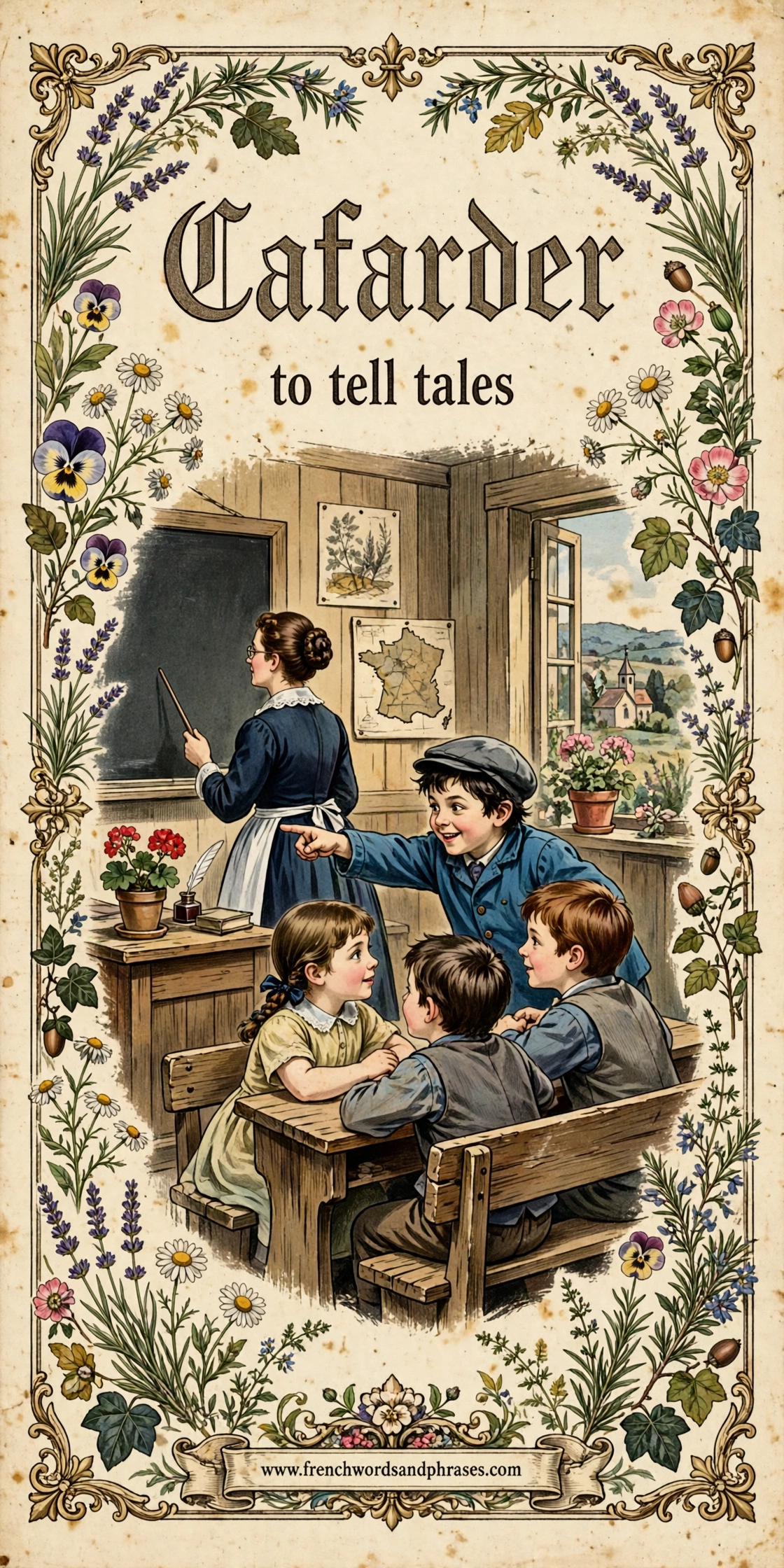
The school corridor at break time: someone has broken a window, everyone saw who did it, and one pupil is already hurrying towards the staff room. Cafarder is the playground’s least loved verb — the tale-telling that makes a cafard, a sneak, of whoever does it.
In this guide, you’ll learn how to conjugate cafarder in all the major French tenses and moods. Explore complete conjugation tables, French examples, English translations, and practice quizzes.
Understanding the French Verb Cafarder
Cafarder is a regular French verb belonging to the first group of verbs, those ending in-er.
It means to tell tales. It belongs to schools, barracks and offices — anywhere a group has its own code of loyalty and despises the informer. Adults use it jokingly of colleagues who run to the boss; among children it is a serious accusation, and the child who cafarde is quickly left out of every game.
Verb classification: First group (-er)
Auxiliary verb: Avoir
Past participle: cafardé
Present participle: cafardant
English equivalents: To tell tales, to sneak, to snitch (fam.); cafarder sur quelqu’un — to tell tales about someone; cafarder auprès du maître — to sneak to the teacher; un élève qui cafarde — a tale-telling pupil; arrête de cafarder ! — stop telling tales!
One important detail: cafarder is familier — informal French, born in the schoolyard. Its parent is the noun un cafard, which means both a cockroach and a tale-bearer: the sneak is imagined scuttling off like the insect to whisper in the teacher’s ear. The construction is cafarder sur quelqu’un or simply cafarder with the teacher as the person you run to. Neutral French would say dénoncer or rapporter; cafarder always carries the schoolyard sneer. A plain regular -er verb: je cafarde, nous cafardons, past participle cafardé.
Experience the Word
Cafarder is the verb of broken trust — one whispered report, and the whole class knows who the cafard is.
Imagine a classroom in 1960. A inkwell has been tipped over the teacher’s desk, and thirty pupils sit in thunderous silence. Then a hand creeps up at the back: « M’sieur, c’est Karim, je l’ai vu ! » — il a cafardé, and for a week nobody will sit beside him at lunch.
The culprit will be punished for an hour. The tale-teller has been marked — cafardé dans toutes les mémoires — for the whole school year.
How to Conjugate Cafarder: Complete French Conjugation Guide
Let’s explore every major conjugation of cafarder, beginning with the indicative mood.
How to Conjugate Cafarder in the Indicative Mood
The indicative mood is used to express facts, observations, actions, and events.
How to Conjugate Cafarder in the Present Tense (Présent)
Used for actions happening now, habitual actions, and general truths.
| Subject | Conjugation |
|---|---|
| je | cafarde |
| tu | cafardes |
| il / elle | cafarde |
| nous | cafardons |
| vous | cafardez |
| ils / elles | cafardent |
Example
Ce garçon cafarde sur ses camarades dès qu’il le peut.
That boy tells tales about his classmates whenever he can.
Quick Quiz 1
Complete the sentence:
Nous ne ______ jamais sur un ami.
Reveal the answer
cafardons
Nous ne cafardons jamais sur un ami.
We never tell tales about a friend.
How to Conjugate Cafarder in the Passé Composé
Used for completed actions in the past. Cafarder takes the auxiliary verb avoir.
| Subject | Conjugation |
|---|---|
| j’ | ai cafardé |
| tu | as cafardé |
| il / elle | a cafardé |
| nous | avons cafardé |
| vous | avez cafardé |
| ils / elles | ont cafardé |
Example
Elle a cafardé auprès de la maîtresse ce matin.
She told tales to the teacher this morning.
How to Conjugate Cafarder in the Imparfait (Imperfect Tense)
Used for habitual past actions, descriptions, and ongoing situations in the past.
| Subject | Conjugation |
|---|---|
| je | cafardais |
| tu | cafardais |
| il / elle | cafardait |
| nous | cafardions |
| vous | cafardiez |
| ils / elles | cafardaient |
Example
Dans notre école, on ne cafardait jamais sur un ami.
In our school, we never told tales about a friend.
Quick Quiz 2
Choose the correct form:
She told tales to the teacher.
Elle ______ auprès de la maîtresse. (a cafardé / est cafardée)
Reveal the answer
a cafardé
Elle a cafardé auprès de la maîtresse.
Cafarder takes avoir.
How to Conjugate Cafarder in the Plus-que-parfait
Used to describe an action that had already been completed before another past event.
| Subject | Conjugation |
|---|---|
| j’ | avais cafardé |
| tu | avais cafardé |
| il / elle | avait cafardé |
| nous | avions cafardé |
| vous | aviez cafardé |
| ils / elles | avaient cafardé |
Example
Il avait cafardé avant même qu’on l’interroge.
He had told tales before anyone even questioned him.
How to Conjugate Cafarder in the Passé Simple
Primarily used in formal writing, literature, and historical narratives. It is rarely used in everyday conversation.
| Subject | Conjugation |
|---|---|
| je | cafardai |
| tu | cafardas |
| il / elle | cafarda |
| nous | cafardâmes |
| vous | cafardâtes |
| ils / elles | cafardèrent |
Example
Le petit cafarda sur son frère et reçut une gifle.
The little boy told tales about his brother and got a slap.
How to Conjugate Cafarder in the Passé Antérieur
A literary tense used to express an action completed immediately before another past action, generally in the passé simple.
| Subject | Conjugation |
|---|---|
| j’ | eus cafardé |
| tu | eus cafardé |
| il / elle | eut cafardé |
| nous | eûmes cafardé |
| vous | eûtes cafardé |
| ils / elles | eurent cafardé |
Example
Dès qu’il eut cafardé, ses camarades cessèrent de lui parler.
As soon as he had told tales, his classmates stopped speaking to him.
How to Conjugate Cafarder in the Future Tense (Futur Simple)
Used to describe actions that will take place in the future.
| Subject | Conjugation |
|---|---|
| je | cafarderai |
| tu | cafarderas |
| il / elle | cafardera |
| nous | cafarderons |
| vous | cafarderez |
| ils / elles | cafarderont |
Example
Si tu cafardes encore, personne ne jouera avec toi.
If you tell tales again, nobody will play with you.
How to Conjugate Cafarder in the Futur Antérieur (Future Perfect)
Used for an action that will have been completed before a particular point in the future.
| Subject | Conjugation |
|---|---|
| j’ | aurai cafardé |
| tu | auras cafardé |
| il / elle | aura cafardé |
| nous | aurons cafardé |
| vous | aurez cafardé |
| ils / elles | auront cafardé |
Example
À la fin de la journée, il aura cafardé sur toute la classe.
By the end of the day, he will have told tales about the whole class.
How to Conjugate Cafarder in the Near Future (Futur Proche)
Used to describe something that is going to happen soon. Formed with aller + infinitive.
| Subject | Conjugation |
|---|---|
| je | vais cafarder |
| tu | vas cafarder |
| il / elle | va cafarder |
| nous | allons cafarder |
| vous | allez cafarder |
| ils / elles | vont cafarder |
Example
Ne va pas cafarder auprès du directeur !
Do not go and tell tales to the headmaster!
How to Conjugate Cafarder in the Conditional Mood
The conditional mood expresses what would happen under certain circumstances. It is also frequently used to make polite requests or express wishes.
How to Conjugate Cafarder in the Present Conditional
| Subject | Conjugation |
|---|---|
| je | cafarderais |
| tu | cafarderais |
| il / elle | cafarderait |
| nous | cafarderions |
| vous | cafarderiez |
| ils / elles | cafarderaient |
Example
Un vrai ami ne cafarderait jamais sur toi.
A true friend would never tell tales about you.
How to Conjugate Cafarder in the Past Conditional
| Subject | Conjugation |
|---|---|
| j’ | aurais cafardé |
| tu | aurais cafardé |
| il / elle | aurait cafardé |
| nous | aurions cafardé |
| vous | auriez cafardé |
| ils / elles | auraient cafardé |
Example
Elle aurait cafardé si la maîtresse l’avait écoutée.
She would have told tales if the teacher had listened to her.
Cafarder in the Literary Past Conditional Form
This less common literary form uses the imperfect subjunctive of avoir.
| Subject | Conjugation |
|---|---|
| j’ | eusse cafardé |
| tu | eusses cafardé |
| il / elle | eût cafardé |
| nous | eussions cafardé |
| vous | eussiez cafardé |
| ils / elles | eussent cafardé |
Example
Jamais le soldat n’eût cafardé sur ses compagnons.
The soldier would never have told tales about his comrades.
How to Conjugate Cafarder in the Subjunctive Mood
The subjunctive is used to express wishes, emotions, doubts, necessity, and uncertainty. It frequently follows expressions such as il faut que (it is necessary that) or bien que (although).
How to Conjugate Cafarder in the Present Subjunctive
| Subject | Conjugation |
|---|---|
| que je | cafarde |
| que tu | cafardes |
| qu’il / qu’elle | cafarde |
| que nous | cafardions |
| que vous | cafardiez |
| qu’ils / qu’elles | cafardent |
Example
Je ne veux pas qu’il cafarde sur ses frères.
I do not want him telling tales about his brothers.
Quick Quiz 3
Complete the sentence using the subjunctive:
Je ne veux pas que vous ______ sur vos camarades.
Reveal the answer
cafardiez
Je ne veux pas que vous cafardiez sur vos camarades.
I do not want you telling tales about your classmates.
How to Conjugate Cafarder in the Imperfect Subjunctive
A literary tense, rarely encountered in modern spoken French.
| Subject | Conjugation |
|---|---|
| que je | cafardasse |
| que tu | cafardasses |
| qu’il / qu’elle | cafardât |
| que nous | cafardassions |
| que vous | cafardassiez |
| qu’ils / qu’elles | cafardassent |
Example
On craignait que le petit cafardât sur toute la cour.
They feared the little boy might tell tales about the whole playground.
How to Conjugate Cafarder in the Pluperfect Subjunctive
A literary construction used to express an action completed before another past action.
| Subject | Conjugation |
|---|---|
| que j’ | eusse cafardé |
| que tu | eusses cafardé |
| qu’il / qu’elle | eût cafardé |
| que nous | eussions cafardé |
| que vous | eussiez cafardé |
| qu’ils / qu’elles | eussent cafardé |
Example
On murmurait qu’il eût cafardé pour obtenir une récompense.
People whispered that he had told tales to get a reward.
How to Conjugate Cafarder in the Past Subjunctive
| Subject | Conjugation |
|---|---|
| que j’ | aie cafardé |
| que tu | aies cafardé |
| qu’il / qu’elle | ait cafardé |
| que nous | ayons cafardé |
| que vous | ayez cafardé |
| qu’ils / qu’elles | aient cafardé |
Example
Je suis déçu qu’elle ait cafardé sur sa meilleure amie.
I am disappointed that she told tales about her best friend.
How to Conjugate Cafarder in the Imperative
The imperative is used to give commands, instructions, invitations, or suggestions. Subject pronouns are omitted.
How to Conjugate Cafarder in the Present Imperative
| Person | Conjugation |
|---|---|
| (tu) | cafarde |
| (nous) | cafardons |
| (vous) | cafardez |
Example
Ne cafarde pas sur tes camarades !
Do not tell tales about your classmates!
Quick Quiz 4
How would you say Do not tell tales about your classmates (tu form)?
Reveal the answer
Ne cafarde pas sur tes camarades !
French Participles of Cafarder
Participles are verb forms that can be used in compound tenses and other grammatical constructions.
Present Participle of Cafarder
cafardant
En cafardant ainsi, tu perds la confiance de tous.
By telling tales like that, you lose everyone’s trust.
Past Participle of Cafarder
cafardé
Cafardé par son propre frère, l’enfant éclata en sanglots.
Told on by his own brother, the child burst into tears.
Cafarder in Everyday French: Real-Life Examples
Now that you know the conjugations, let’s see how cafarder appears in everyday French.
Example 1 — Present
Il cafarde sur ses camarades.
He tells tales about his classmates.
Example 2 — Passé composé
Elle a cafardé auprès de la maîtresse.
She told tales to the teacher.
Example 3 — Imparfait
On ne cafardait jamais sur un ami.
We never told tales about a friend.
Example 4 — Future
Si tu cafardes, personne ne jouera avec toi.
If you tell tales, nobody will play with you.
Example 5 — Conditional
Un vrai ami ne cafarderait jamais.
A true friend would never tell tales.
Example 6 — Imperative
Ne cafarde pas sur tes frères !
Do not tell tales about your brothers!
Beyond Translation: The Meaning of Cafarder
English to sneak in the school sense — he sneaked on us — is the exact twin of cafarder, and French makes the picture uglier: a cafard is a cockroach.
The tale-teller scuttles like an insect.
Do not confuse it with avoir le cafard, to feel blue: that cafard is the same gloomy insect, but it has settled inside your spirits rather than run off to the teacher.
How to Remember the French Verb Cafarder
Remember it this way: Cafarder is about the cockroach scuttling to the teacher with the secret.
- Un cafard is a cockroach AND a tale-bearer — cafarder is to scuttle off and tell, like the insect.
- Familier, schoolyard register: neutral French says dénoncer or rapporter.
- Regular -er: je cafarde, nous cafardons, past participle cafardé.
The key idea is the cockroach scuttling to the teacher with the secret.
Test Your Knowledge of Cafarder
Let’s see how much you’ve learned. Try answering these questions before revealing the answers.
Question 1
What does the noun un cafard mean besides a tale-bearer?
Reveal the answer
A cockroach — the sneak is pictured scuttling off like the insect.
Question 2
How do you say He tells tales about his classmates in French?
Reveal the answer
Il cafarde sur ses camarades.
Question 3
Translate: She told tales to the teacher this morning.
Reveal the answer
Elle a cafardé auprès de la maîtresse ce matin.
Question 4
What is the past participle of cafarder?
Reveal the answer
Cafardé.
Question 5
Complete the sentence:
Je ne veux pas qu’il ______ sur ses frères.
Reveal the answer
cafarde
Je ne veux pas qu’il cafarde sur ses frères.
I do not want him telling tales about his brothers.
Your Final Challenge
Can You Use It?
How would you say this in French?
He told tales just once, and the whole playground remembers it still.
Reveal the answer
Il a cafardé une seule fois, et la cour de récréation entière s’en souvient encore.
He told tales just once, and the whole playground remembers it still.
A little French. A little curiosity. A richer everyday life.
LEARN FRENCH ONE WORD AT A TIME




