A French Word to Live By
How to Conjugate Cadencer in French
/ka.dɑ̃.se/
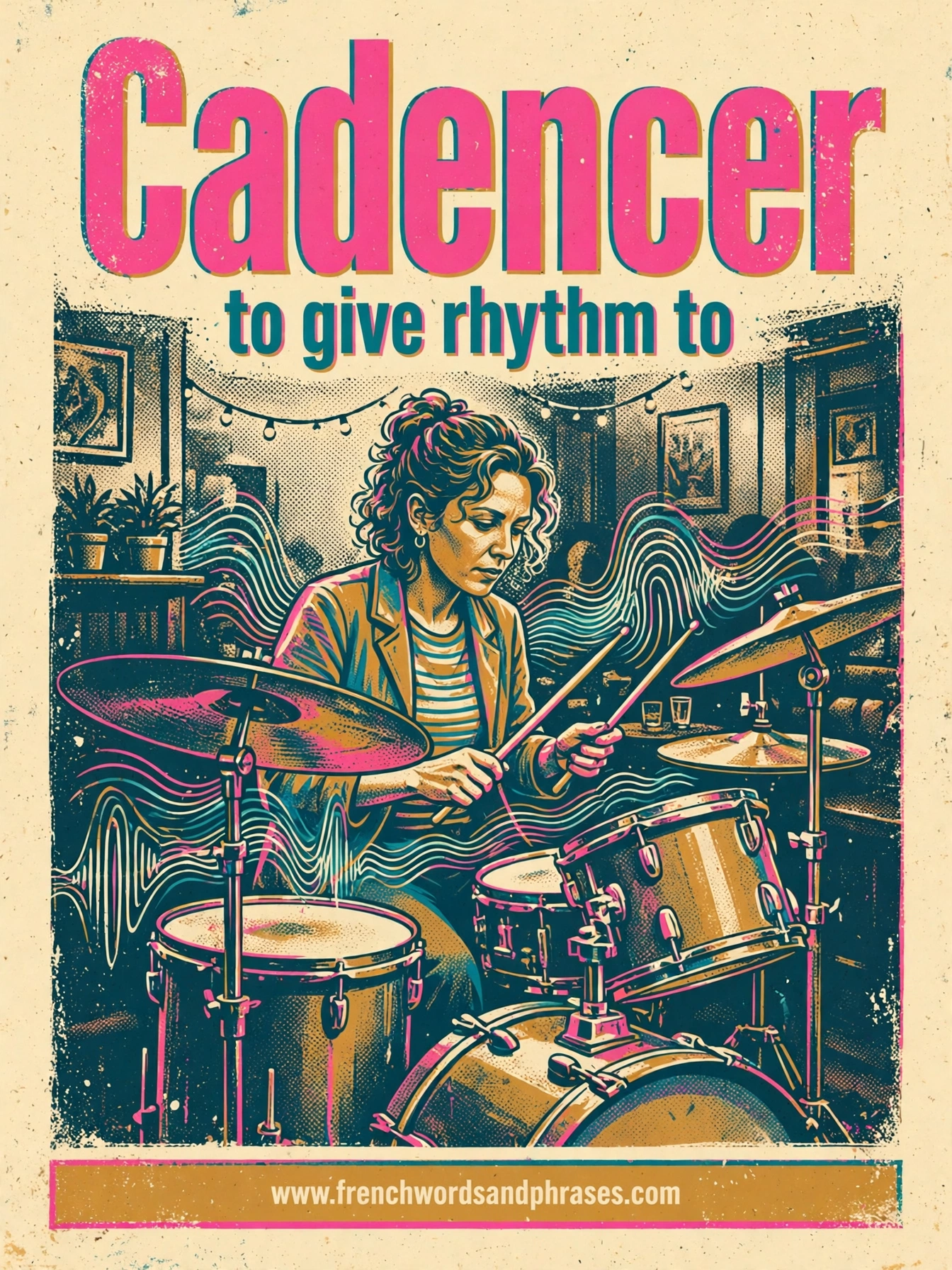
Cadencer means to give rhythm to — to beat time into a march, a poem or a working day so that everything moves in step.
A drummer’s sticks on a marching snare, a metronome ticking on the piano, oars dipping together on a river — cadencer is the verb of measured time: it lays a steady beat under whatever people are doing.
In this guide, you’ll learn how to conjugate cadencer in all the major French tenses and moods. Explore complete conjugation tables, French examples, English translations, and practice quizzes.
Understanding the French Verb Cadencer
Cadencer is a regular French verb belonging to the first group of verbs, those ending in-er.
It means to give rhythm to. It is used of marching, rowing, dancing, verse and factory work — anywhere a rhythm is imposed or kept. In sport and industry, cadencé describes a high, steady work-rate: un rythme cadencé is a pace you have to keep up with.
Verb classification: First group (-er)
Auxiliary verb: Avoir
Past participle: cadencé
Present participle: cadençant
English equivalents: To give rhythm to, to beat time to; cadencer le pas — to march in step, to time one’s steps; cadencer une marche — to set the pace of a march; cadencer un poème — to give a poem its rhythm; un travail cadencé — work done at a steady, rhythmic pace.
One important detail: cadencer ends in -cer, so the c takes a cedilla before the endings a and o to keep its soft s sound: nous cadençons, je cadençais, en cadençant — but je cadence, nous cadencions with a plain c before e and i. It is the twin of the noun la cadence, rhythm or rate, and the past participle cadencé is a common adjective for anything done at a brisk, regular pace: un pas cadencé, une production cadencée.
Experience the Word
Cadencer is the verb of the beat underneath — the measure that turns a crowd of walkers into a marching column.
Imagine a village fête at dusk. The band strikes up, the drummer settles the tempo with two firm beats, and suddenly two hundred people are dancing together, ni trop vite, ni trop lentement — cadencés par la musique, as if one heart were beating for them all.
Nobody counted the steps. The drummer cadenced them — cadencé, in time, together.
How to Conjugate Cadencer: Complete French Conjugation Guide
Let’s explore every major conjugation of cadencer, beginning with the indicative mood.
How to Conjugate Cadencer in the Indicative Mood
The indicative mood is used to express facts, observations, actions, and events.
How to Conjugate Cadencer in the Present Tense (Présent)
Used for actions happening now, habitual actions, and general truths.
| Subject | Conjugation |
|---|---|
| je | cadence |
| tu | cadences |
| il / elle | cadence |
| nous | cadençons |
| vous | cadencez |
| ils / elles | cadencent |
Example
Le tambour cadence la marche des soldats.
The drum gives rhythm to the soldiers’ march.
Quick Quiz 1
Complete the sentence:
Nous ______ la marche avec le tambour.
Reveal the answer
cadençons
Nous cadençons la marche avec le tambour.
We beat time for the march with the drum — note the cedilla.
How to Conjugate Cadencer in the Passé Composé
Used for completed actions in the past. Cadencer takes the auxiliary verb avoir.
| Subject | Conjugation |
|---|---|
| j’ | ai cadencé |
| tu | as cadencé |
| il / elle | a cadencé |
| nous | avons cadencé |
| vous | avez cadencé |
| ils / elles | ont cadencé |
Example
Le chef d’orchestre a cadencé tout le morceau d’un geste sûr.
The conductor gave rhythm to the whole piece with a confident gesture.
How to Conjugate Cadencer in the Imparfait (Imperfect Tense)
Used for habitual past actions, descriptions, and ongoing situations in the past.
| Subject | Conjugation |
|---|---|
| je | cadençais |
| tu | cadençais |
| il / elle | cadençait |
| nous | cadencions |
| vous | cadenciez |
| ils / elles | cadençaient |
Example
Autrefois, un joueur de tambourin cadençait les danses du village.
In the old days, a tambourine player used to give rhythm to the village dances.
Quick Quiz 2
Choose the correct form:
The drummer set the rhythm for the dance.
Le batteur ______ la danse. (a cadencé / est cadencé)
Reveal the answer
a cadencé
Le batteur a cadencé la danse.
Cadencer takes avoir.
How to Conjugate Cadencer in the Plus-que-parfait
Used to describe an action that had already been completed before another past event.
| Subject | Conjugation |
|---|---|
| j’ | avais cadencé |
| tu | avais cadencé |
| il / elle | avait cadencé |
| nous | avions cadencé |
| vous | aviez cadencé |
| ils / elles | avaient cadencé |
Example
Le poète avait cadencé ses vers avant de les lire en public.
The poet had given rhythm to his verses before reading them in public.
How to Conjugate Cadencer in the Passé Simple
Primarily used in formal writing, literature, and historical narratives. It is rarely used in everyday conversation.
| Subject | Conjugation |
|---|---|
| je | cadençai |
| tu | cadenças |
| il / elle | cadença |
| nous | cadençâmes |
| vous | cadençâtes |
| ils / elles | cadençèrent |
Example
Le métronome cadença l’exercice du jeune pianiste.
The metronome set the rhythm for the young pianist’s exercise.
How to Conjugate Cadencer in the Passé Antérieur
A literary tense used to express an action completed immediately before another past action, generally in the passé simple.
| Subject | Conjugation |
|---|---|
| j’ | eus cadencé |
| tu | eus cadencé |
| il / elle | eut cadencé |
| nous | eûmes cadencé |
| vous | eûtes cadencé |
| ils / elles | eurent cadencé |
Example
Quand le tambour eut cadencé la troupe, la parade commença.
When the drum had set the troop marching in time, the parade began.
How to Conjugate Cadencer in the Future Tense (Futur Simple)
Used to describe actions that will take place in the future.
| Subject | Conjugation |
|---|---|
| je | cadencerai |
| tu | cadenceras |
| il / elle | cadencera |
| nous | cadencerons |
| vous | cadencerez |
| ils / elles | cadenceront |
Example
Demain, tu cadenceras la marche avec le tambour.
Tomorrow, you will beat time for the march with the drum.
How to Conjugate Cadencer in the Futur Antérieur (Future Perfect)
Used for an action that will have been completed before a particular point in the future.
| Subject | Conjugation |
|---|---|
| j’ | aurai cadencé |
| tu | auras cadencé |
| il / elle | aura cadencé |
| nous | aurons cadencé |
| vous | aurez cadencé |
| ils / elles | auront cadencé |
Example
Quand nous aurons cadencé le chant, tout le chœur suivra.
Once we have given the song its rhythm, the whole choir will follow.
How to Conjugate Cadencer in the Near Future (Futur Proche)
Used to describe something that is going to happen soon. Formed with aller + infinitive.
| Subject | Conjugation |
|---|---|
| je | vais cadencer |
| tu | vas cadencer |
| il / elle | va cadencer |
| nous | allons cadencer |
| vous | allez cadencer |
| ils / elles | vont cadencer |
Example
Le batteur va cadencer la première danse.
The drummer is going to set the rhythm for the first dance.
How to Conjugate Cadencer in the Conditional Mood
The conditional mood expresses what would happen under certain circumstances. It is also frequently used to make polite requests or express wishes.
How to Conjugate Cadencer in the Present Conditional
| Subject | Conjugation |
|---|---|
| je | cadencerais |
| tu | cadencerais |
| il / elle | cadencerait |
| nous | cadencerions |
| vous | cadenceriez |
| ils / elles | cadenceraient |
Example
Avec un bon tambour, nous cadencerions mieux la procession.
With a good drum, we would keep the procession in time better.
How to Conjugate Cadencer in the Past Conditional
| Subject | Conjugation |
|---|---|
| j’ | aurais cadencé |
| tu | aurais cadencé |
| il / elle | aurait cadencé |
| nous | aurions cadencé |
| vous | auriez cadencé |
| ils / elles | auraient cadencé |
Example
Sans le métronome, elle aurait cadencé le morceau trop vite.
Without the metronome, she would have played the piece too fast.
Cadencer in the Literary Past Conditional Form
This less common literary form uses the imperfect subjunctive of avoir.
| Subject | Conjugation |
|---|---|
| j’ | eusse cadencé |
| tu | eusses cadencé |
| il / elle | eût cadencé |
| nous | eussions cadencé |
| vous | eussiez cadencé |
| ils / elles | eussent cadencé |
Example
Le vieux tambour eût cadencé la marche comme autrefois.
The old drummer would have beaten time for the march as in the old days.
How to Conjugate Cadencer in the Subjunctive Mood
The subjunctive is used to express wishes, emotions, doubts, necessity, and uncertainty. It frequently follows expressions such as il faut que (it is necessary that) or bien que (although).
How to Conjugate Cadencer in the Present Subjunctive
| Subject | Conjugation |
|---|---|
| que je | cadence |
| que tu | cadences |
| qu’il / qu’elle | cadence |
| que nous | cadencions |
| que vous | cadenciez |
| qu’ils / qu’elles | cadencent |
Example
Il faut que le chef cadence clairement chaque mesure.
The conductor must give each bar a clear rhythm.
Quick Quiz 3
Complete the sentence using the subjunctive:
Il faut que vous ______ le pas sans ralentir.
Reveal the answer
cadenciez
Il faut que vous cadenciez le pas sans ralentir.
You must keep the step in time without slowing down.
How to Conjugate Cadencer in the Imperfect Subjunctive
A literary tense, rarely encountered in modern spoken French.
| Subject | Conjugation |
|---|---|
| que je | cadencasse |
| que tu | cadencasses |
| qu’il / qu’elle | cadencât |
| que nous | cadencassions |
| que vous | cadencassiez |
| qu’ils / qu’elles | cadencassent |
Example
Je souhaitais que le tambour cadençât la retraite aux flambeaux.
I hoped the drum would set the rhythm for the torchlight procession.
How to Conjugate Cadencer in the Pluperfect Subjunctive
A literary construction used to express an action completed before another past action.
| Subject | Conjugation |
|---|---|
| que j’ | eusse cadencé |
| que tu | eusses cadencé |
| qu’il / qu’elle | eût cadencé |
| que nous | eussions cadencé |
| que vous | eussiez cadencé |
| qu’ils / qu’elles | eussent cadencé |
Example
On disait que le poète eût cadencé ses vers dès l’enfance.
People said the poet had given rhythm to his verses since childhood.
How to Conjugate Cadencer in the Past Subjunctive
| Subject | Conjugation |
|---|---|
| que j’ | aie cadencé |
| que tu | aies cadencé |
| qu’il / qu’elle | ait cadencé |
| que nous | ayons cadencé |
| que vous | ayez cadencé |
| qu’ils / qu’elles | aient cadencé |
Example
Je suis content que le batteur ait cadencé la danse si régulièrement.
I am glad the drummer kept such a steady rhythm for the dance.
How to Conjugate Cadencer in the Imperative
The imperative is used to give commands, instructions, invitations, or suggestions. Subject pronouns are omitted.
How to Conjugate Cadencer in the Present Imperative
| Person | Conjugation |
|---|---|
| (tu) | cadence |
| (nous) | cadençons |
| (vous) | cadencez |
Example
Cadence le pas, soldat, et ne traîne pas !
Keep in step, soldier, and do not lag behind!
Quick Quiz 4
How would you say Keep in step (tu form)?
Reveal the answer
Cadence le pas !
French Participles of Cadencer
Participles are verb forms that can be used in compound tenses and other grammatical constructions.
Present Participle of Cadencer
cadençant
En cadençant la marche, le tambour unit toute la colonne.
By beating time for the march, the drum unites the whole column.
Past Participle of Cadencer
cadencé
Cadencé par les rames, le bateau glissait en silence.
Given rhythm by the oars, the boat glided along in silence.
Cadencer in Everyday French: Real-Life Examples
Now that you know the conjugations, let’s see how cadencer appears in everyday French.
Example 1 — Present
Le tambour cadence la marche.
The drum gives rhythm to the march.
Example 2 — Passé composé
Le chef a cadencé tout le morceau.
The conductor set the rhythm for the whole piece.
Example 3 — Imparfait
Le métronome cadençait ses exercices.
The metronome kept time for her exercises.
Example 4 — Future
Tu cadenceras la première danse.
You will set the rhythm for the first dance.
Example 5 — Conditional
Nous cadencerions mieux avec un tambour.
We would keep time better with a drum.
Example 6 — Imperative
Cadençons le pas, tous ensemble !
Let us march in step, all together!
Beyond Translation: The Meaning of Cadencer
English cadence and French cadencer are the same word twice — both come from the Latin cadere, to fall, because rhythm is where the beat falls.
To cadence is to make time fall in step.
A marching column, a rowing crew and a well-made poem all have this in common: something underneath them is falling, regularly, like a heartbeat — and cadencer is the verb that puts it there.
How to Remember the French Verb Cadencer
Remember it this way: Cadencer is about the drum under the march — every step falling in time.
- The c grows a cedilla before a and o: nous cadençons, je cadençais, en cadençant.
- Think of la cadence, the rhythm — cadencer is simply to put cadence into something.
- Regular -er underneath: je cadence, nous cadençons, past participle cadencé.
The key idea is the drum under the march — every step falling in time.
Test Your Knowledge of Cadencer
Let’s see how much you’ve learned. Try answering these questions before revealing the answers.
Question 1
Why does nous cadençons have a cedilla?
Reveal the answer
Because the ending begins with o — the ç keeps the c soft: nous cadençons, but nous cadencions with a plain c.
Question 2
How do you say The drum gives rhythm to the march in French?
Reveal the answer
Le tambour cadence la marche.
Question 3
Translate: The conductor set the rhythm for the whole piece.
Reveal the answer
Le chef d’orchestre a cadencé tout le morceau.
Question 4
What is the past participle of cadencer?
Reveal the answer
Cadencé — also a common adjective: un pas cadencé, a marching step in time.
Question 5
Complete the sentence:
Il faut que le chef ______ clairement chaque mesure.
Reveal the answer
cadence
Il faut que le chef cadence clairement chaque mesure.
The conductor must give each bar a clear rhythm.
Your Final Challenge
Can You Use It?
How would you say this in French?
The drum gives rhythm to the march, and the whole village moves forward in step, like a single beating heart.
Reveal the answer
Le tambour cadence la marche, et tout le village avance du même pas, comme un seul cœur qui bat.
The drum gives rhythm to the march, and the whole village moves forward in step, like a single beating heart.
A little French. A little curiosity. A richer everyday life.
LEARN FRENCH ONE WORD AT A TIME