A French Word to Live By
How to Conjugate Cadenasser in French
/kad.na.se/
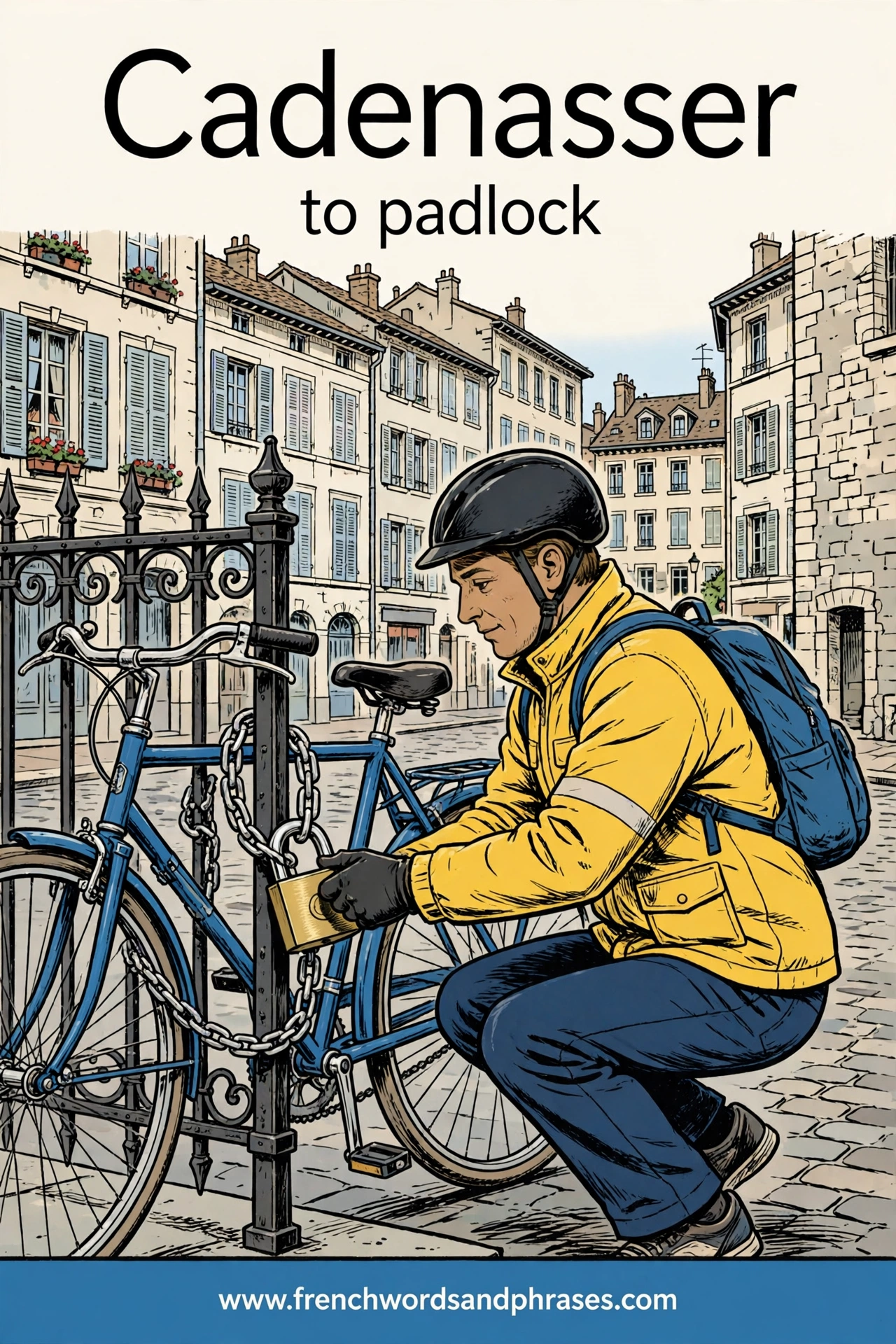
Cadenasser means to padlock — to lock something up with a padlock: a gate, a bike, a cellar door, anything that needs a chain and a click.
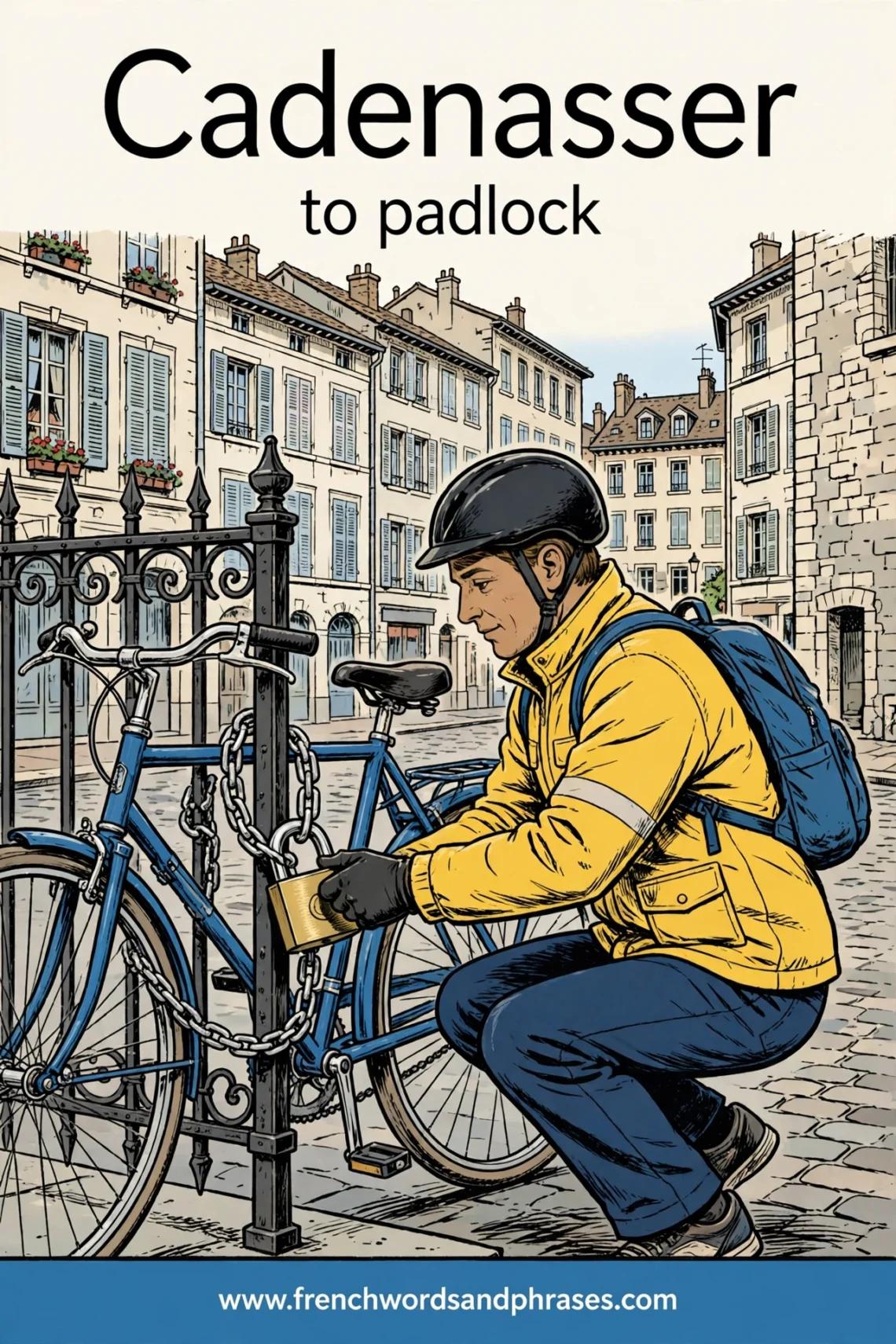
A bicycle locked to the railings, a garden gate closed for the winter — cadenasser is the practical verb of the padlock: one click, and the thing is safe until the key comes back.
In this guide, you’ll learn how to conjugate cadenasser in all the major French tenses and moods. Explore complete conjugation tables, French examples, English translations, and practice quizzes.
Understanding the French Verb Cadenasser
Cadenasser is a regular French verb belonging to the first group of verbs, those ending in-er.
It means to padlock. It is used wherever a padlock does the locking — bikes, gates, cellars, lockers, suitcases, site cabins — and figuratively, now and then, for anything shut away beyond reach: un dossier cadenassé, a file locked down tight. The click of the lock is the whole point: quick, visible security.
Verb classification: First group (-er)
Auxiliary verb: Avoir
Past participle: cadenassé
Present participle: cadenassant
English equivalents: To padlock, to lock with a padlock; cadenasser un vélo — to padlock a bike; cadenasser la grille — to padlock the gate; un cadenas — a padlock; la porte est cadenassée — the door is padlocked; cadenasser sa valise — to padlock one’s suitcase.
One important detail: cadenasser is simply the verb of its noun — un cadenas is a padlock, and to cadenasser is to close one on something. The double s of the stem never changes: je cadenasse, nous cadenassons, ils cadenassent, past participle cadenassé. You will see the participle on a hundred French gates and lockers: cadenassé means locked up tight, key required, no exceptions.
Experience the Word
Cadenasser is the verb of the reassuring click — chain through the wheel, lock shut, walk away in peace.
Imagine a student in a rainy city, late for her lecture. She threads the chain through the front wheel, round the railing, and — clic — elle cadenasse son vélo, then runs up the steps, certain that her bicycle, her one treasure, will still be there at noon.
It takes three seconds. The bike is padlocked — cadenassé — and the morning is safe.
How to Conjugate Cadenasser: Complete French Conjugation Guide
Let’s explore every major conjugation of cadenasser, beginning with the indicative mood.
How to Conjugate Cadenasser in the Indicative Mood
The indicative mood is used to express facts, observations, actions, and events.
How to Conjugate Cadenasser in the Present Tense (Présent)
Used for actions happening now, habitual actions, and general truths.
| Subject | Conjugation |
|---|---|
| je | cadenasse |
| tu | cadenasses |
| il / elle | cadenasse |
| nous | cadenassons |
| vous | cadenassez |
| ils / elles | cadenassent |
Example
Il cadenasse toujours son vélo devant la gare.
He always padlocks his bike in front of the station.
Quick Quiz 1
Complete the sentence:
Nous ______ les portes du dépôt chaque soir.
Reveal the answer
cadenassons
Nous cadenassons les portes du dépôt chaque soir.
We padlock the depot doors every evening.
How to Conjugate Cadenasser in the Passé Composé
Used for completed actions in the past. Cadenasser takes the auxiliary verb avoir.
| Subject | Conjugation |
|---|---|
| j’ | ai cadenassé |
| tu | as cadenassé |
| il / elle | a cadenassé |
| nous | avons cadenassé |
| vous | avez cadenassé |
| ils / elles | ont cadenassé |
Example
J’ai cadenassé la grille avant de partir en vacances.
I padlocked the gate before leaving on holiday.
How to Conjugate Cadenasser in the Imparfait (Imperfect Tense)
Used for habitual past actions, descriptions, and ongoing situations in the past.
| Subject | Conjugation |
|---|---|
| je | cadenassais |
| tu | cadenassais |
| il / elle | cadenassait |
| nous | cadenassions |
| vous | cadenassiez |
| ils / elles | cadenassaient |
Example
Autrefois, on cadenassait les portes des granges chaque soir.
In the old days, the barn doors were padlocked every evening.
Quick Quiz 2
Choose the correct form:
I padlocked the gate.
J’______ la grille. (ai cadenassé / suis cadenassé)
Reveal the answer
ai cadenassé
J’ai cadenassé la grille.
Cadenasser takes avoir.
How to Conjugate Cadenasser in the Plus-que-parfait
Used to describe an action that had already been completed before another past event.
| Subject | Conjugation |
|---|---|
| j’ | avais cadenassé |
| tu | avais cadenassé |
| il / elle | avait cadenassé |
| nous | avions cadenassé |
| vous | aviez cadenassé |
| ils / elles | avaient cadenassé |
Example
Elle avait cadenassé sa valise avant de la mettre dans le train.
She had padlocked her suitcase before putting it on the train.
How to Conjugate Cadenasser in the Passé Simple
Primarily used in formal writing, literature, and historical narratives. It is rarely used in everyday conversation.
| Subject | Conjugation |
|---|---|
| je | cadenassai |
| tu | cadenassas |
| il / elle | cadenassa |
| nous | cadenassâmes |
| vous | cadenassâtes |
| ils / elles | cadenassèrent |
Example
Le gardien cadenassa la grille à la tombée de la nuit.
The caretaker padlocked the gate at nightfall.
How to Conjugate Cadenasser in the Passé Antérieur
A literary tense used to express an action completed immediately before another past action, generally in the passé simple.
| Subject | Conjugation |
|---|---|
| j’ | eus cadenassé |
| tu | eus cadenassé |
| il / elle | eut cadenassé |
| nous | eûmes cadenassé |
| vous | eûtes cadenassé |
| ils / elles | eurent cadenassé |
Example
Quand il eut cadenassé le portail, le gardien rentra chez lui.
When he had padlocked the gate, the caretaker went home.
How to Conjugate Cadenasser in the Future Tense (Futur Simple)
Used to describe actions that will take place in the future.
| Subject | Conjugation |
|---|---|
| je | cadenasserai |
| tu | cadenasseras |
| il / elle | cadenassera |
| nous | cadenasserons |
| vous | cadenasserez |
| ils / elles | cadenasseront |
Example
Ce soir, je cadenasserai le cabanon avant l’orage.
This evening, I will padlock the shed before the storm.
How to Conjugate Cadenasser in the Futur Antérieur (Future Perfect)
Used for an action that will have been completed before a particular point in the future.
| Subject | Conjugation |
|---|---|
| j’ | aurai cadenassé |
| tu | auras cadenassé |
| il / elle | aura cadenassé |
| nous | aurons cadenassé |
| vous | aurez cadenassé |
| ils / elles | auront cadenassé |
Example
À la fermeture, ils auront cadenassé toutes les portes du dépôt.
By closing time, they will have padlocked all the depot doors.
How to Conjugate Cadenasser in the Near Future (Futur Proche)
Used to describe something that is going to happen soon. Formed with aller + infinitive.
| Subject | Conjugation |
|---|---|
| je | vais cadenasser |
| tu | vas cadenasser |
| il / elle | va cadenasser |
| nous | allons cadenasser |
| vous | allez cadenasser |
| ils / elles | vont cadenasser |
Example
Attends, je vais cadenasser mon vélo d’abord.
Wait, I am going to padlock my bike first.
How to Conjugate Cadenasser in the Conditional Mood
The conditional mood expresses what would happen under certain circumstances. It is also frequently used to make polite requests or express wishes.
How to Conjugate Cadenasser in the Present Conditional
| Subject | Conjugation |
|---|---|
| je | cadenasserais |
| tu | cadenasserais |
| il / elle | cadenasserait |
| nous | cadenasserions |
| vous | cadenasseriez |
| ils / elles | cadenasseraient |
Example
Avec une meilleure chaîne, je cadenasserais mon vélo sans inquiétude.
With a better chain, I would padlock my bike without worry.
How to Conjugate Cadenasser in the Past Conditional
| Subject | Conjugation |
|---|---|
| j’ | aurais cadenassé |
| tu | aurais cadenassé |
| il / elle | aurait cadenassé |
| nous | aurions cadenassé |
| vous | auriez cadenassé |
| ils / elles | auraient cadenassé |
Example
Il aurait cadenassé la porte si le cadenas n’était pas rouillé.
He would have padlocked the door if the padlock had not been rusty.
Cadenasser in the Literary Past Conditional Form
This less common literary form uses the imperfect subjunctive of avoir.
| Subject | Conjugation |
|---|---|
| j’ | eusse cadenassé |
| tu | eusses cadenassé |
| il / elle | eût cadenassé |
| nous | eussions cadenassé |
| vous | eussiez cadenassé |
| ils / elles | eussent cadenassé |
Example
Le gardien eût cadenassé la grille avant la nuit.
The caretaker would have padlocked the gate before night.
How to Conjugate Cadenasser in the Subjunctive Mood
The subjunctive is used to express wishes, emotions, doubts, necessity, and uncertainty. It frequently follows expressions such as il faut que (it is necessary that) or bien que (although).
How to Conjugate Cadenasser in the Present Subjunctive
| Subject | Conjugation |
|---|---|
| que je | cadenasse |
| que tu | cadenasses |
| qu’il / qu’elle | cadenasse |
| que nous | cadenassions |
| que vous | cadenassiez |
| qu’ils / qu’elles | cadenassent |
Example
Il faut que tu cadenasses ton vélo à chaque arrêt.
You must padlock your bike at every stop.
Quick Quiz 3
Complete the sentence using the subjunctive:
Je suis content que tu ______ la grille.
Reveal the answer
aies cadenassé
Je suis content que tu aies cadenassé la grille.
I am glad you padlocked the gate.
How to Conjugate Cadenasser in the Imperfect Subjunctive
A literary tense, rarely encountered in modern spoken French.
| Subject | Conjugation |
|---|---|
| que je | cadenassasse |
| que tu | cadenassasses |
| qu’il / qu’elle | cadenassât |
| que nous | cadenassassions |
| que vous | cadenassassiez |
| qu’ils / qu’elles | cadenassassent |
Example
On lui a demandé qu’il cadenassât le portail chaque soir.
He was asked to padlock the gate every evening.
How to Conjugate Cadenasser in the Pluperfect Subjunctive
A literary construction used to express an action completed before another past action.
| Subject | Conjugation |
|---|---|
| que j’ | eusse cadenassé |
| que tu | eusses cadenassé |
| qu’il / qu’elle | eût cadenassé |
| que nous | eussions cadenassé |
| que vous | eussiez cadenassé |
| qu’ils / qu’elles | eussent cadenassé |
Example
On racontait qu’il eût cadenassé la cave avant la guerre.
People said he had padlocked the cellar before the war.
How to Conjugate Cadenasser in the Past Subjunctive
| Subject | Conjugation |
|---|---|
| que j’ | aie cadenassé |
| que tu | aies cadenassé |
| qu’il / qu’elle | ait cadenassé |
| que nous | ayons cadenassé |
| que vous | ayez cadenassé |
| qu’ils / qu’elles | aient cadenassé |
Example
Je suis content que tu aies cadenassé la grille.
I am glad you padlocked the gate.
How to Conjugate Cadenasser in the Imperative
The imperative is used to give commands, instructions, invitations, or suggestions. Subject pronouns are omitted.
How to Conjugate Cadenasser in the Present Imperative
| Person | Conjugation |
|---|---|
| (tu) | cadenasse |
| (nous) | cadenassons |
| (vous) | cadenassez |
Example
Cadenassez vos casiers avant de partir !
Padlock your lockers before leaving!
Quick Quiz 4
How would you say Padlock your lockers (vous form)?
Reveal the answer
Cadenassez vos casiers !
French Participles of Cadenasser
Participles are verb forms that can be used in compound tenses and other grammatical constructions.
Present Participle of Cadenasser
cadenassant
En cadenassant son vélo, elle a remarqué un pneu crevé.
While padlocking her bike, she noticed a flat tyre.
Past Participle of Cadenasser
cadenassé
Cadenassée pour l’hiver, la grille du jardin ne s’ouvrira qu’au printemps.
Padlocked for the winter, the garden gate will not open until spring.
Cadenasser in Everyday French: Real-Life Examples
Now that you know the conjugations, let’s see how cadenasser appears in everyday French.
Example 1 — Present
Il cadenasse son vélo devant la gare.
He padlocks his bike in front of the station.
Example 2 — Passé composé
J’ai cadenassé la grille avant les vacances.
I padlocked the gate before the holidays.
Example 3 — Imparfait
On cadenassait les granges chaque soir.
The barns were padlocked every evening.
Example 4 — Future
Je cadenasserai le cabanon ce soir.
I will padlock the shed this evening.
Example 5 — Conditional
Je cadenasserais mon vélo sans inquiétude.
I would padlock my bike without worry.
Example 6 — Imperative
Cadenassez vos casiers !
Padlock your lockers!
Beyond Translation: The Meaning of Cadenasser
English padlock is both noun and verb, neatly; French cadenasser builds the verb honestly out of the noun — un cadenas goes on, and the thing is cadenassé.
The participle is a sign on a thousand gates.
Cadenassé means: this is locked, this is private, come back with the key — a small word of security that every cyclist, gardener and caretaker in France uses without thinking.
How to Remember the French Verb Cadenasser
Remember it this way: Cadenasser is about the chain through the bicycle wheel and the click of the lock at the station.
- Un cadenas is a padlock: cadenasser is to put one on — gate, bike, locker, suitcase.
- The double s never changes: je cadenasse, nous cadenassons, cadenassé.
- Regular -er with avoir: il a cadenassé la grille.
The key idea is the chain through the bicycle wheel and the click of the lock at the station.
Test Your Knowledge of Cadenasser
Let’s see how much you’ve learned. Try answering these questions before revealing the answers.
Question 1
What is un cadenas?
Reveal the answer
A padlock — cadenasser is the verb built on it: to lock with a padlock.
Question 2
How do you say I padlocked the gate before leaving on holiday in French?
Reveal the answer
J’ai cadenassé la grille avant de partir en vacances.
Question 3
Translate: He always padlocks his bike in front of the station.
Reveal the answer
Il cadenasse toujours son vélo devant la gare.
Question 4
What is the past participle of cadenasser?
Reveal the answer
Cadenassé.
Question 5
Complete the sentence:
Il faut que tu ______ ton vélo à chaque arrêt.
Reveal the answer
cadenasses
Il faut que tu cadenasses ton vélo à chaque arrêt.
You must padlock your bike at every stop.
Your Final Challenge
Can You Use It?
How would you say this in French?
She padlocks her bike to the station railings, and the click of the padlock reassures her every morning.
Reveal the answer
Elle cadenasse son vélo à la grille de la gare, et le clic du cadenas la rassure chaque matin.
She padlocks her bike to the station railings, and the click of the padlock reassures her every morning.
A little French. A little curiosity. A richer everyday life.
LEARN FRENCH ONE WORD AT A TIME