A French Word to Live By
How to Conjugate Caboter in French
/ka.bɔ.te/
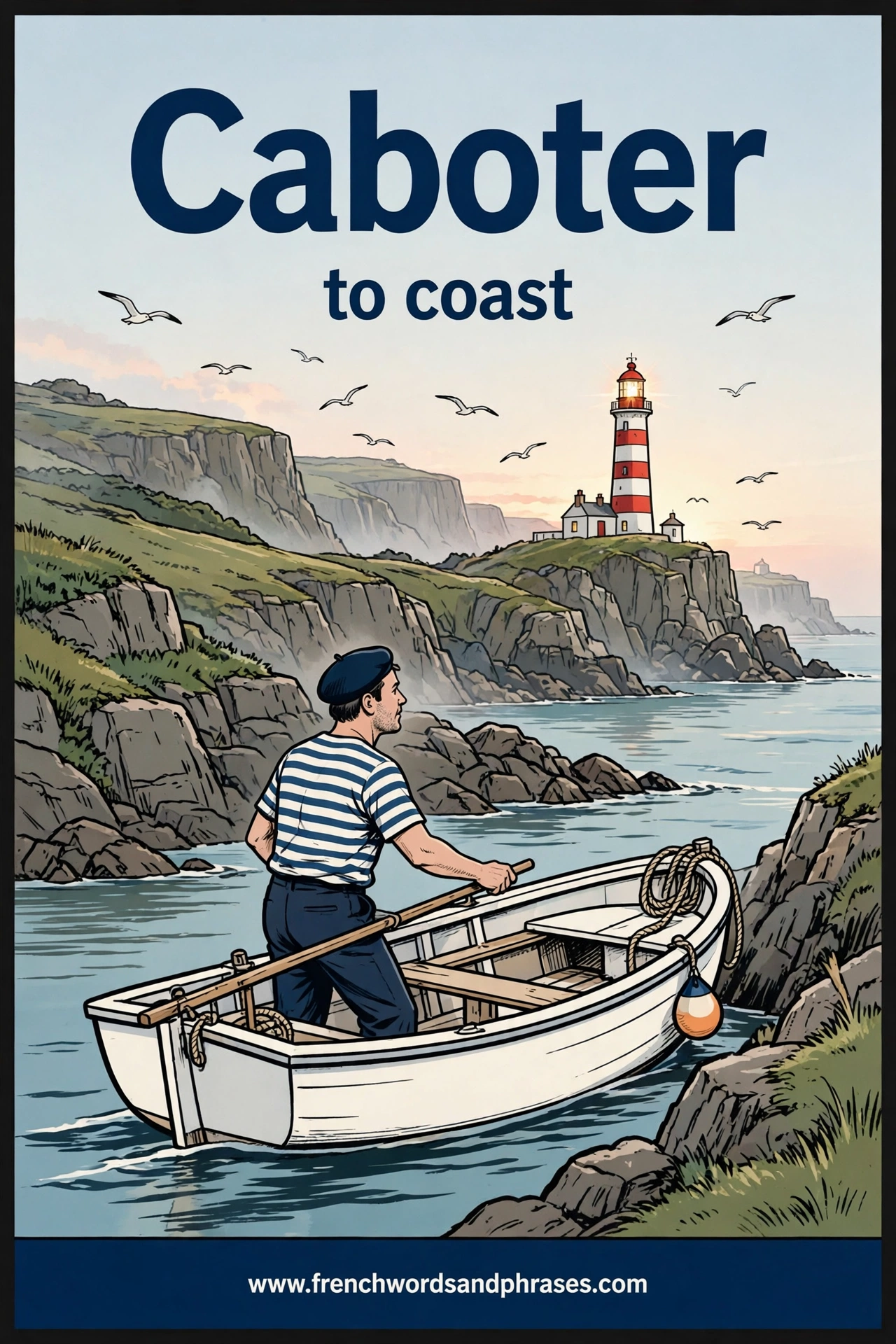
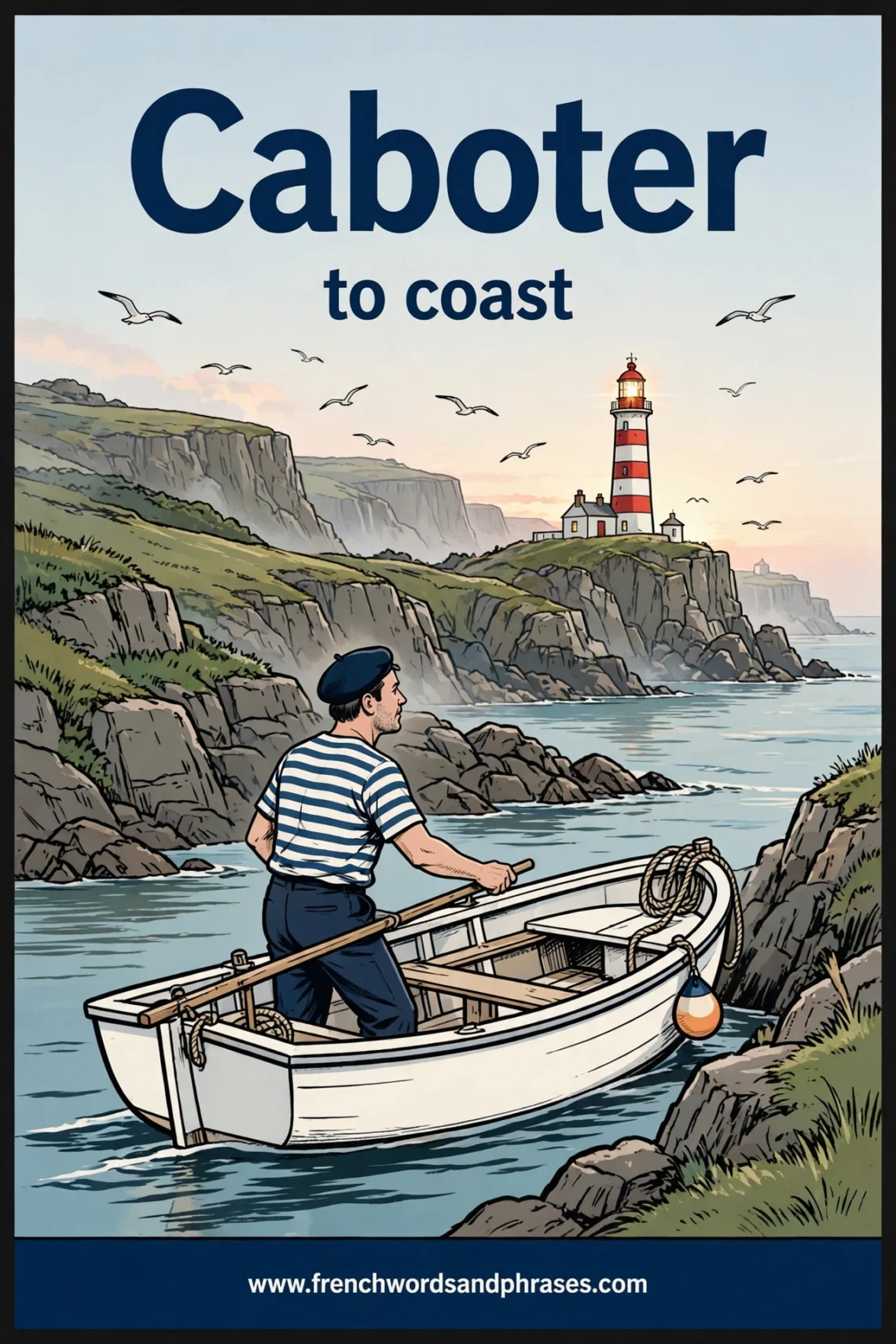
Caboter means to coast — to sail along the coast from port to port, never losing sight of land for long.
A little cargo boat hopping from harbour to harbour down the Brittany coast, a yacht stopping each night in a new cove — caboter is the sailor’s verb for coastal sailing: short hops, familiar waters, land always in view.
In this guide, you’ll learn how to conjugate caboter in all the major French tenses and moods. Explore complete conjugation tables, French examples, English translations, and practice quizzes.
Understanding the French Verb Caboter
Caboter is a regular French verb belonging to the first group of verbs, those ending in-er.
It means to coast. It is used of ships and sailors travelling along a coast in short stages — the opposite of crossing the open ocean. Fishing boats, small cargo vessels and pleasure yachts cabotent; the word carries the smell of small ports, tides and local knowledge rather than blue-water adventure.
Verb classification: First group (-er)
Auxiliary verb: Avoir
Past participle: caboté
Present participle: cabotant
English equivalents: To coast, to sail along the coast; caboter le long des côtes — to coast along the shores; caboter de port en port — to sail from port to port; un bateau qui cabote — a coasting vessel; le cabotage — coastal shipping, coasting trade.
One important detail: caboter gives French its noun le cabotage, coastal shipping — and, by a modern extension, the airline rights called cabotage in English too. The verb itself is perfectly regular: je cabote, nous cabotons, ils cabotent, past participle caboté. It describes the movement, not the boat: what matters is the coast, followed closely, harbour by harbour.
Experience the Word
Caboter is the verb of the coast-hugger — the sea travelled in short, safe hops, with a harbour waiting every evening.
Imagine an old Breton skipper with a boat full of onions. He never crosses to England in one go; il cabote, port après port — Roscoff, Morlaix, Paimpol — sleeping each night in a different harbour, known and welcomed in every one.
He has crossed the same sea a hundred times. He has coasted it — caboté — the way you walk a familiar path, step by step.
How to Conjugate Caboter: Complete French Conjugation Guide
Let’s explore every major conjugation of caboter, beginning with the indicative mood.
How to Conjugate Caboter in the Indicative Mood
The indicative mood is used to express facts, observations, actions, and events.
How to Conjugate Caboter in the Present Tense (Présent)
Used for actions happening now, habitual actions, and general truths.
| Subject | Conjugation |
|---|---|
| je | cabote |
| tu | cabotes |
| il / elle | cabote |
| nous | cabotons |
| vous | cabotez |
| ils / elles | cabotent |
Example
Ce bateau cabote le long des côtes bretonnes.
This boat coasts along the Breton shores.
Quick Quiz 1
Complete the sentence:
Ces bateaux ______ le long des côtes depuis toujours.
Reveal the answer
cabotent
Ces bateaux cabotent le long des côtes depuis toujours.
These boats have always coasted along the shores.
How to Conjugate Caboter in the Passé Composé
Used for completed actions in the past. Caboter takes the auxiliary verb avoir.
| Subject | Conjugation |
|---|---|
| j’ | ai caboté |
| tu | as caboté |
| il / elle | a caboté |
| nous | avons caboté |
| vous | avez caboté |
| ils / elles | ont caboté |
Example
Nous avons caboté de port en port pendant tout l’été.
We coasted from port to port all summer long.
How to Conjugate Caboter in the Imparfait (Imperfect Tense)
Used for habitual past actions, descriptions, and ongoing situations in the past.
| Subject | Conjugation |
|---|---|
| je | cabotais |
| tu | cabotais |
| il / elle | cabotait |
| nous | cabotions |
| vous | cabotiez |
| ils / elles | cabotaient |
Example
Autrefois, les marchands cabotaient entre les îles.
In the old days, the merchants used to coast between the islands.
Quick Quiz 2
Choose the correct form:
We coasted all summer.
Nous ______ tout l’été. (avons caboté / sommes cabotés)
Reveal the answer
avons caboté
Nous avons caboté tout l’été.
Caboter takes avoir.
How to Conjugate Caboter in the Plus-que-parfait
Used to describe an action that had already been completed before another past event.
| Subject | Conjugation |
|---|---|
| j’ | avais caboté |
| tu | avais caboté |
| il / elle | avait caboté |
| nous | avions caboté |
| vous | aviez caboté |
| ils / elles | avaient caboté |
Example
Il avait caboté dix ans avant de traverser l’océan.
He had coasted for ten years before crossing the ocean.
How to Conjugate Caboter in the Passé Simple
Primarily used in formal writing, literature, and historical narratives. It is rarely used in everyday conversation.
| Subject | Conjugation |
|---|---|
| je | cabotai |
| tu | cabotas |
| il / elle | cabota |
| nous | cabotâmes |
| vous | cabotâtes |
| ils / elles | cabotèrent |
Example
Le navire cabota jusqu’à Bordeaux sans incident.
The ship coasted as far as Bordeaux without incident.
How to Conjugate Caboter in the Passé Antérieur
A literary tense used to express an action completed immediately before another past action, generally in the passé simple.
| Subject | Conjugation |
|---|---|
| j’ | eus caboté |
| tu | eus caboté |
| il / elle | eut caboté |
| nous | eûmes caboté |
| vous | eûtes caboté |
| ils / elles | eurent caboté |
Example
Quand ils eurent caboté jusqu’au dernier port, ils vendirent la cargaison.
When they had coasted to the last port, they sold the cargo.
How to Conjugate Caboter in the Future Tense (Futur Simple)
Used to describe actions that will take place in the future.
| Subject | Conjugation |
|---|---|
| je | caboterai |
| tu | caboteras |
| il / elle | cabotera |
| nous | caboterons |
| vous | caboterez |
| ils / elles | caboteront |
Example
Demain, nous caboterons jusqu’à la prochaine île.
Tomorrow, we will coast as far as the next island.
How to Conjugate Caboter in the Futur Antérieur (Future Perfect)
Used for an action that will have been completed before a particular point in the future.
| Subject | Conjugation |
|---|---|
| j’ | aurai caboté |
| tu | auras caboté |
| il / elle | aura caboté |
| nous | aurons caboté |
| vous | aurez caboté |
| ils / elles | auront caboté |
Example
À la fin du mois, le bateau aura caboté sur toute la côte.
By the end of the month, the boat will have coasted along the whole shore.
How to Conjugate Caboter in the Near Future (Futur Proche)
Used to describe something that is going to happen soon. Formed with aller + infinitive.
| Subject | Conjugation |
|---|---|
| je | vais caboter |
| tu | vas caboter |
| il / elle | va caboter |
| nous | allons caboter |
| vous | allez caboter |
| ils / elles | vont caboter |
Example
Le voilier va caboter vers le sud cet après-midi.
The yacht is going to coast southwards this afternoon.
How to Conjugate Caboter in the Conditional Mood
The conditional mood expresses what would happen under certain circumstances. It is also frequently used to make polite requests or express wishes.
How to Conjugate Caboter in the Present Conditional
| Subject | Conjugation |
|---|---|
| je | caboterais |
| tu | caboterais |
| il / elle | caboterait |
| nous | caboterions |
| vous | caboteriez |
| ils / elles | caboteraient |
Example
Avec plus de temps, nous caboterions jusqu’en Espagne.
With more time, we would coast as far as Spain.
How to Conjugate Caboter in the Past Conditional
| Subject | Conjugation |
|---|---|
| j’ | aurais caboté |
| tu | aurais caboté |
| il / elle | aurait caboté |
| nous | aurions caboté |
| vous | auriez caboté |
| ils / elles | auraient caboté |
Example
Ils auraient caboté plus loin sans la tempête.
They would have coasted further without the storm.
Caboter in the Literary Past Conditional Form
This less common literary form uses the imperfect subjunctive of avoir.
| Subject | Conjugation |
|---|---|
| j’ | eusse caboté |
| tu | eusses caboté |
| il / elle | eût caboté |
| nous | eussions caboté |
| vous | eussiez caboté |
| ils / elles | eussent caboté |
Example
Le navire eût caboté jusqu’à Lisbonne avec un meilleur vent.
The ship would have coasted as far as Lisbon with a better wind.
How to Conjugate Caboter in the Subjunctive Mood
The subjunctive is used to express wishes, emotions, doubts, necessity, and uncertainty. It frequently follows expressions such as il faut que (it is necessary that) or bien que (although).
How to Conjugate Caboter in the Present Subjunctive
| Subject | Conjugation |
|---|---|
| que je | cabote |
| que tu | cabotes |
| qu’il / qu’elle | cabote |
| que nous | cabotions |
| que vous | cabotiez |
| qu’ils / qu’elles | cabotent |
Example
Il préfère que nous cabotions plutôt que traverser.
He prefers us to coast rather than cross.
Quick Quiz 3
Complete the sentence using the subjunctive:
Je suis content que vous ______ sans encombre.
Reveal the answer
ayez caboté
Je suis content que vous ayez caboté sans encombre.
I am glad you coasted without any trouble.
How to Conjugate Caboter in the Imperfect Subjunctive
A literary tense, rarely encountered in modern spoken French.
| Subject | Conjugation |
|---|---|
| que je | cabotasse |
| que tu | cabotasses |
| qu’il / qu’elle | cabotât |
| que nous | cabotassions |
| que vous | cabotassiez |
| qu’ils / qu’elles | cabotassent |
Example
Je doutais qu’ils cabotassent par un tel temps.
I doubted they would coast in such weather.
How to Conjugate Caboter in the Pluperfect Subjunctive
A literary construction used to express an action completed before another past action.
| Subject | Conjugation |
|---|---|
| que j’ | eusse caboté |
| que tu | eusses caboté |
| qu’il / qu’elle | eût caboté |
| que nous | eussions caboté |
| que vous | eussiez caboté |
| qu’ils / qu’elles | eussent caboté |
Example
On racontait qu’ils eussent caboté jusqu’en Cornouailles.
People said they had coasted as far as Cornwall.
How to Conjugate Caboter in the Past Subjunctive
| Subject | Conjugation |
|---|---|
| que j’ | aie caboté |
| que tu | aies caboté |
| qu’il / qu’elle | ait caboté |
| que nous | ayons caboté |
| que vous | ayez caboté |
| qu’ils / qu’elles | aient caboté |
Example
Je suis content que vous ayez caboté sans encombre.
I am glad you coasted without any trouble.
How to Conjugate Caboter in the Imperative
The imperative is used to give commands, instructions, invitations, or suggestions. Subject pronouns are omitted.
How to Conjugate Caboter in the Present Imperative
| Person | Conjugation |
|---|---|
| (tu) | cabote |
| (nous) | cabotons |
| (vous) | cabotez |
Example
Cabotez prudemment le long de la côte !
Coast carefully along the shore!
Quick Quiz 4
How would you say Coast carefully along the shore (vous form)?
Reveal the answer
Cabotez prudemment le long de la côte !
French Participles of Caboter
Participles are verb forms that can be used in compound tenses and other grammatical constructions.
Present Participle of Caboter
cabotant
En cabotant, les marins découvrent mille petits ports.
By coasting, sailors discover a thousand little ports.
Past Participle of Caboter
caboté
Caboté toute la journée, le bateau a enfin trouvé un port calme.
Having coasted all day, the boat finally found a calm harbour.
Caboter in Everyday French: Real-Life Examples
Now that you know the conjugations, let’s see how caboter appears in everyday French.
Example 1 — Present
Ce bateau cabote le long des côtes.
This boat coasts along the shores.
Example 2 — Passé composé
Nous avons caboté tout l’été.
We coasted all summer.
Example 3 — Imparfait
Les marchands cabotaient entre les îles.
The merchants used to coast between the islands.
Example 4 — Future
Nous caboterons jusqu’à la prochaine île.
We will coast as far as the next island.
Example 5 — Conditional
Nous caboterions jusqu’en Espagne.
We would coast as far as Spain.
Example 6 — Imperative
Cabotez prudemment !
Coast carefully!
Beyond Translation: The Meaning of Caboter
English to coast suggests freewheeling downhill; French caboter is more disciplined — a working way of sailing, harbour by harbour, that fed whole regions before the railways came.
Its noun crossed into English law.
Cabotage — the right of a foreign ship or airline to carry goods inside one country — is the same word, a souvenir of the centuries when coasting was the trade of every small port in Europe.
How to Remember the French Verb Caboter
Remember it this way: Caboter is about the Breton skipper hopping from harbour to harbour, never out of sight of land.
- Caboter is sailing in short hops along the coast, land always near: de port en port.
- Its noun is le cabotage — coastal shipping, and the airline term in English too.
- Regular -er: je cabote, nous cabotons, past participle caboté.
The key idea is the Breton skipper hopping from harbour to harbour, never out of sight of land.
Test Your Knowledge of Caboter
Let’s see how much you’ve learned. Try answering these questions before revealing the answers.
Question 1
What is the opposite style of sailing to caboter?
Reveal the answer
Crossing the open sea — caboter stays along the coast, from port to port.
Question 2
How do you say We coasted from port to port all summer in French?
Reveal the answer
Nous avons caboté de port en port pendant tout l’été.
Question 3
Translate: This boat coasts along the Breton shores.
Reveal the answer
Ce bateau cabote le long des côtes bretonnes.
Question 4
What is the past participle of caboter?
Reveal the answer
Caboté.
Question 5
Complete the sentence:
Il préfère que nous ______ plutôt que traverser.
Reveal the answer
cabotions
Il préfère que nous cabotions plutôt que traverser.
He prefers us to coast rather than cross.
Your Final Challenge
Can You Use It?
How would you say this in French?
All summer, the little boat coasted from port to port, and every evening a new village was waiting for it.
Reveal the answer
Tout l’été, le petit bateau a caboté de port en port, et chaque soir un nouveau village l’attendait.
All summer, the little boat coasted from port to port, and every evening a new village was waiting for it.
A little French. A little curiosity. A richer everyday life.
LEARN FRENCH ONE WORD AT A TIME