A French Word to Live By
How to Conjugate Cabotiner in French
/ka.bɔ.ti.ne/
Cabotiner means to play-act — to act theatrically, ham it up, and generally behave like a second-rate actor fishing for applause.
An uncle telling a story with enormous gestures, a politician performing for the cameras — cabotiner is the amused, slightly mocking verb for overacting, on stage and in life: too much theatre, not enough truth.
In this guide, you’ll learn how to conjugate cabotiner in all the major French tenses and moods. Explore complete conjugation tables, French examples, English translations, and practice quizzes.
Understanding the French Verb Cabotiner
Cabotiner is a regular French verb belonging to the first group of verbs, those ending in-er.
It means to play-act. It is used of actors who overact, but even more of ordinary people performing in daily life — exaggerating an emotion, playing to the gallery, milking a story. The tone is teasing rather than cruel: arrête de cabotiner is what you say, laughing, to a friend who is laying it on too thick.
Verb classification: First group (-er)
Auxiliary verb: Avoir
Past participle: cabotiné
Present participle: cabotinant
English equivalents: To play-act, to ham it up, to overact; cabotiner devant les caméras — to play-act in front of the cameras; arrête de cabotiner ! — stop play-acting!; un acteur qui cabotine — a ham actor; le cabotinage — ham acting, showing off.
One important detail: cabotiner comes from le cabotin, the strolling player of old fairgrounds — a ham actor, long on gestures and short on talent. The verb keeps that affectionate contempt: to cabotiner is to perform instead of simply being. It is perfectly regular: je cabotine, nous cabotinons, ils cabotinent, past participle cabotiné. Watch the stem: cabotin- runs through every form.
Experience the Word
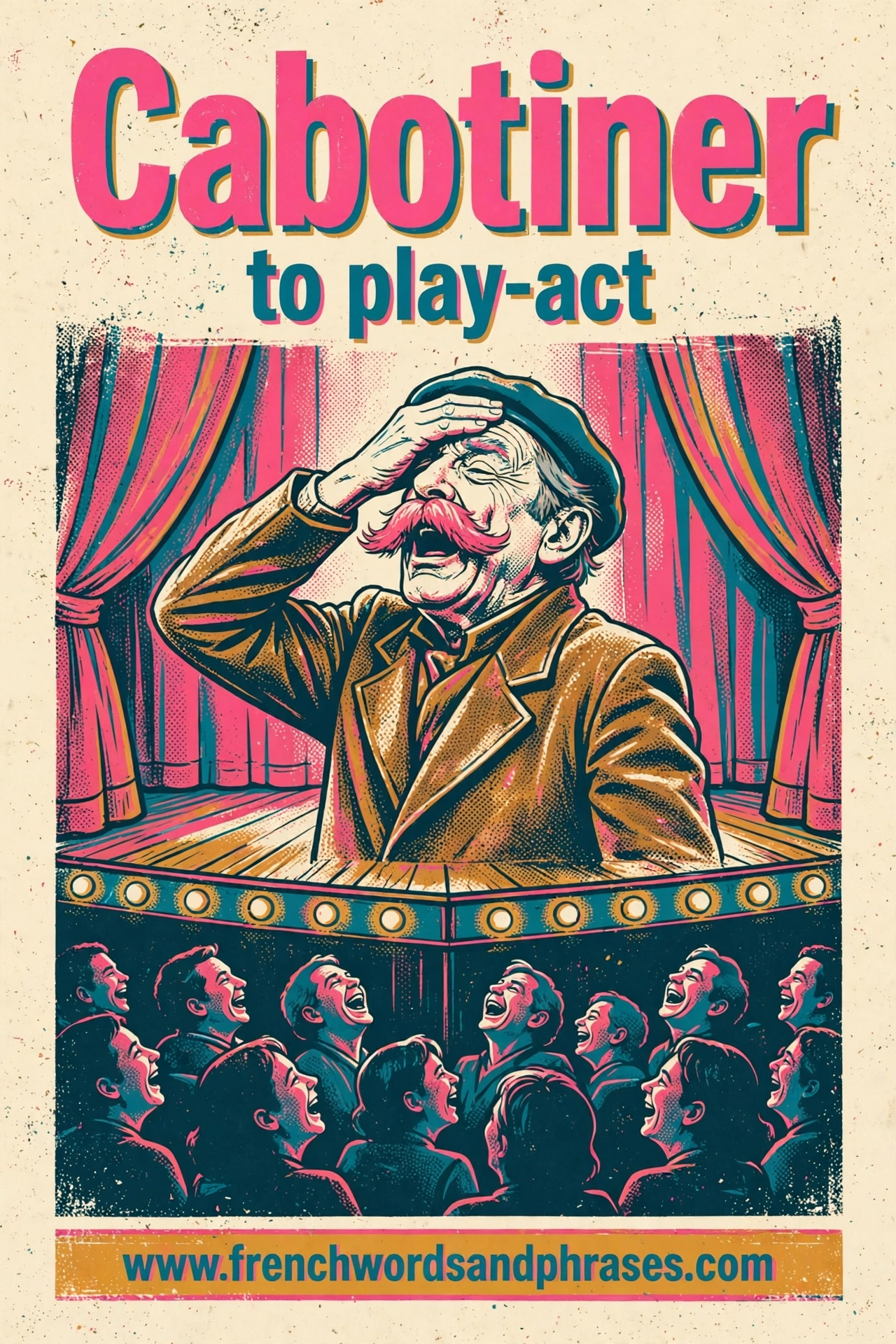
Cabotiner is the verb of too much theatre — every feeling amplified, every gesture aimed at an audience.
Imagine a family dinner. Uncle Bernard has caught a cold — a small cold — but he sighs like a tragic hero, presses a hand to his forehead, and whispers his will. Il cabotine, the whole table knows it, and everyone is laughing too hard to hand him the tissues.
He is not ill and he is not acting in a play. He is play-acting — cabotinant — because an audience of nephews is too good to waste.
How to Conjugate Cabotiner: Complete French Conjugation Guide
Let’s explore every major conjugation of cabotiner, beginning with the indicative mood.
How to Conjugate Cabotiner in the Indicative Mood
The indicative mood is used to express facts, observations, actions, and events.
How to Conjugate Cabotiner in the Present Tense (Présent)
Used for actions happening now, habitual actions, and general truths.
| Subject | Conjugation |
|---|---|
| je | cabotine |
| tu | cabotines |
| il / elle | cabotine |
| nous | cabotinons |
| vous | cabotinez |
| ils / elles | cabotinent |
Example
Cet acteur cabotine au lieu de jouer simplement.
That actor hams it up instead of simply acting.
Quick Quiz 1
Complete the sentence:
Nous ______ un peu quand les caméras arrivent, avouez-le.
Reveal the answer
cabotinons
Nous cabotinons un peu quand les caméras arrivent, avouez-le.
We ham it up a little when the cameras arrive, admit it.
How to Conjugate Cabotiner in the Passé Composé
Used for completed actions in the past. Cabotiner takes the auxiliary verb avoir.
| Subject | Conjugation |
|---|---|
| j’ | ai cabotiné |
| tu | as cabotiné |
| il / elle | a cabotiné |
| nous | avons cabotiné |
| vous | avez cabotiné |
| ils / elles | ont cabotiné |
Example
Il a cabotiné toute la soirée pour impressionner les invités.
He play-acted all evening to impress the guests.
How to Conjugate Cabotiner in the Imparfait (Imperfect Tense)
Used for habitual past actions, descriptions, and ongoing situations in the past.
| Subject | Conjugation |
|---|---|
| je | cabotinais |
| tu | cabotinais |
| il / elle | cabotinait |
| nous | cabotinions |
| vous | cabotiniez |
| ils / elles | cabotinaient |
Example
Enfant, elle cabotinait devant le miroir pendant des heures.
As a child, she used to play-act in front of the mirror for hours.
Quick Quiz 2
Choose the correct form:
She play-acted in front of the mirror.
Elle ______ devant le miroir. (a cabotiné / est cabotinée)
Reveal the answer
a cabotiné
Elle a cabotiné devant le miroir.
Cabotiner takes avoir.
How to Conjugate Cabotiner in the Plus-que-parfait
Used to describe an action that had already been completed before another past event.
| Subject | Conjugation |
|---|---|
| j’ | avais cabotiné |
| tu | avais cabotiné |
| il / elle | avait cabotiné |
| nous | avions cabotiné |
| vous | aviez cabotiné |
| ils / elles | avaient cabotiné |
Example
Il avait cabotiné si souvent que plus personne ne le croyait.
He had play-acted so often that nobody believed him any more.
How to Conjugate Cabotiner in the Passé Simple
Primarily used in formal writing, literature, and historical narratives. It is rarely used in everyday conversation.
| Subject | Conjugation |
|---|---|
| je | cabotinai |
| tu | cabotinas |
| il / elle | cabotina |
| nous | cabotinâmes |
| vous | cabotinâtes |
| ils / elles | cabotinèrent |
Example
Le vieil acteur cabotina une dernière fois avant de quitter la scène.
The old actor hammed it up one last time before leaving the stage.
How to Conjugate Cabotiner in the Passé Antérieur
A literary tense used to express an action completed immediately before another past action, generally in the passé simple.
| Subject | Conjugation |
|---|---|
| j’ | eus cabotiné |
| tu | eus cabotiné |
| il / elle | eut cabotiné |
| nous | eûmes cabotiné |
| vous | eûtes cabotiné |
| ils / elles | eurent cabotiné |
Example
Quand il eut cabotiné assez longtemps, le public commença à rire.
When he had play-acted long enough, the audience began to laugh.
How to Conjugate Cabotiner in the Future Tense (Futur Simple)
Used to describe actions that will take place in the future.
| Subject | Conjugation |
|---|---|
| je | cabotinerai |
| tu | cabotineras |
| il / elle | cabotinera |
| nous | cabotinerons |
| vous | cabotinerez |
| ils / elles | cabotineront |
Example
Si tu continues, tu cabotineras même à ton propre mariage.
If you go on, you will play-act even at your own wedding.
How to Conjugate Cabotiner in the Futur Antérieur (Future Perfect)
Used for an action that will have been completed before a particular point in the future.
| Subject | Conjugation |
|---|---|
| j’ | aurai cabotiné |
| tu | auras cabotiné |
| il / elle | aura cabotiné |
| nous | aurons cabotiné |
| vous | aurez cabotiné |
| ils / elles | auront cabotiné |
Example
À la fin du repas, il aura cabotiné devant toute la famille.
By the end of the meal, he will have play-acted in front of the whole family.
How to Conjugate Cabotiner in the Near Future (Futur Proche)
Used to describe something that is going to happen soon. Formed with aller + infinitive.
| Subject | Conjugation |
|---|---|
| je | vais cabotiner |
| tu | vas cabotiner |
| il / elle | va cabotiner |
| nous | allons cabotiner |
| vous | allez cabotiner |
| ils / elles | vont cabotiner |
Example
Regarde-le, il va encore cabotiner devant les caméras.
Look at him, he is going to play-act in front of the cameras again.
How to Conjugate Cabotiner in the Conditional Mood
The conditional mood expresses what would happen under certain circumstances. It is also frequently used to make polite requests or express wishes.
How to Conjugate Cabotiner in the Present Conditional
| Subject | Conjugation |
|---|---|
| je | cabotinerais |
| tu | cabotinerais |
| il / elle | cabotinerait |
| nous | cabotinerions |
| vous | cabotineriez |
| ils / elles | cabotineraient |
Example
Sans public, il ne cabotinerait pas autant.
Without an audience, he would not ham it up so much.
How to Conjugate Cabotiner in the Past Conditional
| Subject | Conjugation |
|---|---|
| j’ | aurais cabotiné |
| tu | aurais cabotiné |
| il / elle | aurait cabotiné |
| nous | aurions cabotiné |
| vous | auriez cabotiné |
| ils / elles | auraient cabotiné |
Example
Elle aurait cabotiné davantage avec une meilleure salle.
She would have play-acted more with a better audience.
Cabotiner in the Literary Past Conditional Form
This less common literary form uses the imperfect subjunctive of avoir.
| Subject | Conjugation |
|---|---|
| j’ | eusse cabotiné |
| tu | eusses cabotiné |
| il / elle | eût cabotiné |
| nous | eussions cabotiné |
| vous | eussiez cabotiné |
| ils / elles | eussent cabotiné |
Example
Le cabotin eût cabotiné même devant une salle vide.
The ham actor would have play-acted even in front of an empty hall.
How to Conjugate Cabotiner in the Subjunctive Mood
The subjunctive is used to express wishes, emotions, doubts, necessity, and uncertainty. It frequently follows expressions such as il faut que (it is necessary that) or bien que (although).
How to Conjugate Cabotiner in the Present Subjunctive
| Subject | Conjugation |
|---|---|
| que je | cabotine |
| que tu | cabotines |
| qu’il / qu’elle | cabotine |
| que nous | cabotinions |
| que vous | cabotiniez |
| qu’ils / qu’elles | cabotinent |
Example
Je ne supporte pas qu’il cabotine à chaque réunion.
I cannot stand him play-acting at every meeting.
Quick Quiz 3
Complete the sentence using the subjunctive:
Je suis étonné qu’il ______ pendant la cérémonie.
Reveal the answer
ait cabotiné
Je suis étonné qu’il ait cabotiné pendant la cérémonie.
I am amazed he play-acted during the ceremony.
How to Conjugate Cabotiner in the Imperfect Subjunctive
A literary tense, rarely encountered in modern spoken French.
| Subject | Conjugation |
|---|---|
| que je | cabotinasse |
| que tu | cabotinasses |
| qu’il / qu’elle | cabotinât |
| que nous | cabotinassions |
| que vous | cabotinassiez |
| qu’ils / qu’elles | cabotinassent |
Example
On riait, bien qu’il cabotinât sans s’en rendre compte.
People laughed, although he was hamming it up without realising.
How to Conjugate Cabotiner in the Pluperfect Subjunctive
A literary construction used to express an action completed before another past action.
| Subject | Conjugation |
|---|---|
| que j’ | eusse cabotiné |
| que tu | eusses cabotiné |
| qu’il / qu’elle | eût cabotiné |
| que nous | eussions cabotiné |
| que vous | eussiez cabotiné |
| qu’ils / qu’elles | eussent cabotiné |
Example
On racontait qu’elle eût cabotiné devant le roi lui-même.
People said she had play-acted before the king himself.
How to Conjugate Cabotiner in the Past Subjunctive
| Subject | Conjugation |
|---|---|
| que j’ | aie cabotiné |
| que tu | aies cabotiné |
| qu’il / qu’elle | ait cabotiné |
| que nous | ayons cabotiné |
| que vous | ayez cabotiné |
| qu’ils / qu’elles | aient cabotiné |
Example
Je suis étonné qu’il ait cabotiné pendant un enterrement.
I am amazed he play-acted during a funeral.
How to Conjugate Cabotiner in the Imperative
The imperative is used to give commands, instructions, invitations, or suggestions. Subject pronouns are omitted.
How to Conjugate Cabotiner in the Present Imperative
| Person | Conjugation |
|---|---|
| (tu) | cabotine |
| (nous) | cabotinons |
| (vous) | cabotinez |
Example
Ne cabotine pas, dis simplement la vérité !
Do not play-act, just tell the truth!
Quick Quiz 4
How would you say Do not play-act (tu form)?
Reveal the answer
Ne cabotine pas !
French Participles of Cabotiner
Participles are verb forms that can be used in compound tenses and other grammatical constructions.
Present Participle of Cabotiner
cabotinant
En cabotinant ainsi, il a fini par amuser tout le monde.
By hamming it up like that, he ended up amusing everyone.
Past Participle of Cabotiner
cabotiné
Cabotiné devant tant de miroirs, son jeu est devenu une habitude.
Having play-acted in front of so many mirrors, his acting became a habit.
Cabotiner in Everyday French: Real-Life Examples
Now that you know the conjugations, let’s see how cabotiner appears in everyday French.
Example 1 — Present
Cet acteur cabotine au lieu de jouer.
That actor hams it up instead of acting.
Example 2 — Passé composé
Il a cabotiné toute la soirée.
He play-acted all evening.
Example 3 — Imparfait
Elle cabotinait devant le miroir.
She used to play-act in front of the mirror.
Example 4 — Future
Tu cabotineras même à ton mariage.
You will play-act even at your wedding.
Example 5 — Conditional
Il ne cabotinerait pas sans public.
He would not ham it up without an audience.
Example 6 — Imperative
Ne cabotine pas !
Do not play-act!
Beyond Translation: The Meaning of Cabotiner
English ham is the closest cousin — the ham actor — and French cabotiner carries the same fond mockery, inherited from the cabotins, the travelling players of the old fairs.
Every family has one.
The verb survives because the behaviour does: wherever someone turns a headache into a tragedy and a story into a performance, French reaches for cabotiner — half scolding, half laughing.
How to Remember the French Verb Cabotiner
Remember it this way: Cabotiner is about Uncle Bernard turning a small cold into a grand tragedy at the dinner table.
- Le cabotin is the old fairground ham actor: cabotiner is to act like one.
- Arrête de cabotiner ! — the classic laughing reproach: stop play-acting!
- Regular -er with the stem cabotin-: je cabotine, nous cabotinons, past participle cabotiné.
The key idea is Uncle Bernard turning a small cold into a grand tragedy at the dinner table.
Test Your Knowledge of Cabotiner
Let’s see how much you’ve learned. Try answering these questions before revealing the answers.
Question 1
What is a cabotin, the word behind cabotiner?
Reveal the answer
A strolling ham actor of the old fairgrounds — big gestures, small talent.
Question 2
How do you say Stop play-acting! (tu form) in French?
Reveal the answer
Arrête de cabotiner !
Question 3
Translate: He play-acted all evening to impress the guests.
Reveal the answer
Il a cabotiné toute la soirée pour impressionner les invités.
Question 4
What is the past participle of cabotiner?
Reveal the answer
Cabotiné.
Question 5
Complete the sentence:
Je ne supporte pas qu’il ______ à chaque réunion.
Reveal the answer
cabotine
Je ne supporte pas qu’il cabotine à chaque réunion.
I cannot stand him play-acting at every meeting.
Your Final Challenge
Can You Use It?
How would you say this in French?
He has play-acted since childhood, and his family could no longer have dinner without his little theatre.
Reveal the answer
Il cabotine depuis l’enfance, et sa famille ne saurait plus dîner sans son petit théâtre.
He has play-acted since childhood, and his family could no longer have dinner without his little theatre.
A little French. A little curiosity. A richer everyday life.
LEARN FRENCH ONE WORD AT A TIME