
A French Word to Live By
How to Conjugate Cabosser in French
/ka.bɔ.se/
Cabosser means to dent — to knock a bump into metal, a car body, a saucepan or a helmet so that the smooth surface is spoiled.
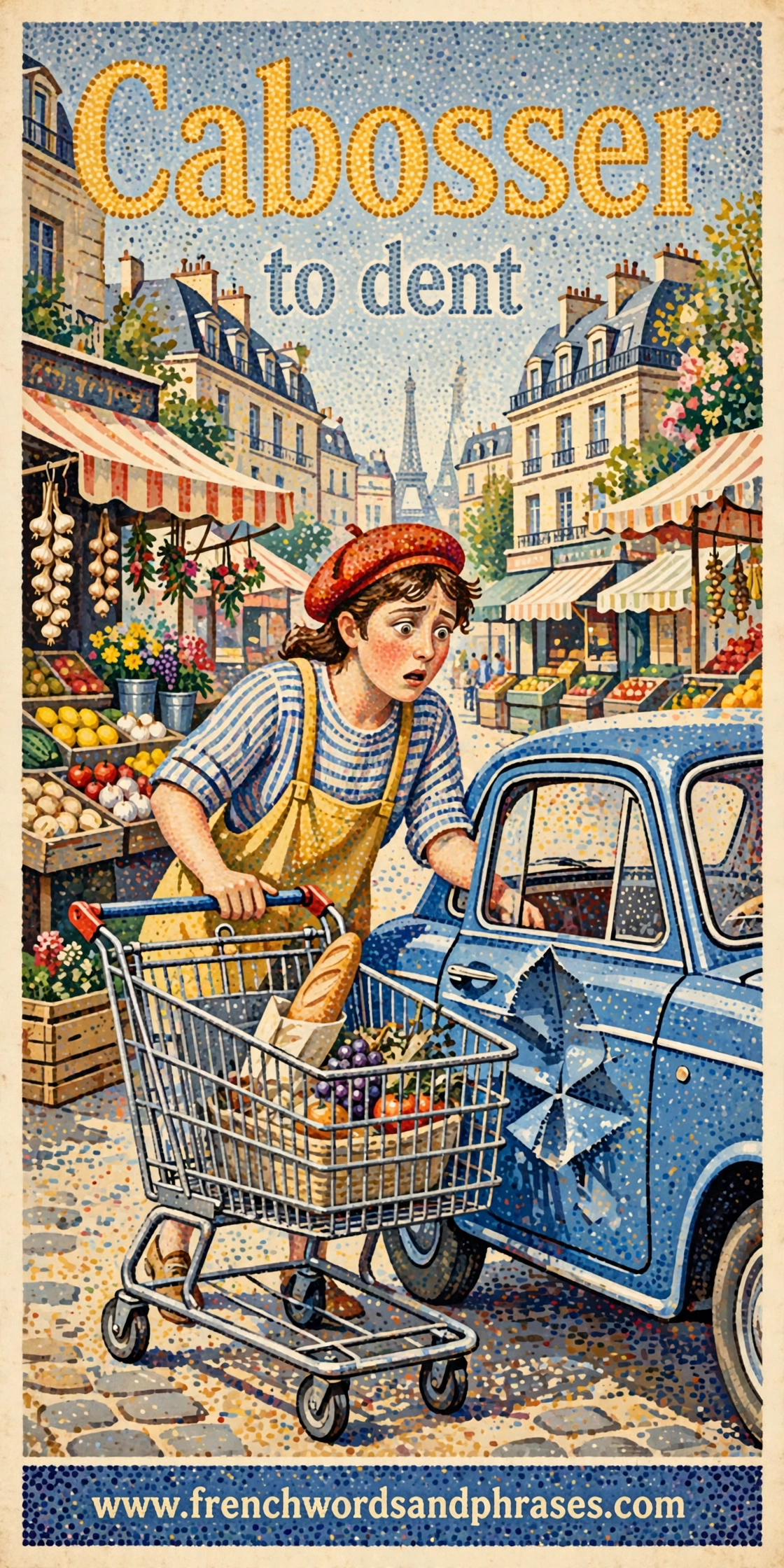
A supermarket trolley meeting a car door, a saucepan dropped on a stone floor — cabosser is the everyday verb of the dent: a small disaster of bent metal that everyone has caused at least once.
In this guide, you’ll learn how to conjugate cabosser in all the major French tenses and moods. Explore complete conjugation tables, French examples, English translations, and practice quizzes.
Understanding the French Verb Cabosser
Cabosser is a regular French verb belonging to the first group of verbs, those ending in-er.
It means to dent. It is the standard verb for dents in metal and hard objects — car bodies, saucepans, helmets, cans and bumpers — and, by extension, for anything battered: an old cabossé hat, a cabossé suitcase. The damage is visible but not fatal: what is cabossé is dented, not destroyed.
Verb classification: First group (-er)
Auxiliary verb: Avoir
Past participle: cabossé
Present participle: cabossant
English equivalents: To dent, to bash in; cabosser une portière — to dent a car door; cabosser une casserole — to dent a saucepan; une aile cabossée — a dented wing; se cabosser la tête (familiar) — to bump one’s head.
One important detail: cabosser is built on la bosse, the bump — to cabosser something is to put a bosse into it the wrong way, a hollow bump in metal. It is perfectly regular: je cabosse, nous cabossons, ils cabossent, past participle cabossé. The adjective cabossé is everywhere in daily life: une voiture cabossée, un casque cabossé — anything battered and knocked out of shape.
Experience the Word
Cabosser is the verb of the small metal disaster — the bump that was not there this morning.
Imagine a car park on a Saturday. A runaway trolley rolls gently, slowly, inevitably — et elle cabosse la portière de la voiture neuve. The owner returns with his shopping, stares at the shiny dent, and sighs the sigh known in every language.
The car still drives perfectly. It has simply been dented — cabossée — and the dent will tell the story for years.
How to Conjugate Cabosser: Complete French Conjugation Guide
Let’s explore every major conjugation of cabosser, beginning with the indicative mood.
How to Conjugate Cabosser in the Indicative Mood
The indicative mood is used to express facts, observations, actions, and events.
How to Conjugate Cabosser in the Present Tense (Présent)
Used for actions happening now, habitual actions, and general truths.
| Subject | Conjugation |
|---|---|
| je | cabosse |
| tu | cabosses |
| il / elle | cabosse |
| nous | cabossons |
| vous | cabossez |
| ils / elles | cabossent |
Example
Les chariots cabossent souvent les portières sur ce parking.
The trolleys often dent the car doors in this car park.
Quick Quiz 1
Complete the sentence:
Les enfants ______ toujours les bidons en jouant au foot.
Reveal the answer
cabossent
Les enfants cabossent toujours les bidons en jouant au foot.
The children always dent the cans playing football.
How to Conjugate Cabosser in the Passé Composé
Used for completed actions in the past. Cabosser takes the auxiliary verb avoir.
| Subject | Conjugation |
|---|---|
| j’ | ai cabossé |
| tu | as cabossé |
| il / elle | a cabossé |
| nous | avons cabossé |
| vous | avez cabossé |
| ils / elles | ont cabossé |
Example
Tu as cabossé ma casserole préférée !
You have dented my favourite saucepan!
How to Conjugate Cabosser in the Imparfait (Imperfect Tense)
Used for habitual past actions, descriptions, and ongoing situations in the past.
| Subject | Conjugation |
|---|---|
| je | cabossais |
| tu | cabossais |
| il / elle | cabossait |
| nous | cabossions |
| vous | cabossiez |
| ils / elles | cabossaient |
Example
Chaque hiver, la grêle cabossait les toits des voitures.
Every winter, the hail used to dent the car roofs.
Quick Quiz 2
Choose the correct form:
The stone dented the helmet.
La pierre ______ le casque. (a cabossé / est cabossée)
Reveal the answer
a cabossé
La pierre a cabossé le casque.
Cabosser takes avoir.
How to Conjugate Cabosser in the Plus-que-parfait
Used to describe an action that had already been completed before another past event.
| Subject | Conjugation |
|---|---|
| j’ | avais cabossé |
| tu | avais cabossé |
| il / elle | avait cabossé |
| nous | avions cabossé |
| vous | aviez cabossé |
| ils / elles | avaient cabossé |
Example
Il avait cabossé l’aile avant même le premier contrôle.
He had dented the wing before even the first inspection.
How to Conjugate Cabosser in the Passé Simple
Primarily used in formal writing, literature, and historical narratives. It is rarely used in everyday conversation.
| Subject | Conjugation |
|---|---|
| je | cabossai |
| tu | cabossas |
| il / elle | cabossa |
| nous | cabossâmes |
| vous | cabossâtes |
| ils / elles | cabossèrent |
Example
La pierre cabossa le casque du cycliste sans le blesser.
The stone dented the cyclist’s helmet without hurting him.
How to Conjugate Cabosser in the Passé Antérieur
A literary tense used to express an action completed immediately before another past action, generally in the passé simple.
| Subject | Conjugation |
|---|---|
| j’ | eus cabossé |
| tu | eus cabossé |
| il / elle | eut cabossé |
| nous | eûmes cabossé |
| vous | eûtes cabossé |
| ils / elles | eurent cabossé |
Example
Quand la branche eut cabossé le toit, l’eau commença à entrer.
When the branch had dented the roof, the water began to come in.
How to Conjugate Cabosser in the Future Tense (Futur Simple)
Used to describe actions that will take place in the future.
| Subject | Conjugation |
|---|---|
| je | cabosserai |
| tu | cabosseras |
| il / elle | cabossera |
| nous | cabosserons |
| vous | cabosserez |
| ils / elles | cabosseront |
Example
Si tu continues, tu cabosseras toute la carrosserie.
If you go on like that, you will dent the whole bodywork.
How to Conjugate Cabosser in the Futur Antérieur (Future Perfect)
Used for an action that will have been completed before a particular point in the future.
| Subject | Conjugation |
|---|---|
| j’ | aurai cabossé |
| tu | auras cabossé |
| il / elle | aura cabossé |
| nous | aurons cabossé |
| vous | aurez cabossé |
| ils / elles | auront cabossé |
Example
À la fin du déménagement, ils auront cabossé la moitié des meubles.
By the end of the move, they will have dented half the furniture.
How to Conjugate Cabosser in the Near Future (Futur Proche)
Used to describe something that is going to happen soon. Formed with aller + infinitive.
| Subject | Conjugation |
|---|---|
| je | vais cabosser |
| tu | vas cabosser |
| il / elle | va cabosser |
| nous | allons cabosser |
| vous | allez cabosser |
| ils / elles | vont cabosser |
Example
Attention, tu vas cabosser la portière !
Careful, you are going to dent the door!
How to Conjugate Cabosser in the Conditional Mood
The conditional mood expresses what would happen under certain circumstances. It is also frequently used to make polite requests or express wishes.
How to Conjugate Cabosser in the Present Conditional
| Subject | Conjugation |
|---|---|
| je | cabosserais |
| tu | cabosserais |
| il / elle | cabosserait |
| nous | cabosserions |
| vous | cabosseriez |
| ils / elles | cabosseraient |
Example
Un seul coup de marteau cabosserait cette tôle fine.
A single hammer blow would dent this thin sheet metal.
How to Conjugate Cabosser in the Past Conditional
| Subject | Conjugation |
|---|---|
| j’ | aurais cabossé |
| tu | aurais cabossé |
| il / elle | aurait cabossé |
| nous | aurions cabossé |
| vous | auriez cabossé |
| ils / elles | auraient cabossé |
Example
La grêle aurait cabossé la voiture sans le garage.
The hail would have dented the car without the garage.
Cabosser in the Literary Past Conditional Form
This less common literary form uses the imperfect subjunctive of avoir.
| Subject | Conjugation |
|---|---|
| j’ | eusse cabossé |
| tu | eusses cabossé |
| il / elle | eût cabossé |
| nous | eussions cabossé |
| vous | eussiez cabossé |
| ils / elles | eussent cabossé |
Example
La pierre eût cabossé le casque sans le blesser.
The stone would have dented the helmet without hurting him.
How to Conjugate Cabosser in the Subjunctive Mood
The subjunctive is used to express wishes, emotions, doubts, necessity, and uncertainty. It frequently follows expressions such as il faut que (it is necessary that) or bien que (although).
How to Conjugate Cabosser in the Present Subjunctive
| Subject | Conjugation |
|---|---|
| que je | cabosse |
| que tu | cabosses |
| qu’il / qu’elle | cabosse |
| que nous | cabossions |
| que vous | cabossiez |
| qu’ils / qu’elles | cabossent |
Example
Je ne veux pas que tu cabosses la nouvelle casserole.
I do not want you to dent the new saucepan.
Quick Quiz 3
Complete the sentence using the subjunctive:
Je regrette que la grêle ______ ton vélo.
Reveal the answer
ait cabossé
Je regrette que la grêle ait cabossé ton vélo.
I am sorry the hail dented your bike.
How to Conjugate Cabosser in the Imperfect Subjunctive
A literary tense, rarely encountered in modern spoken French.
| Subject | Conjugation |
|---|---|
| que je | cabossasse |
| que tu | cabossasses |
| qu’il / qu’elle | cabossât |
| que nous | cabossassions |
| que vous | cabossassiez |
| qu’ils / qu’elles | cabossassent |
Example
Il fallait éviter que les valises cabossassent les instruments.
They had to stop the suitcases denting the instruments.
How to Conjugate Cabosser in the Pluperfect Subjunctive
A literary construction used to express an action completed before another past action.
| Subject | Conjugation |
|---|---|
| que j’ | eusse cabossé |
| que tu | eusses cabossé |
| qu’il / qu’elle | eût cabossé |
| que nous | eussions cabossé |
| que vous | eussiez cabossé |
| qu’ils / qu’elles | eussent cabossé |
Example
On voyait bien que la chute eût cabossé le bidon.
You could see the fall had dented the can.
How to Conjugate Cabosser in the Past Subjunctive
| Subject | Conjugation |
|---|---|
| que j’ | aie cabossé |
| que tu | aies cabossé |
| qu’il / qu’elle | ait cabossé |
| que nous | ayons cabossé |
| que vous | ayez cabossé |
| qu’ils / qu’elles | aient cabossé |
Example
Je regrette que la grêle ait cabossé ton vélo.
I am sorry the hail dented your bike.
How to Conjugate Cabosser in the Imperative
The imperative is used to give commands, instructions, invitations, or suggestions. Subject pronouns are omitted.
How to Conjugate Cabosser in the Present Imperative
| Person | Conjugation |
|---|---|
| (tu) | cabosse |
| (nous) | cabossons |
| (vous) | cabossez |
Example
Ne cabossez pas les casseroles en les rangeant !
Do not dent the saucepans when you put them away!
Quick Quiz 4
How would you say Do not dent the saucepans (vous form)?
Reveal the answer
Ne cabossez pas les casseroles !
French Participles of Cabosser
Participles are verb forms that can be used in compound tenses and other grammatical constructions.
Present Participle of Cabosser
cabossant
En cabossant le toit, la branche a fait un bruit terrible.
In denting the roof, the branch made a terrible noise.
Past Participle of Cabosser
cabossé
Cabossée de partout, la vieille voiture roule encore très bien.
Dented all over, the old car still runs very well.
Cabosser in Everyday French: Real-Life Examples
Now that you know the conjugations, let’s see how cabosser appears in everyday French.
Example 1 — Present
Les chariots cabossent les portières.
The trolleys dent the car doors.
Example 2 — Passé composé
Tu as cabossé ma casserole !
You have dented my saucepan!
Example 3 — Imparfait
La grêle cabossait les toits des voitures.
The hail used to dent the car roofs.
Example 4 — Future
Tu cabosseras la carrosserie si tu continues.
You will dent the bodywork if you go on.
Example 5 — Conditional
Un seul coup cabosserait cette tôle.
A single blow would dent this sheet metal.
Example 6 — Imperative
Ne cabossez pas les casseroles !
Do not dent the saucepans!
Beyond Translation: The Meaning of Cabosser
English dent is plain and practical; French cabosser hides a bump inside it — la bosse is the bump you raise on your head, and a dent is its mirror image in metal.
Every French driver knows the adjective.
Une voiture cabossée is not a wreck — it is a car with a history, and the verb cabosser belongs to that same honest scale of damage: annoying, visible, and entirely survivable.
How to Remember the French Verb Cabosser
Remember it this way: Cabosser is about the runaway trolley and the shiny new dent in the car door.
- La bosse is a bump: cabosser is to knock a hollow bump into metal — to dent it.
- The adjective cabossé describes every battered car, helmet and suitcase in France.
- Regular -er: je cabosse, nous cabossons, past participle cabossé.
The key idea is the runaway trolley and the shiny new dent in the car door.
Test Your Knowledge of Cabosser
Let’s see how much you’ve learned. Try answering these questions before revealing the answers.
Question 1
What French noun hides inside cabosser?
Reveal the answer
La bosse — a bump; to dent is to knock a hollow bump into something.
Question 2
How do you say You have dented my favourite saucepan in French?
Reveal the answer
Tu as cabossé ma casserole préférée !
Question 3
Translate: The hail dented the car roofs.
Reveal the answer
La grêle a cabossé les toits des voitures.
Question 4
What is the past participle of cabosser?
Reveal the answer
Cabossé.
Question 5
Complete the sentence:
Je ne veux pas que tu ______ la nouvelle casserole.
Reveal the answer
cabosses
Je ne veux pas que tu cabosses la nouvelle casserole.
I do not want you to dent the new saucepan.
Your Final Challenge
Can You Use It?
How would you say this in French?
The old car, dented all over, tells the story of twenty years of car parks, hail and journeys.
Reveal the answer
La vieille voiture, cabossée de partout, raconte vingt ans de parkings, de grêle et de voyages.
The old car, dented all over, tells the story of twenty years of car parks, hail and journeys.
A little French. A little curiosity. A richer everyday life.
LEARN FRENCH ONE WORD AT A TIME




