A French Word to Live By
How to Conjugate Aller in French
Pronunciation: /a.le/
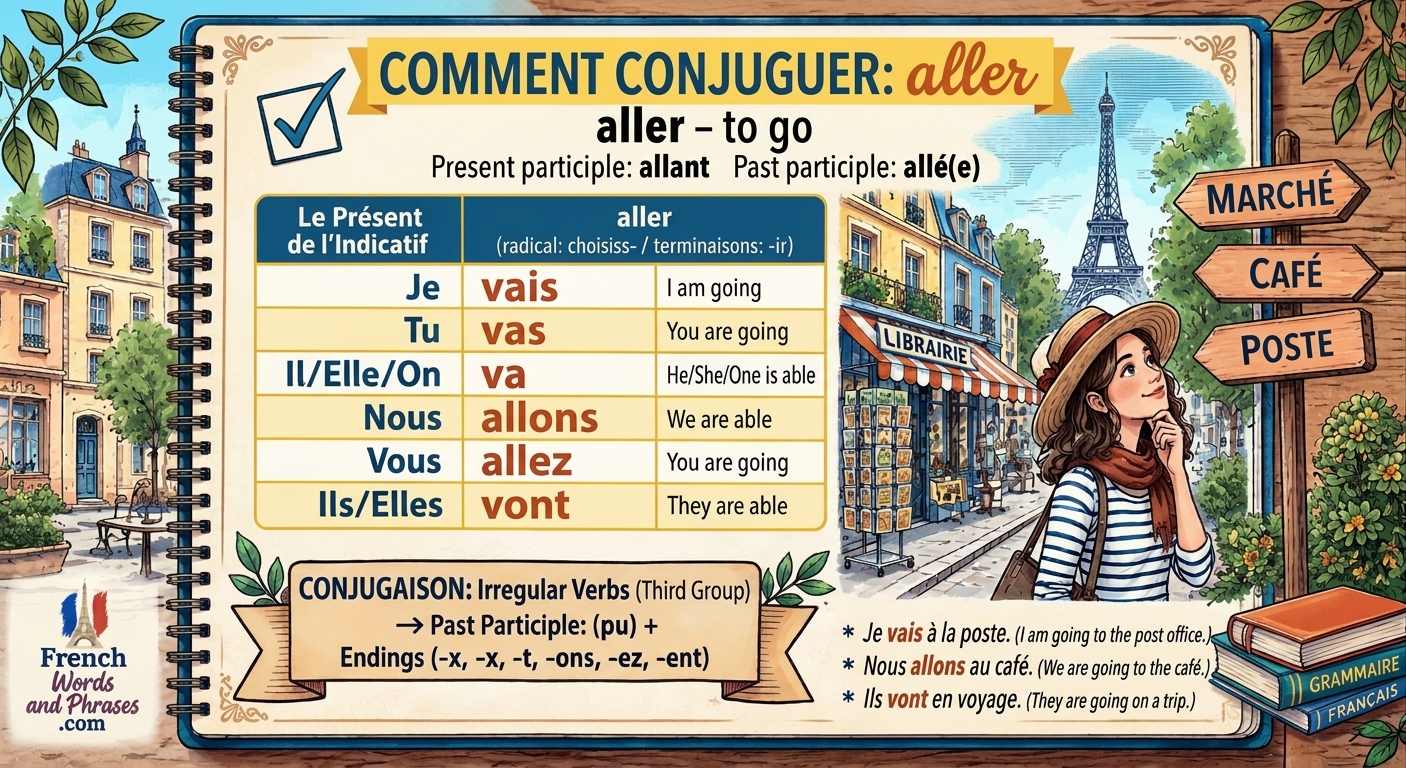
Aller means “to go” in English.
Few French verbs are as useful as aller. Whether you’re going to work, visiting a friend, exploring a new city, or simply describing where you’re headed, this little verb is everywhere. It is also one of the most irregular verbs in French, with forms that change considerably from one tense to another.
In this guide, you’ll learn how to conjugate aller in all the major French tenses and moods, understand how it works, and see how French speakers use it in everyday conversation.
Understanding the French Verb Aller
- Infinitive: aller
- English meaning: to go
- Verb group: Third group (irregular verb)
- Auxiliary verb: être
- Past participle: allé
- Present participle: allant
Aller is highly irregular. Its present-tense forms do not follow the usual patterns of regular -er verbs, despite ending in -er. In compound tenses, it uses être rather than avoir.
Because aller uses être as its auxiliary, its past participle agrees with the subject:
- Il est allé. — He went.
- Elle est allée. — She went.
- Ils sont allés. — They went (masculine or mixed group).
- Elles sont allées. — They went (feminine group).
Experience the Word
Imagine someone asking where you’re going. In French, the question is simple:
Où vas-tu ? — Where are you going?
And the answer might be:
Je vais au marché. — I’m going to the market.
That single verb, aller, helps you talk about movement, plans, destinations, and even the future.
Indicative Mood (Indicatif)
The indicative mood is used to describe facts, actions, and events. Here are the major indicative conjugations of aller.
Présent (Present)
Used for actions happening now, habitual actions, and general statements.
| French | English |
|---|---|
| je vais | I go / I am going |
| tu vas | you go / you are going |
| il va / elle va | he goes / she goes |
| nous allons | we go / we are going |
| vous allez | you go / you are going |
| ils vont / elles vont | they go / they are going |
Passé composé (Past)
Used for completed actions in the past. It is formed with the present tense of être and the past participle allé.
| French | English |
|---|---|
| je suis allé / je suis allée | I went |
| tu es allé / tu es allée | you went |
| il est allé / elle est allée | he went / she went |
| nous sommes allés / nous sommes allées | we went |
| vous êtes allés / vous êtes allées / vous êtes allé / vous êtes allée | you went |
| ils sont allés / elles sont allées | they went |
Imparfait (Imperfect)
Used for ongoing, repeated, or habitual actions in the past.
| French | English |
|---|---|
| j’allais | I was going / I used to go |
| tu allais | you were going / you used to go |
| il allait / elle allait | he was going / she was going |
| nous allions | we were going / we used to go |
| vous alliez | you were going / you used to go |
| ils allaient / elles allaient | they were going / they used to go |
Plus-que-parfait (Pluperfect)
Used to describe an action that had already happened before another past event.
| French | English |
|---|---|
| j’étais allé / j’étais allée | I had gone |
| tu étais allé / tu étais allée | you had gone |
| il était allé / elle était allée | he had gone / she had gone |
| nous étions allés / nous étions allées | we had gone |
| vous étiez allés / vous étiez allées / vous étiez allé / vous étiez allée | you had gone |
| ils étaient allés / elles étaient allées | they had gone |
Passé simple (Simple Past)
Primarily used in formal writing, literature, and historical narration.
| French | English |
|---|---|
| j’allai | I went |
| tu allas | you went |
| il alla / elle alla | he went / she went |
| nous allâmes | we went |
| vous allâtes | you went |
| ils allèrent / elles allèrent | they went |
Passé antérieur (Anterior Past)
A literary tense used to describe an action completed immediately before another past action, usually alongside the passé simple.
| French | English |
|---|---|
| je fus allé / je fus allée | I had gone |
| tu fus allé / tu fus allée | you had gone |
| il fut allé / elle fut allée | he had gone / she had gone |
| nous fûmes allés / nous fûmes allées | we had gone |
| vous fûtes allés / vous fûtes allées / vous fûtes allé / vous fûtes allée | you had gone |
| ils furent allés / elles furent allées | they had gone |
Futur (Future)
Used to describe actions that will happen in the future.
| French | English |
|---|---|
| j’irai | I will go |
| tu iras | you will go |
| il ira / elle ira | he will go / she will go |
| nous irons | we will go |
| vous irez | you will go |
| ils iront / elles iront | they will go |
Futur antérieur (Future Perfect)
Used for an action that will have been completed before a particular point in the future.
| French | English |
|---|---|
| je serai allé / je serai allée | I will have gone |
| tu seras allé / tu seras allée | you will have gone |
| il sera allé / elle sera allée | he will have gone / she will have gone |
| nous serons allés / nous serons allées | we will have gone |
| vous serez allés / vous serez allées / vous serez allé / vous serez allée | you will have gone |
| ils seront allés / elles seront allées | they will have gone |
Futur proche (Near Future)
Used to describe something that is going to happen soon. It is formed with the present tense of aller followed by an infinitive.
| French | English |
|---|---|
| je vais aller | I am going to go |
| tu vas aller | you are going to go |
| il va aller / elle va aller | he is going to go / she is going to go |
| nous allons aller | we are going to go |
| vous allez aller | you are going to go |
| ils vont aller / elles vont aller | they are going to go |
Conditional Mood (Conditionnel)
The conditional mood is used to express hypothetical situations, wishes, possibilities, and polite requests.
Présent (Present)
| French | English |
|---|---|
| j’irais | I would go |
| tu irais | you would go |
| il irait / elle irait | he would go / she would go |
| nous irions | we would go |
| vous iriez | you would go |
| ils iraient / elles iraient | they would go |
Passé (Past)
Used to describe something that would have happened under different circumstances.
| French | English |
|---|---|
| je serais allé / je serais allée | I would have gone |
| tu serais allé / tu serais allée | you would have gone |
| il serait allé / elle serait allée | he would have gone / she would have gone |
| nous serions allés / nous serions allées | we would have gone |
| vous seriez allés / vous seriez allées / vous seriez allé / vous seriez allée | you would have gone |
| ils seraient allés / elles seraient allées | they would have gone |
Passé – Forme alternative (Literary Alternative)
A rare literary form of the conditional past, constructed with the imperfect subjunctive of être and the past participle.
| French | English |
|---|---|
| je fusse allé / je fusse allée | I would have gone |
| tu fusses allé / tu fusses allée | you would have gone |
| il fût allé / elle fût allée | he would have gone / she would have gone |
| nous fussions allés / nous fussions allées | we would have gone |
| vous fussiez allés / vous fussiez allées / vous fussiez allé / vous fussiez allée | you would have gone |
| ils fussent allés / elles fussent allées | they would have gone |
Subjunctive Mood (Subjonctif)
The subjunctive is used after certain expressions of emotion, necessity, doubt, desire, and uncertainty.
Présent (Present)
| French | English |
|---|---|
| que j’aille | that I go |
| que tu ailles | that you go |
| qu’il aille / qu’elle aille | that he go / that she go |
| que nous allions | that we go |
| que vous alliez | that you go |
| qu’ils aillent / qu’elles aillent | that they go |
Imparfait (Imperfect)
A literary tense rarely used in everyday spoken French.
| French | English |
|---|---|
| que j’allasse | that I went |
| que tu allasses | that you went |
| qu’il allât / qu’elle allât | that he went / that she went |
| que nous allassions | that we went |
| que vous allassiez | that you went |
| qu’ils allassent / qu’elles allassent | that they went |
Plus-que-parfait (Pluperfect)
A literary tense used to express an action that had already happened before another past action.
| French | English |
|---|---|
| que je fusse allé / que je fusse allée | that I had gone |
| que tu fusses allé / que tu fusses allée | that you had gone |
| qu’il fût allé / qu’elle fût allée | that he had gone / that she had gone |
| que nous fussions allés / que nous fussions allées | that we had gone |
| que vous fussiez allés / que vous fussiez allées / que vous fussiez allé / que vous fussiez allée | that you had gone |
| qu’ils fussent allés / qu’elles fussent allées | that they had gone |
Passé (Past)
Used to describe a completed action that is connected to the present or to another action.
| French | English |
|---|---|
| que je sois allé / que je sois allée | that I went / have gone |
| que tu sois allé / que tu sois allée | that you went / have gone |
| qu’il soit allé / qu’elle soit allée | that he went / that she went |
| que nous soyons allés / que nous soyons allées | that we went / have gone |
| que vous soyez allés / que vous soyez allées / que vous soyez allé / que vous soyez allée | that you went / have gone |
| qu’ils soient allés / qu’elles soient allées | that they went / have gone |
Imperative Mood (Impératif)
The imperative is used to give commands, instructions, or advice. It has three forms and does not include a subject pronoun.
Présent (Present)
| French | English |
|---|---|
| va | go (informal singular) |
| allons | let’s go |
| allez | go (formal or plural) |
Remember: The imperative is normally va, but the final -s returns before y in the expression vas-y (go ahead / go there).
Participles (Participe)
Présent (Present Participle)
| French | English |
|---|---|
| allant | going |
Passé (Past Participle)
| French | English |
|---|---|
| allé | gone (masculine singular) |
| allés | gone (masculine or mixed plural) |
| allée | gone (feminine singular) |
| allées | gone (feminine plural) |
Aller in Everyday French
Here are some common expressions and sentences using aller:
- Ça va ? — How are you?
- Ça va bien. — I’m doing well.
- Je vais bien, merci. — I’m doing well, thank you.
- On y va ! — Let’s go!
- J’y vais. — I’m going there / I’m off.
- Comment allez-vous ? — How are you? (formal)
- Je vais au travail. — I’m going to work.
- Nous allons partir. — We are going to leave.
- Tout va bien. — Everything is going well.
- Vas-y ! — Go ahead!
Beyond Translation
Aller is much more than a verb of movement. It is central to several everyday French expressions.
One of its most important uses is forming the futur proche. French speakers commonly use the present tense of aller followed by an infinitive to talk about what is going to happen:
- Je vais manger. — I’m going to eat.
- Elle va travailler. — She is going to work.
- Nous allons voyager. — We are going to travel.
The expression ça va is also one of the most familiar phrases in French. Depending on the context, it can mean “How are you?”, “I’m fine,” or “It’s going well.”
How to Remember the Conjugation of Aller
Because aller is irregular, memorizing its forms is especially important. Start with the present tense:
- je vais
- tu vas
- il va
- nous allons
- vous allez
- ils vont
Notice that the verb uses several different stems: v-, all-, and vont. The future and conditional use another stem: ir-.
Remember these key forms:
- Present: vais, vas, va, allons, allez, vont
- Future: irai, iras, ira, irons, irez, iront
- Past participle: allé
- Present participle: allant
Practice them in short sentences. For example, say where you are going today, where you went yesterday, and where you will go tomorrow.
Test Your Knowledge
Choose the correct form of aller for each sentence. Open each answer to check your understanding.
1. Je _____ au cinéma ce soir. (I am going to the cinema tonight.)
Answer: vais
Je vais au cinéma ce soir.
2. Hier, nous _____ au restaurant. (Yesterday, we went to the restaurant.)
Answer: sommes allés / sommes allées
Nous sommes allés au restaurant. Use allées for an entirely feminine group.
3. Demain, elle _____ à Paris. (Tomorrow, she will go to Paris.)
Answer: ira
Demain, elle ira à Paris.
4. Quand j’étais petit, j’_____ souvent chez mes grands-parents. (When I was little, I often used to go to my grandparents’ house.)
Answer: allais
Quand j’étais petit, j’allais souvent chez mes grands-parents.
5. Il faut que tu _____ chez le médecin. (You need to go to the doctor.)
Answer: ailles
Il faut que tu ailles chez le médecin.
Your Final Challenge
Try translating these sentences into French using the correct form of aller:
- I am going home.
- We went to the beach yesterday.
- They will go to school tomorrow.
- She is going to study tonight.
- Let’s go!
Reveal the suggested answers
- Je vais à la maison. / Je rentre chez moi.
- Nous sommes allés à la plage hier. (Allées for an entirely feminine group.)
- Ils iront à l’école demain. / Elles iront à l’école demain.
- Elle va étudier ce soir.
- Allons-y !
A little French. A little curiosity. A richer everyday life.
LEARN FRENCH ONE WORD AT A TIME.