A French Word to Live By
How to Conjugate Voir in French
Pronunciation: /vwaʁ/
Voir means “to see” in English.
Seeing is such a natural part of everyday life that it’s no surprise the French verb voir is used constantly. You see a friend, notice something interesting, watch the world go by, or imagine what the future might bring. From simple observations to familiar expressions, voir is an essential French verb.
In this guide, you’ll learn how to conjugate voir in the major French tenses and moods, understand its irregular forms, and discover how French speakers use it in everyday conversation.
Understanding the French Verb Voir
- Infinitive: voir
- English meaning: to see
- Verb group: Third group (irregular -oir verb)
- Auxiliary verb: avoir
- Past participle: vu
- Present participle: voyant
Voir is an irregular verb. Its present-tense forms have a distinctive pattern, and its future and conditional forms use the stem verr-.
Unlike aller, voir uses avoir as its auxiliary in compound tenses:
- J’ai vu le film. — I saw the film.
- Tu as vu Marie. — You saw Marie.
- Nous avons vu la mer. — We saw the sea.
The past participle vu normally remains unchanged when used with avoir, unless a preceding direct object requires agreement.
Experience the Word
Imagine meeting a friend and asking whether they saw a particular film:
Tu as vu ce film ? — Did you see that film?
Or perhaps you’re pointing out something beautiful:
Tu vois cette montagne ? — Do you see that mountain?
With voir, you can describe what you see, what you have seen, and what you hope to see.
Indicative Mood (Indicatif)
The indicative mood is used to describe facts, observations, and events. Here are the major indicative conjugations of voir.
Présent (Present)
Used for actions happening now, habitual actions, and general statements.
| French | English |
|---|---|
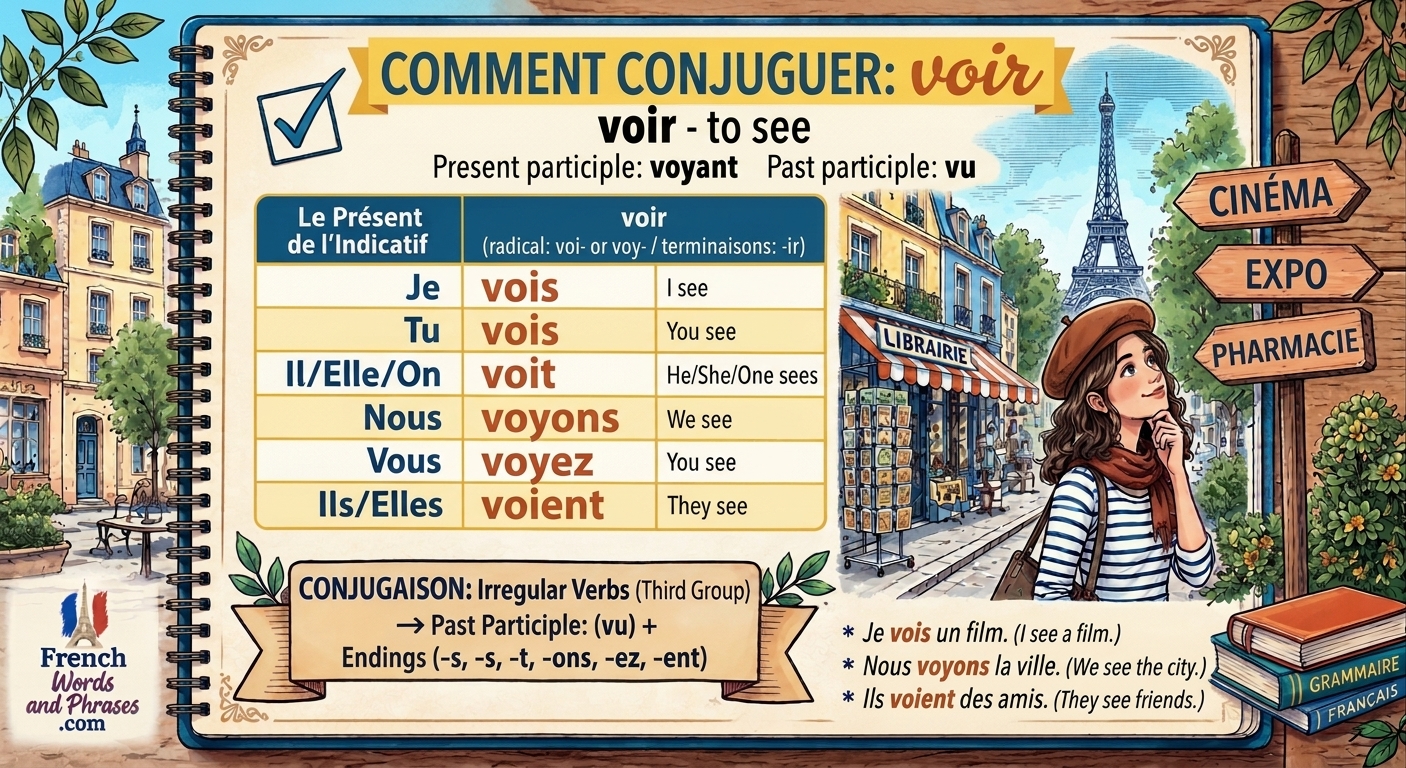
| je vois | I see / I am seeing |
| tu vois | you see / you are seeing |
| il voit / elle voit | he sees / she sees |
| nous voyons | we see / we are seeing |
| vous voyez | you see / you are seeing |
| ils voient / elles voient | they see / they are seeing |
Passé composé (Past)
Used for completed actions in the past. It is formed with the present tense of avoir and the past participle vu.
| French | English |
|---|---|
| j’ai vu | I saw / I have seen |
| tu as vu | you saw / you have seen |
| il a vu / elle a vu | he saw / she saw |
| nous avons vu | we saw / we have seen |
| vous avez vu | you saw / you have seen |
| ils ont vu / elles ont vu | they saw / they have seen |
Imparfait (Imperfect)
Used for ongoing, repeated, or habitual actions in the past.
| French | English |
|---|---|
| je voyais | I was seeing / I used to see |
| tu voyais | you were seeing / you used to see |
| il voyait / elle voyait | he was seeing / she was seeing |
| nous voyions | we were seeing / we used to see |
| vous voyiez | you were seeing / you used to see |
| ils voyaient / elles voyaient | they were seeing / they used to see |
Plus-que-parfait (Pluperfect)
Used to describe an action that had already happened before another past event.
| French | English |
|---|---|
| j’avais vu | I had seen |
| tu avais vu | you had seen |
| il avait vu / elle avait vu | he had seen / she had seen |
| nous avions vu | we had seen |
| vous aviez vu | you had seen |
| ils avaient vu / elles avaient vu | they had seen |
Passé simple (Simple Past)
Primarily used in formal writing, literature, and historical narration.
| French | English |
|---|---|
| je vis | I saw |
| tu vis | you saw |
| il vit / elle vit | he saw / she saw |
| nous vîmes | we saw |
| vous vîtes | you saw |
| ils virent / elles virent | they saw |
Passé antérieur (Anterior Past)
A literary tense used to describe an action completed immediately before another past action, usually alongside the passé simple.
| French | English |
|---|---|
| j’eus vu | I had seen |
| tu eus vu | you had seen |
| il eut vu / elle eut vu | he had seen / she had seen |
| nous eûmes vu | we had seen |
| vous eûtes vu | you had seen |
| ils eurent vu / elles eurent vu | they had seen |
Futur (Future)
Used to describe actions that will happen in the future.
| French | English |
|---|---|
| je verrai | I will see |
| tu verras | you will see |
| il verra / elle verra | he will see / she will see |
| nous verrons | we will see |
| vous verrez | you will see |
| ils verront / elles verront | they will see |
Futur antérieur (Future Perfect)
Used for an action that will have been completed before a particular point in the future.
| French | English |
|---|---|
| j’aurai vu | I will have seen |
| tu auras vu | you will have seen |
| il aura vu / elle aura vu | he will have seen / she will have seen |
| nous aurons vu | we will have seen |
| vous aurez vu | you will have seen |
| ils auront vu / elles auront vu | they will have seen |
Futur proche (Near Future)
Used to describe something that is going to happen soon. It is formed with the present tense of aller followed by an infinitive.
| French | English |
|---|---|
| je vais voir | I am going to see |
| tu vas voir | you are going to see |
| il va voir / elle va voir | he is going to see / she is going to see |
| nous allons voir | we are going to see |
| vous allez voir | you are going to see |
| ils vont voir / elles vont voir | they are going to see |
Conditional Mood (Conditionnel)
The conditional mood is used to express hypothetical situations, wishes, possibilities, and polite requests.
Présent (Present)
| French | English |
|---|---|
| je verrais | I would see |
| tu verrais | you would see |
| il verrait / elle verrait | he would see / she would see |
| nous verrions | we would see |
| vous verriez | you would see |
| ils verraient / elles verraient | they would see |
Passé (Past)
Used to describe something that would have happened under different circumstances.
| French | English |
|---|---|
| j’aurais vu | I would have seen |
| tu aurais vu | you would have seen |
| il aurait vu / elle aurait vu | he would have seen / she would have seen |
| nous aurions vu | we would have seen |
| vous auriez vu | you would have seen |
| ils auraient vu / elles auraient vu | they would have seen |
Passé – Forme alternative (Literary Alternative)
A rare literary form of the conditional past, constructed with the imperfect subjunctive of avoir and the past participle.
| French | English |
|---|---|
| j’eusse vu | I would have seen |
| tu eusses vu | you would have seen |
| il eût vu / elle eût vu | he would have seen / she would have seen |
| nous eussions vu | we would have seen |
| vous eussiez vu | you would have seen |
| ils eussent vu / elles eussent vu | they would have seen |
Subjunctive Mood (Subjonctif)
The subjunctive is used after certain expressions of emotion, necessity, doubt, desire, and uncertainty.
Présent (Present)
| French | English |
|---|---|
| que je voie | that I see |
| que tu voies | that you see |
| qu’il voie / qu’elle voie | that he see / that she see |
| que nous voyions | that we see |
| que vous voyiez | that you see |
| qu’ils voient / qu’elles voient | that they see |
Imparfait (Imperfect)
A literary tense rarely used in everyday spoken French.
| French | English |
|---|---|
| que je visse | that I saw |
| que tu visses | that you saw |
| qu’il vît / qu’elle vît | that he saw / that she saw |
| que nous vissions | that we saw |
| que vous vissiez | that you saw |
| qu’ils vissent / qu’elles vissent | that they saw |
Plus-que-parfait (Pluperfect)
A literary tense used to express an action that had already happened before another past action.
| French | English |
|---|---|
| que j’eusse vu | that I had seen |
| que tu eusses vu | that you had seen |
| qu’il eût vu / qu’elle eût vu | that he had seen / that she had seen |
| que nous eussions vu | that we had seen |
| que vous eussiez vu | that you had seen |
| qu’ils eussent vu / qu’elles eussent vu | that they had seen |
Passé (Past)
Used to describe a completed action that is connected to the present or to another action.
| French | English |
|---|---|
| que j’aie vu | that I saw / have seen |
| que tu aies vu | that you saw / have seen |
| qu’il ait vu / qu’elle ait vu | that he saw / that she saw |
| que nous ayons vu | that we saw / have seen |
| que vous ayez vu | that you saw / have seen |
| qu’ils aient vu / qu’elles aient vu | that they saw / have seen |
Imperative Mood (Impératif)
The imperative is used to give commands, instructions, or advice. It has three forms and does not include a subject pronoun.
Présent (Present)
| French | English |
|---|---|
| vois | see (informal singular) |
| voyons | let’s see |
| voyez | see (formal or plural) |
In everyday French, voyons is also commonly used to express surprise, impatience, or encouragement, much like “come on” or “let’s see.”
Participles (Participe)
Présent (Present Participle)
| French | English |
|---|---|
| voyant | seeing |
Passé (Past Participle)
| French | English |
|---|---|
| vu | seen (masculine singular) |
| vus | seen (masculine or mixed plural) |
| vue | seen (feminine singular) |
| vues | seen (feminine plural) |
Important: With the auxiliary avoir, the past participle usually does not agree with the subject. It agrees with a preceding direct object when one is present. For example: Les photos que j’ai vues — The photos that I saw.
Voir in Everyday French
Here are some common expressions and sentences using voir:
- Tu vois ? — You see? / Do you understand?
- Je vois. — I see.
- À bientôt ! À plus tard ! — See you soon! See you later!
- On verra. — We’ll see.
- Je ne vois pas. — I don’t see.
- Tu as vu ça ? — Did you see that?
- Je voudrais voir ce livre. — I would like to see this book.
- Nous verrons demain. — We will see tomorrow.
- Ça se voit. — It shows. / It’s obvious.
- Il faut voir. — We’ll have to see.
Beyond Translation
Voir means “to see,” but French speakers use it in several ways beyond the literal act of seeing.
For example, je vois can mean “I understand.” When someone explains an idea and you respond Je vois, you’re saying that you understand what they mean.
It’s also useful to distinguish voir from regarder:
- Voir: to see or notice something.
- Regarder: to look at something or watch something intentionally.
Compare these examples:
- Je vois un oiseau. — I see a bird.
- Je regarde un film. — I’m watching a film.
You might also hear on verra, a wonderfully useful expression meaning “we’ll see.” It can express uncertainty, possibility, or a decision that will be made later.
How to Remember the Conjugation of Voir
Because voir is irregular, it helps to memorize its most important forms first.
Start with the present tense:
- je vois
- tu vois
- il voit
- nous voyons
- vous voyez
- ils voient
Then remember the important stems and participles:
- Present: voi- and voy-
- Future: verr-
- Conditional: verr-
- Past participle: vu
- Present participle: voyant
Practice by describing what you see around you. Then try saying what you saw yesterday and what you will see tomorrow.
Test Your Knowledge
Choose the correct form of voir for each sentence. Open each answer to check your understanding.
1. Je _____ la mer. (I see the sea.)
Answer: vois
Je vois la mer.
2. Hier, nous _____ un beau film. (Yesterday, we saw a beautiful film.)
Answer: avons vu
Hier, nous avons vu un beau film.
3. Demain, tu _____ tes amis. (Tomorrow, you will see your friends.)
Answer: verras
Demain, tu verras tes amis.
4. Quand j’étais enfant, je _____ souvent mes cousins. (When I was a child, I often used to see my cousins.)
Answer: voyais
Quand j’étais enfant, je voyais souvent mes cousins.
5. Je suis heureux que tu _____ le résultat. (I’m happy that you see the result.)
Answer: voies
Je suis heureux que tu voies le résultat.
Your Final Challenge
Try translating these sentences into French using the correct form of voir:
- I see a beautiful house.
- We saw that movie yesterday.
- She will see her family tomorrow.
- They are going to see the exhibition.
- We’ll see!
Reveal the suggested answers
- Je vois une belle maison.
- Nous avons vu ce film hier.
- Elle verra sa famille demain.
- Ils vont voir l’exposition. / Elles vont voir l’exposition.
- On verra !
A little French. A little curiosity. A richer everyday life.
LEARN FRENCH ONE WORD AT A TIME.