A French Word to Live By
Translate Aimant to English
/ɛ.mɑ̃/
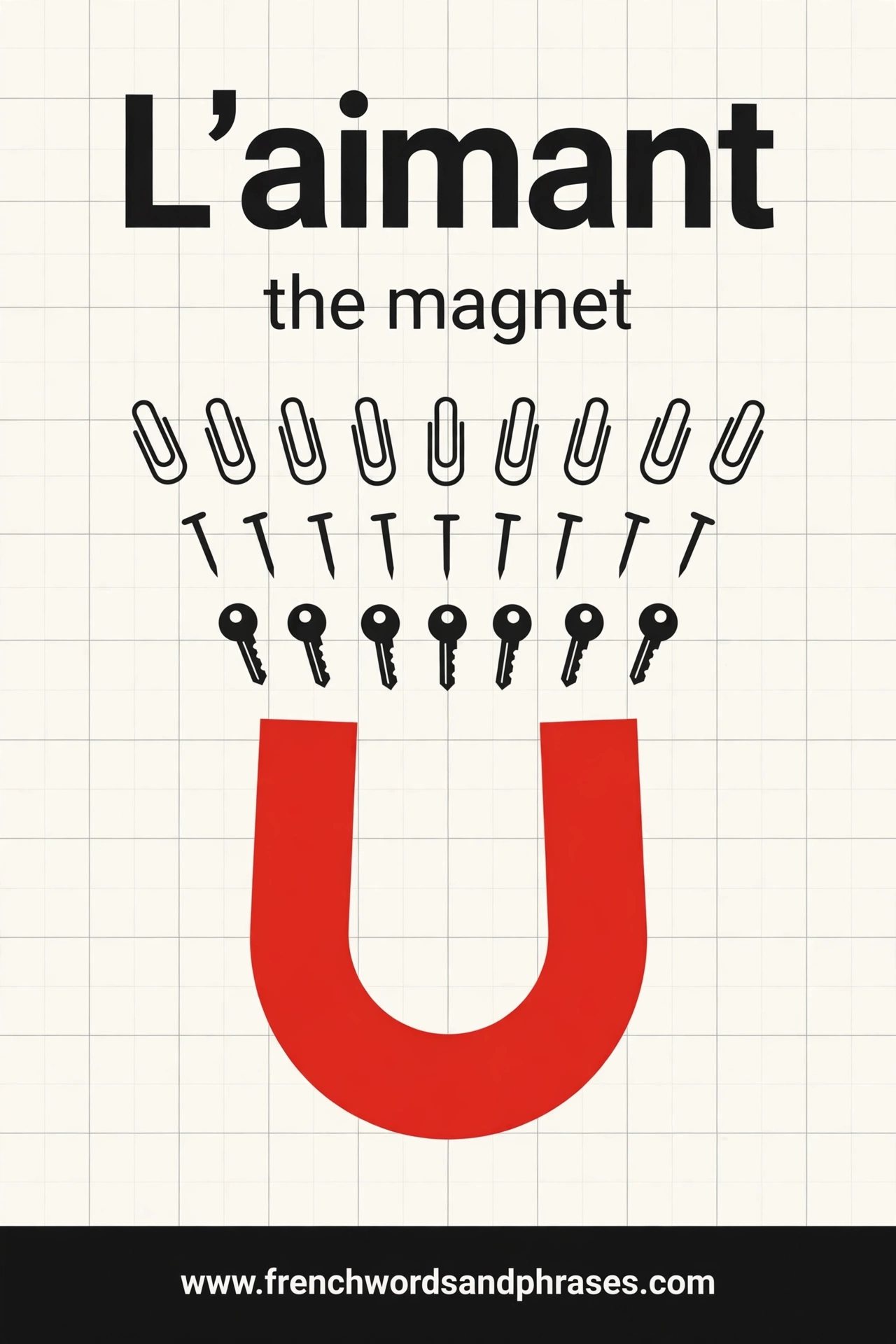
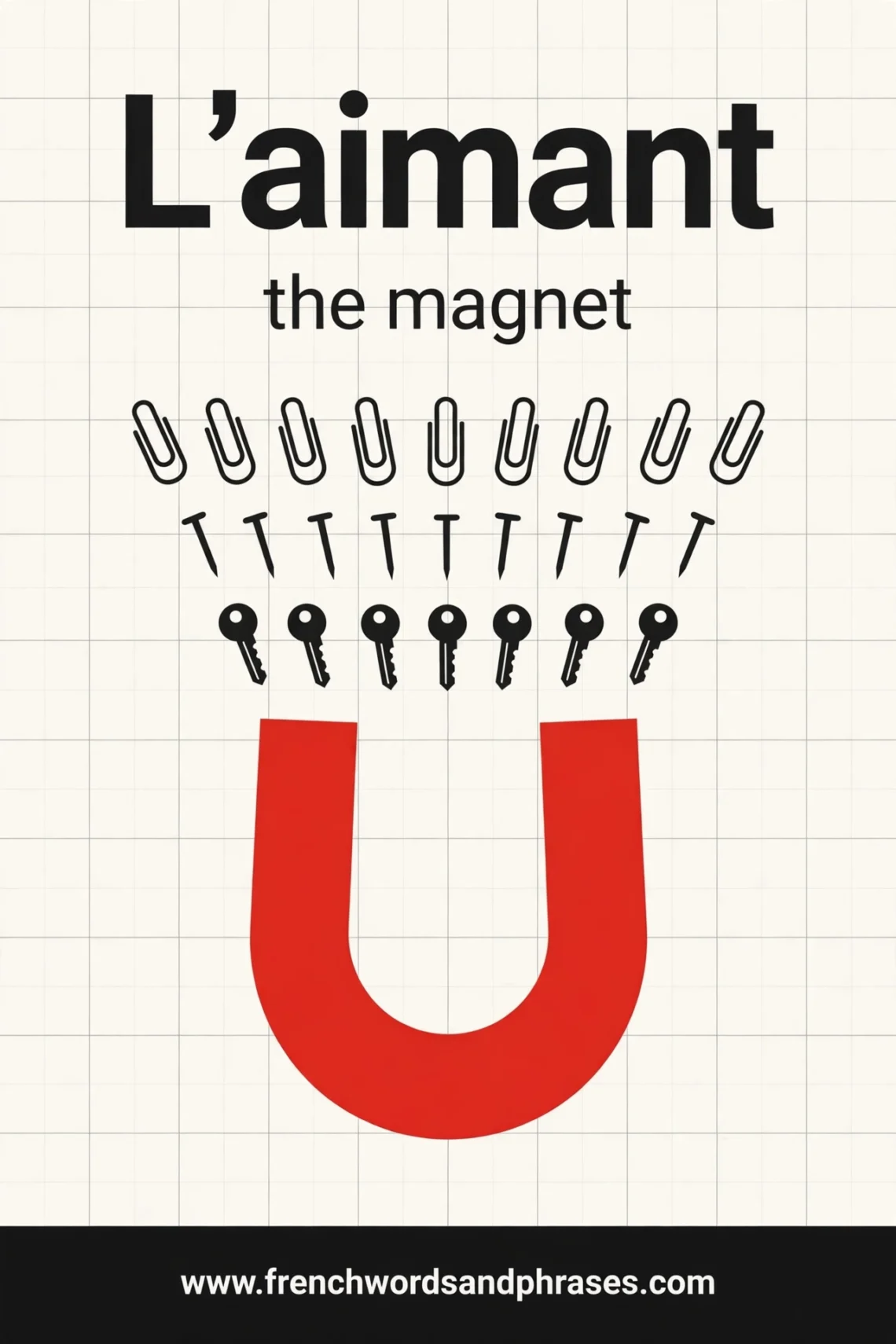
L’Aimant means a magnet.
The schoolboy tips the paper clips onto the desk and sweeps the horseshoe over them — and the clips leap up like iron filings at a fairground: l’aimant, the magnet, the stone that pulls without touching.
In this guide, you’ll learn what aimant means in English, how to use it with its articles, how to form its plural, and how it appears in everyday French. Explore French examples, English translations, and practice quizzes.
Understanding the French Noun Aimant
Aimant is a masculine French noun, learned with its article: l’aimant, un aimant — the article melts before the vowel. Its name is a small poem: aimant is the present participle of aimer, to love — the « loving stone », the stone that draws iron to itself as if it loved it. Old French called the lodestone pierre d’aimant.
It means a magnet — the object that attracts iron and steel: un aimant attire le fer, a magnet attracts iron, les pôles d’un aimant, the poles of a magnet. Modern life sticks it on every fridge: un aimant de frigo, a fridge magnet, often a souvenir. Figuratively, a person or a place can be un aimant: un aimant à touristes, a magnet for tourists. The verb for its action is aimanter, to magnetise.
Gender: Masculine — l’aimant
Definite article: l’ — l’aimant (the magnet), melted before the vowel
Indefinite article: un — un aimant (a magnet)
Plural: les aimants — regular, with a simple -s
Spelling note: from aimer, to love — the « loving stone » that draws iron to itself
Key verb: attirer — un aimant attire le fer, a magnet attracts iron
English equivalents: A magnet.
The physics is said simply: l’aimant attire the iron and repousse, repels, the same pole of another magnet — les pôles opposés s’attirent, opposite poles attract. On the fridge door, les aimants hold the shopping list and the children’s drawings. Beware the twin use of the same word: aimant is also the adjective-participle « loving » in literary French — un père aimant, a loving father — context decides which aimant you have.
Experience the Word
Aimant is attraction made visible: an invisible hand reaching across a table, asking iron to come closer.
Imagine the kitchen fridge as a family museum — postcards from three holidays, a drawing of a purple horse, the dentist’s card — all of it held up by a dozen aimants, each one a small souvenir with a job to do.
You have not just named a piece of metal. You have named the force that draws things together — l’aimant, the loving stone.
How to Use Aimant in French: Complete Guide
Let’s explore how aimant works in French, beginning with its articles — l’aimant, un aimant, un aimant attire le fer.
Aimant with the Definite Article (L’, Les)
Used for a specific magnet — the one on the desk, the one on the fridge. The article melts before the vowel.
| Form | French |
|---|---|
| Masculine singular | l’aimant |
| Plural | les aimants |
Example
L’aimant attire tous les trombones.
The magnet attracts all the paper clips.
Aimant with the Indefinite Article (Un, Des)
Used for a magnet in general — any magnet, in the classroom or the kitchen.
| Form | French |
|---|---|
| Masculine singular | un aimant |
| Plural | des aimants |
Example
Un aimant peut attirer le fer à distance.
A magnet can attract iron from a distance.
Aimant at Work (Attirer, repousser, les pôles…)
Magnets attract, repel and have poles — the fixed phrases of the science lesson.
| Phrase | French |
|---|---|
| a magnet attracts iron | un aimant attire le fer |
| the poles of a magnet | les pôles d’un aimant |
| opposite poles attract | les pôles opposés s’attirent |
| a fridge magnet | un aimant de frigo |
| a magnet for tourists | un aimant à touristes |
Example
Les pôles opposés s’attirent, les mêmes se repoussent.
Opposite poles attract, the same poles repel each other.
Quick Quiz 1
Complete the sentence:
______ aimant tient la liste des courses sur le frigo. (the)
Reveal the answer
L’
L’aimant tient la liste des courses sur le frigo.
The magnet holds the shopping list on the fridge — le melts into l’ before the vowel.
The Plural of Aimant
Aimant takes a regular plural in -s — a whole constellation on the fridge door.
| Number | French |
|---|---|
| Singular | l’aimant |
| Plural | les aimants |
Example
Les aimants du frigo viennent de tous nos voyages.
The fridge magnets come from all our trips.
Aimant with Possessive Adjectives (Mon, Ton, Son…)
Possessives agree with the noun: aimant is masculine, so mon, ton, son in the singular.
| Owner | French |
|---|---|
| my | mon aimant |
| your (tu) | ton aimant |
| his / her | son aimant |
| our | notre aimant |
| your (vous) | votre aimant |
| their | leur aimant |
Example
Mon aimant préféré vient de Lisbonne.
My favourite magnet comes from Lisbon.
Quick Quiz 2
Complete the sentence:
Il a perdu ______ aimant en forme de tour Eiffel. (his)
Reveal the answer
son
Il a perdu son aimant en forme de tour Eiffel.
He lost his Eiffel-tower-shaped magnet — son, because aimant is masculine.
Aimant with Demonstrative Adjectives (Cet, Ces)
Used to point: cet aimant, this magnet — cet, because the noun begins with a vowel.
| Form | French |
|---|---|
| Masculine singular | cet aimant |
| Plural | ces aimants |
Example
Cet aimant est très puissant pour sa taille.
This magnet is very powerful for its size.
Aimant with Adjectives
Adjectives agree with aimant — masculine singular: un aimant puissant, un petit aimant.
| Adjective | With Aimant |
|---|---|
| puissant (powerful) | un aimant puissant |
| petit (small) | un petit aimant |
| naturel (natural) | un aimant naturel |
| rond (round) | un aimant rond |
| coloré (colourful) | un aimant coloré |
Example
Un petit aimant suffit pour une carte postale.
A small magnet is enough for a postcard.
Quick Quiz 3
Complete the sentence:
C’est un aimant très ______, il tient dix feuilles. (powerful)
Reveal the answer
puissant
C’est un aimant très puissant, il tient dix feuilles.
It is a very powerful magnet, it holds ten sheets — puissant, masculine, to agree with aimant.
Everyday Expressions with Aimant
Classrooms, fridges and holiday souvenirs — the aimant phrases of daily life.
| Expression | In English |
|---|---|
| un aimant attire le fer | a magnet attracts iron |
| un aimant de frigo | a fridge magnet |
| les pôles d’un aimant | the poles of a magnet |
| un aimant à touristes | a magnet for tourists |
| coller avec un aimant | to stick (something) with a magnet |
Example
Cette place est un aimant à touristes en été.
This square is a magnet for tourists in summer.
Words from the Same Family as Aimant
Attraction and iron — the words that travel with aimant.
| French | In English |
|---|---|
| aimer | to love — the verb inside the word |
| aimanter | to magnetise (the verb) |
| le fer | iron |
| attirer | to attract |
| un trombone | a paper clip — the magnet’s favourite prey |
Example
L’aimant attire le trombone sans le toucher.
The magnet attracts the paper clip without touching it.
Quick Quiz 4
Why is a magnet called un aimant, a « loving » thing?
Reveal the answer
Because it draws iron to itself as if it loved it — aimant is the participle of aimer, to love.
L’aimant attire le fer comme un amoureux.
The magnet attracts iron like a lover.
Aimant in Everyday French: Real-Life Examples
Now that you know the word, let’s see how aimant appears in everyday French.
Example 1 — In class
L’aimant attire les trombones sur le bureau.
The magnet attracts the paper clips on the desk.
Example 2 — On the fridge
Mets la liste sous un aimant, sur le frigo.
Put the list under a magnet, on the fridge.
Example 3 — Souvenirs
Chaque voyage rapporte un aimant nouveau.
Every trip brings back a new magnet.
Example 4 — Physics
Les pôles opposés s’attirent toujours.
Opposite poles always attract.
Example 5 — Figurative
Ce café est un aimant à étudiants.
This café is a magnet for students.
Example 6 — Lost and found
Mon aimant préféré est tombé derrière le frigo.
My favourite magnet fell behind the fridge.
Beyond Translation: The Meaning of Aimant
French named the magnet after love: aimant, the loving one, because the lodestone reached for iron the way a lover reaches — across a distance, without hands. Medieval sailors steered by its cousin the compass needle, aimantée, magnetised, and trusted the loving stone with their lives. The word keeps both lives today: the physicist’s poles and the tourist’s fridge souvenir, the force of nature and the small coloured proof that you were in Lisbon.
To say aimant is to say attraction has a name — and the name is love.
It evokes leaping paper clips, museum fridges, and every place that pulls a crowd the way the stone pulls iron.
How to Remember the French Noun Aimant
Remember it this way: Aimant is a magnet — masculine with a melted article: l’aimant, the loving stone that attracts iron.
- Masculine, vowel first — l’aimant, un aimant, mon aimant, cet aimant.
- The love inside — aimant comes from aimer: the stone that loves iron.
- The action — un aimant attire le fer; les pôles opposés s’attirent.
The key idea is l’aimant — a magnet, masculine; from aimer, the loving stone.
Test Your Knowledge of Aimant
Let’s see how much you’ve learned. Try answering these questions before revealing the answers.
Question 1
Is aimant masculine or feminine?
Reveal the answer
Masculine — l’aimant, un aimant.
Question 2
How do you say a fridge magnet?
Reveal the answer
Un aimant de frigo.
Question 3
Translate: Opposite poles attract.
Reveal the answer
Les pôles opposés s’attirent.
Question 4
From which verb does aimant take its name?
Reveal the answer
Aimer, to love — the magnet is the « loving stone » that draws iron to itself.
Question 5
Complete the sentence:
______ aimants du frigo racontent nos voyages. (the)
Reveal the answer
Les
Les aimants du frigo racontent nos voyages.
The fridge magnets tell the story of our trips.
Your Final Challenge
Can You Use It?
How would you say this in French?
“The magnet attracts all the paper clips.”
Reveal the answer
L’aimant attire tous les trombones.
The magnet attracts all the paper clips.
A little French. A little curiosity. A richer everyday life.
LEARN FRENCH ONE WORD AT A TIME