A French Word to Live By
How to Conjugate Pouvoir in French
/pu.vwaʁ/
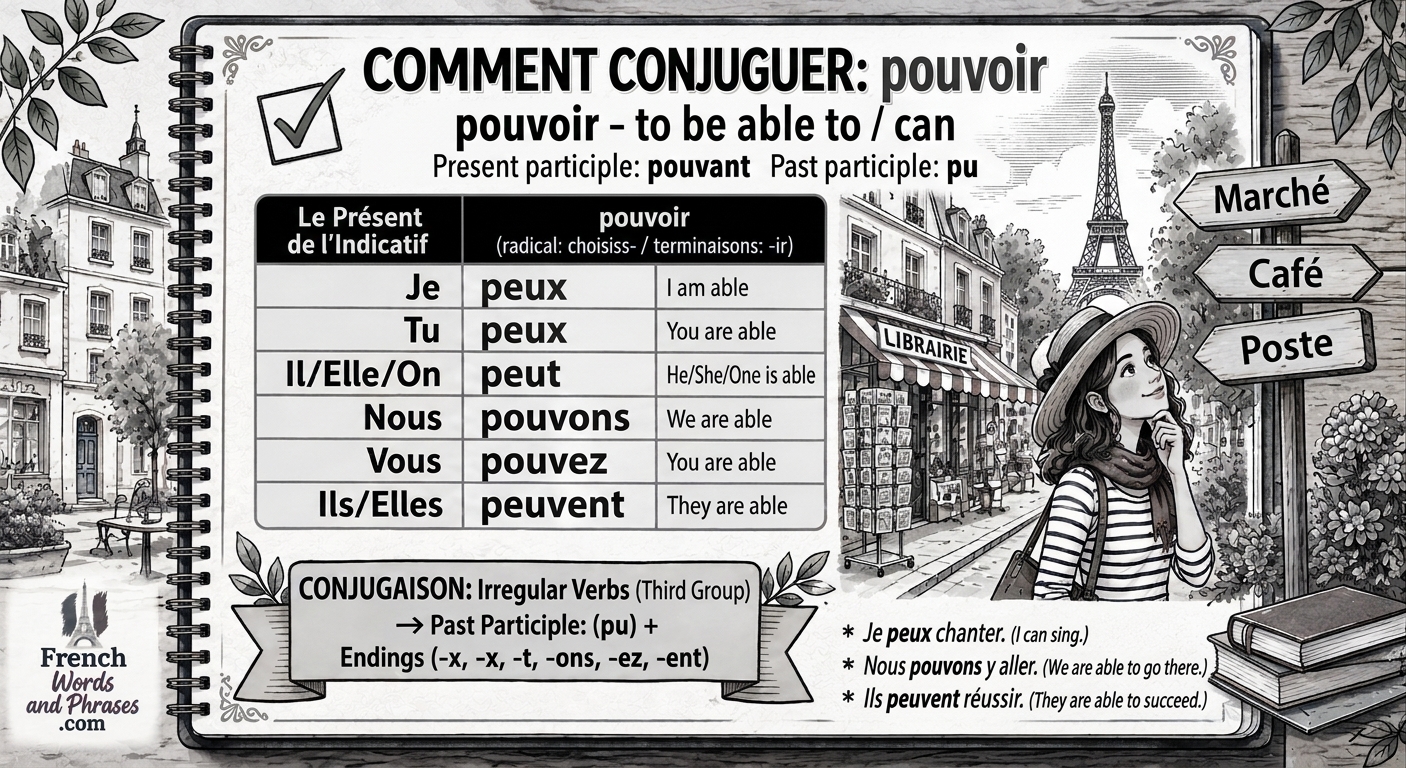
Pouvoir means to be able to, can, or may.
We use pouvoir every day to talk about what we can do, what we are able to accomplish, and what we are permitted to do. It is one of the most useful verbs in the French language.
In this guide, you’ll learn how to conjugate pouvoir in all the major French tenses and moods. Explore complete conjugation tables, French examples, English translations, pronunciation links, and practice quizzes.
Understanding the French Verb Pouvoir
Pouvoir is an irregular French verb belonging to the third group of verbs.
It means to be able to, can, or may. It is commonly used to express ability, possibility, permission, and sometimes uncertainty.
Verb classification: Third group (irregular -oir verb)
Auxiliary verb: Avoir
Past participle: pu
Present participle: pouvant
English equivalents: To be able to, can, may.
One important detail: pouvoir has irregular conjugations, so its forms must be learned individually.
In the present tense, both je peux and je puis are possible. The form je puis is more formal and is commonly encountered in the expression puis-je, meaning “may I?”
Experience the Word
Pouvoir is a verb that gives us the ability to express what is possible.
Imagine asking someone whether they can help you, telling a friend that you can speak French, or asking permission to leave early.
In each situation, pouvoir helps you communicate what someone is able to do or what they may do.
It is the French verb that opens the door to possibility.
How to Conjugate Pouvoir: Complete French Conjugation Guide
Let’s explore every major conjugation of pouvoir, beginning with the indicative mood.
How to Conjugate Pouvoir in the Indicative Mood
The indicative mood is used to express facts, observations, actions, and events.
How to Conjugate Pouvoir in the Present Tense (Présent)
Used to express what someone can do, is able to do, or is permitted to do.
| Subject | Conjugation |
|---|---|
| je | peux / puis |
| tu | peux |
| il / elle | peut |
| nous | pouvons |
| vous | pouvez |
| ils / elles | peuvent |
Both je peux and je puis are correct. Je peux is the usual everyday form. Je puis is more formal and is especially common in questions such as Puis-je entrer ?
Example
Je peux parler français.
I can speak French.
Another Example
Puis-je vous poser une question ?
May I ask you a question?
Quick Quiz 1
Complete the sentence:
Nous ______ venir avec vous.
Reveal the answer
pouvons
Nous pouvons venir avec vous.
We can come with you.
How to Conjugate Pouvoir in the Passé Composé
Used for completed actions in the past. Pouvoir takes the auxiliary verb avoir and the past participle pu.
| Subject | Conjugation |
|---|---|
| j’ | ai pu |
| tu | as pu |
| il / elle | a pu |
| nous | avons pu |
| vous | avez pu |
| ils / elles | ont pu |
Example
Hier, j’ai pu terminer mon travail.
Yesterday, I was able to finish my work.
How to Conjugate Pouvoir in the Imparfait (Imperfect Tense)
Used for habitual past abilities, ongoing possibilities, and situations in which someone was able to do something.
| Subject | Conjugation |
|---|---|
| je | pouvais |
| tu | pouvais |
| il / elle | pouvait |
| nous | pouvions |
| vous | pouviez |
| ils / elles | pouvaient |
Example
Quand j’étais jeune, je pouvais courir pendant des heures.
When I was young, I could run for hours.
Quick Quiz 2
Choose the correct form:
When we were children, we could play outside all day.
Quand nous étions enfants, nous ______ jouer dehors toute la journée.
Reveal the answer
pouvions
Quand nous étions enfants, nous pouvions jouer dehors toute la journée.
How to Conjugate Pouvoir in the Plus-que-parfait
Used to describe an ability or possibility that had existed before another past event.
| Subject | Conjugation |
|---|---|
| j’ | avais pu |
| tu | avais pu |
| il / elle | avait pu |
| nous | avions pu |
| vous | aviez pu |
| ils / elles | avaient pu |
Example
J’avais pu terminer le projet avant son arrivée.
I had been able to finish the project before his arrival.
How to Conjugate Pouvoir in the Passé Simple
Primarily used in formal writing, literature, and historical narratives. It is rarely used in everyday conversation.
| Subject | Conjugation |
|---|---|
| je | pus |
| tu | pus |
| il / elle | put |
| nous | pûmes |
| vous | pûtes |
| ils / elles | purent |
Example
Malgré les difficultés, il put terminer son voyage.
Despite the difficulties, he was able to complete his journey.
How to Conjugate Pouvoir in the Passé Antérieur
A literary tense used to express an action or possibility completed immediately before another past action, generally in the passé simple.
| Subject | Conjugation |
|---|---|
| j’ | eus pu |
| tu | eus pu |
| il / elle | eut pu |
| nous | eûmes pu |
| vous | eûtes pu |
| ils / elles | eurent pu |
Example
Dès qu’il eut pu entrer, il rejoignit ses amis.
As soon as he had been able to enter, he joined his friends.
How to Conjugate Pouvoir in the Future Tense (Futur Simple)
Used to describe what someone will be able to do or what will be possible in the future.
| Subject | Conjugation |
|---|---|
| je | pourrai |
| tu | pourras |
| il / elle | pourra |
| nous | pourrons |
| vous | pourrez |
| ils / elles | pourront |
Example
Demain, je pourrai vous aider.
Tomorrow, I will be able to help you.
How to Conjugate Pouvoir in the Futur Antérieur (Future Perfect)
Used for an ability or possibility that will have been realized before a particular point in the future.
| Subject | Conjugation |
|---|---|
| j’ | aurai pu |
| tu | auras pu |
| il / elle | aura pu |
| nous | aurons pu |
| vous | aurez pu |
| ils / elles | auront pu |
Example
À la fin de la journée, nous aurons pu terminer le travail.
By the end of the day, we will have been able to finish the work.
How to Conjugate Pouvoir in the Near Future (Futur Proche)
Used to describe something that someone is going to be able to do soon. Formed with aller + infinitive.
| Subject | Conjugation |
|---|---|
| je | vais pouvoir |
| tu | vas pouvoir |
| il / elle | va pouvoir |
| nous | allons pouvoir |
| vous | allez pouvoir |
| ils / elles | vont pouvoir |
Example
Je vais pouvoir partir plus tôt.
I’m going to be able to leave earlier.
How to Conjugate Pouvoir in the Conditional Mood
The conditional mood expresses what would be possible under certain circumstances. It is also frequently used to make polite requests, express wishes, or describe hypothetical situations.
How to Conjugate Pouvoir in the Present Conditional
| Subject | Conjugation |
|---|---|
| je | pourrais |
| tu | pourrais |
| il / elle | pourrait |
| nous | pourrions |
| vous | pourriez |
| ils / elles | pourraient |
Example
Je pourrais vous aider demain.
I could help you tomorrow.
How to Conjugate Pouvoir in the Past Conditional
Used to describe something that would have been possible in the past, often under different circumstances.
| Subject | Conjugation |
|---|---|
| j’ | aurais pu |
| tu | aurais pu |
| il / elle | aurait pu |
| nous | aurions pu |
| vous | auriez pu |
| ils / elles | auraient pu |
Example
J’aurais pu venir si j’avais eu le temps.
I could have come if I had had the time.
Pouvoir in the Literary Past Conditional Form
This less common literary form uses the imperfect subjunctive of avoir.
| Subject | Conjugation |
|---|---|
| j’ | eusse pu |
| tu | eusses pu |
| il / elle | eût pu |
| nous | eussions pu |
| vous | eussiez pu |
| ils / elles | eussent pu |
Example
Il eût pu réussir avec davantage de préparation.
He could have succeeded with more preparation.
How to Conjugate Pouvoir in the Subjunctive Mood
The subjunctive is used to express wishes, emotions, doubts, necessity, and uncertainty. It frequently follows expressions such as il faut que (it is necessary that) or bien que (although).
How to Conjugate Pouvoir in the Present Subjunctive
| Subject | Conjugation |
|---|---|
| que je | puisse |
| que tu | puisses |
| qu’il / qu’elle | puisse |
| que nous | puissions |
| que vous | puissiez |
| qu’ils / qu’elles | puissent |
Example
Il faut que je puisse terminer ce travail.
I must be able to finish this work.
Quick Quiz 3
Complete the sentence using the subjunctive:
Il faut que nous ______ partir maintenant.
Reveal the answer
puissions
Il faut que nous puissions partir maintenant.
We must be able to leave now.
How to Conjugate Pouvoir in the Imperfect Subjunctive
A literary tense, rarely encountered in modern spoken French.
| Subject | Conjugation |
|---|---|
| que je | pusse |
| que tu | pusses |
| qu’il / qu’elle | pût |
| que nous | pussions |
| que vous | pussiez |
| qu’ils / qu’elles | pussent |
Example
Il souhaitait qu’elle pût venir avec nous.
He wished that she could come with us.
How to Conjugate Pouvoir in the Pluperfect Subjunctive
A literary construction used to express an ability or possibility completed before another past action.
| Subject | Conjugation |
|---|---|
| que j’ | eusse pu |
| que tu | eusses pu |
| qu’il / qu’elle | eût pu |
| que nous | eussions pu |
| que vous | eussiez pu |
| qu’ils / qu’elles | eussent pu |
Example
Il regrettait que nous n’eussions pas pu rester.
He regretted that we had not been able to stay.
How to Conjugate Pouvoir in the Past Subjunctive
| Subject | Conjugation |
|---|---|
| que j’ | aie pu |
| que tu | aies pu |
| qu’il / qu’elle | ait pu |
| que nous | ayons pu |
| que vous | ayez pu |
| qu’ils / qu’elles | aient pu |
Example
Je suis heureux que tu aies pu venir.
I’m happy that you were able to come.
How to Conjugate Pouvoir in the Imperative
Unlike many French verbs, pouvoir does not have a standard imperative form in modern French.
The verb expresses ability, possibility, or permission, rather than a direct command. For this reason, its imperative forms are not used in ordinary French.
When giving instructions or making suggestions, French speakers generally use other expressions.
Example
Vous pouvez entrer.
You may come in.
Another Example
Entrez, s’il vous plaît.
Come in, please.
Quick Quiz 4
Does pouvoir have a standard imperative form?
Reveal the answer
No. Pouvoir has no standard imperative conjugation in modern French.
French Participles of Pouvoir
Participles are verb forms that can be used in compound tenses and other grammatical constructions.
Present Participle of Pouvoir
pouvant
Pouvant compter sur ses amis, elle était rassurée.
Being able to count on her friends, she felt reassured.
Past Participle of Pouvoir
pu
Nous avons pu terminer à temps.
We were able to finish on time.
Pouvoir in Everyday French: Real-Life Examples
Now that you know the conjugations, let’s see how pouvoir appears in everyday French.
Example 1 — Present
Je peux vous aider.
I can help you.
Example 2 — Passé composé
Elle a pu trouver une solution.
She was able to find a solution.
Example 3 — Imparfait
Quand j’étais petit, je pouvais courir très vite.
When I was little, I could run very fast.
Example 4 — Future
Nous pourrons partir demain matin.
We will be able to leave tomorrow morning.
Example 5 — Conditional
Pourriez-vous m’aider, s’il vous plaît ?
Could you help me, please?
Example 6 — Subjunctive
Il faut que tu puisses comprendre la situation.
You must be able to understand the situation.
Beyond Translation: The Meaning of Pouvoir
English has several ways to translate pouvoir. Depending on the sentence, it can mean can, could, may, or to be able to.
Ability: Je peux nager. — I can swim.
Permission: Vous pouvez entrer. — You may come in.
Possibility: Il peut pleuvoir demain. — It may rain tomorrow.
Polite requests: Pourriez-vous m’aider ? — Could you help me?
The exact English translation depends on the context. This is why it is useful to understand the meaning of the entire sentence rather than translating the verb word for word.
How to Remember the French Verb Pouvoir
Remember it this way: Pouvoir is the verb you use when talking about what you can do or what is possible.
- You can speak French: Je peux parler français.
- You can help someone: Je peux vous aider.
- You could travel tomorrow: Je pourrais voyager demain.
The key idea is ability or possibility.
Pay special attention to the irregular forms: peux, peut, pouvons, pouvez, peuvent.
Test Your Knowledge of Pouvoir
Let’s see how much you’ve learned. Try answering these questions before revealing the answers.
Question 1
What auxiliary verb is used with pouvoir in compound tenses?
Reveal the answer
Avoir.
Question 2
How do you say “I will be able to” in French?
Reveal the answer
Je pourrai.
Question 3
Translate: “We were able to finish the work.”
Reveal the answer
Nous avons pu terminer le travail.
Question 4
What is the present participle of pouvoir?
Reveal the answer
Pouvant.
Question 5
Complete the sentence:
Si j’avais plus de temps, je ______ voyager davantage.
Reveal the answer
pourrais
Si j’avais plus de temps, je pourrais voyager davantage.
If I had more time, I could travel more.
Your Final Challenge
Can You Use It?
How would you say this in French?
“Tomorrow, we will be able to visit the museum.”
Reveal the answer
Demain, nous pourrons visiter le musée.
Tomorrow, we will be able to visit the museum.
A little French. A little curiosity. A richer everyday life.
LEARN FRENCH ONE WORD AT A TIME