A French Word to Live By
How to Conjugate Caserner in French
/ka.zɛʁ.ne/
Caserner means to quarter — to lodge soldiers in barracks, to shut troops away in their quarters.
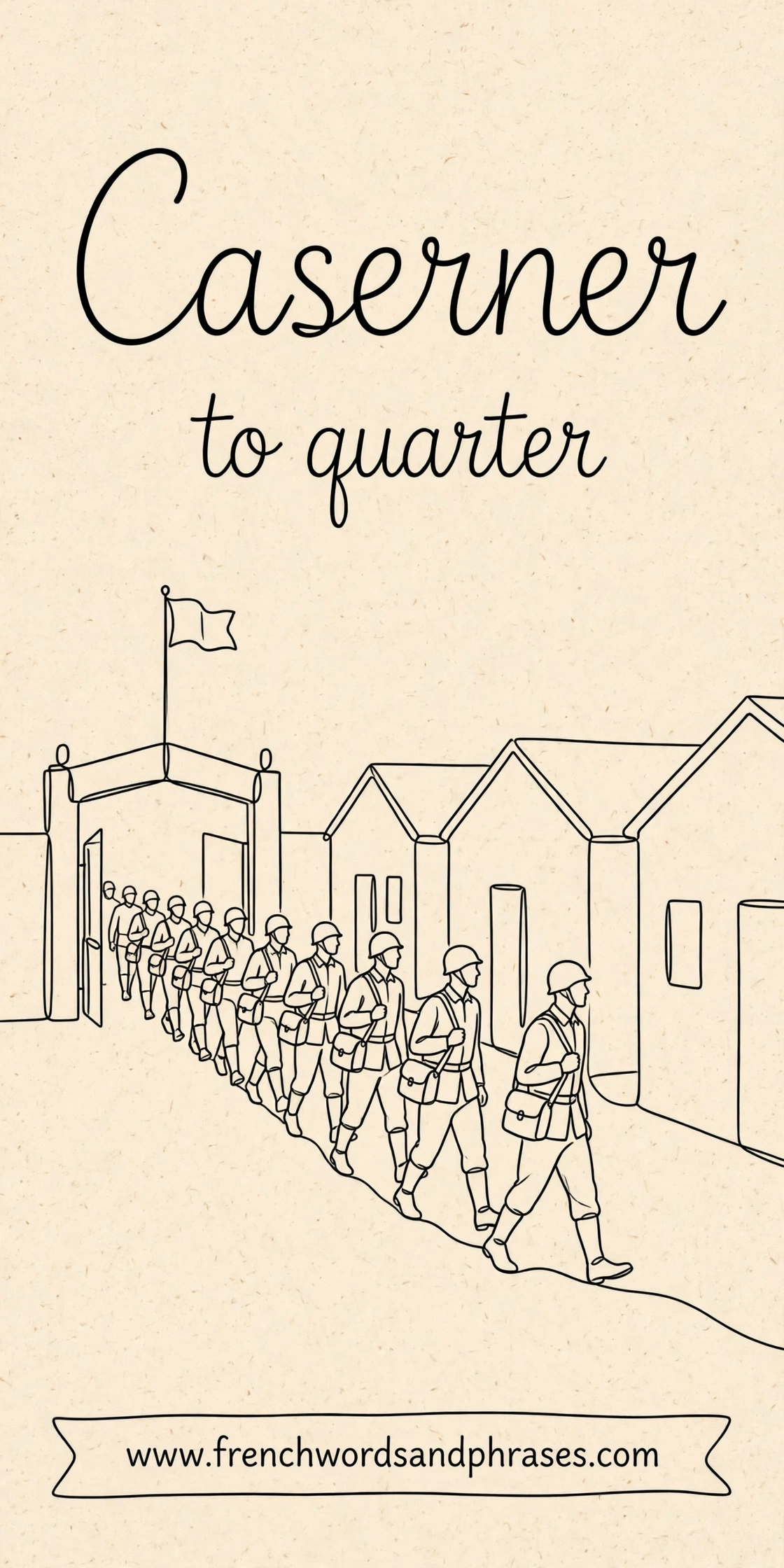
A garrison town at dusk: bugles, boots on cobblestones, and hundreds of young soldiers filing back through the barrack gate. Caserner is the army’s housekeeping verb — to quarter troops in barracks, and, by extension, to shut anyone away in an institution.
In this guide, you’ll learn how to conjugate caserner in all the major French tenses and moods. Explore complete conjugation tables, French examples, English translations, and practice quizzes.
Understanding the French Verb Caserner
Caserner is a regular French verb belonging to the first group of verbs, those ending in-er.
It means to quarter. It belongs to military and administrative French — quartering troops, recruits and sometimes refugees or students — and it often carries a slight chill: to caserner people is to house them collectively, under discipline, out of sight.
Verb classification: First group (-er)
Auxiliary verb: Avoir
Past participle: caserné
Present participle: casernant
English equivalents: To quarter, to barrack; caserner des troupes — to quarter troops; caserner des soldats dans un lycée — to billet soldiers in a school; une caserne — barracks, also a fire station (une caserne de pompiers); être caserné — to be quartered, to be shut away.
One important detail: caserner is the verb of une caserne, barracks — the same caserne that houses firemen in a caserne de pompiers. It is a regular -er verb: je caserne, nous casernons, past participle caserné. It is used transitively (caserner des soldats, to quarter soldiers) and in the passive picture être caserné, to be shut up in barracks — a phrase also used figuratively for any life confined to one institution.
Experience the Word
Caserner is the verb of collective lodging — hundreds of beds, one gate, and a bugle to mark the hours.
Imagine a frontier town in 1913. The new regiment arrives by train at dawn; by noon the men are casernés in the long white barracks above the river, their rifles racked, their kits folded — a small city of soldiers folded inside the town.
The town has gained a thousand inhabitants in a morning. They are quartered — casernés — and the gate closes behind them.
How to Conjugate Caserner: Complete French Conjugation Guide
Let’s explore every major conjugation of caserner, beginning with the indicative mood.
How to Conjugate Caserner in the Indicative Mood
The indicative mood is used to express facts, observations, actions, and events.
How to Conjugate Caserner in the Present Tense (Présent)
Used for actions happening now, habitual actions, and general truths.
| Subject | Conjugation |
|---|---|
| je | caserne |
| tu | casernes |
| il / elle | caserne |
| nous | casernons |
| vous | casernez |
| ils / elles | casernent |
Example
L’armée caserne les recrues près de la frontière.
The army quarters the recruits near the frontier.
Quick Quiz 1
Complete the sentence:
Nous ______ les soldats dans le bâtiment neuf.
Reveal the answer
casernons
Nous casernons les soldats dans le bâtiment neuf.
We are quartering the soldiers in the new building.
How to Conjugate Caserner in the Passé Composé
Used for completed actions in the past. Caserner takes the auxiliary verb avoir.
| Subject | Conjugation |
|---|---|
| j’ | ai caserné |
| tu | as caserné |
| il / elle | a caserné |
| nous | avons caserné |
| vous | avez caserné |
| ils / elles | ont caserné |
Example
On a caserné les soldats dans l’ancien lycée.
The soldiers were quartered in the old school.
How to Conjugate Caserner in the Imparfait (Imperfect Tense)
Used for habitual past actions, descriptions, and ongoing situations in the past.
| Subject | Conjugation |
|---|---|
| je | casernais |
| tu | casernais |
| il / elle | casernait |
| nous | casernions |
| vous | caserniez |
| ils / elles | casernaient |
Example
Le régiment casernait ses hommes dans trois villages.
The regiment used to quarter its men in three villages.
Quick Quiz 2
Choose the correct form:
The soldiers were quartered in the old school.
On ______ les soldats dans l’ancien lycée. (a caserné / est caserné)
Reveal the answer
a caserné
On a caserné les soldats dans l’ancien lycée.
Caserner takes avoir.
How to Conjugate Caserner in the Plus-que-parfait
Used to describe an action that had already been completed before another past event.
| Subject | Conjugation |
|---|---|
| j’ | avais caserné |
| tu | avais caserné |
| il / elle | avait caserné |
| nous | avions caserné |
| vous | aviez caserné |
| ils / elles | avaient caserné |
Example
Ils avaient caserné la garnison avant l’arrivée du général.
They had quartered the garrison before the general’s arrival.
How to Conjugate Caserner in the Passé Simple
Primarily used in formal writing, literature, and historical narratives. It is rarely used in everyday conversation.
| Subject | Conjugation |
|---|---|
| je | casernai |
| tu | casernas |
| il / elle | caserna |
| nous | casernâmes |
| vous | casernâtes |
| ils / elles | casernèrent |
Example
En 1870, on caserna les troupes dans les faubourgs de la ville.
In 1870, the troops were quartered in the outskirts of the town.
How to Conjugate Caserner in the Passé Antérieur
A literary tense used to express an action completed immediately before another past action, generally in the passé simple.
| Subject | Conjugation |
|---|---|
| j’ | eus caserné |
| tu | eus caserné |
| il / elle | eut caserné |
| nous | eûmes caserné |
| vous | eûtes caserné |
| ils / elles | eurent caserné |
Example
Quand le colonel eut caserné ses hommes, il inspecta les cuisines.
When the colonel had quartered his men, he inspected the kitchens.
How to Conjugate Caserner in the Future Tense (Futur Simple)
Used to describe actions that will take place in the future.
| Subject | Conjugation |
|---|---|
| je | casernerai |
| tu | caserneras |
| il / elle | casernera |
| nous | casernerons |
| vous | casernerez |
| ils / elles | caserneront |
Example
Demain, le régiment casernera les nouvelles recrues.
Tomorrow, the regiment will quarter the new recruits.
How to Conjugate Caserner in the Futur Antérieur (Future Perfect)
Used for an action that will have been completed before a particular point in the future.
| Subject | Conjugation |
|---|---|
| j’ | aurai caserné |
| tu | auras caserné |
| il / elle | aura caserné |
| nous | aurons caserné |
| vous | aurez caserné |
| ils / elles | auront caserné |
Example
À la fin du mois, on aura caserné tout le bataillon.
By the end of the month, the whole battalion will have been quartered.
How to Conjugate Caserner in the Near Future (Futur Proche)
Used to describe something that is going to happen soon. Formed with aller + infinitive.
| Subject | Conjugation |
|---|---|
| je | vais caserner |
| tu | vas caserner |
| il / elle | va caserner |
| nous | allons caserner |
| vous | allez caserner |
| ils / elles | vont caserner |
Example
La mairie va caserner les pompiers volontaires dans l’ancienne école.
The town hall is going to quarter the volunteer firemen in the old school.
How to Conjugate Caserner in the Conditional Mood
The conditional mood expresses what would happen under certain circumstances. It is also frequently used to make polite requests or express wishes.
How to Conjugate Caserner in the Present Conditional
| Subject | Conjugation |
|---|---|
| je | casernerais |
| tu | casernerais |
| il / elle | casernerait |
| nous | casernerions |
| vous | caserneriez |
| ils / elles | caserneraient |
Example
On casernerait les troupes à la campagne si la caserne était pleine.
The troops would be quartered in the countryside if the barracks were full.
How to Conjugate Caserner in the Past Conditional
| Subject | Conjugation |
|---|---|
| j’ | aurais caserné |
| tu | aurais caserné |
| il / elle | aurait caserné |
| nous | aurions caserné |
| vous | auriez caserné |
| ils / elles | auraient caserné |
Example
Ils auraient caserné les soldats au château sans l’incendie.
They would have quartered the soldiers at the château if not for the fire.
Caserner in the Literary Past Conditional Form
This less common literary form uses the imperfect subjunctive of avoir.
| Subject | Conjugation |
|---|---|
| j’ | eusse caserné |
| tu | eusses caserné |
| il / elle | eût caserné |
| nous | eussions caserné |
| vous | eussiez caserné |
| ils / elles | eussent caserné |
Example
Le général eût caserné ses hommes avant la nuit.
The general would have quartered his men before nightfall.
How to Conjugate Caserner in the Subjunctive Mood
The subjunctive is used to express wishes, emotions, doubts, necessity, and uncertainty. It frequently follows expressions such as il faut que (it is necessary that) or bien que (although).
How to Conjugate Caserner in the Present Subjunctive
| Subject | Conjugation |
|---|---|
| que je | caserne |
| que tu | casernes |
| qu’il / qu’elle | caserne |
| que nous | casernions |
| que vous | caserniez |
| qu’ils / qu’elles | casernent |
Example
Il faut que l’armée caserne les recrues loin de la frontière.
The army must quarter the recruits far from the frontier.
Quick Quiz 3
Complete the sentence using the subjunctive:
Il faut que vous ______ les recrues avant ce soir.
Reveal the answer
caserniez
Il faut que vous caserniez les recrues avant ce soir.
You must quarter the recruits before this evening.
How to Conjugate Caserner in the Imperfect Subjunctive
A literary tense, rarely encountered in modern spoken French.
| Subject | Conjugation |
|---|---|
| que je | casernasse |
| que tu | casernasses |
| qu’il / qu’elle | casernât |
| que nous | casernassions |
| que vous | casernassiez |
| qu’ils / qu’elles | casernassent |
Example
Le maire refusait qu’on casernât des soldats dans les écoles.
The mayor refused to have soldiers quartered in the schools.
How to Conjugate Caserner in the Pluperfect Subjunctive
A literary construction used to express an action completed before another past action.
| Subject | Conjugation |
|---|---|
| que j’ | eusse caserné |
| que tu | eusses caserné |
| qu’il / qu’elle | eût caserné |
| que nous | eussions caserné |
| que vous | eussiez caserné |
| qu’ils / qu’elles | eussent caserné |
Example
On racontait qu’ils eussent caserné mille hommes dans le village.
People said they had quartered a thousand men in the village.
How to Conjugate Caserner in the Past Subjunctive
| Subject | Conjugation |
|---|---|
| que j’ | aie caserné |
| que tu | aies caserné |
| qu’il / qu’elle | ait caserné |
| que nous | ayons caserné |
| que vous | ayez caserné |
| qu’ils / qu’elles | aient caserné |
Example
Je suis surpris qu’on ait caserné les pompiers si loin du centre.
I am surprised the firemen were quartered so far from the centre.
How to Conjugate Caserner in the Imperative
The imperative is used to give commands, instructions, invitations, or suggestions. Subject pronouns are omitted.
How to Conjugate Caserner in the Present Imperative
| Person | Conjugation |
|---|---|
| (tu) | caserne |
| (nous) | casernons |
| (vous) | casernez |
Example
Casernez les recrues dans le bâtiment neuf !
Quarter the recruits in the new building!
Quick Quiz 4
How would you say Quarter the recruits in the new building (tu form)?
Reveal the answer
Caserne les recrues dans le bâtiment neuf !
French Participles of Caserner
Participles are verb forms that can be used in compound tenses and other grammatical constructions.
Present Participle of Caserner
casernant
En casernant les troupes dans la ville, l’armée anime ses commerces.
By quartering the troops in the town, the army livens up its shops.
Past Participle of Caserner
caserné
Casernés loin de leurs familles, les jeunes soldats écrivent chaque soir.
Quartered far from their families, the young soldiers write home every evening.
Caserner in Everyday French: Real-Life Examples
Now that you know the conjugations, let’s see how caserner appears in everyday French.
Example 1 — Present
L’armée caserne les recrues près de la frontière.
The army quarters the recruits near the frontier.
Example 2 — Passé composé
On a caserné les soldats dans l’ancien lycée.
The soldiers were quartered in the old school.
Example 3 — Imparfait
Le régiment casernait ses hommes dans trois villages.
The regiment used to quarter its men in three villages.
Example 4 — Future
Le régiment casernera les nouvelles recrues demain.
The regiment will quarter the new recruits tomorrow.
Example 5 — Conditional
On casernerait les troupes à la campagne si la caserne était pleine.
The troops would be quartered in the countryside if the barracks were full.
Example 6 — Imperative
Casernez les recrues dans le bâtiment neuf !
Quarter the recruits in the new building!
Beyond Translation: The Meaning of Caserner
English to quarter soldiers is the same idea from the same barrack world — French caserner simply names the building, la caserne.
One word houses both soldiers and firemen.
In every French town the caserne may be military or a caserne de pompiers; the verb belongs to the army, but the building, and its discipline of bells, bunks and collective life, is shared by all uniformed services.
How to Remember the French Verb Caserner
Remember it this way: Caserner is about bugles, bunks and the barrack gate closing at dusk.
- Une caserne is barracks (or a fire station); caserner is to put troops into barracks — to quarter them.
- Être caserné paints the picture: shut away in quarters, under discipline.
- Regular -er: je caserne, nous casernons, past participle caserné.
The key idea is bugles, bunks and the barrack gate closing at dusk.
Test Your Knowledge of Caserner
Let’s see how much you’ve learned. Try answering these questions before revealing the answers.
Question 1
What is une caserne?
Reveal the answer
Barracks — the building where soldiers (or firemen) are quartered; caserner is to quarter them there.
Question 2
How do you say The army quarters the recruits near the frontier in French?
Reveal the answer
L’armée caserne les recrues près de la frontière.
Question 3
Translate: The soldiers were quartered in the old school.
Reveal the answer
On a caserné les soldats dans l’ancien lycée.
Question 4
What is the past participle of caserner?
Reveal the answer
Caserné.
Question 5
Complete the sentence:
Il faut que l’armée ______ les recrues loin de la frontière.
Reveal the answer
caserne
Il faut que l’armée caserne les recrues loin de la frontière.
The army must quarter the recruits far from the frontier.
Your Final Challenge
Can You Use It?
How would you say this in French?
The recruits are quartered at the edge of town, and the evening bugle call covers the rooftops.
Reveal the answer
On caserne les recrues au bout de la ville, et la sonnerie du soir couvre les toits.
The recruits are quartered at the edge of town, and the evening bugle call covers the rooftops.
A little French. A little curiosity. A richer everyday life.
LEARN FRENCH ONE WORD AT A TIME