A French Word to Live By
How to Conjugate Se caser in French
/sə ka.ze/
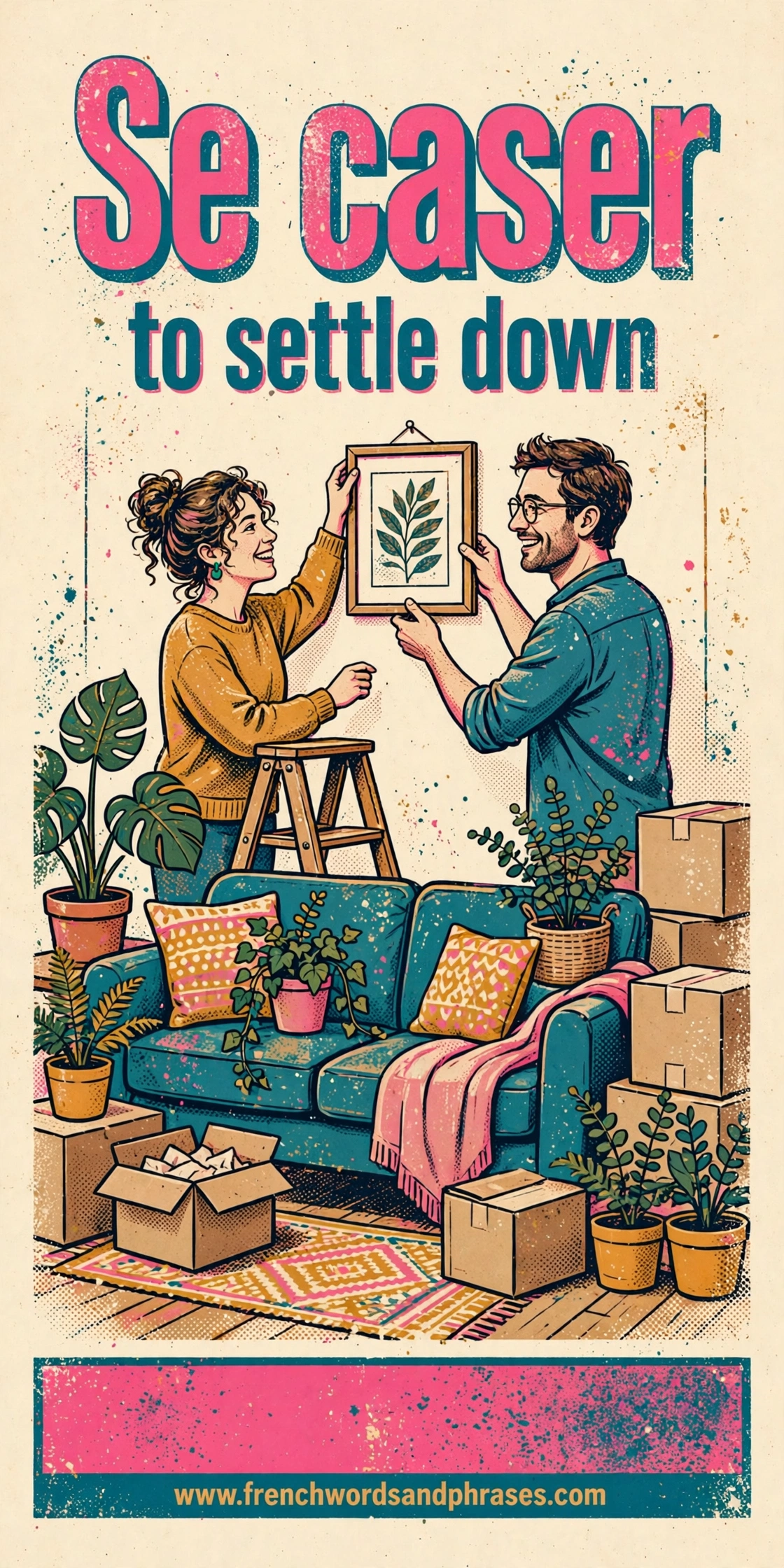
Se caser means to settle down — to find your place in life, usually with a partner, a home and a steady existence.
The friend who changed city every year, flat every six months and job every spring suddenly signs a mortgage, marries and plants a garden — se caser is the verb of that landing: the restless bird finally finding its compartment, its case, and staying there.
In this guide, you’ll learn how to conjugate se caser in all the major French tenses and moods. Explore complete conjugation tables, French examples, English translations, and practice quizzes.
Understanding the French Verb Se caser
Se caser is a regular French verb belonging to the first group of verbs, those ending in-er.
It means to settle down. It is the standard familiar verb for settling down in the full sense — partner, home, routine — and can also be used, more literally, for settling oneself into a place: se caser dans un fauteuil, dans un petit appartement, to ensconce yourself somewhere comfortable.
Verb classification: First group (-er), reflexive
Auxiliary verb: Être
Past participle: casé
Present participle: casant
English equivalents: To settle down; se caser avec quelqu’un — to settle down with someone; se caser dans un appartement — to settle into a flat; être casé — to be settled, to be sorted (familiar); caser quelqu’un — to find someone a place (plain caser).
One important detail: se caser is the reflexive of caser (to stow away) — to stow yourself away, into a home and a settled life. Being reflexive, it takes être in every compound tense and the past participle agrees with the subject: elle s’est casée, ils se sont casés. The tone is affectionate and slightly teasing — familiar, but never insulting: parents ask, with a smile, alors, tu te cases quand ?
Experience the Word
Se caser is the verb of the landing — the moment a wandering life finds its compartment and closes the door, content.
Imagine Karim at twenty-five: three countries, five flats, a van. At thirty-two he telephones his mother with impossible news — a village house, a fiancée, a dog. Il s’est casé, she tells the whole family, half laughing, half moved.
He has not given up adventure. He has settled — casé — into the place that was waiting for him.
How to Conjugate Se caser: Complete French Conjugation Guide
Let’s explore every major conjugation of se caser, beginning with the indicative mood.
How to Conjugate Se caser in the Indicative Mood
The indicative mood is used to express facts, observations, actions, and events.
How to Conjugate Se caser in the Present Tense (Présent)
Used for actions happening now, habitual actions, and general truths.
| Subject | Conjugation |
|---|---|
| je | me case |
| tu | te cases |
| il / elle | se case |
| nous | nous casons |
| vous | vous casez |
| ils / elles | se casent |
Example
À trente ans, il se case enfin et achète un appartement.
At thirty, he is finally settling down and buying a flat.
Quick Quiz 1
Complete the sentence:
Nous nous ______ dans un petit village de Provence.
Reveal the answer
casons
Nous nous casons dans un petit village de Provence.
We are settling down in a small village in Provence.
How to Conjugate Se caser in the Passé Composé
Used for completed actions in the past. Se caser takes the auxiliary verb être.
| Subject | Conjugation |
|---|---|
| je | me suis casé / me suis casée |
| tu | t’es casé / t’es casée |
| il / elle | s’est casé / s’est casée |
| nous | nous sommes casés / nous sommes casées |
| vous | vous êtes casés / vous êtes casées / vous êtes casé / vous êtes casée |
| ils / elles | se sont casés / se sont casées |
Example
Elle s’est casée avec un ami d’enfance l’an dernier.
She settled down with a childhood friend last year.
How to Conjugate Se caser in the Imparfait (Imperfect Tense)
Used for habitual past actions, descriptions, and ongoing situations in the past.
| Subject | Conjugation |
|---|---|
| je | me casais |
| tu | te casais |
| il / elle | se casait |
| nous | nous casions |
| vous | vous casiez |
| ils / elles | se casaient |
Example
Jeune, il voyageait sans cesse et ne se casait jamais.
When he was young, he travelled constantly and never settled down.
Quick Quiz 2
Choose the correct form:
She settled down last year.
Elle ______ l’an dernier. (s’est casée / a casé)
Reveal the answer
s’est casée
Elle s’est casée l’an dernier.
Se caser is reflexive, takes être, and the participle agrees: casée.
How to Conjugate Se caser in the Plus-que-parfait
Used to describe an action that had already been completed before another past event.
| Subject | Conjugation |
|---|---|
| je | m’étais casé / m’étais casée |
| tu | t’étais casé / t’étais casée |
| il / elle | s’était casé / s’était casée |
| nous | nous étions casés / nous étions casées |
| vous | vous étiez casés / vous étiez casées / vous étiez casé / vous étiez casée |
| ils / elles | s’étaient casés / s’étaient casées |
Example
Ils s’étaient casés dans un village avant la naissance du bébé.
They had settled down in a village before the baby was born.
How to Conjugate Se caser in the Passé Simple
Primarily used in formal writing, literature, and historical narratives. It is rarely used in everyday conversation.
| Subject | Conjugation |
|---|---|
| je | me casai |
| tu | te casas |
| il / elle | se casa |
| nous | nous casâmes |
| vous | vous casâtes |
| ils / elles | se casèrent |
Example
Après des années de voyage, elle se casa dans un port de Bretagne.
After years of travelling, she settled down in a Breton port.
How to Conjugate Se caser in the Passé Antérieur
A literary tense used to express an action completed immediately before another past action, generally in the passé simple.
| Subject | Conjugation |
|---|---|
| je | me fus casé / me fus casée |
| tu | te fus casé / te fus casée |
| il / elle | se fut casé / se fut casée |
| nous | nous fûmes casés / nous fûmes casées |
| vous | vous fûtes casés / vous fûtes casées / vous fûtes casé / vous fûtes casée |
| ils / elles | se furent casés / se furent casées |
Example
Dès qu’il se fut casé, il invita ses amis à pendre la crémaillère.
As soon as he had settled down, he invited his friends to a housewarming.
How to Conjugate Se caser in the Future Tense (Futur Simple)
Used to describe actions that will take place in the future.
| Subject | Conjugation |
|---|---|
| je | me caserai |
| tu | te caseras |
| il / elle | se casera |
| nous | nous caserons |
| vous | vous caserez |
| ils / elles | se caseront |
Example
Un jour, tu te caseras, toi aussi, et tu seras heureux.
One day, you will settle down too, and you will be happy.
How to Conjugate Se caser in the Futur Antérieur (Future Perfect)
Used for an action that will have been completed before a particular point in the future.
| Subject | Conjugation |
|---|---|
| je | me serai casé / me serai casée |
| tu | te seras casé / te seras casée |
| il / elle | se sera casé / se sera casée |
| nous | nous serons casés / nous serons casées |
| vous | vous serez casés / vous serez casées / vous serez casé / vous serez casée |
| ils / elles | se seront casés / se seront casées |
Example
À quarante ans, ils se seront casés depuis longtemps.
By forty, they will have been settled for a long time.
How to Conjugate Se caser in the Near Future (Futur Proche)
Used to describe something that is going to happen soon. Formed with aller + infinitive.
| Subject | Conjugation |
|---|---|
| je | vais me caser |
| tu | vas te caser |
| il / elle | va se caser |
| nous | allons nous caser |
| vous | allez vous caser |
| ils / elles | vont se caser |
Example
Écoute, elle va se caser avec son ami de lycée !
Listen, she is going to settle down with her school boyfriend!
How to Conjugate Se caser in the Conditional Mood
The conditional mood expresses what would happen under certain circumstances. It is also frequently used to make polite requests or express wishes.
How to Conjugate Se caser in the Present Conditional
| Subject | Conjugation |
|---|---|
| je | me caserais |
| tu | te caserais |
| il / elle | se caserait |
| nous | nous caserions |
| vous | vous caseriez |
| ils / elles | se caseraient |
Example
Il se caserait volontiers, s’il trouvait la bonne personne.
He would gladly settle down if he found the right person.
How to Conjugate Se caser in the Past Conditional
| Subject | Conjugation |
|---|---|
| je | me serais casé / me serais casée |
| tu | te serais casé / te serais casée |
| il / elle | se serait casé / se serait casée |
| nous | nous serions casés / nous serions casées |
| vous | vous seriez casés / vous seriez casées / vous seriez casé / vous seriez casée |
| ils / elles | se seraient casés / se seraient casées |
Example
Elle se serait casée plus tôt si elle avait rencontré son mari à vingt ans.
She would have settled down sooner if she had met her husband at twenty.
Se caser in the Literary Past Conditional Form
This less common literary form uses the imperfect subjunctive of être.
| Subject | Conjugation |
|---|---|
| je | me fusse casé / me fusse casée |
| tu | te fusses casé / te fusses casée |
| il / elle | se fût casé / se fût casée |
| nous | nous fussions casés / nous fussions casées |
| vous | vous fussiez casés / vous fussiez casées / vous fussiez casé / vous fussiez casée |
| ils / elles | se fussent casés / se fussent casées |
Example
Il se fût casé dans son village sans la guerre.
He would have settled down in his village if not for the war.
How to Conjugate Se caser in the Subjunctive Mood
The subjunctive is used to express wishes, emotions, doubts, necessity, and uncertainty. It frequently follows expressions such as il faut que (it is necessary that) or bien que (although).
How to Conjugate Se caser in the Present Subjunctive
| Subject | Conjugation |
|---|---|
| que je | me case |
| que tu | te cases |
| qu’il / qu’elle | se case |
| que nous | nous casions |
| que vous | vous casiez |
| qu’ils / qu’elles | se casent |
Example
Ses parents veulent qu’il se case enfin.
His parents want him to settle down at last.
Quick Quiz 3
Complete the sentence using the subjunctive:
Ses parents veulent que tu te ______ enfin.
Reveal the answer
cases
Ses parents veulent que tu te cases enfin.
His parents want you to settle down at last.
How to Conjugate Se caser in the Imperfect Subjunctive
A literary tense, rarely encountered in modern spoken French.
| Subject | Conjugation |
|---|---|
| que je | me casasse |
| que tu | te casasses |
| qu’il / qu’elle | se casât |
| que nous | nous casassions |
| que vous | vous casassiez |
| qu’ils / qu’elles | se casassent |
Example
On ne pensait pas qu’elle se casât si jeune.
Nobody thought she would settle down so young.
How to Conjugate Se caser in the Pluperfect Subjunctive
A literary construction used to express an action completed before another past action.
| Subject | Conjugation |
|---|---|
| que je | me fusse casé / me fusse casée |
| que tu | te fusses casé / te fusses casée |
| qu’il / qu’elle | se fût casé / se fût casée |
| que nous | nous fussions casés / nous fussions casées |
| que vous | vous fussiez casés / vous fussiez casées / vous fussiez casé / vous fussiez casée |
| ils / elles | se fussent casés / se fussent casées |
Example
On racontait qu’ils se fussent casés en secret.
People said they had settled down in secret.
How to Conjugate Se caser in the Past Subjunctive
| Subject | Conjugation |
|---|---|
| que je | me sois casé / me sois casée |
| que tu | te sois casé / te sois casée |
| qu’il / qu’elle | se soit casé / se soit casée |
| que nous | nous soyons casés / nous soyons casées |
| que vous | vous soyez casés / vous soyez casées / vous soyez casé / vous soyez casée |
| qu’ils / qu’elles | se soient casés / se soient casées |
Example
Je suis ravi que vous vous soyez casés près de chez nous.
I am delighted you have settled down near us.
How to Conjugate Se caser in the Imperative
The imperative is used to give commands, instructions, invitations, or suggestions. Subject pronouns are omitted.
How to Conjugate Se caser in the Present Imperative
| Person | Conjugation |
|---|---|
| (tu) | case-toi |
| (nous) | casons-nous |
| (vous) | casez-vous |
Example
Case-toi, il est temps de fonder une famille !
Settle down, it is time to start a family!
Quick Quiz 4
How would you say Settle down (tu form)?
Reveal the answer
Case-toi !
French Participles of Se caser
Participles are verb forms that can be used in compound tenses and other grammatical constructions.
Present Participle of Se caser
casant
En se casant dans ce village, ils ont trouvé le calme.
By settling down in this village, they found peace and quiet.
Past Participle of Se caser
casé
Casée dans son petit appartement, elle ne veut plus déménager.
Settled in her little flat, she never wants to move again.
Se caser in Everyday French: Real-Life Examples
Now that you know the conjugations, let’s see how se caser appears in everyday French.
Example 1 — Present
À trente ans, il se case enfin.
At thirty, he is finally settling down.
Example 2 — Passé composé
Elle s’est casée avec un ami d’enfance.
She settled down with a childhood friend.
Example 3 — Imparfait
Jeune, il ne se casait jamais.
When young, he never settled down.
Example 4 — Future
Un jour, tu te caseras, toi aussi.
One day, you will settle down too.
Example 5 — Conditional
Il se caserait volontiers avec la bonne personne.
He would gladly settle down with the right person.
Example 6 — Imperative
Case-toi, il est temps !
Settle down, it is time!
Beyond Translation: The Meaning of Se caser
English settle down is the exact equivalent, but French se caser keeps the picture of its parent verb: une case is a compartment, and to settle down is to slide yourself into yours.
It is said with a smile, never with contempt.
Se caser is not giving up — it is the happy ending French families celebrate at housewarmings: the wanderer has found the square of the grid with his name on it.
How to Remember the French Verb Se caser
Remember it this way: Se caser is about the restless bird sliding into its own compartment — home at last.
- Se caser is caser turned on yourself: to stow yourself into a home, a partner, a settled life.
- Always être, and the participle agrees: elle s’est casée, ils se sont casés.
- The tu imperative tucks the pronoun behind: case-toi !
The key idea is the restless bird sliding into its own compartment — home at last.
Test Your Knowledge of Se caser
Let’s see how much you’ve learned. Try answering these questions before revealing the answers.
Question 1
Which auxiliary does se caser use, and why?
Reveal the answer
Être — it is a reflexive verb: elle s’est casée l’an dernier.
Question 2
How do you say She settled down with a childhood friend in French?
Reveal the answer
Elle s’est casée avec un ami d’enfance.
Question 3
Translate: His parents want him to settle down at last.
Reveal the answer
Ses parents veulent qu’il se case enfin.
Question 4
What is the past participle of se caser?
Reveal the answer
Casé — agreeing: casée, casés, casées.
Question 5
Complete the sentence:
Ils ______ dans un village avant la naissance du bébé. (passé composé)
Reveal the answer
se sont casés
Ils se sont casés dans un village avant la naissance du bébé.
They settled down in a village before the baby was born.
Your Final Challenge
Can You Use It?
How would you say this in French?
After ten years of travelling, he settles down in a village, and the evening silence pleases him.
Reveal the answer
Après dix ans de voyages, il se case dans un village, et le silence du soir lui plaît.
After ten years of travelling, he settles down in a village, and the evening silence pleases him.
A little French. A little curiosity. A richer everyday life.
LEARN FRENCH ONE WORD AT A TIME