A French Word to Live By
Translate Avoir horreur de to English
/a.vwaʁ ɔ.ʁœʁ də/
Avoir horreur de means to hate — to detest, to be unable to stand something.
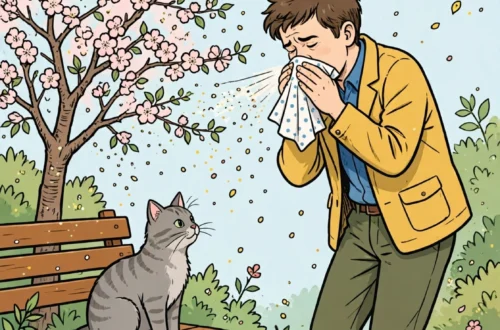
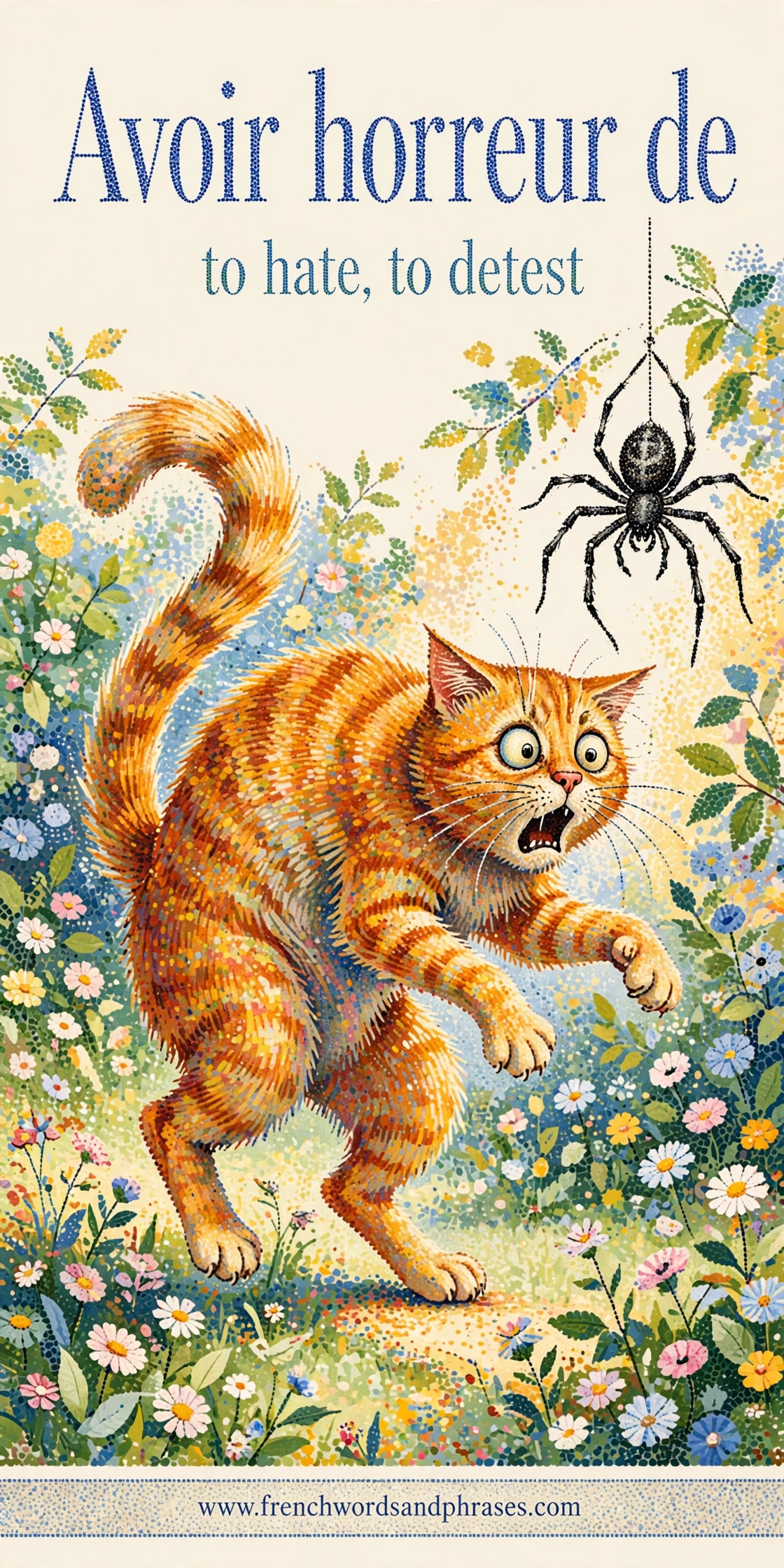
The spider is small, motionless, and exactly in the middle of the bathroom ceiling. Your flatmate takes one look, backs out of the doorway with her towel still over her shoulder, and announces it to the whole flat: « J’ai horreur des araignées ! » The shower can wait. Possibly forever.
Let’s explore how avoir horreur de works in French, beginning with the whole phrase on one card.
Understanding the French Phrase Avoir horreur de
Avoir horreur de is a French expression built from avoir (to have), horreur (horror, loathing) and de. It is French’s strongest everyday way to say you hate something — not a mild dislike but a whole-body detestation: spiders, queues, hypocrisy, getting up early.
It means to hate, to detest, to be unable to stand. Where détester is a clean, direct verb, avoir horreur de dresses the hatred in horror: the thing is not just disliked, it makes your skin crawl. French uses it constantly and often half-humorously — j’ai horreur de me lever tôt — which keeps its strength bearable.
Type: Expression — strong aversion (avoir + horreur + de + noun or infinitive)
Answers the need: Saying you hate or detest something, thoroughly
Register: Neutral to expressive — everyday speech everywhere, often with a smile
Strength: Maximum dislike — the top of the French aversion scale
One important usage detail: the thing hated takes de, and with a definite noun the de joins the article — horreur des araignées (de + les), horreur du bruit (de + le). Before an infinitive it stays de: j’ai horreur de attendre. The exclamation quelle horreur ! is a separate creature: it reacts to something dreadful or ugly, it does not name a hatred.
Experience the Word
Avoir horreur de is dislike with the volume turned up — and French, which loves measure, uses its loudest aversion phrase with surprising lightness.
Imagine a queue at the bakery on Sunday morning, twenty people deep, and a grandfather shaking his head at the length of it. J’ai horreur de faire la queue, he announces — then joins it anyway, because the bread is worth it. The horror is real; so is the good humour it is said with.
French hatred, in this phrase, is theatrical. Avoir horreur de lets you detest something completely — and stay charming while you do it.
How to Use Avoir horreur de in French: Complete Guide
Let’s explore how avoir horreur de works in French, beginning with the whole phrase on one card.
Avoir horreur de at a Glance
The Whole Phrase on One Card
Real meaning, literal picture, English twin and register — avoir horreur de in five lines.
| Point | Avoir horreur de |
|---|---|
| What it really means | to hate, to detest — to be unable to stand something |
| Word for word | to have horror of |
| English equivalent | to hate / to detest / I can’t stand… |
| Register | neutral to expressive — everyday, often half-humorous |
| Use it for | spiders, queues, noise, hypocrisy — your personal horrors |
Example
J’ai horreur des araignées.
I hate spiders.
Word by Word: Building the Loathing
Three small pieces — take them one by one and the shudder builds itself.
| Word | Literal meaning | Its job in the phrase |
|---|---|---|
| avoir | to have | the verb that holds the feeling — the horror is carried in you |
| horreur | horror, loathing | a feminine noun, une horreur — borrowed from the cinema of fear and put to work in the kitchen |
| de | of | the link that names the hated thing — joining the article when a noun follows: des, du |
Example
Elle a horreur du mensonge.
She detests lying.
Quick Quiz 1
How does de appear before les araignées — de les or des?
Reveal the answer
Des — de + les always contracts to des: horreur des araignées. With le it becomes du: horreur du bruit.
Il a horreur des foules et du bruit.
He hates crowds and noise.
When You Say It: The Detestation Moments
Avoir horreur de fires at moments like these — everyone has a list, and the phrase introduces it.
| Situation | Example |
|---|---|
| Creatures | j’ai horreur des serpents — I can’t stand snakes |
| Daily ordeals | elle a horreur de faire la queue — she hates queueing |
| Early mornings | il a horreur de se lever tôt — he hates getting up early |
| Character faults | nous avons horreur de l’hypocrisie — we detest hypocrisy |
| Foods | les enfants ont horreur des épinards — the children hate spinach |
Example
J’ai horreur de repasser, c’est ma corvée détestée.
I hate ironing — it’s my most detested chore.
Make It Yours: Hatred in Every Shape
The phrase takes people, things and actions — and turns up or down with the company it keeps.
| Form | French | In English |
|---|---|---|
| I hate | j’ai horreur de | I hate, I detest |
| Hating a thing | j’ai horreur du froid | I hate the cold |
| Hating an action | j’ai horreur d’attendre | I hate waiting |
| Hating a person | il a horreur de son voisin | he can’t stand his neighbour |
| Softened by humour | j’ai horreur de ça, moi ! | I hate that, me! (said with a grin) |
| Question | tu as horreur de quoi, toi ? | what do you hate, then? |
Example
Tu as horreur des films d’horreur ? Moi aussi.
You hate horror films? Me too.
Quick Quiz 2
Is avoir horreur de stronger or weaker than ne pas aimer?
Reveal the answer
Much stronger — ne pas aimer is a calm ‘don’t like’; avoir horreur de is the top of the scale: detestation, skin-crawling hatred.
Je n’aime pas le café, mais j’ai horreur du thé fumé.
I don’t like coffee, but I detest smoked tea.
Everyday Expressions: Building on the Loathing
Avoir horreur de slots into these everyday frames — each one ready to use as it stands.
| Frame | In English |
|---|---|
| avoir horreur de + noun | to hate, to detest something |
| avoir horreur de + infinitive | to hate doing something |
| j’ai horreur de ça | I hate that |
| avoir horreur de quelqu’un | to be unable to stand someone |
| quelle horreur ! | how dreadful! (a separate exclamation — a reaction, not a hatred) |
Example
Elle a horreur de parler en public, vraiment horreur.
She hates speaking in public — really hates it.
Close Cousins: The Aversion Scale
French grades hatred carefully — avoir horreur de sits at the top; its cousins mark every step down.
| Expression | The difference |
|---|---|
| avoir horreur de | to detest — the strongest, with a shudder of horror in it |
| détester | to hate, to detest — the direct verb, strong and clean, the neutral top choice |
| ne pas supporter | to be unable to stand — endurance language: the thing exceeds your tolerance |
| ne pas aimer | to not like — calm, measured, the polite middle |
| avoir horreur de… mais | the classic French softener — total hatred, immediately excused by love of the result |
Example
Je déteste attendre, mais je ne supporte pas non plus la précipitation.
I hate waiting, but I can’t stand rushing either.
Quick Quiz 3
Which cousin speaks of tolerance exceeded — détester or ne pas supporter?
Reveal the answer
Ne pas supporter — to be unable to stand it: the thing is more than you can bear. Détester is pure hatred, no measuring involved.
Je ne supporte plus ce bruit de perceuse.
I can’t stand this drill noise any more.
Avoir horreur de and Its Neighbours
The aversion shelf around the phrase — from mild distaste to the beloved opposite.
| French | In English |
|---|---|
| adorer | to love, to adore — the exact opposite pole |
| un cauchemar | a nightmare — what the hated thing feels like |
| insupportable | unbearable, unstandable |
| une phobie | a phobia — hatred with a clinical name |
| dégoûtant | disgusting — the quality that triggers the horror |
| se forcer | to force yourself — what you do despite the horror |
Example
Il adore les araignées, elle en a horreur : beau couple.
He loves spiders, she hates them: a fine couple.
Watch Out: The Traps Around Avoir horreur de
The traps: contractions that cannot be skipped, an exclamation that is not a hatred, and horror borrowed from the wrong film.
| Trap | The truth |
|---|---|
| de les, de le | the contractions are compulsory — horreur des araignées, horreur du bruit; de les and de le do not exist |
| quelle horreur ! | the exclamation reacts to something dreadful — a dress, a disaster — it does not say what you hate |
| too strong for tastes | for ordinary preferences French is milder: je n’aime pas trop le café. Horreur is for real detestation — or deliberate comic excess |
| word for word in English | ‘to have horror of’ creaks — English says to hate, to detest, can’t stand |
Example
Quelle horreur, ce prix ! Moi qui ai déjà horreur de dépenser…
What a dreadful price! And I already hate spending…
Quick Quiz 4
True or false: j’ai horreur de les araignées is correct French.
Reveal the answer
False — de + les contracts, always: j’ai horreur des araignées.
Elle a horreur des souris et des araignées.
She hates mice and spiders.
Avoir horreur de in Everyday French: Real-Life Examples
Now that you know the word, let’s see how avoir horreur de appears in everyday French.
Example 1 — In the bathroom
J’ai horreur des araignées, même des petites.
I hate spiders, even the small ones.
Example 2 — At the market
Elle a horreur de faire la queue, elle vient à huit heures.
She hates queueing — she comes at eight o’clock.
Example 3 — Early rising
Il a horreur de se lever tôt, surtout l’hiver.
He hates getting up early, especially in winter.
Example 4 — At the office
Nous avons horreur des réunions qui ne finissent jamais.
We hate meetings that never end.
Example 5 — Strong tastes
Les enfants ont horreur des choux de Bruxelles.
The children detest Brussels sprouts.
Example 6 — The confession
J’ai horreur de le dire, mais j’ai horreur de ton chapeau.
I hate to say it, but I hate your hat.
Beyond Translation: The Meaning of Avoir horreur de
Horreur is a word French borrowed from the theatre and the cinema — the genre of fear — and then, characteristically, brought into the kitchen. The result is a hatred that performs itself a little: j’ai horreur des araignées is a small stage speech, and everyone listening smiles even as they fetch the glass and the postcard.
To avoir horreur de is to detest with style — the shudder is real, and so is the wink.
It is the politest maximum in French: nothing stronger exists on the aversion scale, yet the phrase offends no one, because its theatre makes clear the horror is yours, not theirs.
How to Remember the French Phrase Avoir horreur de
Remember it this way: Avoir horreur de is hatred borrowed from the horror film — a full shudder, worn with a smile.
- You contract without mercy — horreur des araignées, horreur du bruit: de + les and de + le always merge.
- You place it at the top of the scale — above détester in drama, far above the calm ne pas aimer.
- You keep the exclamation apart — quelle horreur ! reacts to a dreadful thing; it names no hatred.
The key idea is avoir horreur de means to hate, to detest — the top of the aversion scale, with de contracting to des or du before nouns.
Test Your Knowledge of Avoir horreur de
Let’s see how much you’ve learned. Try answering these questions before revealing the answers.
Question 1
What does avoir horreur de mean?
Reveal the answer
To hate, to detest — to be unable to stand something.
Question 2
How do you say ‘I hate spiders’?
Reveal the answer
J’ai horreur des araignées — de + les contracts to des.
Question 3
Where does avoir horreur de sit on the aversion scale?
Reveal the answer
At the very top — stronger than détester in colour, far stronger than ne pas aimer.
Question 4
What does quelle horreur ! mean, and how is it different?
Reveal the answer
‘How dreadful!’ — an exclamation reacting to something awful; it does not name a thing you hate.
Question 5
Complete the sentence:
J’ai horreur ______ bruit le matin. (I hate noise in the morning.)
Reveal the answer
du
J’ai horreur du bruit le matin.
I hate noise in the morning.
Your Final Challenge
Can You Use It?
How would you say this in French?
“I hate spiders.”
Reveal the answer
J’ai horreur des araignées.
I hate spiders.
A little French. A little curiosity. A richer everyday life.
LEARN FRENCH ONE WORD AT A TIME