A French Word to Live By
Translate Avoir l’air to English
/a.vwaʁ lɛʁ/
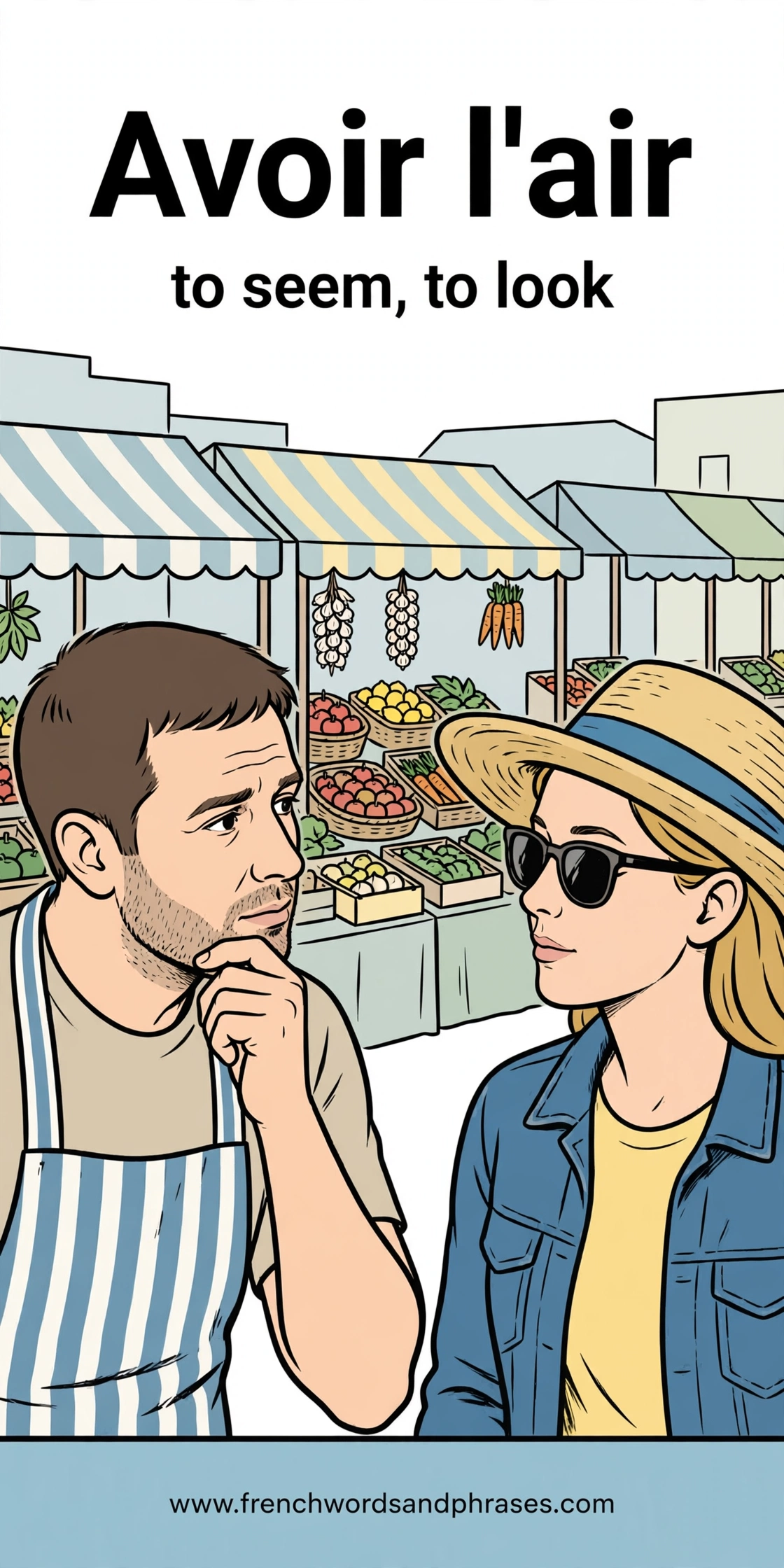
Avoir l’air means to seem — to look, to appear (avoir l’air + adjective).
Your neighbour comes back from three weeks by the sea, rested, tanned, two kilos lighter, and the concierge greets her in the doorway with the compliment French keeps ready for exactly this moment: « Vous avez l’air en forme ! » Nothing has been measured or proven — it is all in the air she carries with her.
Let’s explore how avoir l’air works in French, beginning with the whole phrase on one card.
Understanding the French Phrase Avoir l’air
Avoir l’air is a French expression built from avoir (to have) and l’air (the air, the look, the appearance). Followed by an adjective, it is the standard French way to say someone seems or looks a certain way: il a l’air fatigué, he looks tired. The verdict comes from the surface — from the air a person gives off.
It means to seem, to look, to appear. French judges by l’air — the visible atmosphere around a person: their face, their posture, their colour. Avoir l’air is therefore a judgement with a built-in modesty: it reports an impression, not a fact. He may be perfectly well; il a l’air fatigué is only what his face announces.
Type: Expression — appearance (avoir + l’air + adjective, or de + infinitive)
Answers the need: Saying someone looks or seems a certain way
Register: Neutral — the everyday verb of appearances, safe everywhere
Strength: Impression, not proof — the phrase itself admits it is judging by looks
One important usage detail: the adjective after avoir l’air traditionally agrees with air in careful grammar (elle a l’air fatigué, air being masculine), but modern usage very often agrees with the person (elle a l’air fatiguée) — both are heard, and the person-agreement is now the commoner in speech. Followed by de plus an infinitive, it means to look as if: il a l’air de dormir, he looks as if he is asleep.
Experience the Word
Avoir l’air is French politeness built into grammar — a way to describe people that admits, in the very phrase, that you might be wrong.
Imagine the first day back after the holidays, a whole office reading each other’s faces at the coffee machine. Tu as l’air reposé. Elle a l’air soucieuse. Nobody claims knowledge; everyone trades in airs — and the impressions, traded kindly, become the morning’s real news.
French is a civilisation of the surface, unashamed. Avoir l’air says the surface is worth reading — it just refuses to call the reading a certainty.
How to Use Avoir l’air in French: Complete Guide
Let’s explore how avoir l’air works in French, beginning with the whole phrase on one card.
Avoir l’air at a Glance
The Whole Phrase on One Card
Real meaning, literal picture, English twin and register — avoir l’air in five lines.
| Point | Avoir l’air |
|---|---|
| What it really means | to seem, to look — to give the impression of being |
| Word for word | to have the air (the look, the appearance) |
| English equivalent | to look / to seem / to appear |
| Register | neutral — the everyday verb of appearances |
| Use it for | faces, moods, health, weather in people — every first impression |
Example
Tu as l’air fatigué, assieds-toi.
You look tired — sit down.
Word by Word: Building the Impression
Two small pieces — take them one by one and the first impression builds itself.
| Word | Literal meaning | Its job in the phrase |
|---|---|---|
| avoir | to have | the verb that holds the impression — the look is something a person carries |
| l’air | the air, the look | a masculine noun — not the air you breathe, but the air you give off: face, bearing, expression |
Example
Cette maison a l’air abandonnée.
This house looks abandoned.
Quick Quiz 1
Does avoir l’air fatigué prove the person is tired?
Reveal the answer
No — the phrase reports an impression, and says so: he looks tired. The truth might be a bad light, a long day, or nothing at all.
Il a l’air fatigué, mais il dit qu’il va très bien.
He looks tired, but he says he is very well.
When You Say It: The First-Impression Moments
Avoir l’air fires at moments like these — a face is read, kindly or not, and the reading is shared.
| Situation | Example |
|---|---|
| A compliment | vous avez l’air en forme ! — you look well, you look in great shape! |
| A worry | elle a l’air malade, tu ne trouves pas ? — she looks ill, don’t you think? |
| A mood read at a glance | il a l’air content ce matin — he looks happy this morning |
| Doubt about food | ce poisson n’a pas l’air frais — this fish doesn’t look fresh |
| Looking as if | ils ont l’air de s’ennuyer — they look as if they are bored |
Example
Tu as l’air heureux, raconte-moi tout.
You look happy — tell me everything.
Make It Yours: Impressions for Every Face
The phrase takes an adjective, a de plus infinitive, or even a whole comparison — appearances in every shape.
| Form | French | In English |
|---|---|---|
| With an adjective | il a l’air fatigué | he looks tired |
| For a woman, spoken style | elle a l’air fatiguée | she looks tired (agreement with the person — very common) |
| Looks as if + verb | il a l’air de dormir | he looks as if he is asleep |
| Looks like a noun | elle a l’air d’une actrice | she looks like an actress |
| The opposite verdict | il n’a pas l’air commode | he doesn’t look easy-going |
| Question | j’ai l’air fatigué ? | do I look tired? |
Example
Elle a l’air d’avoir vingt ans.
She looks twenty years old.
Quick Quiz 2
Grammar books: elle a l’air fatigué or fatiguée?
Reveal the answer
Both live in French — the strict rule agrees with air (masculine: fatigué), but everyday French overwhelmingly agrees with the person (fatiguée). You will be understood, and correct, with either.
Elle a l’air fatiguée après ce long voyage.
She looks tired after that long journey.
Everyday Expressions: Building on the Impression
Avoir l’air slots into these everyday frames — each one ready to use as it stands.
| Frame | In English |
|---|---|
| avoir l’air + adjective | to look, to seem (a quality) |
| avoir l’air de + infinitive | to look as if (doing something) |
| avoir l’air d’un / d’une + noun | to look like a… |
| avoir l’air en forme | to look well, to look in good shape |
| ça a l’air bon | that looks good (food, plans, anything) |
Example
Ça a l’air bon, ce gâteau, je peux goûter ?
That cake looks good — can I taste it?
Close Cousins: The Other Ways to Seem
French seems in several keys — avoir l’air is the visual one; its cousins think, judge or turn out.
| Expression | The difference |
|---|---|
| avoir l’air | to look, to seem — the verdict of the eyes, from a face or a surface |
| sembler | to seem — the general verb, for facts and impressions alike, a touch more formal |
| paraître | to appear, to seem — the literary cousin, also ‘to be published’ for books |
| on dirait | it looks like, you’d say — the spoken twin, judging by appearances out loud |
| avoir l’air de rien | to look harmless, unremarkable — often hiding more than it shows |
Example
On dirait un professeur, avec ses lunettes.
He looks like a teacher, with his glasses.
Quick Quiz 3
A quiet colleague turns out to run marathons. Which cousin describes her — avoir l’air de rien?
Reveal the answer
Yes — avoir l’air de rien means to look like nothing special, harmless and unremarkable — while hiding reserves nobody guessed.
Elle a l’air de rien, mais elle court le marathon en trois heures.
She looks unremarkable, but she runs the marathon in three hours.
Avoir l’air and Its Neighbours
The appearance shelf around the phrase — impressions on one side, the reality check on the other.
| French | In English |
|---|---|
| l’apparence | appearance — the noun of the whole family |
| une mine | a look, a complexion — avoir bonne mine, to look well |
| être en forme | to be in shape, to be well — the fact behind the compliment |
| faire semblant | to pretend — appearances deliberately arranged |
| les apparences sont trompeuses | appearances are deceptive — the family’s warning label |
| en réalité | in reality — what the air may be hiding |
Example
Il a bonne mine, mais les apparences sont trompeuses : il est épuisé.
He looks well, but appearances are deceptive: he is exhausted.
Watch Out: The Traps Around Avoir l’air
The traps: an adjective that wanders, air confused with song, and être used where the eyes should judge.
| Trap | The truth |
|---|---|
| agreement anxiety | fatigué (with air) is the grammarian’s form, fatiguée (with the woman) is the street’s — do not let the choice stop the sentence |
| l’air is also a tune | un air de musique is a melody — whistling one is charming, but avoir l’air never sings |
| il est fatigué vs il a l’air fatigué | être states the fact, avoir l’air reports the look — use the second when you are guessing from a face |
| word for word in English | ‘to have the air tired’ collapses — English says to look tired, to seem tired |
Example
Il n’est pas triste, il a seulement l’air fatigué.
He is not sad, he just looks tired.
Quick Quiz 4
True or false: avoir l’air can be followed by de plus an infinitive.
Reveal the answer
True — il a l’air de dormir, she looks as if she knows: avoir l’air de + infinitive means to look as if.
Ils ont l’air de bien s’amuser.
They look as if they are having a good time.
Avoir l’air in Everyday French: Real-Life Examples
Now that you know the word, let’s see how avoir l’air appears in everyday French.
Example 1 — The compliment
Vous avez l’air en forme, les vacances vous ont réussi.
You look in great shape — the holiday has done you good.
Example 2 — The tired friend
Tu as l’air fatigué, va te reposer.
You look tired — go and rest.
Example 3 — The doubtful dish
Cette soupe a l’air délicieuse.
This soup looks delicious.
Example 4 — Looking as if
Il a l’air de chercher quelque chose.
He looks as if he is looking for something.
Example 5 — The deceptive quiet one
Elle a l’air de rien, mais c’est la meilleure joueuse de l’équipe.
She looks unremarkable, but she is the team’s best player.
Example 6 — The weather in a face
Le ciel a l’air menaçant, prends un parapluie.
The sky looks threatening — take an umbrella.
Beyond Translation: The Meaning of Avoir l’air
Every culture reads faces; French is simply honest about the reading. Avoir l’air builds the disclaimer into the compliment and the criticism alike: this is the air you give off, no more, no less. It is the grammar of a civilisation that takes surfaces seriously — and refuses, politely, to mistake them for souls.
To avoir l’air is to be judged by your weather — and French knows weather changes.
That is why the phrase carries compliments so well: vous avez l’air en forme praises the whole visible person, and leaves the rest respectfully uninspected.
How to Remember the French Phrase Avoir l’air
Remember it this way: Avoir l’air is judgement by weather — you read the air around a person, and the phrase itself admits it is only a reading.
- You follow it with an adjective — l’air fatigué, l’air content, l’air en forme: the look gets a name.
- You add de for actions — l’air de dormir, l’air de s’ennuyer: to look as if.
- You let the agreement breathe — grammarians agree with air, the street agrees with the person; both are heard daily.
The key idea is avoir l’air means to seem, to look — an impression read from a person’s air, with an adjective or de + infinitive.
Test Your Knowledge of Avoir l’air
Let’s see how much you’ve learned. Try answering these questions before revealing the answers.
Question 1
What does avoir l’air mean?
Reveal the answer
To seem, to look — to give the impression of being a certain way.
Question 2
How do you say ‘he looks tired’?
Reveal the answer
Il a l’air fatigué — avoir l’air plus an adjective.
Question 3
How do you say ‘she looks as if she is sleeping’?
Reveal the answer
Elle a l’air de dormir — avoir l’air de plus an infinitive.
Question 4
What does avoir l’air en forme mean?
Reveal the answer
To look well, in good shape — the classic French compliment on a healthy appearance.
Question 5
Complete the sentence:
Tu ______ l’air content aujourd’hui. (You look happy today.)
Reveal the answer
as
Tu as l’air content aujourd’hui.
You look happy today.
Your Final Challenge
Can You Use It?
How would you say this in French?
“You look tired today.”
Reveal the answer
Tu as l’air fatigué aujourd’hui.
You look tired today.
A little French. A little curiosity. A richer everyday life.
LEARN FRENCH ONE WORD AT A TIME