A French Word to Live By
Translate Avoir honte de to English
/a.vwaʁ ɔ̃t də/
Avoir honte de means to be ashamed of — to feel shame about something.
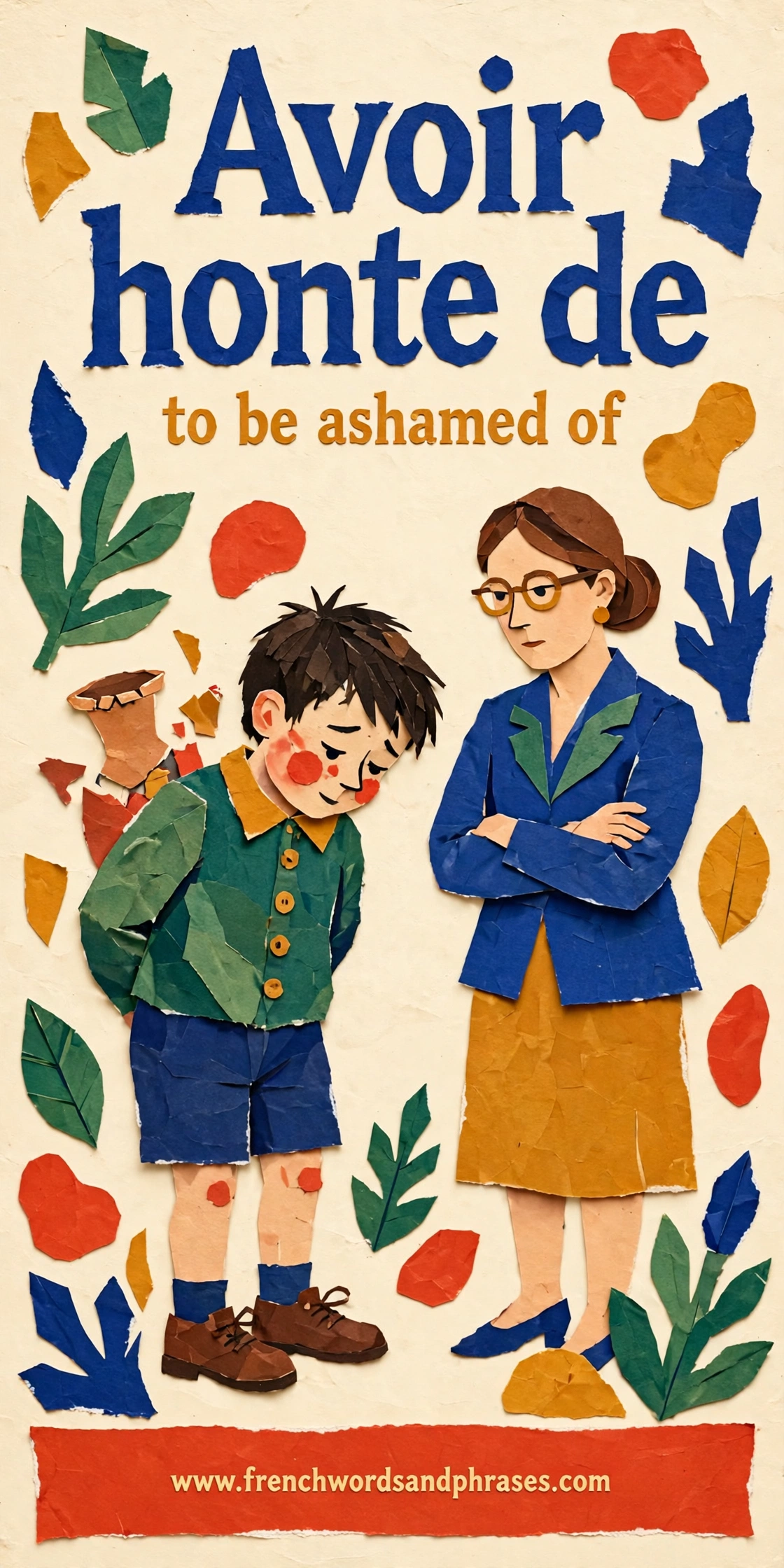
The vase was already cracked, everyone knew that — but it was the dog who got the blame, all evening, until your little cousin could stand it no longer. Red-faced, staring at her shoes, she whispers it to the whole table: « J’ai honte. » The room goes quiet, then kind.
Let’s explore how avoir honte de works in French, beginning with the whole phrase on one card.
Understanding the French Phrase Avoir honte de
Avoir honte de is a French expression built from avoir (to have), la honte (shame) and de. It is the standard French way to say you are ashamed — of something you did, of something you are, or on behalf of someone else. The shame is a thing you carry, and the de names its cause.
It means to be ashamed of, to feel shame about. J’ai honte de mon comportement: I am ashamed of my behaviour. French also uses the phrase in a famous sharpened form — avoir honte pour quelqu’un, to feel shame on someone else’s behalf, the cringing embarrassment of watching another person disgrace themselves.
Type: Expression — emotion (avoir + honte + de + noun or infinitive)
Answers the need: Saying you are ashamed — of an act, a failure, or for someone else
Register: Neutral — everyday speech and writing; strong but never slangy
Strength: Strong — real shame, though often softened by tu n’as pas à avoir honte, you have nothing to be ashamed of
One important usage detail: the cause follows de — honte de mentir, honte de son échec. With de plus an infinitive, the shame is about doing: j’ai honte de le dire, I am ashamed to say it. Note too that honte alone, with no de at all, makes the famous exclamation of protest: c’est une honte ! — it’s a disgrace, it’s scandalous.
Experience the Word
Avoir honte de is shame spoken aloud — and in French, saying it is already half of the repair, because the phrase admits the fault before anyone else names it.
Imagine the apprentice who has ruined the sauce in a busy kitchen, certain the chef’s anger is coming. Instead the old chef tastes, shrugs, and tells of his own first year. Tu n’as pas à avoir honte, he says — you have nothing to be ashamed of. The shame drains out of the room like steam.
French treats shame as a weight, not a stain. What you have can be set down — and avoir honte, said honestly, is how the setting-down begins.
How to Use Avoir honte de in French: Complete Guide
Let’s explore how avoir honte de works in French, beginning with the whole phrase on one card.
Avoir honte de at a Glance
The Whole Phrase on One Card
Real meaning, literal picture, English twin and register — avoir honte de in five lines.
| Point | Avoir honte de |
|---|---|
| What it really means | to be ashamed of — to feel shame about something |
| Word for word | to have shame of |
| English equivalent | to be ashamed of / to feel ashamed |
| Register | neutral — speech and writing, strong but proper |
| Use it for | faults admitted, failures owned, shame felt for others |
Example
J’ai honte de mon comportement hier soir.
I am ashamed of my behaviour last night.
Word by Word: Building the Shame
Three small pieces — take them one by one and the blush builds itself.
| Word | Literal meaning | Its job in the phrase |
|---|---|---|
| avoir | to have | the verb that holds the feeling — shame is carried, like the other avoir states |
| honte | shame | a feminine noun, la honte — the silent h means de never shortens strangely, but the article drops in the set phrase |
| de | of, about | the link that names the cause — a noun or an infinitive follows |
Example
Il a honte de ses notes ce trimestre.
He is ashamed of his marks this term.
Quick Quiz 1
You feel shame because of something your brother did. Honte de lui or honte pour lui?
Reveal the answer
Honte pour lui — shame on someone else’s behalf takes pour. Honte de names your own cause; honte pour is the cringe you feel watching another.
Quand il a chanté faux devant tout le monde, j’ai eu honte pour lui.
When he sang off-key in front of everyone, I felt ashamed for him.
When You Say It: The Ashamed Moments
Avoir honte de fires at moments like these — a fault is owned, or someone else’s behaviour makes you cringe.
| Situation | Example |
|---|---|
| Admitting a fault | j’ai honte de ce que j’ai dit — I am ashamed of what I said |
| A failure | elle a honte de son échec à l’examen — she is ashamed of failing the exam |
| Ashamed to speak | il a honte de le dire, mais il a besoin d’aide — he is ashamed to say it, but he needs help |
| For someone else | nous avions honte pour lui pendant son discours — we felt ashamed for him during his speech |
| Nothing to hide | tu n’as pas à avoir honte de tes origines — you have no reason to be ashamed of your origins |
Example
Elle n’a pas à avoir honte : elle a fait de son mieux.
She has nothing to be ashamed of: she did her best.
Make It Yours: Shame in Every Shape
The phrase softens into reassurance as easily as it sharpens into protest — context does the work.
| Form | French | In English |
|---|---|---|
| I am ashamed | j’ai honte | I am ashamed |
| Ashamed of a thing | j’ai honte de mon erreur | I am ashamed of my mistake |
| Ashamed to do | j’ai honte de demander | I am ashamed to ask |
| For someone else | avoir honte pour quelqu’un | to feel ashamed for someone |
| No need for shame | tu n’as pas à avoir honte | you have nothing to be ashamed of |
| As protest | c’est une honte ! | it’s a disgrace! (a different, famous use) |
Example
J’ai honte de le dire, mais je ne sais pas nager.
I am ashamed to say it, but I can’t swim.
Quick Quiz 2
A price doubles overnight and people protest: c’est une honte ! Who is ashamed?
Reveal the answer
Nobody, exactly — c’est une honte ! means ‘it’s a disgrace, it’s scandalous’: the shame is thrown at the situation, not felt by the speaker.
Doubler les prix en une semaine, c’est une honte !
Doubling the prices in one week — it’s a disgrace!
Everyday Expressions: Building on the Shame
Avoir honte de slots into these everyday frames — each one ready to use as it stands.
| Frame | In English |
|---|---|
| avoir honte de + noun | to be ashamed of something |
| avoir honte de + infinitive | to be ashamed to do something |
| avoir honte pour quelqu’un | to feel ashamed on someone’s behalf |
| tu n’as pas à avoir honte | you have nothing to be ashamed of |
| c’est une honte ! | it’s a disgrace! it’s scandalous! |
Example
Il a honte de demander de l’aide, et c’est bien dommage.
He is ashamed to ask for help, and that is a real pity.
Close Cousins: The Other Shame Words
French shades shame finely — avoir honte de is the honest centre; its cousins embarrass, disgrace or blush.
| Expression | The difference |
|---|---|
| avoir honte de | to be ashamed of — your own fault or failure, honestly felt |
| être gêné | to be embarrassed, uncomfortable — lighter, social awkwardness |
| être mort de honte | to be mortified — shame at maximum, informal exaggeration |
| faire honte à quelqu’un | to shame someone, to disgrace them — the shame is aimed at another |
| rougir de honte | to blush with shame — the body’s visible answer |
Example
Elle était morte de honte quand son téléphone a sonné au théâtre.
She was mortified when her phone rang in the theatre.
Quick Quiz 3
Which cousin is mere social embarrassment, lighter than shame — être gêné or être mort de honte?
Reveal the answer
Être gêné — embarrassed, ill at ease. Mort de honte is the opposite end: mortified.
Il était un peu gêné, mais pas honteux.
He was a bit embarrassed, but not ashamed.
Avoir honte de and Its Neighbours
The conscience shelf around the phrase — from the first blush to the clean apology.
| French | In English |
|---|---|
| la pudeur | modesty, reserve — shame’s respectable cousin |
| s’excuser | to apologise — shame’s way out |
| regretter | to regret — the cooler, thinking feeling |
| la fierté | pride — shame’s exact opposite |
| sans honte | shameless — without shame, said with disapproval |
| demander pardon | to ask forgiveness |
Example
Il s’est excusé, et la honte est partie avec les excuses.
He apologised, and the shame left with the apology.
Watch Out: The Traps Around Avoir honte de
The traps: an English adjective that misleads, shame aimed the wrong way, and honte where gêne belongs.
| Trap | The truth |
|---|---|
| je suis honte | honte is a noun — French has shame with avoir: j’ai honte, never je suis honte |
| honte de vs honte pour | de names your own cause; pour is shame felt for another person’s behaviour — swapping them changes the story |
| too strong for small awkwardness | a forgotten name or a wrong door is gêne, embarrassment — save honte for real faults |
| word for word in English | ‘to have shame of’ is understandable but stiff — English says to be ashamed of |
Example
J’ai honte de mon retard, pas seulement de la gêne.
I am ashamed of being late — not merely embarrassed.
Quick Quiz 4
True or false: avoir honte can be said with nothing after it.
Reveal the answer
True — j’ai honte stands alone perfectly; de adds the cause when you want to name it.
J’ai honte, pardonne-moi.
I am ashamed, forgive me.
Avoir honte de in Everyday French: Real-Life Examples
Now that you know the word, let’s see how avoir honte de appears in everyday French.
Example 1 — The confession
J’ai honte de ce que j’ai fait, je te demande pardon.
I am ashamed of what I did — I ask your forgiveness.
Example 2 — The exam
Il a honte de sa note, il la cache à ses parents.
He is ashamed of his mark, he hides it from his parents.
Example 3 — The reassurance
Tu n’as pas à avoir honte, tout le monde se trompe.
You have nothing to be ashamed of — everyone makes mistakes.
Example 4 — For a friend
Quand il a menti devant le patron, j’ai eu honte pour lui.
When he lied in front of the boss, I felt ashamed for him.
Example 5 — Ashamed to ask
Elle a honte de demander, alors elle se débrouille seule.
She is ashamed to ask, so she manages on her own.
Example 6 — The protest
Laisser ces gens sans abri, c’est une honte !
Leaving these people homeless — it’s a disgrace!
Beyond Translation: The Meaning of Avoir honte de
English is ashamed — shame as an identity, a state of the whole person. French has shame, and the difference is merciful: a possession can be examined, named, and set down. The phrase even builds in the remedy — tu n’as pas à avoir honte, you do not have to carry this.
To avoir honte de is to hold your fault in your hands — where it can be looked at, and then put away.
And French keeps a second use for the public square: c’est une honte ! — shame picked up and thrown at injustice, where it belongs.
How to Remember the French Phrase Avoir honte de
Remember it this way: Avoir honte de is shame carried in the hands — heavy, honest, and made to be set down again.
- You never say je suis honte — shame is had, like the rest of the avoir family.
- You aim it carefully — de for your own cause, pour for shame felt on someone else’s behalf.
- You keep the protest apart — c’est une honte ! throws shame at a situation; it feels none itself.
The key idea is avoir honte de means to be ashamed of — shame you have, with de naming the cause and pour naming another person.
Test Your Knowledge of Avoir honte de
Let’s see how much you’ve learned. Try answering these questions before revealing the answers.
Question 1
What does avoir honte de mean?
Reveal the answer
To be ashamed of — to feel shame about something.
Question 2
How do you say ‘I am ashamed of what I said’?
Reveal the answer
J’ai honte de ce que j’ai dit — de names the cause.
Question 3
What does avoir honte pour quelqu’un add?
Reveal the answer
Shame on someone else’s behalf — the cringe you feel at another person’s behaviour.
Question 4
What does c’est une honte ! mean?
Reveal the answer
It’s a disgrace! — a protest at a scandalous situation, not a confession of shame.
Question 5
Complete the sentence:
Elle ______ honte de son erreur. (She is ashamed of her mistake.)
Reveal the answer
a
Elle a honte de son erreur.
She is ashamed of her mistake.
Your Final Challenge
Can You Use It?
How would you say this in French?
“I am ashamed of what I said.”
Reveal the answer
J’ai honte de ce que j’ai dit.
I am ashamed of what I said.
A little French. A little curiosity. A richer everyday life.
LEARN FRENCH ONE WORD AT A TIME