A French Word to Live By
Translate Allergie to English
/a.lɛʁ.ʒi/
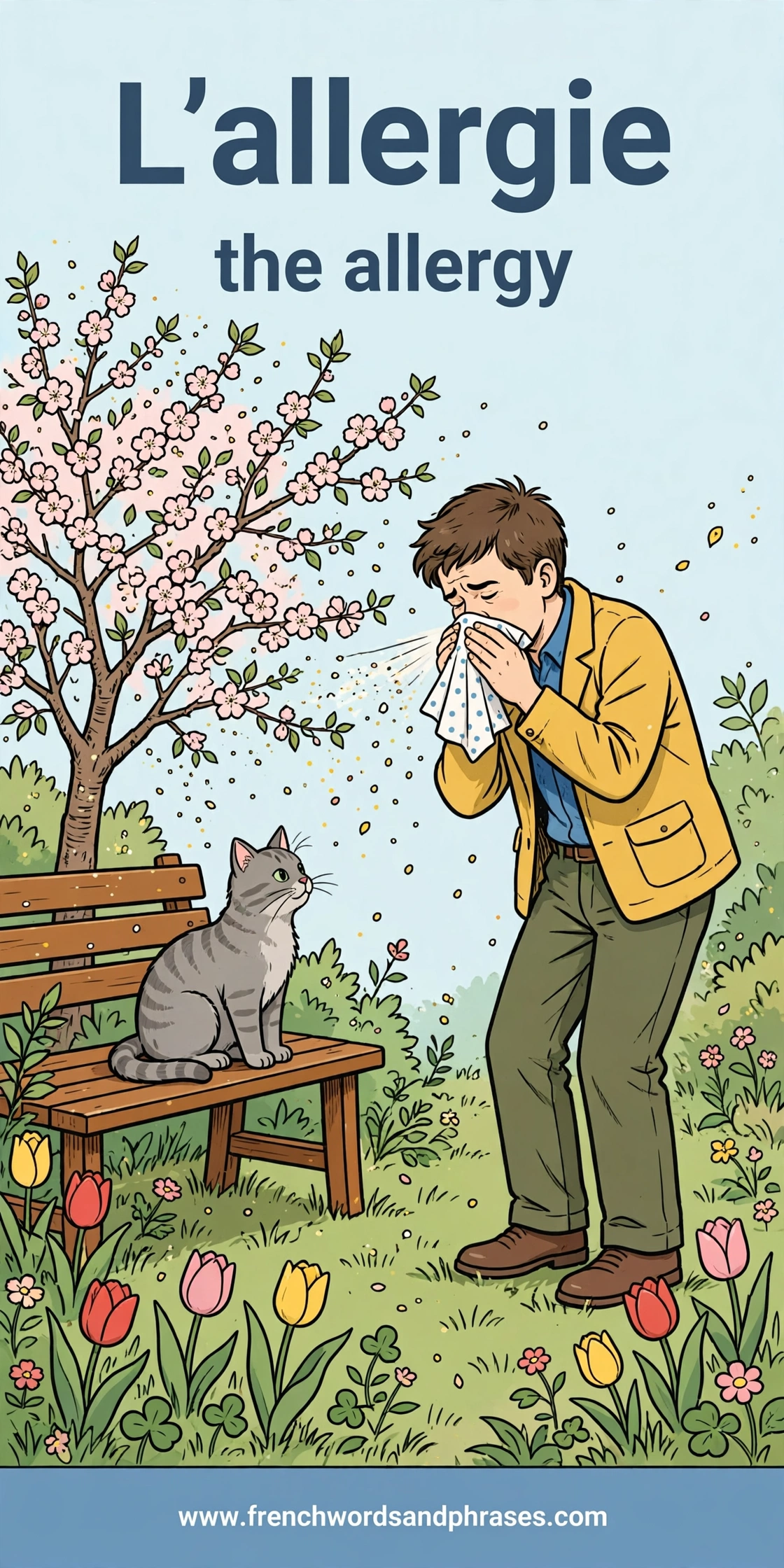
L’allergie means the allergy.
Spring in the park, the first warm wind — and a sneeze that arrives like a trumpet: l’allergie, the allergy, the body’s false alarm, mistaking a grain of pollen for an invading army.
In this guide, you’ll learn what allergie means in English, how to use it with its articles, how to form its plural, and how it appears in everyday French. Explore French examples, English translations, and practice quizzes.
Understanding the French Noun Allergie
Allergie is a feminine French noun, learned with its article: l’allergie, une allergie — the article hides in the apostrophe, because allergie begins with a vowel. The word is a modern medical coinage from Greek roots, allos (other) and ergon (work): the body working otherwise, reacting to harmless things as if they were enemies.
It means an allergy — the body’s overreaction to a substance: une allergie au pollen, a pollen allergy, une allergie aux noix, a nut allergy, être allergique à, to be allergic to. The great spring one has its own name: le rhume des foins, hay fever. French also uses the word with a smile for people: il est allergique au travail, he is allergic to work — the medical word borrowed for a very human condition.
Gender: Feminine — l’allergie
Definite article: l’ — l’allergie (the allergy)
Indefinite article: une — une allergie (an allergy)
Plural: les allergies — regular, with a simple -s
The construction: une allergie à / au / aux… — an allergy to…
The adjective: allergique — être allergique à, to be allergic to
English equivalents: The allergy.
The allergy is always à something: une allergie au pollen (à + le), aux noix (à + les), à la poussière. The person is allergique with the same à: je suis allergique aux chats, I am allergic to cats. And the spring sneezing season has its own title — le rhume des foins, hay fever, literally the hay cold.
Experience the Word
Allergie is the word for a bodyguard who attacks the guests: the defence system doing its job far too well, against pollen, dust and dinner.
Imagine the first picnic of April, the grass green, the bread and cheese out — and the uncle already sneezing into his handkerchief, eyes watering, laughing between sneezes: « C’est mon allergie, elle revient avec le printemps. » His allergy keeps the calendar better than he does.
You have not just named a condition. You have named the body’s misunderstanding — l’allergie, the false alarm that arrives every spring.
How to Use Allergie in French: Complete Guide
Let’s explore how allergie works in French, beginning with its articles — l’allergie, une allergie, une allergie au pollen.
Allergie with the Definite Article (L’, Les)
Used for a specific allergy — the famous one, the one the doctor confirmed.
| Form | French |
|---|---|
| Feminine singular | l’allergie |
| Plural | les allergies |
Example
L’allergie au pollen commence en avril.
The pollen allergy starts in April.
Allergie with the Indefinite Article (Une, Des)
Used for an allergy in general — one line on the medical form.
| Form | French |
|---|---|
| Feminine singular | une allergie |
| Plural | des allergies |
Example
Elle a une allergie aux chats.
She has a cat allergy.
Allergies and Their Causes (Au pollen, Aux noix…)
An allergy is always à something — French attaches the cause with à, au, aux.
| Cause | French |
|---|---|
| a pollen allergy | une allergie au pollen |
| a nut allergy | une allergie aux noix |
| a dust allergy | une allergie à la poussière |
| a milk allergy | une allergie au lait |
| hay fever | le rhume des foins |
Example
Son allergie aux noix est sérieuse.
His nut allergy is serious.
Quick Quiz 1
Complete the sentence:
______ allergie revient chaque printemps. (the)
Reveal the answer
L’
L’allergie revient chaque printemps.
The allergy comes back every spring — allergie is feminine and begins with a vowel, so l’.
The Plural of Allergie
Allergie takes a regular plural in -s — some unlucky people collect them.
| Number | French |
|---|---|
| Singular | l’allergie |
| Plural | les allergies |
Example
Les allergies sont fréquentes au printemps.
Allergies are common in spring.
Allergie with Possessive Adjectives (Mon, Ton, Son…)
Possessives agree with the noun: allergie is feminine, but before a vowel the possessive takes the masculine-looking form — mon allergie.
| Owner | French |
|---|---|
| my | mon allergie |
| your (tu) | ton allergie |
| his / her | son allergie |
| our | notre allergie |
| your (vous) | votre allergie |
| their | leur allergie |
Example
Mon allergie m’empêche d’avoir un chat.
My allergy stops me from having a cat.
Quick Quiz 2
Complete the sentence:
Il connaît bien ______ allergie et évite les noix. (his)
Reveal the answer
son
Il connaît bien son allergie et évite les noix.
He knows his allergy well and avoids nuts — son, because allergie begins with a vowel.
Allergie with Demonstrative Adjectives (Cette, Ces)
Used to point: cette allergie, this allergy — the new one nobody expected.
| Form | French |
|---|---|
| Feminine singular | cette allergie |
| Plural | ces allergies |
Example
Cette allergie est apparue l’année dernière.
This allergy appeared last year.
Allergie with Adjectives
Adjectives agree with allergie — feminine singular: une allergie grave, une allergie alimentaire.
| Adjective | With Allergie |
|---|---|
| grave (serious) | une allergie grave |
| alimentaire (food) | une allergie alimentaire |
| saisonnière (seasonal) | une allergie saisonnière |
| rare (rare) | une allergie rare |
| connue (known) | une allergie connue |
Example
Une allergie alimentaire demande de la prudence.
A food allergy requires care.
Quick Quiz 3
Complete the sentence:
C’est une allergie ______, elle revient au printemps. (seasonal)
Reveal the answer
saisonnière
C’est une allergie saisonnière, elle revient au printemps.
It is a seasonal allergy, it comes back in spring — saisonnière, feminine, to agree with allergie.
Everyday Expressions with Allergie
Doctors, springs and dinner tables — the allergie phrases of daily life.
| Expression | In English |
|---|---|
| être allergique à | to be allergic to |
| le rhume des foins | hay fever |
| un test d’allergie | an allergy test |
| une crise d’allergie | an allergy attack |
| allergique au travail (joke) | allergic to work — said of the lazy |
Example
Je suis allergique à la poussière.
I am allergic to dust.
Words from the Same Family as Allergie
Sneezes and seasons — the words that travel with allergie.
| French | In English |
|---|---|
| allergique | allergic (the adjective) |
| le pollen | the pollen |
| éternuer | to sneeze (the verb) |
| le médecin | the doctor |
| un mouchoir | a handkerchief |
Example
Le pollen le fait éternuer toute la journée.
The pollen makes him sneeze all day.
Quick Quiz 4
What is le rhume des foins?
Reveal the answer
Hay fever — the spring pollen allergy, literally the hay cold.
Son rhume des foins commence avec les fleurs.
His hay fever starts with the flowers.
Allergie in Everyday French: Real-Life Examples
Now that you know the word, let’s see how allergie appears in everyday French.
Example 1 — In spring
Mon allergie au pollen revient en avril.
My pollen allergy comes back in April.
Example 2 — At the doctor’s
Je suis allergique aux chats.
I am allergic to cats.
Example 3 — At dinner
Elle a une allergie aux noix, attention !
She has a nut allergy, be careful!
Example 4 — Sneezing
Le pollen fait éternuer tout le monde.
The pollen makes everyone sneeze.
Example 5 — Hay fever
Le rhume des foins gâche son pique-nique.
Hay fever spoils his picnic.
Example 6 — The joke
Lui, il est allergique au travail !
Him, he’s allergic to work!
Beyond Translation: The Meaning of Allergie
Allergie is a young word for an old misery: doctors coined it in 1906, from Greek words for « other work », because the body was working otherwise than it should. French took it everywhere — into the spring meadow (le rhume des foins), onto the menu (une allergie aux noix, printed in bold), and into the joke about the colleague who is allergique au travail. A word barely a century old that already runs from the hospital to the picnic: that is a successful word.
To say allergie is to name the body’s false alarm — and to keep a handkerchief ready.
It evokes the first warm wind, the watering eyes, and the sneeze heard across the park.
How to Remember the French Noun Allergie
Remember it this way: Allergie is the allergy — feminine with a hidden article: l’allergie, and it always points at its cause with à.
- Always feminine — l’allergie, une allergie; the la hides in the apostrophe.
- The construction — une allergie au pollen, aux noix; the person is allergique à.
- The spring name — le rhume des foins, hay fever.
The key idea is l’allergie — the allergy, feminine; être allergique à = to be allergic to.
Test Your Knowledge of Allergie
Let’s see how much you’ve learned. Try answering these questions before revealing the answers.
Question 1
Is allergie masculine or feminine?
Reveal the answer
Feminine — l’allergie, une allergie.
Question 2
How do you say I am allergic to cats?
Reveal the answer
Je suis allergique aux chats.
Question 3
Translate: She has a nut allergy.
Reveal the answer
Elle a une allergie aux noix.
Question 4
What is le rhume des foins?
Reveal the answer
Hay fever — the spring pollen allergy.
Question 5
Complete the sentence:
______ allergies reviennent au printemps. (the)
Reveal the answer
Les
Les allergies reviennent au printemps.
The allergies come back in spring.
Your Final Challenge
Can You Use It?
How would you say this in French?
“I am allergic to cats.”
Reveal the answer
Je suis allergique aux chats.
I am allergic to cats.
A little French. A little curiosity. A richer everyday life.
LEARN FRENCH ONE WORD AT A TIME