A French Word to Live By
Translate Auberge to English
/o.bɛʁʒ/
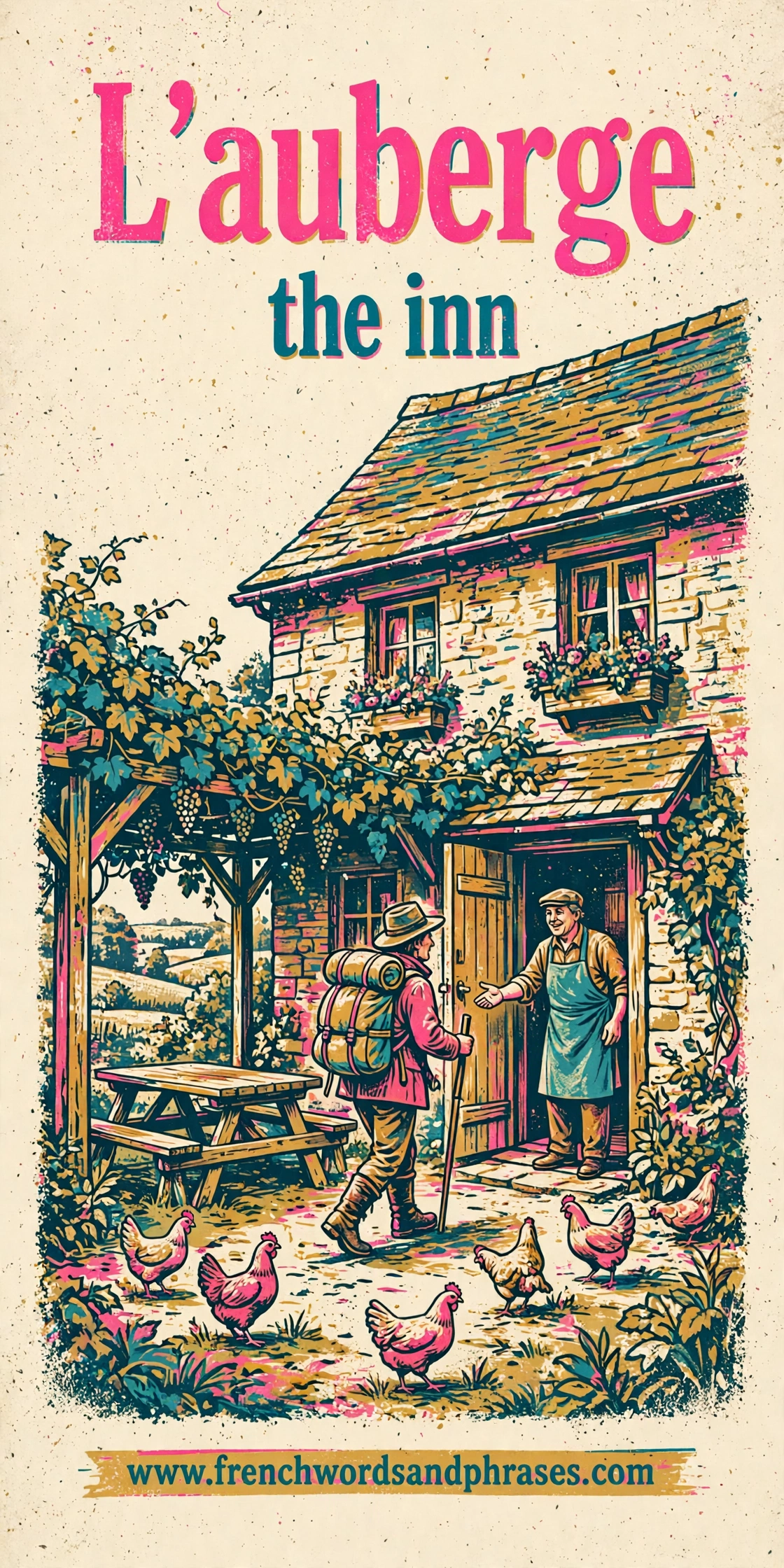
L’auberge means the inn.
A stone house on a country road, shutters open, the smell of soup drifting from the kitchen and a lamp lit for late travellers: l’auberge, the inn — France’s oldest promise of a bed, a meal and a warm welcome under one roof.
In this guide, you’ll learn what auberge means in English, how to use it with its articles, how to form its plural, and how it appears in everyday French. Explore French examples, English translations, and practice quizzes.
Understanding the French Noun Auberge
Auberge is a feminine French noun, learned with its article: l’auberge, une auberge. The article hides in the apostrophe — auberge begins with a vowel, so la becomes l’. The word is old: it travelled from a Germanic word for shelter into French along the pilgrim roads, and it still smells of woodsmoke and long journeys.
It means an inn — a small, welcoming place, usually in the country, where travellers eat and sleep: une auberge de campagne, a country inn, dormir dans une auberge, to sleep in an inn. Its most famous child is l’auberge de jeunesse, the youth hostel — the backpacker’s auberge, with dormitories and a shared kitchen. The person who keeps the inn is l’aubergiste, the innkeeper.
Gender: Feminine — l’auberge
Definite article: l’ — l’auberge (the inn)
Indefinite article: une — une auberge (an inn)
Plural: les auberges — regular, with a simple -s
Famous compound: l’auberge de jeunesse — the youth hostel
The innkeeper: l’aubergiste — the man or woman who runs the inn
English equivalents: The inn.
An auberge is not a hotel: un hôtel is a business with a desk and numbered doors, while an auberge promises a table, a home-cooked meal and an owner who greets you. You eat à l’auberge and sleep dans une auberge — and in the old phrase on n’est pas sorti de l’auberge, we are not out of the inn yet, meaning: the trouble is far from over.
Experience the Word
Auberge is hospitality before it became an industry: one house, one family, one long table where strangers become guests.
Imagine the cyclist at dusk, rain beginning, who sees a lighted window and a painted sign — auberge. Inside: soup, bread, a dry bed, and the innkeeper already pulling out a chair. The whole of old France is in that doorway.
You have not just named a place to sleep. You have named welcome itself — l’auberge, the inn, where the road provides.
How to Use Auberge in French: Complete Guide
Let’s explore how auberge works in French, beginning with its articles — l’auberge, une auberge, l’auberge de jeunesse.
Auberge with the Definite Article (L’, Les)
Used for a specific inn — the one in the village, the one with the red shutters.
| Form | French |
|---|---|
| Feminine singular | l’auberge |
| Plural | les auberges |
Example
L’auberge du village sert le dîner à dix-neuf heures.
The village inn serves dinner at seven in the evening.
Auberge with the Indefinite Article (Une, Des)
Used for an inn in general — any roof for the night.
| Form | French |
|---|---|
| Feminine singular | une auberge |
| Plural | des auberges |
Example
Nous cherchons une auberge pour la nuit.
We are looking for an inn for the night.
Kinds of Auberge (De campagne, De jeunesse…)
French qualifies its inns — by countryside, by youth, by the road they stand on.
| Kind | French |
|---|---|
| a country inn | une auberge de campagne |
| a youth hostel | une auberge de jeunesse |
| a village inn | une auberge de village |
| an inn on the road | une auberge au bord de la route |
| a family inn | une auberge familiale |
Example
Les jeunes dorment à l’auberge de jeunesse.
The young people are sleeping at the youth hostel.
Quick Quiz 1
Complete the sentence:
______ auberge est au bout du chemin. (the)
Reveal the answer
L’
L’auberge est au bout du chemin.
The inn is at the end of the lane — auberge is feminine and begins with a vowel, so l’.
The Plural of Auberge
Auberge takes a regular plural in -s — the pilgrim roads were lined with them.
| Number | French |
|---|---|
| Singular | l’auberge |
| Plural | les auberges |
Example
Les auberges du chemin accueillent les marcheurs.
The inns along the way welcome the walkers.
Auberge with Possessive Adjectives (Ma, Ta, Sa…)
Possessives agree with the noun: auberge is feminine, but before a vowel the possessive uses the masculine-looking form — mon auberge.
| Owner | French |
|---|---|
| my | mon auberge |
| your (tu) | ton auberge |
| his / her | son auberge |
| our | notre auberge |
| your (vous) | votre auberge |
| their | leur auberge |
Example
Son auberge est connue dans toute la région.
His inn is known throughout the region.
Quick Quiz 2
Complete the sentence:
Elle a ouvert ______ auberge il y a dix ans. (her)
Reveal the answer
son
Elle a ouvert son auberge il y a dix ans.
She opened her inn ten years ago — son, because auberge begins with a vowel.
Auberge with Demonstrative Adjectives (Cette, Ces)
Used to point: cette auberge, this inn — the one everyone recommends.
| Form | French |
|---|---|
| Feminine singular | cette auberge |
| Plural | ces auberges |
Example
Cette auberge sert la meilleure soupe du pays.
This inn serves the best soup in the area.
Auberge with Adjectives
Adjectives agree with auberge — feminine singular: une petite auberge, une auberge accueillante.
| Adjective | With Auberge |
|---|---|
| petite (small) | une petite auberge |
| accueillante (welcoming) | une auberge accueillante |
| ancienne (old) | une ancienne auberge |
| de campagne (country) | une auberge de campagne |
| célèbre (famous) | une auberge célèbre |
Example
Nous avons trouvé une auberge accueillante près du lac.
We found a welcoming inn near the lake.
Quick Quiz 3
Complete the sentence:
C’est une auberge très ______. (welcoming)
Reveal the answer
accueillante
C’est une auberge très accueillante.
It is a very welcoming inn — accueillante, feminine, to agree with auberge.
Everyday Expressions with Auberge
Roads, hostels and one famous idiom — the auberge phrases of daily life.
| Expression | In English |
|---|---|
| l’auberge de jeunesse | the youth hostel |
| l’aubergiste | the innkeeper |
| manger à l’auberge | to eat at the inn |
| on n’est pas sorti de l’auberge | we’re not out of the woods yet (the trouble isn’t over) |
| une auberge espagnole | a place where you only find what you bring (a potluck place) |
Example
Le projet avance mal : on n’est pas sorti de l’auberge !
The project is going badly: we’re not out of the woods yet!
Words from the Same Family as Auberge
Shelter and welcome — the words that travel with auberge.
| French | In English |
|---|---|
| l’hôtel | the hotel — bigger, less personal |
| l’aubergiste | the innkeeper |
| héberger | to lodge, to put someone up (the verb) |
| le gîte | a holiday cottage, rural lodging |
| accueillir | to welcome (the verb) |
Example
L’aubergiste accueille les voyageurs avec le sourire.
The innkeeper welcomes the travellers with a smile.
Quick Quiz 4
What is une auberge de jeunesse?
Reveal the answer
A youth hostel — the backpacker’s inn, with dormitories and a shared kitchen.
L’auberge de jeunesse est complète ce week-end.
The youth hostel is full this weekend.
Auberge in Everyday French: Real-Life Examples
Now that you know the word, let’s see how auberge appears in everyday French.
Example 1 — On the road
Nous dormons ce soir dans une auberge.
Tonight we are sleeping in an inn.
Example 2 — Dinner
L’auberge sert un dîner simple et bon.
The inn serves a simple, good dinner.
Example 3 — Backpackers
L’auberge de jeunesse coûte moins cher que l’hôtel.
The youth hostel costs less than the hotel.
Example 4 — The welcome
L’aubergiste nous attend sur le pas de la porte.
The innkeeper is waiting for us on the doorstep.
Example 5 — The idiom
Avec ce retard, on n’est pas sorti de l’auberge.
With this delay, we’re not out of the woods yet.
Example 6 — In the country
Une auberge de campagne, c’est le calme assuré.
A country inn means guaranteed peace and quiet.
Beyond Translation: The Meaning of Auberge
The auberge is older than the hotel by a thousand years. Along the pilgrim roads and the royal highways, the auberge was where France ate, slept, changed horses and heard the news — the innkeeper knew everything, and the common table mixed merchants, soldiers and priests. The word even left two idioms behind: une auberge espagnole, a Spanish inn, where travellers found only what they brought with them, and on n’est pas sorti de l’auberge — we haven’t left the inn yet, the journey’s troubles are not over.
To say auberge is to knock on a lighted door at the end of a long road.
It evokes the common table, the steaming soup and the key handed over with a smile — hospitality as France first invented it.
How to Remember the French Noun Auberge
Remember it this way: Auberge is the inn — feminine with a hidden article: l’auberge, and its famous child is l’auberge de jeunesse, the youth hostel.
- Always feminine — l’auberge, une auberge; the la hides in the apostrophe.
- The hostel phrase — l’auberge de jeunesse, the youth hostel.
- The idiom — on n’est pas sorti de l’auberge, we’re not out of the woods yet.
The key idea is l’auberge — the inn, feminine; l’auberge de jeunesse = the youth hostel.
Test Your Knowledge of Auberge
Let’s see how much you’ve learned. Try answering these questions before revealing the answers.
Question 1
Is auberge masculine or feminine?
Reveal the answer
Feminine — l’auberge, une auberge.
Question 2
How do you say youth hostel?
Reveal the answer
Une auberge de jeunesse.
Question 3
Translate: We are looking for an inn for the night.
Reveal the answer
Nous cherchons une auberge pour la nuit.
Question 4
What does on n’est pas sorti de l’auberge mean?
Reveal the answer
We’re not out of the woods yet — the trouble is far from over.
Question 5
Complete the sentence:
______ auberges du village sont pleines. (the)
Reveal the answer
Les
Les auberges du village sont pleines.
The village inns are full.
Your Final Challenge
Can You Use It?
How would you say this in French?
“We are looking for an inn for the night.”
Reveal the answer
Nous cherchons une auberge pour la nuit.
We are looking for an inn for the night.
A little French. A little curiosity. A richer everyday life.
LEARN FRENCH ONE WORD AT A TIME