A French Word to Live By
Translate Épinards to English
/e.pi.naʁ/
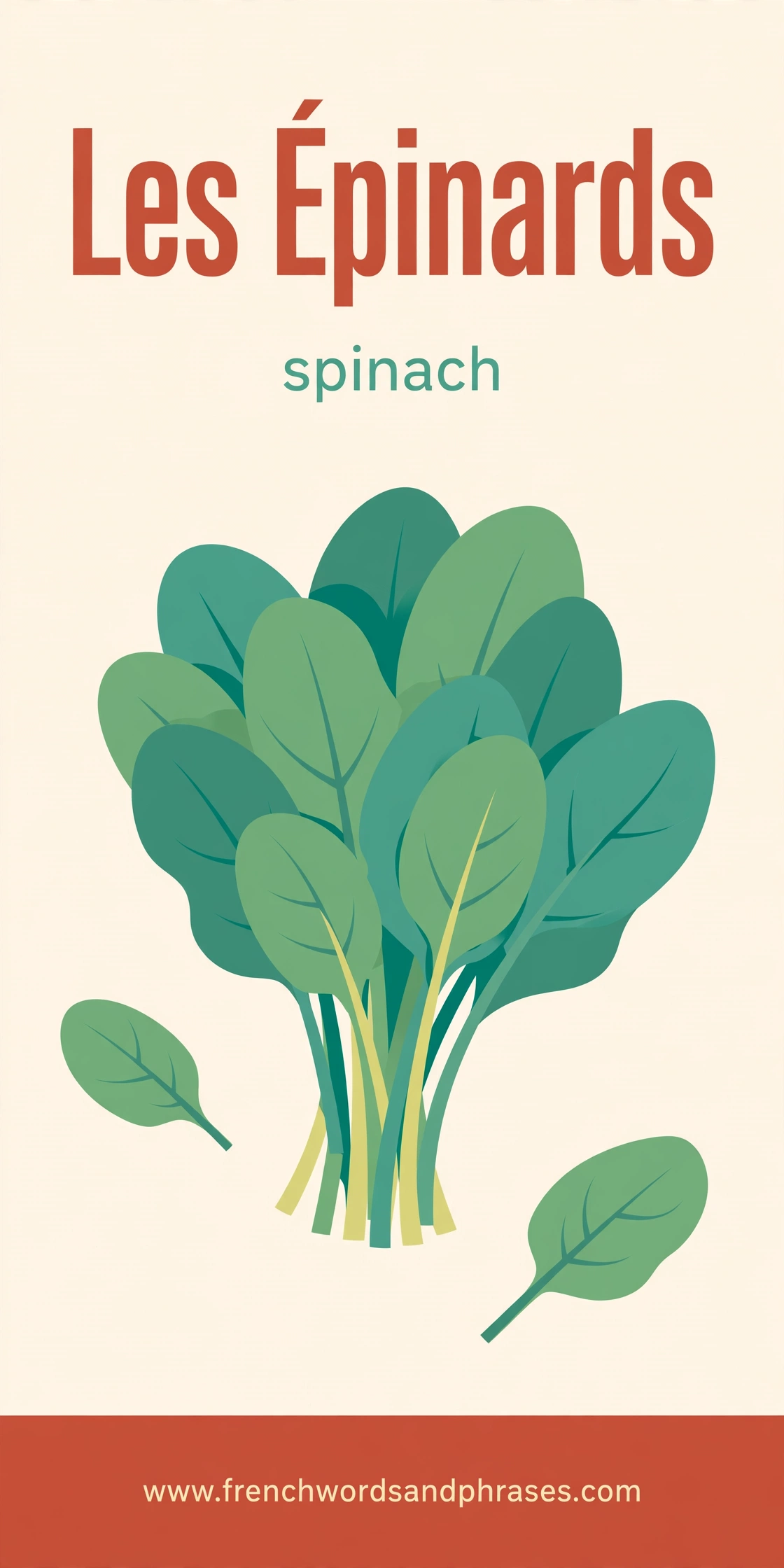
Les épinards means spinach.
The market gardener’s stall, early morning: crates of deep green leaves, still wet from washing, sold by the kilo and destined to shrink to almost nothing in the pan — les épinards, always in the plural, always in a heap.
In this guide, you’ll learn what épinards means in English, how to use it with its articles, how to form its plural, and how it appears in everyday French. Explore French examples, English translations, and practice quizzes.
Understanding the French Noun Épinards
Épinards is a masculine French noun — and for the food itself, it lives in the plural. It is learned together with its article: les épinards, des épinards. The singular exists, but un épinard is one single plant in the garden, not what lands on your plate.
It means spinach — the green leaves that France washes three times, cooks in minutes, and serves à la crème, in quiches, or simply with garlic and butter. On the plate, spinach is always plural in French: you eat des épinards, never a single épinard. The singular belongs to the gardener, who sows un épinard and watches it give leaf after leaf.
Gender: Masculine (plural)
Definite article: les — les épinards (spinach)
Indefinite article: des — des épinards (spinach, some spinach)
Singular: un épinard — one spinach plant
English equivalents: Spinach.
One important usage detail: keep the food in the plural. Je mange des épinards is the sentence; un épinard would mean one plant, and nobody serves one plant for dinner. And when French children push their spinach away, grandparents reach for the same argument everywhere: Popeye — Popeye le marin — eats his épinards and becomes strong enough to do anything.
Experience the Word
Épinards is more than a vegetable. It is the green mountain of the market stall that melts, in five minutes, into a small green hill on the plate.
Imagine the kitchen ritual: the leaves washed once, twice, three times; the pan enormous and the result tiny — and a grandmother promising that this, this is what makes you strong.
You have not just cooked a leaf. You have joined the club of Popeye.
How to Use Épinards in French: Complete Guide
Let’s explore how épinards works in French, beginning with its articles — and its garden singular.
Épinards with the Definite Article (Les)
The definite article of épinards is always les — the food is named in the plural, and its singular partner is a plant, not a portion.
| Number | French |
|---|---|
| Plural (the food) | les épinards |
| Singular (one plant) | un épinard — a spinach plant |
Example
Les épinards sont sur la table, à côté du poulet.
The spinach is on the table, next to the chicken.
Épinards with the Indefinite Article (Des)
Des épinards names the food in general — at the market, on the menu — while un épinard is one plant in the garden.
| Number | French |
|---|---|
| Plural | des épinards |
| Singular | un épinard — one plant |
Example
Elle achète des épinards frais au marché.
She buys fresh spinach at the market.
Épinards at the Market and in the Kitchen
Fresh, creamed and in bunches — the spinach of the stall and the stove.
| French | In English |
|---|---|
| les épinards frais | fresh spinach |
| les jeunes pousses d’épinards | baby spinach leaves |
| les épinards à la crème | creamed spinach |
| les épinards en branches | leaf spinach |
| les épinards hachés | chopped spinach |
| une botte d’épinards | a bunch of spinach |
Example
Les épinards à la crème accompagnent le poisson.
Creamed spinach goes with the fish.
Quick Quiz 1
How do you say spinach, the food, in French?
Reveal the answer
Les épinards, des épinards — always in the plural, even for one portion.
Je mange des épinards à la crème.
I’m eating creamed spinach.
The Plural of Épinards — It Is the Word
There is no ordinary singular for the food: épinards is already plural, and the singular un épinard names the plant in the garden.
| Number | French |
|---|---|
| The food (plural) | les épinards |
| One plant (singular) | un épinard |
Example
Dans le jardin, un épinard donne beaucoup de feuilles.
In the garden, one spinach plant gives a lot of leaves.
Épinards with Possessive Adjectives (Mes, Tes, Ses…)
Possessives agree with the noun — and épinards is plural, so it takes the plural forms: mes, tes, ses, nos, vos, leurs.
| Owner | French |
|---|---|
| my | mes épinards |
| your (tu) | tes épinards |
| his / her | ses épinards |
| our | nos épinards |
| your (vous) | vos épinards |
| their | leurs épinards |
Example
Je lave mes épinards trois fois avant de les cuire.
I wash my spinach three times before cooking it.
Quick Quiz 2
Complete the sentence:
Elle met ______ épinards dans la quiche. (her)
Reveal the answer
ses
Elle met ses épinards dans la quiche.
She puts her spinach in the quiche.
Épinards with Demonstrative Adjectives (Ces)
Used to point: this spinach here — and the singular partner is cet épinard, one plant, with cet because of the vowel.
| Number | French |
|---|---|
| Singular | cet épinard |
| Plural | ces épinards |
Example
Ces épinards sont très frais ce matin.
This spinach is very fresh this morning.
Épinards with Adjectives
Adjectives agree with épinards, masculine plural — frais, cuits, hachés.
| Adjective | With Épinards |
|---|---|
| frais (fresh) | des épinards frais |
| cuits (cooked) | des épinards cuits |
| hachés (chopped) | des épinards hachés |
| jeunes (young) | de jeunes épinards |
| verts (green) | des épinards verts |
Example
Des épinards frais, un peu d’ail, et le dîner est prêt.
Fresh spinach, a little garlic, and dinner is ready.
Quick Quiz 3
Complete the sentence:
Je préfère les épinards ______, pas en boîte. (fresh)
Reveal the answer
frais
Je préfère les épinards frais, pas en boîte.
I prefer fresh spinach, not tinned.
Everyday Expressions with Épinards
At the table and in the quiche, these are the épinards phrases of daily life.
| Expression | In English |
|---|---|
| manger des épinards | to eat spinach |
| les épinards à la crème | creamed spinach |
| une quiche aux épinards | a spinach quiche |
| laver les épinards | to wash the spinach |
| fort comme Popeye | strong like Popeye |
| des épinards frais du marché | fresh market spinach |
Example
Comme Popeye, il mange des épinards pour être fort.
Like Popeye, he eats spinach to be strong.
Words from the Same Family as Épinards
Leaves, greens and iron — the words that travel with épinards, starting with its own singular.
| French | In English |
|---|---|
| un épinard | one spinach plant |
| la feuille | the leaf |
| la bette | Swiss chard |
| la laitue | the lettuce |
| le chou | the cabbage |
| le fer | iron |
Example
On dit que les épinards sont riches en fer.
They say spinach is rich in iron.
Quick Quiz 4
A child refuses his spinach. Which sailor do French grandparents mention?
Reveal the answer
Popeye — Popeye le marin, who eats spinach and becomes strong enough to do anything.
Mange tes épinards, comme Popeye !
Eat your spinach, like Popeye!
Épinards in Everyday French: Real-Life Examples
Now that you know the word, let’s see how épinards appears in everyday French.
Example 1 — At the market
Je prends un kilo d’épinards frais, s’il vous plaît.
I’ll take a kilo of fresh spinach, please.
Example 2 — Washing
Lave bien les épinards, ils sont pleins de sable.
Wash the spinach well, it’s full of sand.
Example 3 — At lunch
Nous mangeons des épinards à la crème avec le saumon.
We’re eating creamed spinach with the salmon.
Example 4 — With children
Mange tes épinards, comme Popeye !
Eat your spinach, like Popeye!
Example 5 — In the quiche
Elle prépare une quiche aux épinards pour ce soir.
She’s making a spinach quiche for tonight.
Example 6 — In the garden
Un épinard du jardin donne des feuilles tout l’été.
One garden spinach plant gives leaves all summer.
See les épinards in a story: Fruits and Vegetables: French Vocabulary (Fruits et Légumes) — a Saturday trip to a French market.
Beyond Translation: The Meaning of Épinards
Spinach reached France from Persia by way of Spain, and legend gave it a second homeland: dishes served on a bed of spinach are called à la florentine, after Florence and Catherine de Médicis, who is said to have brought her own spinach cooks with her to France. Its fame for iron grew far beyond the truth — but the legend, like Popeye’s muscles, never quite went away.
To say les épinards is to heap the plate with green.
It evokes the washed leaves and the shrinking pan, the quiche and the crème, and a sailor with a tin of spinach who taught generations of children to finish their vegetables.
How to Remember the French Noun Épinards
Remember it this way: Épinards is spinach — masculine and plural on the plate, with les and des, while un épinard is a single plant in the garden.
- You eat in the plural — je mange des épinards, toujours au pluriel.
- You plant in the singular — un épinard pousse dans le jardin.
- You get strong — comme Popeye, le marin aux épinards.
The key idea is les épinards on the plate — un épinard in the garden.
Test Your Knowledge of Épinards
Let’s see how much you’ve learned. Try answering these questions before revealing the answers.
Question 1
Is épinards masculine or feminine?
Reveal the answer
Masculine — and plural for the food: les épinards, des épinards.
Question 2
How do you say spinach (the food) in French?
Reveal the answer
Les épinards / des épinards — the plural, even for one portion.
Question 3
Translate: She buys fresh spinach at the market.
Reveal the answer
Elle achète des épinards frais au marché.
Question 4
What does un épinard (singular) mean?
Reveal the answer
One spinach plant — the plant in the garden, not the food on the plate.
Question 5
Complete the sentence:
Mange ______ épinards, comme Popeye !
Reveal the answer
tes
Mange tes épinards, comme Popeye !
Eat your spinach, like Popeye!
Your Final Challenge
Can You Use It?
How would you say this in French?
“The children eat spinach with cream.”
Reveal the answer
Les enfants mangent des épinards à la crème.
The children eat spinach with cream.
A little French. A little curiosity. A richer everyday life.
LEARN FRENCH ONE WORD AT A TIME