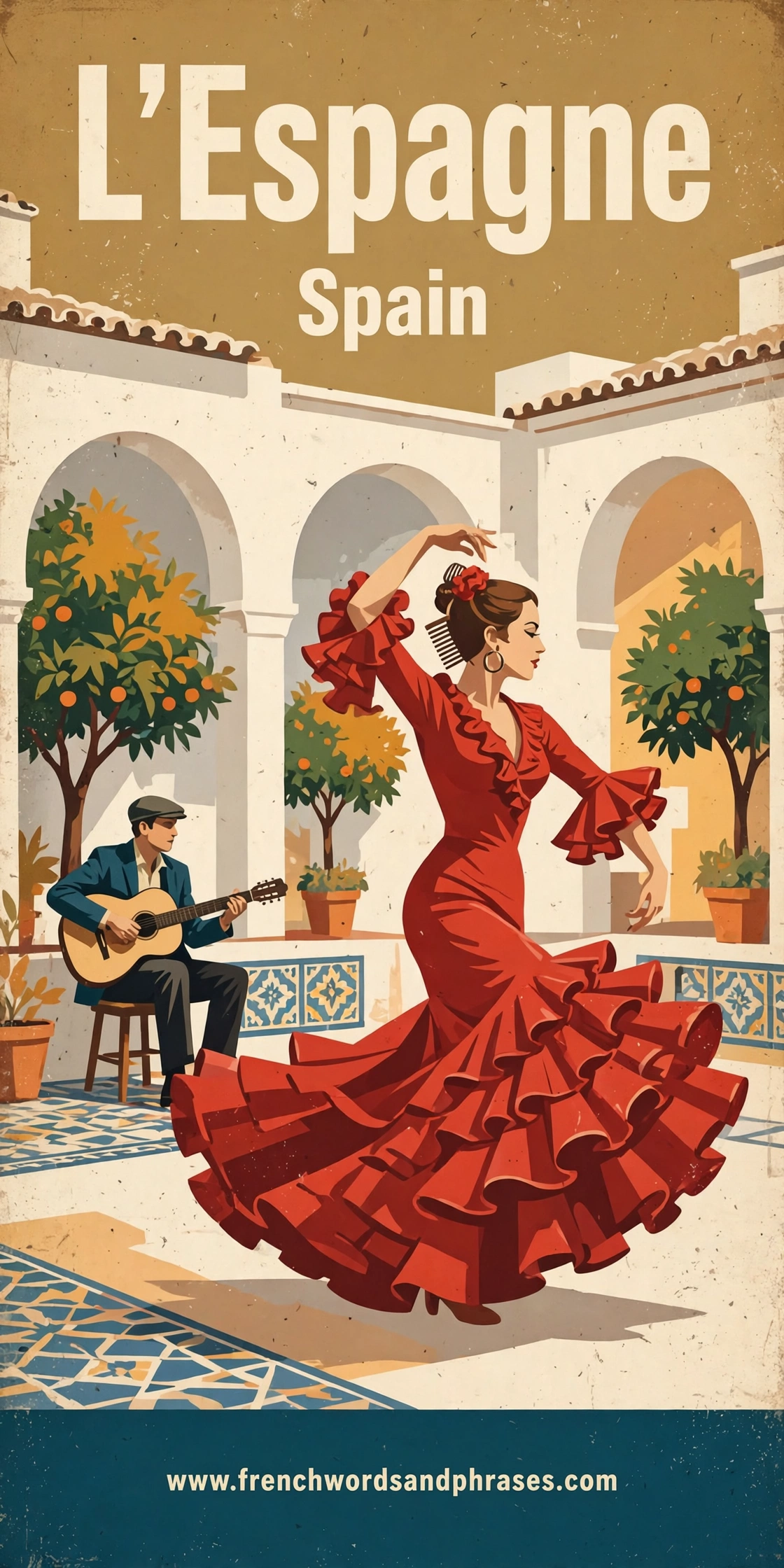
A French Word to Live By
Translate Espagne to English
/ɛs.paɲ/
L’Espagne means Spain.
Sun, siestas and a language spoken on four continents: l’Espagne, Spain — France’s neighbour across the Pyrenees, close enough for a school trip and different enough to feel like another world.
In this guide, you’ll learn what Espagne means in English, how to use it with its articles, how to form its plural, and how it appears in everyday French. Explore French examples, English translations, and practice quizzes.
Understanding the French Noun Espagne
Espagne is a feminine proper noun, learned with its article: l’Espagne — the article melts before the opening vowel. Feminine, it takes en for in/to and d’ for from: en Espagne, d’Espagne. The name goes back to the Roman Hispania — which the Romans themselves may have understood as the land of rabbits.
It means Spain — the great country of the Iberian Peninsula, south of the Pyrenees, with Madrid as its capital. Its people are les Espagnols and les Espagnoles, its language l’espagnol, spoken by hundreds of millions from Madrid to Mexico City. France and Spain share a mountain border and a long, tangled history — and a favourite French saying warns what lies between them: vérité en deçà des Pyrénées, erreur au-delà, truth on this side of the Pyrenees, error beyond.
Gender: Feminine — l’Espagne
Definite article: l’ — l’Espagne (Spain), melted before the vowel
Saying in / to: en — en Espagne
Saying from: d’ — venir d’Espagne
Capital: Madrid
The people: les Espagnols, les Espagnoles
English equivalents: Spain.
Espagne behaves like France with a melted article: en Espagne, d’Espagne, and l’Espagne as subject or object. The Pyrenees do the geography: Spain is au sud des Pyrénées, and the crossing is a school-trip rite of passage for French teenagers learning l’espagnol, the most-studied second language in French schools.
Experience the Word
Espagne is the south made country: late dinners, long light, plazas full at midnight — everything France imagines when it looks over the mountains.
Imagine the school coach crossing the Pyrenees at dawn, thirty French teenagers waking as the signs change language, and someone at the back announcing, to no one in particular: on est en Espagne !
You have not just named a country. You have named the great southern neighbour — l’Espagne, Spain, beyond the Pyrenees.
How to Use Espagne in French: Complete Guide
Let’s explore how Espagne works in French, beginning with its article and prepositions — l’Espagne, en Espagne, d’Espagne.
Espagne with the Definite Article (L’)
As subject or object, Espagne keeps her melted article: l’Espagne.
| Form | French |
|---|---|
| The country | l’Espagne |
| The south of Spain | le sud de l’Espagne |
| All of Spain | toute l’Espagne |
Example
L’Espagne est au sud de la France.
Spain is south of France.
Saying In, To and From: En Espagne, D’Espagne
Feminine countries take en for in/to and de for from — before a vowel, de becomes d’.
| Meaning | French |
|---|---|
| in Spain, to Spain | en Espagne |
| from Spain | d’Espagne |
| across Spain | dans toute l’Espagne |
| to the capital | à Madrid |
Example
Nous passons nos vacances en Espagne.
We spend our holidays in Spain.
The People of Spain: Les Espagnols
The inhabitants take a capital letter — and espagnol, small e, is the language and the adjective.
| Person | French |
|---|---|
| a Spanish man | un Espagnol |
| a Spanish woman | une Espagnole |
| Spanish men / the Spanish | les Espagnols |
| Spanish women | les Espagnoles |
Example
Les Espagnols dînent très tard.
Spaniards eat dinner very late.
Quick Quiz 1
Complete the sentence:
Elle part ______ Espagne demain. (to)
Reveal the answer
en
Elle part en Espagne demain.
She’s leaving for Spain tomorrow — feminine countries take en, with no article.
The Language and the Adjective: Espagnol
Espagnol is a world language — and an adjective that agrees like any other.
| Use | French |
|---|---|
| the language | l’espagnol |
| masculine adjective | un vin espagnol |
| feminine adjective | une chanson espagnole |
| to speak Spanish | parler espagnol |
Example
L’espagnol est parlé dans beaucoup de pays.
Spanish is spoken in many countries.
Espagne at a Glance
The facts every beginner meets first — capital, currency, language.
| Point | Espagne |
|---|---|
| Capital | Madrid |
| Currency | l’euro |
| Language | l’espagnol |
| Border with France | les Pyrénées |
| Famous islands | les Baléares et les Canaries |
Example
Madrid est la capitale de l’Espagne.
Madrid is the capital of Spain.
Quick Quiz 2
What is the capital of Spain?
Reveal the answer
Madrid
Madrid est la capitale de l’Espagne.
Madrid is the capital of Spain.
Espagne and Its Neighbours
Spain shares the Iberian Peninsula with Portugal and looks at France over the mountains.
| Direction | French |
|---|---|
| to the north | la France, au-delà des Pyrénées |
| to the west | le Portugal |
| to the south | le Maroc, across the sea |
| the peninsula | la péninsule ibérique |
Example
Le Portugal est à l’ouest de l’Espagne.
Portugal is west of Spain.
Espagne with Adjectives
Adjectives agree with Espagne — feminine singular: l’Espagne entière, the whole of Spain.
| Adjective | With Espagne |
|---|---|
| entière (whole) | l’Espagne entière |
| belle (beautiful) | la belle Espagne |
| ensoleillée (sunny) | l’Espagne ensoleillée |
| ancienne (old) | la vieille Espagne |
Example
L’Espagne ensoleillée attire les touristes.
Sunny Spain attracts tourists.
Quick Quiz 3
Complete the sentence:
Une chanson ______ passe à la radio. (Spanish)
Reveal the answer
espagnole
Une chanson espagnole passe à la radio.
A Spanish song is playing on the radio — espagnole, feminine, to agree with chanson.
Everyday Expressions with Espagne
Mountains, châteaux and late dinners — the Espagne phrases of daily life.
| Expression | In English |
|---|---|
| en Espagne | in Spain |
| d’Espagne | from Spain; Spanish (of origin) |
| les Pyrénées | the Pyrenees — the mountain border |
| un château en Espagne | a castle in Spain — a daydream, a pipe dream |
| à l’espagnole | in the Spanish way |
Example
Il construit des châteaux en Espagne.
He builds castles in Spain — he daydreams.
Words from the Same Family as Espagne
Spanish and Spain — the words that travel with Espagne.
| French | In English |
|---|---|
| espagnol | Spanish — the language and the adjective |
| un Espagnol | a Spanish man |
| ibérique | Iberian |
| hispanophone | Spanish-speaking |
| la péninsule | a peninsula |
Example
L’espagnol est la langue de l’Espagne et du Mexique.
Spanish is the language of Spain and Mexico.
Quick Quiz 4
What is un château en Espagne?
Reveal the answer
A castle in Spain — a daydream, a project that will never exist.
Ses châteaux en Espagne sont magnifiques mais impossibles.
His castles in Spain are magnificent but impossible.
Espagne in Everyday French: Real-Life Examples
Now that you know the word, let’s see how Espagne appears in everyday French.
Example 1 — Holidays
Nous passons nos vacances en Espagne.
We spend our holidays in Spain.
Example 2 — Language
Elle apprend l’espagnol à l’école.
She is learning Spanish at school.
Example 3 — Geography
L’Espagne est au sud des Pyrénées.
Spain is south of the Pyrenees.
Example 4 — Food
La paella vient d’Espagne.
Paella comes from Spain.
Example 5 — Evenings
En Espagne, on dîne très tard.
In Spain, people eat dinner very late.
Example 6 — Daydreams
Il construit des châteaux en Espagne.
He builds castles in Spain — he daydreams.
Beyond Translation: The Meaning of Espagne
Espagne has lived in the French imagination for a thousand years — as enemy, as ally, as the exotic south an hour from the border. French keeps the souvenir in a perfect idiom: un château en Espagne, a castle in Spain, is a beautiful plan that will never be built, a daydream with an address. Pascal gave the frontier its philosophy — truth on this side of the Pyrenees, error on the other — and every French schoolchild who crosses into Spain with a phrasebook is still testing the proposition.
To say Espagne is to look south, over the mountains, toward the sun.
It evokes late dinners, white villages and the coach crossing at dawn — Spain, near and wonderfully other.
How to Remember the French Noun Espagne
Remember it this way: Espagne is feminine with a melted article: l’Espagne — en Espagne, d’Espagne.
- Feminine, vowel first — l’Espagne, never la Espagne.
- The prepositions — en Espagne (in, to), d’Espagne (from).
- The idiom — un château en Espagne is a daydream, a pipe dream.
The key idea is l’Espagne — Spain, feminine; en Espagne, d’Espagne.
Test Your Knowledge of Espagne
Let’s see how much you’ve learned. Try answering these questions before revealing the answers.
Question 1
Is Espagne masculine or feminine in French?
Reveal the answer
Feminine — l’Espagne.
Question 2
How do you say in Spain?
Reveal the answer
En Espagne — feminine countries take en.
Question 3
Translate: We spend our holidays in Spain.
Reveal the answer
Nous passons nos vacances en Espagne.
Question 4
What mountains separate France and Spain?
Reveal the answer
Les Pyrénées — the Pyrenees.
Question 5
Complete the sentence:
______ Espagne est au sud de la France. (the)
Reveal the answer
L’
L’Espagne est au sud de la France.
Spain is south of France.
Your Final Challenge
Can You Use It?
How would you say this in French?
“She’s leaving for Spain tomorrow.”
Reveal the answer
Elle part en Espagne demain.
She’s leaving for Spain tomorrow.
A little French. A little curiosity. A richer everyday life.
LEARN FRENCH ONE WORD AT A TIME