A French Word to Live By
Translate Enchanté to English
/ɑ̃.ʃɑ̃.te/
Enchanté means nice to meet you.
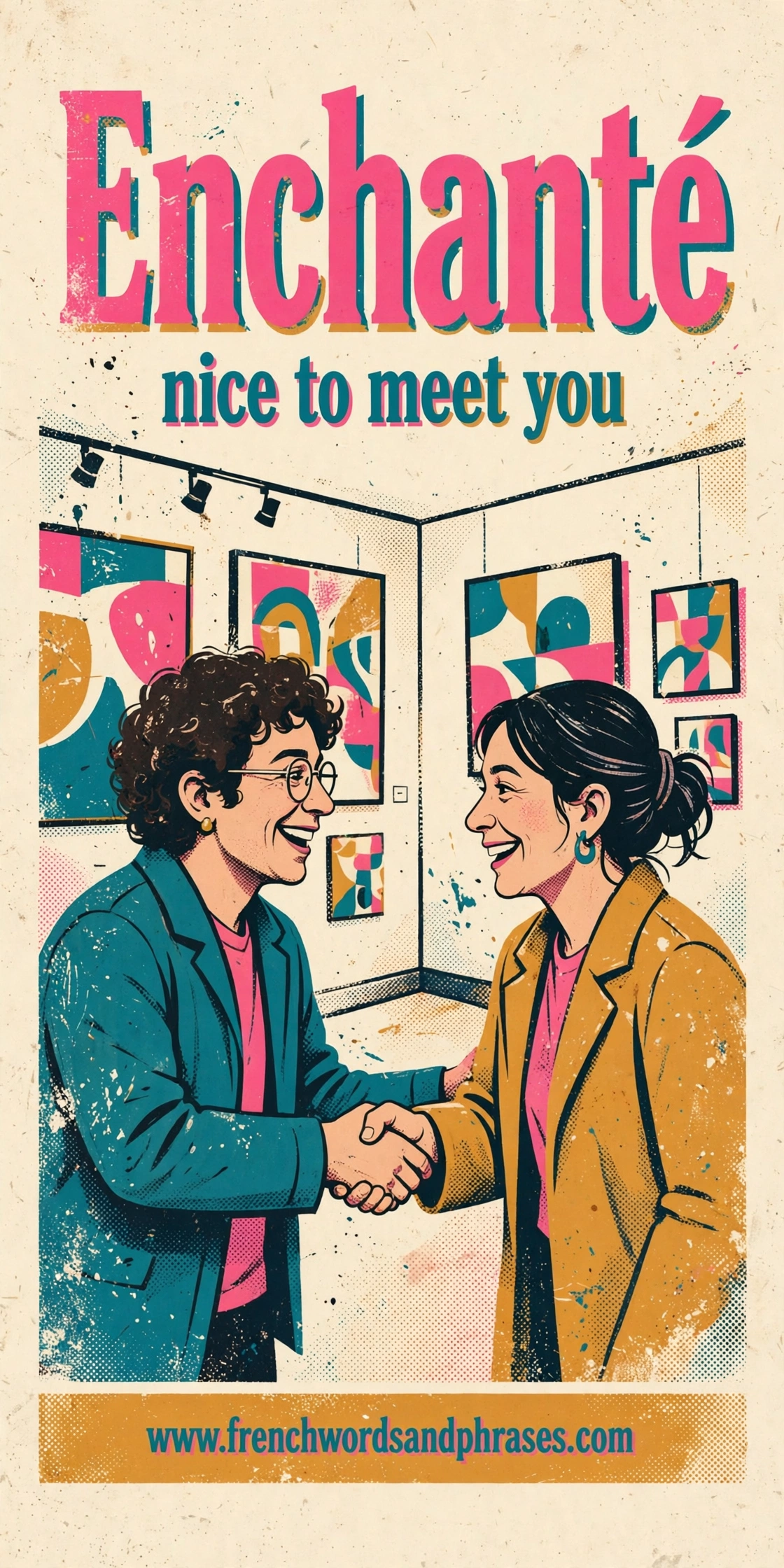
A hand is held out, a name is given — « Marc, enchanté » — and the handshake itself seems to smile. Enchanté is the word of introductions: pleased to meet you, delighted. Underneath the courtesy lives its older magic: enchanté is the past participle of enchanter, to enchant — to meet you, it says, is a small spell.
In this guide, you’ll learn what enchanté means in English, how it agrees — enchanté, enchantée — where it stands at introductions, and how its everyday sense of delighted differs from the greeting. Explore French examples, English translations, and practice quizzes.
Understanding the French Adjective Enchanté
Enchanté is a French adjective — the past participle of enchanter, to enchant, to delight — used above all as the set word of introductions: enchanté, pleased to meet you. It agrees with the speaker: a man says enchanté, a woman says enchantée (same sound, extra written -e), and to a group, enchantés or enchantées. Beyond introductions it keeps its full adjectival life: enchanté de, delighted to or delighted with.
At an introduction it means pleased to meet you, nice to meet you: « Enchanté, madame » — pleased to meet you, madam. In ordinary sentences it means delighted: enchanté de vous voir, delighted to see you; les enfants sont enchantés du cadeau, the children are delighted with the present. The reply to an introduction is often mirrored — enchanté, moi de même — or answered with a name and the same word back.
Type: Adjective — past participle of enchanter; the introduction word
Answers the question: How do you greet a new acquaintance? — with delight, performed politely
Changes form: Agrees with the speaker: enchanté (m), enchantée (f), enchantés / enchantées (pl)
English equivalents: Pleased to meet you; delighted.
One important usage detail: enchanté is said AT the introduction, as the hands meet and the names land — not during the conversation, and not at goodbye. A woman writes enchantée but says the identical sound; the agreement is visible, not audible. And enchanté stands alone: no verb needed. « Madame Leroy. — Enchanté. » The word is the whole sentence of welcome.
Experience the Word
Enchanté is politeness with a spark of theatre — it pretends, gracefully, that this meeting is a pleasure and not an accident.
Imagine the village wedding: a hundred introductions under the string lights, cousins of cousins, names half-heard — and enchanté, enchantée, enchanté, passed from handshake to handshake like a glass being raised a hundred times.
You have not just registered a name. You have declared the meeting itself a delight.
How to Use Enchanté in French: Complete Guide
Let’s explore how enchanté works in French, beginning with the whole word on one card.
Enchanté at a Glance
Before the details, here is the whole word on one card.
The Whole Word on One Card
Meaning, type, position and forms — enchanté in four lines.
| Point | Enchanté |
|---|---|
| Meaning | pleased to meet you at introductions; delighted elsewhere |
| Type | adjective — past participle of enchanter, to enchant |
| Position | alone at introductions; after être, or before de + infinitive, in sentences |
| Register | polite and warm — the dressed word of first meetings |
Example
Madame Leroy, je vous présente mon fils. — Enchanté, madame.
Mrs Leroy, may I introduce my son. — Pleased to meet you, madam.
The Four Forms of Enchanté
Enchanté agrees with the person who IS enchanted — at introductions, with the speaker.
| Form | Enchanté | Example |
|---|---|---|
| Masculine singular | enchanté | enchanté, monsieur — pleased to meet you (a man speaking) |
| Feminine singular | enchantée | enchantée, madame — pleased to meet you (a woman speaking) |
| Masculine plural | enchantés | enchantés de vous voir — delighted to see you (men, or a mixed group) |
| Feminine plural | enchantées | enchantées du cadeau — delighted with the present (women) |
Example
Les enfants sont enchantés de leur nouvelle école.
The children are delighted with their new school.
Quick Quiz 1
A woman is introduced to you. She smiles and says… which written form — enchanté or enchantée?
Reveal the answer
Enchantée — the adjective agrees with her; the sound is the same, the extra -e is written only.
Enchantée, monsieur.
Pleased to meet you, sir.
The Feminine of Enchanté: Enchantée
The feminine adds a written -e and changes nothing you can hear — enchanté and enchantée are pronounced identically.
| Situation | Example |
|---|---|
| A man introduced | Marc, enchanté — Marc, pleased to meet you |
| A woman introduced | Claire, enchantée — Claire, pleased to meet you |
| A woman delighted | elle est enchantée du voyage — she is delighted with the trip |
| Women delighted | elles sont enchantées — they are delighted |
Example
Elle est enchantée de travailler avec vous.
She is delighted to work with you.
Where Enchanté Goes: Alone, or After Être
At introductions enchanté stands entirely alone; in sentences it follows être or se montrer, and takes de before what delights.
| Pattern | Example |
|---|---|
| Alone, at an introduction | enchanté ! — pleased to meet you! |
| After être | je suis enchanté de vous voir — I am delighted to see you |
| Before de + infinitive | enchanté de faire votre connaissance — pleased to make your acquaintance |
| Before de + noun | enchantés du résultat — delighted with the result |
Example
Enchanté de faire votre connaissance.
Pleased to make your acquaintance.
Quick Quiz 2
Complete the introduction: Je vous présente ma sœur, Claire. — ______, monsieur. (Claire is speaking)
Reveal the answer
Enchantée
Claire agrees with herself: enchantée, with the written feminine -e.
Enchantée, monsieur. — Pleased to meet you, sir.
More Enchanté: Comparing Delight
Enchanté compares the regular way, with plus and aussi — though at introductions it never compares at all.
| Degree | Example |
|---|---|
| As delighted as | aussi enchanté que — as delighted as |
| More delighted | plus enchanté que — more delighted than |
| Very delighted | très enchanté — delighted indeed |
| Absolutely delighted | absolument enchanté — the full, warm form |
Example
Nous sommes absolument enchantés de votre visite.
We are absolutely delighted by your visit.
Everyday Expressions with Enchanté
Enchanté leaves the introduction and lives a full adjectival life in these frames.
| Expression | In English |
|---|---|
| enchanté de vous voir | delighted to see you |
| enchanté de faire votre connaissance | pleased to make your acquaintance |
| être enchanté du résultat | to be delighted with the result |
| les enfants enchantés | the delighted children |
| un public enchanté | a delighted, enchanted audience |
Example
Le public, enchanté, a applaudi dix minutes.
The audience, delighted, applauded for ten minutes.
Quick Quiz 3
What does enchanté de vous voir mean?
Reveal the answer
Delighted to see you
Beyond introductions, enchanté de + infinitive is pure delight at the meeting.
Enchanté de vous voir, entrez. — Delighted to see you, come in.
Enchanté and Its Neighbours
Enchanté keeps company with the words of welcome, delight and old magic.
| French | In English |
|---|---|
| enchanter | to enchant; to delight (the verb) |
| ravi | delighted, thrilled — the close cousin (ravi de vous voir) |
| heureux de vous voir | happy to see you — the plainer welcome |
| une connaissance | an acquaintance — faire votre connaissance, to meet you |
| enchanté (conte) | enchanted — la forêt enchantée, the enchanted forest |
Example
Les enfants écoutent l’histoire de la forêt enchantée.
The children listen to the story of the enchanted forest.
Watch Out: The Traps Around Enchanté
The traps: the timing, the invisible feminine, and the verb that is not a greeting.
| Trap | The truth |
|---|---|
| Saying it at goodbye | enchanté belongs to the meeting, not the parting — au revoir closes |
| A man writing enchantée | agreement follows the speaker: he writes enchanté, she writes enchantée |
| Hearing a difference | there is none: enchanté and enchantée sound identical |
| Enchanter as a greeting verb | you do not conjugate the greeting — enchanté stands alone |
Example
Enchanté à l’arrivée, au revoir au départ.
Enchanté on arrival, au revoir on departure.
Quick Quiz 4
Two men are introduced and shake hands. What does each say?
Reveal the answer
Enchanté
Each agrees with himself — enchanté — often with the name riding in front.
Marc, enchanté. — Paul, enchanté. — Marc, pleased to meet you. — Paul, pleased to meet you.
Enchanté in Everyday French: Real-Life Examples
Now that you know the word, let’s see how enchanté appears in everyday French.
Example 1 — An introduction
Je vous présente mon mari. — Enchanté, monsieur.
May I introduce my husband. — Pleased to meet you, sir.
Example 2 — A woman introduced
Claire, enchantée, bienvenue à la maison.
Claire, pleased to meet you, welcome to our home.
Example 3 — Delighted to see you
Enchanté de vous voir, entrez donc.
Delighted to see you, do come in.
Example 4 — Children and a gift
Les enfants sont enchantés du cadeau.
The children are delighted with the present.
Example 5 — A result
Nous sommes enchantés du résultat, merci à tous.
We are delighted with the result, thank you everyone.
Example 6 — Making acquaintance
Enchanté de faire votre connaissance, madame.
Pleased to make your acquaintance, madam.
Beyond Translation: The Meaning of Enchanté
Enchanté is a fairy tale that went into business dress. Enchanter descends from the Latin incantare — to sing a spell over someone, in- plus cantare, to sing — and the word still carries both lives: la forêt enchantée is bewitched by a fairy’s song, and the enchanté of the boardroom is delighted by a colleague’s arrival. The introduction formula simply froze the compliment at its warmest: to meet you is presented, by both sides at once, as a pleasure — a small, mutual, entirely polite enchantment.
Enchanté is the spell politeness casts over a first meeting — delight, declared in advance.
Learn it with its cousin ravi: enchanté for the handshake, ravi de vous voir for the friend at the door, and the whole scale of French delight is yours.
How to Remember the French Adjective Enchanté
Remember it this way: Enchanté is the introduction word — pleased to meet you — agreeing with the speaker: enchanté for him, enchantée (written, unheard) for her.
- You say it at the handshake — enchanté quand les noms se donnent, jamais au départ.
- You agree with yourself — lui : enchanté ; elle : enchantée, même son, une lettre de plus.
- You hear the old spell — enchanter, chanter un sort : la rencontre est un petit enchantement.
The key idea is enchanté = pleased to meet you; delighted; feminine enchantée (same sound).
Test Your Knowledge of Enchanté
Let’s see how much you’ve learned. Try answering these questions before revealing the answers.
Question 1
What does enchanté mean at an introduction?
Reveal the answer
Pleased to meet you, nice to meet you — the set word of first meetings.
Question 2
What is the feminine form, and how does it sound?
Reveal the answer
Enchantée — with a written -e; it sounds exactly like enchanté.
Question 3
Translate: Delighted to see you, come in.
Reveal the answer
Enchanté de vous voir, entrez.
Question 4
Complete the sentence:
Les enfants sont ______ du cadeau. (delighted)
Reveal the answer
enchantés
Les enfants sont enchantés du cadeau.
The children are delighted with the present.
Question 5
Which verb does enchanté come from, and what did it first mean?
Reveal the answer
Enchanter — to enchant: to sing a spell over someone, from Latin incantare.
Your Final Challenge
Can You Use It?
How would you say this in French?
“Pleased to meet you, madam, delighted to see you.”
Reveal the answer
Enchanté, madame, enchanté de vous voir.
Pleased to meet you, madam, delighted to see you.
A little French. A little curiosity. A richer everyday life.
LEARN FRENCH ONE WORD AT A TIME