A French Word to Live By
Translate Fort to English
/fɔʁ/
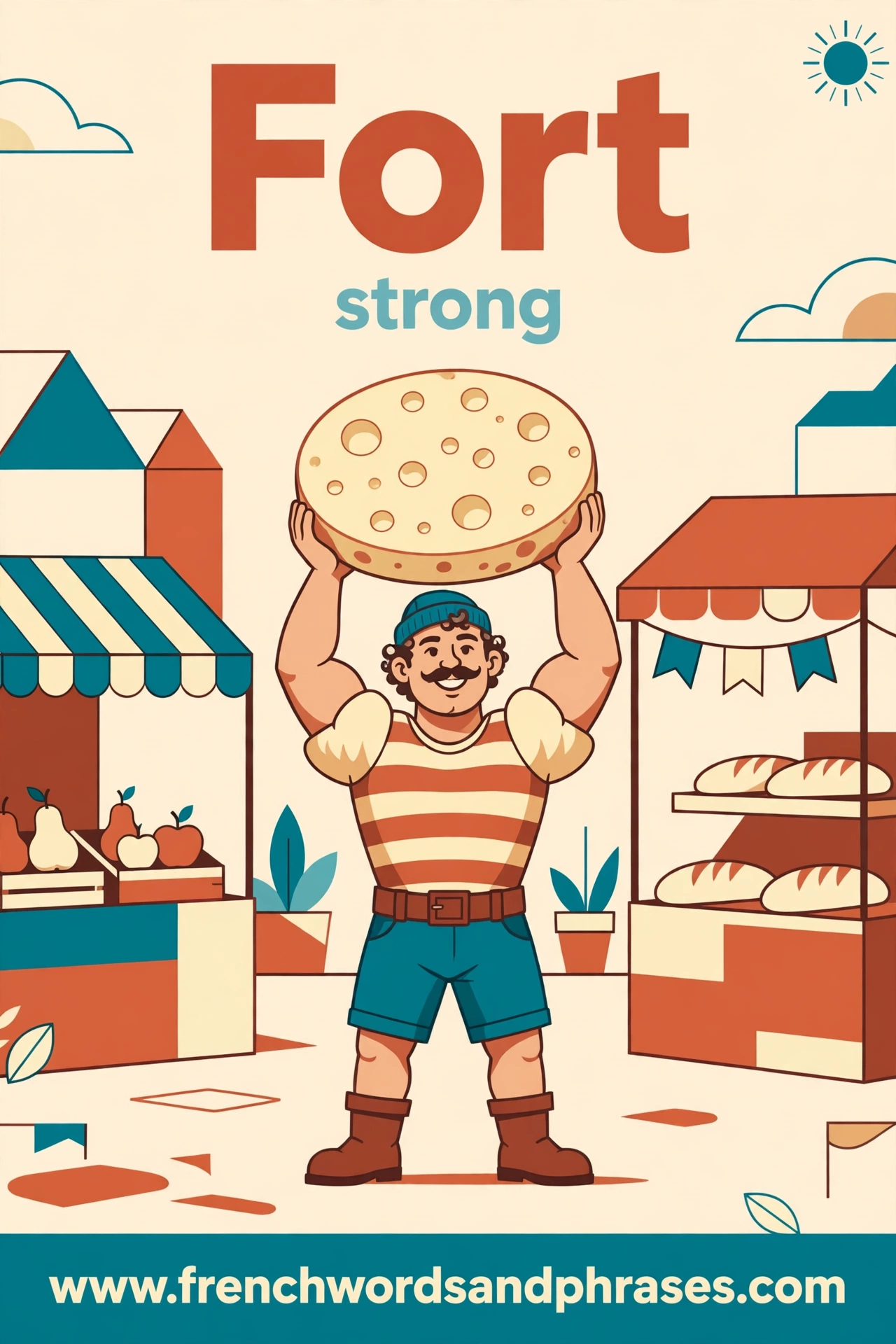
Fort means strong.
The harbour at dawn: fishermen hauling nets hand over hand, ropes creaking, crates of fish swinging onto the quay. Then, from the little café by the port, a second kind of strength drifts out — the smell of coffee, dark and serious. Both are fort.
In this guide, you’ll learn what fort means in English, how its feminine forte is formed, why fort also describes coffee, cheese and voices, and the expressions — fort en maths, c’est fort ! — that French uses all day long. Explore French examples, English translations, and practice quizzes.
Understanding the French Adjective Fort
Fort is a French adjective of strength — one of the oldest and hardest-working in the language. It agrees in the usual way: fort, forte, forts, fortes, with the feminine adding -e and waking up the final t.
It means strong — strong arms, strong wind, strong coffee. It covers muscle (un homme fort), power (un moteur fort), intensity (un café fort, une voix forte) and talent (fort en maths, strong at maths). If something impresses by its force, French reaches for fort.
Type: Adjective of strength — force and intensity
Answers the question: What is it like? — strong
Changes form: Yes — fort, forte, forts, fortes
English equivalents: Strong; powerful; loud (of a voice).
One important usage detail: fort follows the noun — un vent fort, une femme forte. And to say someone is strong AT a subject, French uses fort en, exactly like faible en: elle est forte en maths.
Experience the Word
Fort is the adjective of the harbour, the gym and the espresso cup — the word French uses whenever the world pushes back and something pushes harder.
Imagine an old fisherman mending a net, his hands like rope, telling you about the winter the sea took the harbour wall: « La mer était forte, mais nous étions plus forts. » The sea was strong, but we were stronger.
You have not just measured muscle. You have saluted whatever refuses to break.
How to Use Fort in French: Complete Guide
Let’s explore how fort works in French, beginning with the whole word on one card.
Fort at a Glance
Before the details, here is the whole word on one card.
The Whole Word on One Card
Meaning, type, position and forms — fort in four lines.
| Point | Fort |
|---|---|
| Meaning | strong |
| Type | adjective of strength — force and intensity |
| Usual position | after the noun — un homme fort |
| Form | fort / forte / forts / fortes |
Example
Le vent est fort sur la côte aujourd’hui.
The wind is strong on the coast today.
The Four Forms of Fort
Fort forms its feminine the regular way, with -e — but listen: the silent t of fort wakes up in forte, and the word sounds bigger.
| Form | Fort | Example |
|---|---|---|
| Masculine singular | fort | un bras fort — a strong arm |
| Feminine singular | forte | une voix forte — a strong, loud voice |
| Masculine plural | forts | des bras forts — strong arms |
| Feminine plural | fortes | des voix fortes — strong voices |
Example
Elle a des épaules fortes et une volonté de fer.
She has strong shoulders and a will of iron.
Quick Quiz 1
What is the feminine of fort?
Reveal the answer
forte
Une femme forte.
A strong woman.
The Feminine of Fort: Forte
Add -e and the word wakes up: fort ends in a silent t, forte sounds it. The plural simply adds -s to each form.
| Pattern | Example |
|---|---|
| Masculine | un café fort — a strong coffee |
| Feminine | une odeur forte — a strong smell |
| Plural masculine | des vents forts — strong winds |
| Plural feminine | des couleurs fortes — strong colours |
Example
Cette sauce a un goût fort, presque piquant.
This sauce has a strong taste, almost spicy.
Where Fort Goes: After the Noun
Fort follows the noun it describes. After être, it often brings en to name the subject someone is strong at.
| Pattern | Example |
|---|---|
| noun + fort | un moteur fort — a powerful engine |
| être + fort | Il est très fort. — He is very strong. |
| fort en + subject | forte en maths — strong at maths |
| Before the noun | un fort homme — not in everyday French; fort follows |
Example
Mon frère est fort en histoire, moi je suis fort en sport.
My brother is strong at history, I am strong at sport.
Quick Quiz 2
How do you say ‘strong at maths’ — fort à maths or fort en maths?
Reveal the answer
fort en maths
Elle est forte en maths.
She is strong at maths.
Stronger Still: Comparing with Fort
Fort compares the regular way — plus fort is one of the most heard comparisons in French, from playgrounds to building sites.
| Degree | Example |
|---|---|
| As strong as | aussi fort que — as strong as |
| Stronger | plus fort — stronger |
| Less strong | moins fort — less strong |
| The strongest (masc.) | le plus fort — le plus fort du village |
| The strongest (fem.) | la plus forte — la plus forte de l’équipe |
Example
Parle plus fort, je n’entends rien !
Speak louder, I can’t hear anything!
Everyday Expressions with Fort
Fort is everywhere: in the café order, in the classroom, and in one exclamation — c’est fort ! — that means ‘that’s a bit much!’
| Expression | In English |
|---|---|
| un café fort | a strong coffee |
| fort en maths | strong at maths |
| c’est fort ! | that’s a bit much! — I can’t believe it! |
| à forte voix | in a loud voice, aloud |
| fort comme un bœuf | strong as an ox |
| c’est son fort | that’s his strong point — the noun hiding in the adjective |
Example
Fort comme un bœuf, il porte les deux valises d’une main.
Strong as an ox, he carries both suitcases in one hand.
Quick Quiz 3
What does c’est fort ! mean, said with surprise?
Reveal the answer
That’s a bit much! / I can’t believe it!
Trois heures de retard ? C’est fort !
Three hours late? That’s a bit much!
Fort and Its Neighbours
Fort heads the strength family. Its neighbours grade force from solid to storm-force — and faible waits at the bottom.
| French | In English |
|---|---|
| puissant | powerful — stronger, more formal |
| robuste | sturdy, robust |
| solide | solid, well-built |
| musclé | muscular |
| faible | weak — the direct opposite |
| fragile | fragile — the delicate opposite |
Example
Le nouveau moteur est plus puissant, mais l’ancien était déjà fort.
The new engine is more powerful, but the old one was already strong.
Watch Out: The Traps Around Fort
Fort looks simple, but it has range: it can describe a voice, a cheese and a rain shower — it must not shrink to muscles alone.
| Trap | The truth |
|---|---|
| fort ≠ only muscles | un café fort, une pluie forte, une voix forte — strength of intensity too |
| une femme forte | can mean a strong woman — or, tactfully, a well-built one; context decides |
| fort en, not fort à | strong at a subject takes en: fort en géographie |
| le fort (noun) | the strong point: c’est son fort — same spelling, different job |
Example
Les maths, c’est son fort ; le sport, c’est le mien.
Maths is his strong point; sport is mine.
Quick Quiz 4
Translate: a strong coffee and a loud voice.
Reveal the answer
Un café fort et une voix forte.
Fort covers taste and sound, not just muscles.
A strong coffee and a loud voice.
Fort in Everyday French: Real-Life Examples
Now that you know the word, let’s see how fort appears in everyday French.
Example 1 — At the gym
Il soulève des poids lourds ; il est vraiment fort.
He lifts heavy weights; he is really strong.
Example 2 — In the café
Un café fort, s’il vous plaît, je me suis levé à cinq heures.
A strong coffee, please, I got up at five o’clock.
Example 3 — At school
Ma sœur est forte en maths, elle m’aide pour mes devoirs.
My sister is strong at maths, she helps me with my homework.
Example 4 — Weather
Le vent est trop fort pour sortir en bateau.
The wind is too strong to go out in a boat.
Example 5 — At a concert
Elle a une voix forte, on l’entend jusqu’au fond de la salle.
She has a powerful voice, you can hear her at the back of the hall.
Example 6 — Exclamation
Il a mangé tout le gâteau tout seul ? C’est fort !
He ate the whole cake by himself? That’s a bit much!
Beyond Translation: The Meaning of Fort
English says strong for the meaning of fort — and fort may be the hardest-working adjective in French, covering arms and engines, coffee and cheese, voices and rain.
To call something fort is to say it makes itself felt.
The word even builds the strong point itself: c’est son fort — that is his fort, his fortress, the thing he does best. In French, strength is a place you can stand.
How to Remember the French Adjective Fort
Remember it this way: Fort is the strong word with a sleeping letter — the t sleeps in fort and wakes up in forte.
- You wake the t in the feminine — fort → forte, une voix forte.
- You say strong at a subject with en — fort en maths, fort en sport.
- You park it after the noun — un vent fort, un café fort.
The key idea is fort, forte, forts, fortes — strength of muscle, taste, sound and skill.
Test Your Knowledge of Fort
Let’s see how much you’ve learned. Try answering these questions before revealing the answers.
Question 1
What does fort mean?
Reveal the answer
Strong — of muscle, power, taste, sound or skill.
Question 2
What are the forms of fort?
Reveal the answer
fort, forte, forts, fortes — the feminine sounds the t.
Question 3
Translate: a strong woman.
Reveal the answer
Une femme forte.
Question 4
Complete: il est fort ______ histoire. (strong at history)
Reveal the answer
en
Il est fort en histoire.
He is strong at history.
Question 5
What does c’est son fort mean?
Reveal the answer
That’s his strong point — les maths, c’est son fort.
Your Final Challenge
Can You Use It?
How would you say this in French?
“The wind is strong, but my brother is stronger — and his coffee is the strongest of all.”
Reveal the answer
Le vent est fort, mais mon frère est plus fort — et son café est le plus fort de tous.
The wind is strong, but my brother is stronger — and his coffee is the strongest of all.
A little French. A little curiosity. A richer everyday life.
LEARN FRENCH ONE WORD AT A TIME