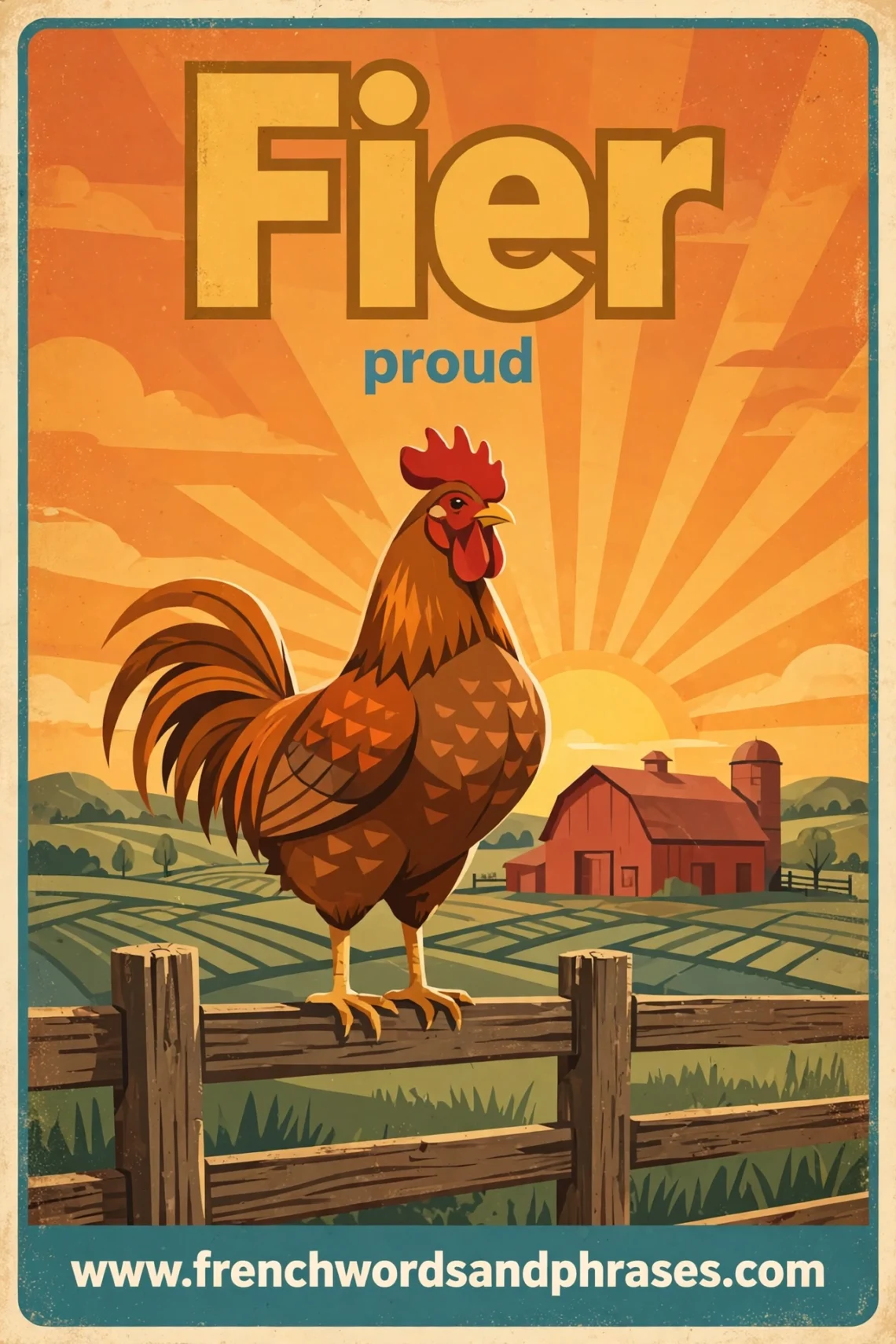
A French Word to Live By
Translate Fier to English
/fjɛʁ/
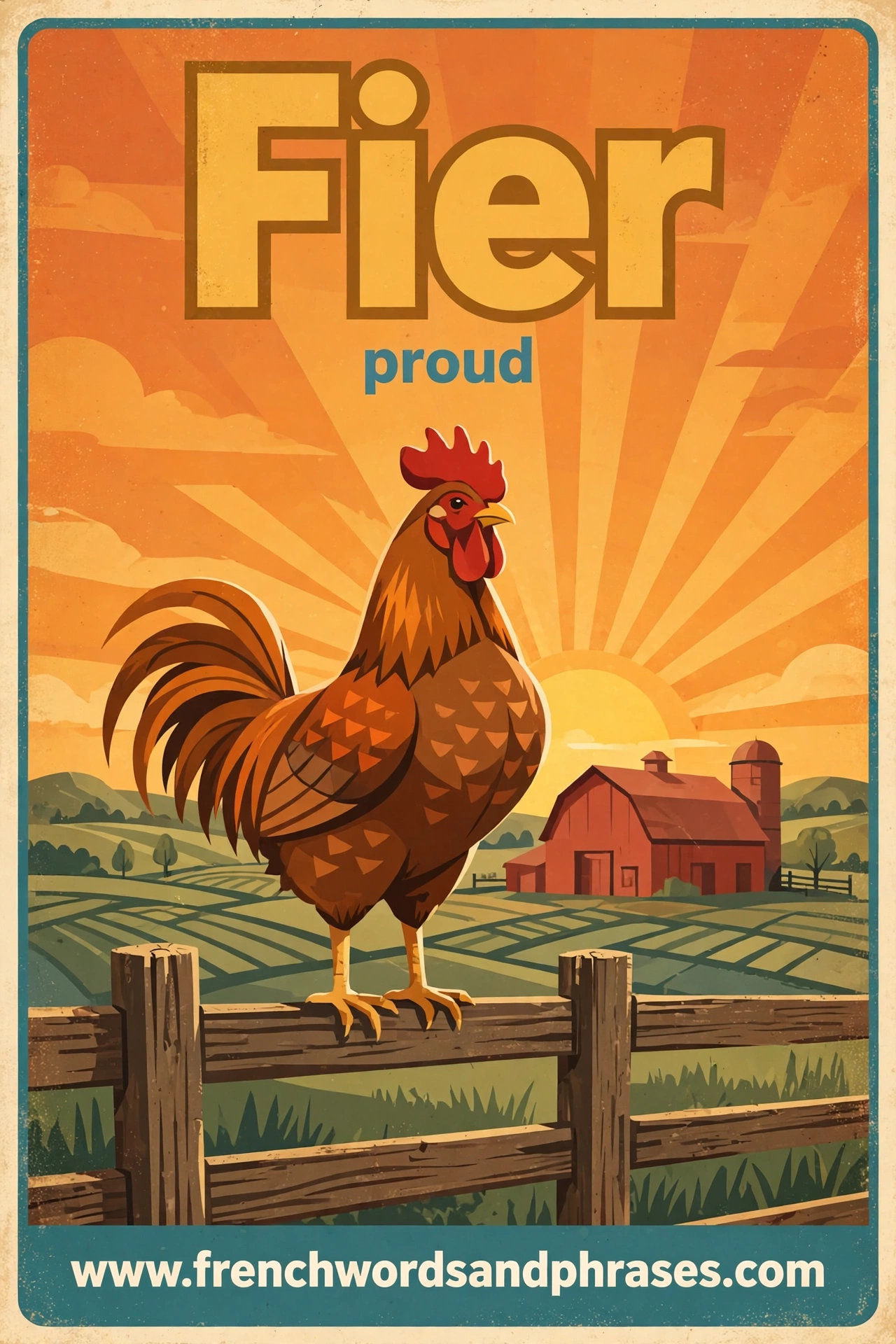
Fier means proud.
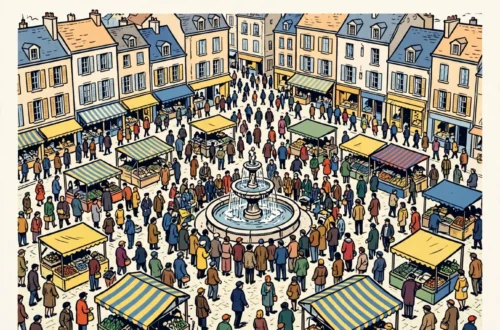
The village square on a Sunday morning: an old man in his best jacket stands a little straighter as his granddaughter, in a white dress, carries a candle past the fountain. He says nothing. He doesn’t need to. He is fier.
In this guide, you’ll learn what fier means in English, how its feminine fière is formed, the pattern fier de that French uses every day, and why being fier is a compliment — while its cousin orgueilleux is not. Explore French examples, English translations, and practice quizzes.
Understanding the French Adjective Fier
Fier is a French adjective of feeling — the adjective of pride. It changes for the feminine: fier becomes fière, with a grave accent and a new sound, as if the word itself stood taller.
It means proud — pleased and dignified about something earned: un père fier, une équipe fière. It is almost always followed by de: fier de son fils, fier de son travail, fier d’être français. French fier is healthy pride, the straight back — not vanity.
Type: Adjective of feeling — pride
Answers the question: What is he/she like? — proud
Changes form: Yes — fier, fière, fiers, fières
English equivalents: Proud.
One important usage detail: fier is followed by de — fier de + noun, or fier de + infinitive: elle est fière de conduire, she is proud to drive. English ‘proud of’ maps straight onto it.
Experience the Word
Fier is the adjective of the straightened back — the feeling that arrives quietly, when something you love has done well.
Imagine the school concert: forty children, one small violin slightly out of tune, and in the third row a mother whose eyes are shining. She is not embarrassed. She is fière — the violinist is hers.
You have not just felt pleased. You have stood a little taller inside your own life.
How to Use Fier in French: Complete Guide
Let’s explore how fier works in French, beginning with the whole word on one card.
Fier at a Glance
Before the details, here is the whole word on one card.
The Whole Word on One Card
Meaning, type, position and forms — fier in four lines.
| Point | Fier |
|---|---|
| Meaning | proud |
| Type | adjective of feeling — pride |
| Usual position | after the noun — un père fier |
| Form | fier / fière / fiers / fières |
Example
C’est un artisan fier de son métier.
He is a craftsman proud of his trade.
The Four Forms of Fier
Fier is one of the adjectives whose feminine truly changes: fier becomes fière — the -er ending opens into -ère, and the sound changes with it.
| Form | Fier | Example |
|---|---|---|
| Masculine singular | fier | un père fier — a proud father |
| Feminine singular | fière | une mère fière — a proud mother |
| Masculine plural | fiers | des pères fiers — proud fathers |
| Feminine plural | fières | des mères fières — proud mothers |
Example
Ils sont fiers de leur fille, et elle est fière d’eux.
They are proud of their daughter, and she is proud of them.
Quick Quiz 1
What is the feminine of fier?
Reveal the answer
fière
Une mère fière.
A proud mother.
The Feminine of Fier: Fière
Adjectives ending in -er form their feminine in -ère: the grave accent opens the vowel, and the r finally sounds. Fier is the model of the whole family.
| Pattern | Example |
|---|---|
| Masculine -er | fier — un homme fier |
| Feminine -ère | fière — une femme fière |
| The same family | cher → chère, dernier → dernière, étranger → étrangère |
| Plural | fiers / fières — des parents fiers, des mamans fières |
Example
Elle est fière, et elle a bien raison de l’être.
She is proud, and she has every reason to be.
Where Fier Goes: After the Noun
Fier follows the noun, and after être it almost always travels with de, carrying the reason for the pride behind it.
| Pattern | Example |
|---|---|
| noun + fier | un regard fier — a proud look |
| être + fier | Il est fier. — He is proud. |
| fier de + noun | fier de son équipe — proud of his team |
| fier de + infinitive | fière de conduire — proud to drive |
Example
Nous sommes fiers de notre village et de son équipe.
We are proud of our village and of its team.
Quick Quiz 2
Complete: je suis fier ___ mon fils. (of)
Reveal the answer
de
Je suis fier de mon fils.
I am proud of my son.
Prouder Still: Comparing with Fier
Fier compares the regular way, and every form agrees: plus fier, plus fière — pride, measured out.
| Degree | Example |
|---|---|
| As proud as | aussi fier que — as proud as |
| Prouder | plus fier — prouder |
| Less proud | moins fier — less proud |
| The proudest (masc.) | le plus fier — le père le plus fier de l’école |
| The proudest (fem.) | la plus fière — la plus fière des mamans |
Example
Après la victoire, l’entraîneur était le plus fier de tous.
After the victory, the coach was the proudest of all.
Everyday Expressions with Fier
Fier appears at graduations, matches and family dinners — wherever French people stand a little straighter.
| Expression | In English |
|---|---|
| fier de toi | proud of you — the words every child wants to hear |
| fier comme un paon | proud as a peacock — beaming with pride |
| avoir l’air fier | to look proud |
| fier de son travail | proud of one’s work |
| un fier succès | a resounding success — an old-fashioned, triumphant phrase |
| la fierté | pride — the noun of the family |
Example
Fier comme un paon, il montre la photo à tout le café.
Proud as a peacock, he shows the photo to the whole café.
Quick Quiz 3
What does fier comme un paon mean?
Reveal the answer
Proud as a peacock
Après son diplôme, il était fier comme un paon.
After his degree, he was proud as a peacock.
Fier and Its Neighbours
Pride has neighbours on both sides of the line — humble contentment below, arrogance above. Fier stands exactly on the healthy spot.
| French | In English |
|---|---|
| content | pleased, glad — the smaller, everyday cousin |
| satisfait | satisfied |
| orgueilleux | arrogant, full of oneself — pride gone wrong |
| vaniteux | vain — proud of appearances |
| modeste | modest — the quiet opposite |
| humble | humble — pride’s gentle opposite |
Example
Il est fier de son fils, mais jamais orgueilleux.
He is proud of his son, but never arrogant.
Watch Out: The Traps Around Fier
Two traps: fier is not ‘trust’ — that is a different word wearing the same coat — and the feminine accent is not decoration.
| Trap | The truth |
|---|---|
| se fier à | a different verb: se fier à quelqu’un = to trust someone — je me fie à toi, I trust you |
| the feminine accent | fière with è — ‘fiere’ without the accent is a misspelling |
| fier vs orgueilleux | fier is a compliment; orgueilleux is a criticism — choose carefully |
| fier de, not fier avec | proud of is fier de: fière de sa sœur |
Example
Je suis fier de ma sœur, et je me fie à elle complètement.
I am proud of my sister, and I trust her completely.
Quick Quiz 4
Which sentence means ‘I trust you’ — je suis fier de toi or je me fie à toi?
Reveal the answer
je me fie à toi
Je suis fier de toi means I am proud of you.
Je me fie à toi — I trust you.
Fier in Everyday French: Real-Life Examples
Now that you know the word, let’s see how fier appears in everyday French.
Example 1 — At the graduation
Ses parents sont fiers d’elle : elle a réussi son examen.
Her parents are proud of her: she passed her exam.
Example 2 — At the match
Les supporters sont fiers de leur équipe ce soir.
The supporters are proud of their team tonight.
Example 3 — At work
Je suis fier de ce rapport, il m’a pris trois semaines.
I am proud of this report, it took me three weeks.
Example 4 — In the family
Grand-père est fier comme un paon depuis la naissance du bébé.
Grandfather has been proud as a peacock since the baby was born.
Example 5 — About a town
Les habitants sont fiers de leur marché et de leur église.
The inhabitants are proud of their market and their church.
Example 6 — Quietly
Elle n’en parle pas, mais elle est fière de conduire enfin.
She doesn’t talk about it, but she is proud to finally be driving.
Beyond Translation: The Meaning of Fier
English says proud for the meaning of fier — but English proud walks a fence: one step to the left, humility; one step to the right, the deadly sin. French fier stands more calmly on the good side.
To be fier is to hold your head up about something real.
The vanity French disapproves of has its own words — orgueilleux, vaniteux. Fier keeps the dignity and leaves the sin to others.
How to Remember the French Adjective Fier
Remember it this way: Fier is the proud word that stands taller in the feminine — fier becomes fière, and the accent is the sound of a back straightening.
- You watch the feminine open up — fier → fière, like cher → chère.
- You keep de in your pocket — fier de toi, fier de son travail.
- You park it after the noun — un père fier, un regard fier.
The key idea is fier, fière, fiers, fières — and always fier de for ‘proud of’.
Test Your Knowledge of Fier
Let’s see how much you’ve learned. Try answering these questions before revealing the answers.
Question 1
What does fier mean?
Reveal the answer
Proud — healthy, earned pride.
Question 2
What are the forms of fier?
Reveal the answer
fier, fière, fiers, fières — the feminine takes -ère.
Question 3
Translate: a proud mother.
Reveal the answer
Une mère fière.
Question 4
Complete: nous sommes fiers ______ notre équipe.
Reveal the answer
de
Nous sommes fiers de notre équipe.
We are proud of our team.
Question 5
What is the difference between fier and orgueilleux?
Reveal the answer
Fier is healthy pride, a compliment; orgueilleux is arrogance, a criticism.
Your Final Challenge
Can You Use It?
How would you say this in French?
“I am proud of my daughter: she is proud of her work, and we are all proud of her.”
Reveal the answer
Je suis fier de ma fille : elle est fière de son travail, et nous sommes tous fiers d’elle.
I am proud of my daughter: she is proud of her work, and we are all proud of her.
A little French. A little curiosity. A richer everyday life.
LEARN FRENCH ONE WORD AT A TIME