A French Word to Live By
Translate Froid to English
/fʁwa/
Froid means cold.
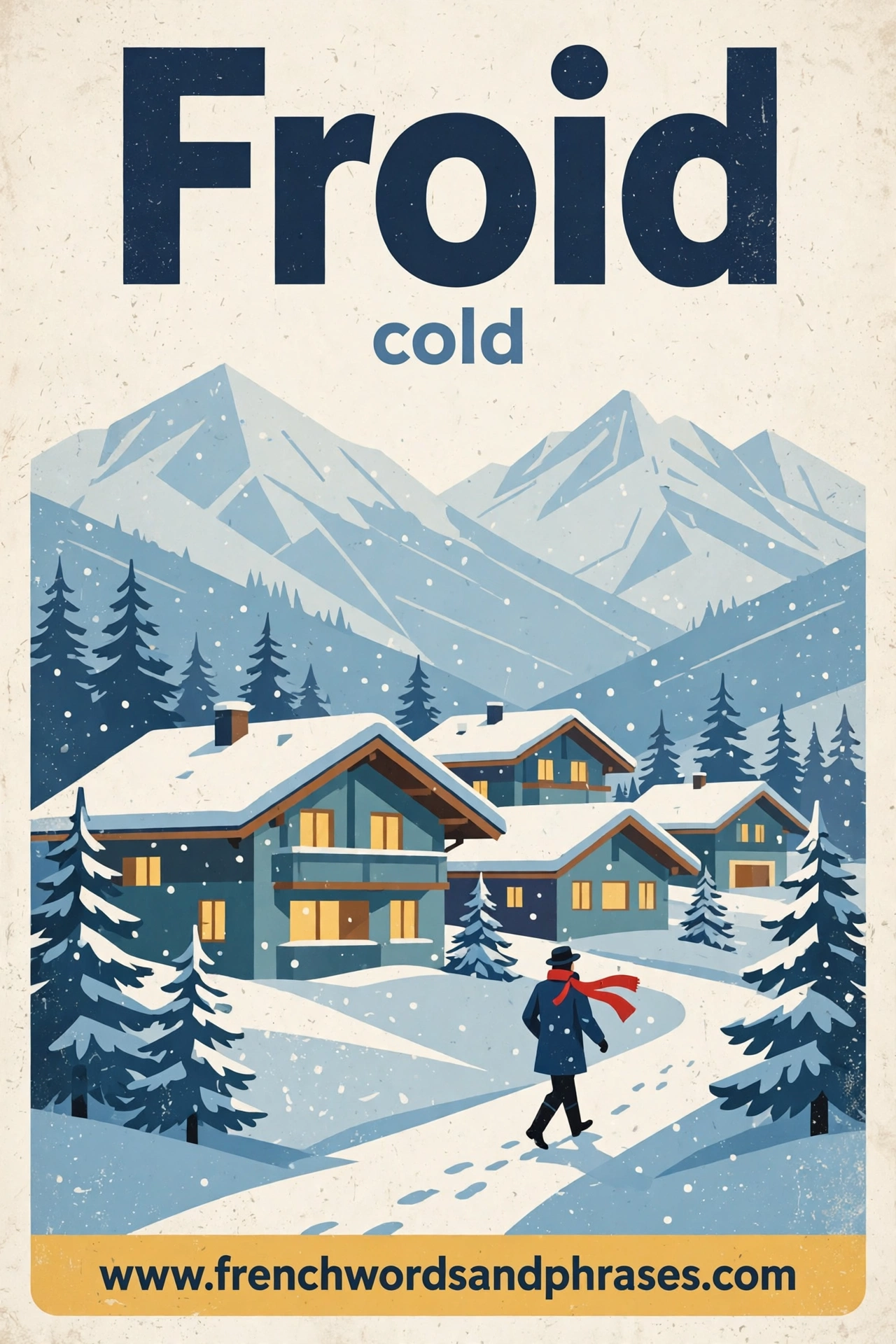
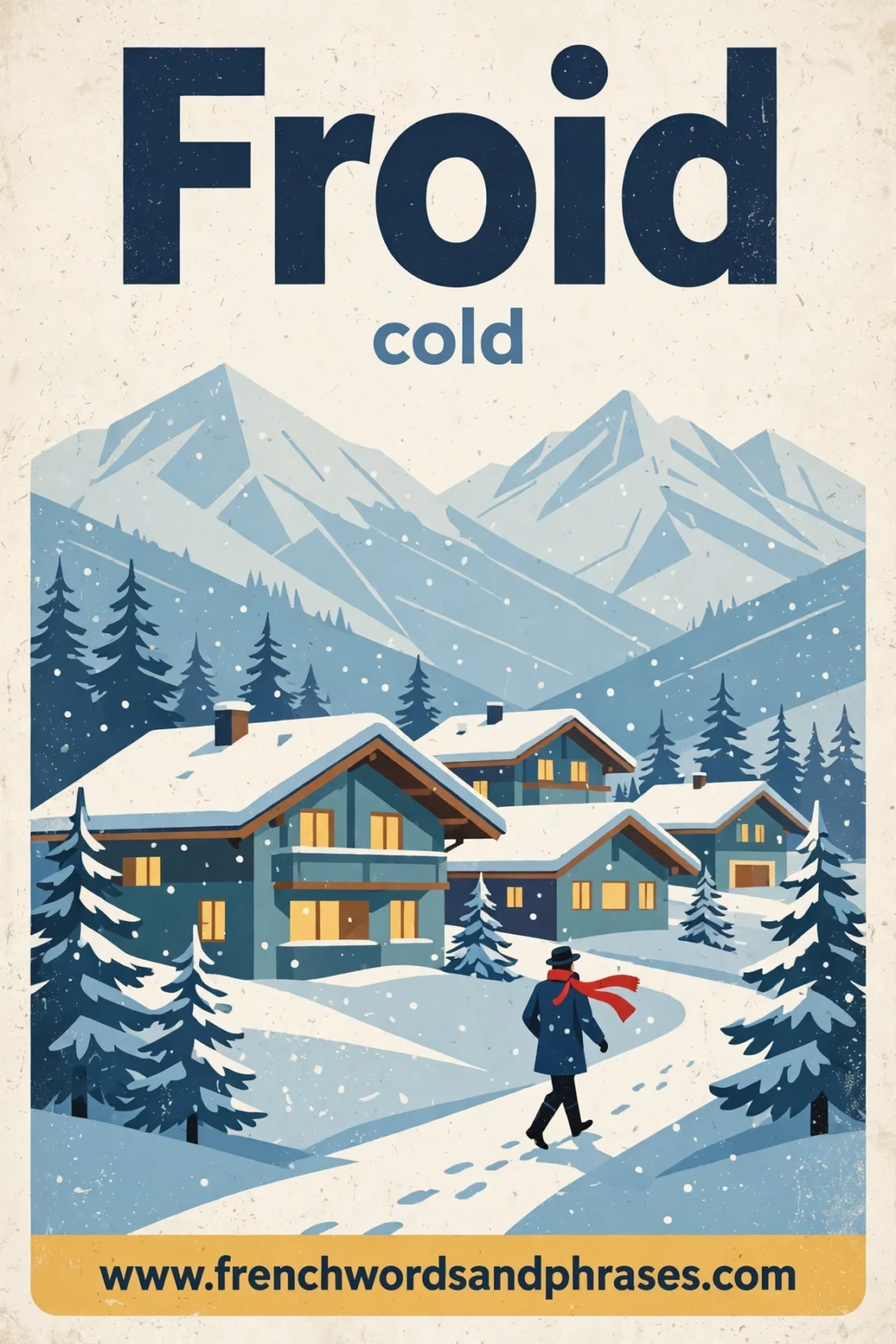
January in the mountains: breath in clouds, fingers slow on the ski lift, a lake locked in grey ice. In the village café the windows steam up as everyone stamps the snow off their boots. One word rules the whole month: froid.
In this guide, you’ll learn what froid means in English, how its feminine froide is formed, the difference between il fait froid and j’ai froid — a trap for every learner — and how French uses froid for food, weather and unwelcoming smiles. Explore French examples, English translations, and practice quizzes.
Understanding the French Adjective Froid
Froid is a French adjective of temperature — the adjective of cold. It agrees in the regular way: froid, froide, froids, froides. The masculine ends in a silent d; the feminine froide wakes that d up.
It means cold — cold weather, cold hands, cold soup. It also describes people who seem distant: un accueil froid, a cold welcome; un regard froid, a cold look. And it hides inside the weather itself: il fait froid, it is cold outside.
Type: Adjective of temperature — cold
Answers the question: What is it like? — cold
Changes form: Yes — froid, froide, froids, froides
English equivalents: Cold.
One important usage detail: French splits English ‘cold’ in two. For the weather, say il fait froid — never il est froid. For a person who FEELS cold, say j’ai froid — literally ‘I have cold’. Keep être for things: la soupe est froide, the soup is cold.
Experience the Word
Froid is the adjective of January — the word that arrives with scarves, red noses and hands wrapped around a hot bowl.
Imagine stepping off a night train in a mountain town: the platform empty, the air like glass, your breath writing small white words in front of you. Someone on the platform laughs and says the only possible sentence: « Il fait froid ! »
You have not just read a thermometer. You have felt the season take hold of you.
How to Use Froid in French: Complete Guide
Let’s explore how froid works in French, beginning with the whole word on one card.
Froid at a Glance
Before the details, here is the whole word on one card.
The Whole Word on One Card
Meaning, type, position and forms — froid in four lines.
| Point | Froid |
|---|---|
| Meaning | cold |
| Type | adjective of temperature |
| Usual position | after the noun — un vent froid |
| Form | froid / froide / froids / froides |
Example
Un vent froid souffle de la montagne.
A cold wind is blowing from the mountain.
The Four Forms of Froid
Froid forms its feminine with -e, and the sleeping d wakes up: froid is silent at the end, froide rings out. The plurals add -s.
| Form | Froid | Example |
|---|---|---|
| Masculine singular | froid | un thé froid — a cold tea |
| Feminine singular | froide | une soupe froide — a cold soup |
| Masculine plural | froids | des thés froids — cold teas |
| Feminine plural | froides | des soupes froides — cold soups |
Example
Elle sert des boissons froides et des plats chauds.
She serves cold drinks and hot dishes.
Quick Quiz 1
What is the feminine of froid?
Reveal the answer
froide
Une eau froide.
Cold water.
The Feminine of Froid: Froide
Add -e and the final d comes alive: froid, froide. Its warm mirror, chaud, works exactly the same way in reverse.
| Pattern | Example |
|---|---|
| Masculine | un matin froid — a cold morning |
| Feminine | une nuit froide — a cold night |
| Its mirror | chaud → chaude — hot works the same way |
| Plural | froids / froides — des vents froids, des mains froides |
Example
Ses mains sont froides, donne-lui des gants.
Her hands are cold, give her some gloves.
Where Froid Goes: After the Noun
Froid follows the noun for things — but French weather and French bodies have their own special sentences, and they never copy the English pattern.
| Pattern | Example |
|---|---|
| noun + froid | une boisson froide — a cold drink |
| The weather | Il fait froid. — It is cold (outside). |
| A person feels cold | J’ai froid. — I am cold (literally: I have cold) |
| A thing is cold | La soupe est froide. — The soup is cold. |
Example
Il fait froid dehors, et moi, j’ai froid aux pieds.
It is cold outside, and my feet are cold.
Quick Quiz 2
How do you say ‘I am cold’ — je suis froid or j’ai froid?
Reveal the answer
j’ai froid
Je suis froid would describe a cold personality — or worse.
J’ai froid — I am cold.
Colder Still: Comparing with Froid
Froid compares the regular way, with plus, moins and aussi — winter itself seems to enjoy the game.
| Degree | Example |
|---|---|
| As cold as | aussi froid que — as cold as |
| Colder | plus froid — colder |
| Less cold | moins froid — less cold |
| The coldest (masc.) | le plus froid — le mois le plus froid de l’année |
| The coldest (fem.) | la plus froide — la nuit la plus froide de l’hiver |
Example
Janvier est plus froid que décembre cette année.
January is colder than December this year.
Everyday Expressions with Froid
Froid chills more than soup: it describes welcomes, glances and even blood — and it names the chill you catch from a blast of cold air.
| Expression | In English |
|---|---|
| il fait froid | it is cold (weather) |
| avoir froid | to be cold (a person) |
| un accueil froid | a cold welcome |
| garder la tête froide | to keep a cool head |
| à froid | cold, without warming up — démarrer à froid; figuratively: off the cuff |
| un coup de froid | a chill — catching cold from a blast of cold air |
Example
Malgré le bruit, elle garde la tête froide et finit son travail.
Despite the noise, she keeps a cool head and finishes her work.
Quick Quiz 3
What does il fait froid describe — a person or the weather?
Reveal the answer
The weather
For a person, say j’ai froid.
Il fait froid — it is cold outside.
Froid and Its Neighbours
Froid anchors the cold end of the temperature shelf. Its neighbours run from a pleasant coolness down to the frozen pole — and chaud waits at the other end.
| French | In English |
|---|---|
| frais | cool, fresh — pleasantly cool: un vent frais |
| glacé | icy, freezing — much colder |
| gelé | frozen — for water, fingers and toes |
| glacial | glacial, icy — the extreme, also for a stare |
| chaud | hot, warm — the direct opposite |
| tiède | lukewarm — the unhappy middle |
Example
L’eau du lac est glacée, bien plus froide qu’hier.
The lake water is icy, much colder than yesterday.
Watch Out: The Traps Around Froid
Froid holds the most famous trap in beginner French — the weather sentence — plus one about people who only SEEM cold.
| Trap | The truth |
|---|---|
| il est froid for weather | wrong — the weather is il fait froid; il est froid describes a cold person, or worse |
| je suis froid for ‘I feel cold’ | wrong — say j’ai froid; je suis froid means you are cold-hearted |
| froid for people | un homme froid = a distant, unfriendly man — a character judgement |
| le froid (noun) | the cold itself: le froid arrive, the winter cold is coming |
Example
Il a l’air froid, mais en fait il est simplement timide.
He seems cold, but in fact he is simply shy.
Quick Quiz 4
Translate: it is cold today, and I am cold.
Reveal the answer
Il fait froid aujourd’hui, et j’ai froid.
Fait for the weather, avoir for the person.
It is cold today, and I am cold.
Froid in Everyday French: Real-Life Examples
Now that you know the word, let’s see how froid appears in everyday French.
Example 1 — Weather
Il fait froid ce matin, mets ton manteau et ton écharpe.
It is cold this morning, put on your coat and scarf.
Example 2 — At home
La soupe est froide, je la remets sur le feu.
The soup is cold, I’ll put it back on the stove.
Example 3 — At the café
Un thé froid avec du citron, s’il vous plaît.
A cold tea with lemon, please.
Example 4 — In winter
Mes mains sont froides malgré mes gants.
My hands are cold despite my gloves.
Example 5 — About a person
Son accueil était froid, presque impoli.
His welcome was cold, almost rude.
Example 6 — A remedy
J’ai froid, ferme la fenêtre et fais un feu.
I’m cold, close the window and light a fire.
Beyond Translation: The Meaning of Froid
English says cold for the meaning of froid — one word for the weather, the soup and the person. French froid is cleverer: it keeps the three apart, with il fait froid for the sky, être froid for things, and avoir froid for you.
To say j’ai froid is to carry the cold with you, like a possession you would happily give back.
And when the cold turns to character — un accueil froid — French lets you feel the temperature of a room full of people, no thermometer needed.
How to Remember the French Adjective Froid
Remember it this way: Froid is the cold word with three doors — fait for the weather, avoir for you, être for things.
- You never say il est froid for the sky — il fait froid, always.
- You feel cold with avoir — j’ai froid, tu as froid, nous avons froid.
- You wake the d in the feminine — froid → froide, une soupe froide.
The key idea is froid, froide, froids, froides — il fait froid outside, j’ai froid inside.
Test Your Knowledge of Froid
Let’s see how much you’ve learned. Try answering these questions before revealing the answers.
Question 1
What does froid mean?
Reveal the answer
Cold — of weather, things and unwelcoming people.
Question 2
What are the forms of froid?
Reveal the answer
froid, froide, froids, froides — the feminine wakes up the d.
Question 3
Translate: a cold night.
Reveal the answer
Une nuit froide.
Question 4
Complete the sentence:
______ fait froid aujourd’hui, mets un pull.
Reveal the answer
Il
Il fait froid aujourd’hui, mets un pull.
It is cold today, put on a jumper.
Question 5
How do you say ‘she is cold’ (she feels cold)?
Reveal the answer
Elle a froid. — French uses avoir: she ‘has’ cold.
Your Final Challenge
Can You Use It?
How would you say this in French?
“It is cold this morning: the soup is cold, my hands are cold, and I am cold.”
Reveal the answer
Il fait froid ce matin : la soupe est froide, mes mains sont froides, et j’ai froid.
It is cold this morning: the soup is cold, my hands are cold, and I am cold.
A little French. A little curiosity. A richer everyday life.
LEARN FRENCH ONE WORD AT A TIME