A French Word to Live By
Translate Me to English
/mə/
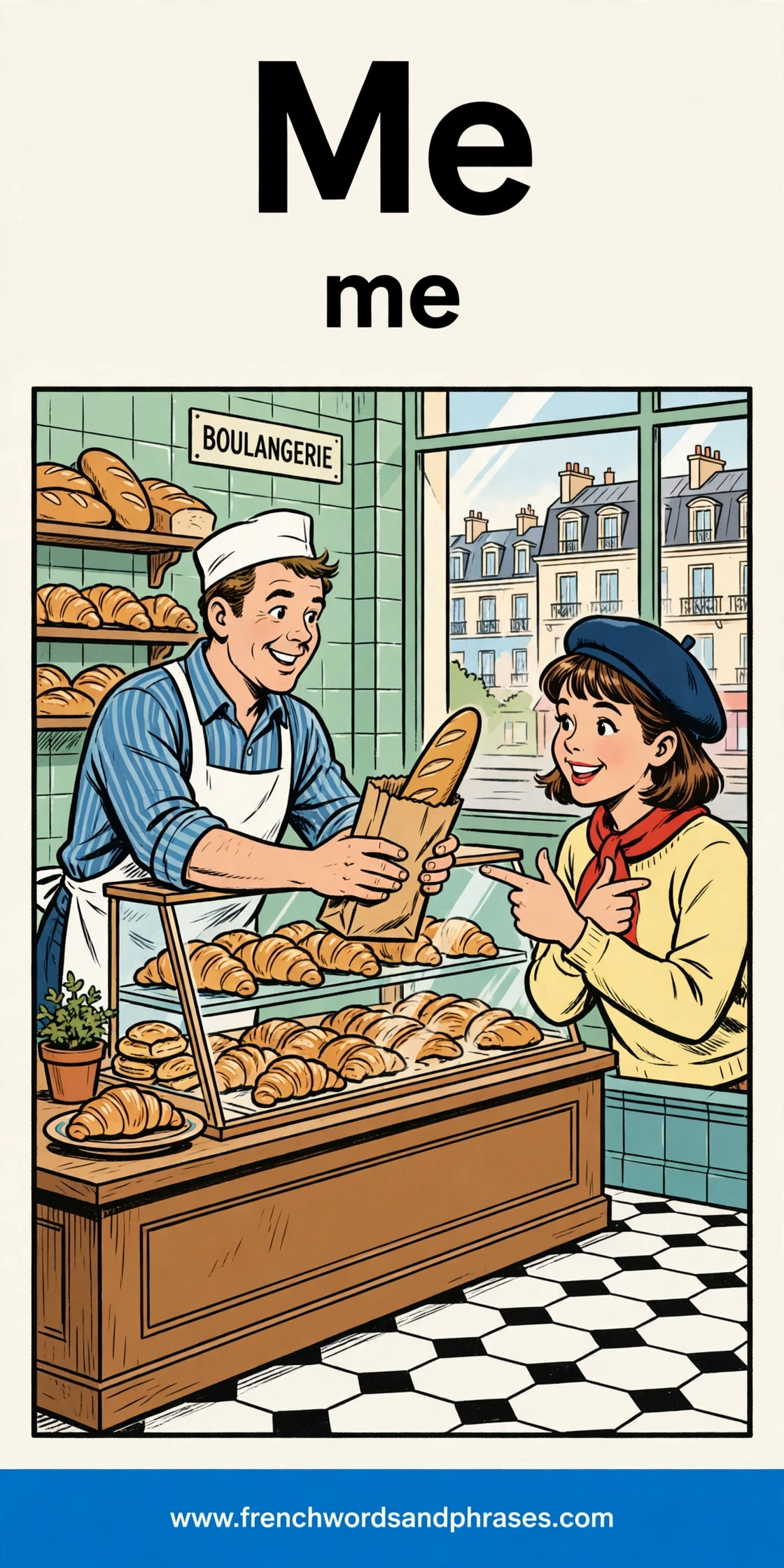
Me means me — the object and reflexive pronoun for je.
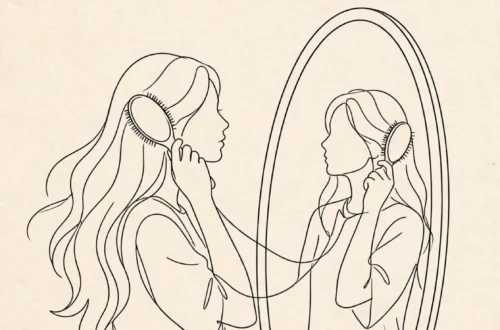
A hand raised in a classroom, a name called in a crowd — « Moi ! » But inside the sentence, quietly glued to the verb, lives the smaller twin: « Il me voit, elle me parle, je me lève. » Me is how French says me wherever the action lands: seen, heard, helped — and how je acts on itself, every morning, in je me lève.
Let’s explore how me works in French, beginning with the whole word on one card.
Understanding the French Pronoun Me
Me is a French object pronoun — the unstressed form of moi. It stands for the person speaking (je) whenever that person is not the subject: as a direct object (il me voit, he sees me), an indirect object (elle me parle, she speaks to me), and as the reflexive pronoun of je (je me lève, I get up — literally I raise myself). Before a vowel or silent h it shrinks to m’: il m’écoute, he listens to me. It always stands immediately before the verb.
It means me, and to me: tu me connais, you know me; il me donne le livre, he gives me the book (he gives the book to me); elle me téléphone, she phones me. In its reflexive life it means myself: je me couche, I go to bed; je me trompe, I make a mistake — je me trompe is one of the most useful sentences in France. What me never does is stand alone or carry stress: for that — after prepositions, in comparisons, in one-word answers — French switches to its strong twin, moi.
Type: Object pronoun — direct, indirect and reflexive (for je)
Answers the question: Qui ? / À qui ? — Whom? / To whom? (me)
Position: Immediately before the verb: il me voit; elides to m’ before a vowel: il m’aide
Watch the pair: me (unstressed, before the verb) vs moi (stressed, standing strong)
One important usage detail: in affirmative commands, me moves behind the verb and becomes its strong twin moi — regarde-moi !, look at me!; aide-moi !, help me! — but the negative command puts me back in front: ne me regarde pas ! And in the passé composé of reflexive verbs, me travels with être: je me suis levé, I got up.
Experience the Word
Me is the smallest stage in French grammar: one syllable where the speaker stops acting and starts being acted on — seen, called, helped, loved.
Imagine the small boy at the fence of the schoolyard, jumping to be seen by his mother in the crowd of parents, shouting the oldest sentence in the world: « Maman, regarde-moi ! » Inside a calm sentence he would be me — il me regarde — but excitement promotes him to moi, and the grammar bends to the joy.
You have not just learned a pronoun. You have found where je goes when the world acts on it — me, tucked against the verb.
How to Use Me in French: Complete Guide
Let’s explore how me works in French, beginning with the whole word on one card.
Me at a Glance
The Whole Word on One Card
Meaning, jobs, position and family — me in four lines.
| Point | Me |
|---|---|
| Meaning | me, to me — and myself in reflexive verbs |
| Jobs | direct object, indirect object, reflexive pronoun of je |
| Position | just before the verb; m’ before a vowel: il m’écoute |
| Its family | moi (the stressed twin), te (you), se (himself/herself) |
Example
Il me connaît depuis l’école.
He has known me since school.
The Pattern in Action: The Three Jobs of Me
Me receives the action, receives the giving, and turns the action back on je.
| Pattern | Example |
|---|---|
| direct object | elle me voit — she sees me |
| indirect object | il me donne un livre — he gives me a book |
| reflexive | je me lève à sept heures — I get up at seven |
| elided | tu m’écoutes ? — are you listening to me? |
Example
Elle me parle et je me tais.
She speaks to me and I fall silent.
Quick Quiz 1
Where does me stand in the sentence — before or after the verb?
Reveal the answer
Before the verb — glued to it: il me voit.
Tu me téléphones ce soir ?
Will you phone me tonight?
Me at Work: The Reflexive Morning
Half of me’s life is the reflexive routine — the verbs French uses for the body’s day.
| Pattern | Example |
|---|---|
| je me lève | I get up |
| je me lave | I wash (myself) |
| je me couche | I go to bed |
| je me trompe | I make a mistake — the great confession |
| je me dépêche | I hurry |
Example
Je me lève, je me lave, et je me dépêche.
I get up, I wash, and I hurry.
Me or Moi? The Quiet Twin and the Strong Twin
Same person, different strength: me whispers before the verb, moi stands up everywhere else.
| Situation | Example |
|---|---|
| before the verb | il me voit — he sees me |
| after a preposition | avec moi — with me (never « avec me ») |
| in a command | regarde-moi ! — look at me! (me becomes moi) |
| standing alone | qui veut du café ? — moi ! — who wants coffee? — me! |
Example
Viens avec moi, il me l’a demandé.
Come with me, he asked me (for it).
Quick Quiz 2
« Help me! » as a command — aide-me or aide-moi?
Reveal the answer
Aide-moi — in affirmative commands, me becomes moi behind the verb.
Aide-moi, s’il te plaît !
Help me, please!
Everyday Expressions with Me
Me turns up wherever people act on the speaker — a dozen times a day.
| Expression | In English |
|---|---|
| il me semble que… | it seems to me that… |
| ça me plaît | I like it (it pleases me) |
| il me manque | I miss him (he is missing to me) |
| ça me fait plaisir | that makes me happy |
| je me demande si… | I wonder if… |
Example
Il me semble que tu me manques déjà.
It seems to me that I already miss you.
Close Cousins: Te, Se, Nous, Vous
The object-pronoun family: one for each person, all glued to the verb the same way.
| Word | The difference |
|---|---|
| me | me — for je |
| te | you — for tu: je te vois |
| se | himself, herself, themselves — for il, elle, ils, elles |
| nous / vous | us / you — same form as the subject words, working as objects |
Example
Je te vois, tu me vois, on se voit.
I see you, you see me, we see each other.
Quick Quiz 3
In je me trompe, is me an object or a reflexive?
Reveal the answer
A reflexive — je acts on itself: I mistake myself, I am wrong.
Pardon, je me trompe souvent de rue.
Sorry, I often take the wrong street.
Me and Its Neighbours
The pronoun shelf around me — its strong twin and its fellow objects.
| French | In English |
|---|---|
| moi | me — stressed: avec moi, moi aussi |
| te | you (object, for tu) |
| le / la | him, it / her, it (direct objects) |
| lui | to him, to her (indirect object) |
| y / en | there / of it, some — the object cousins |
Example
Elle le lui donne, et moi, elle me regarde.
She gives it to him, and as for me, she looks at me.
Watch Out: The Traps Around Me
The traps: moi in me’s place, the missing elision, and the command that swaps them.
| Trap | The truth |
|---|---|
| « il moi voit » | before the verb it is me: il me voit — moi never stands there |
| « il me écoute » | before a vowel, me becomes m’: il m’écoute |
| commands | affirmative: aide-moi (moi, behind); negative: ne m’aide pas (me, in front) |
| je me suis with avoir | reflexive passé composé takes être: je me suis levé |
Example
Ne me regarde pas, je me suis trompé !
Don’t look at me, I made a mistake!
Quick Quiz 4
Complete: il ______ écoute toujours (listens to me)
Reveal the answer
m’ — me elides before a vowel: il m’écoute.
Il m’écoute toujours jusqu’au bout.
He always listens to me to the end.
Me in Everyday French: Real-Life Examples
Now that you know the word, let’s see how me appears in everyday French.
Example 1 — Being seen
Tu me vois, là, près de la porte ?
Can you see me, there, near the door?
Example 2 — The morning
Je me lève à six heures et demie.
I get up at half past six.
Example 3 — The phone
Elle me téléphone tous les dimanches.
She phones me every Sunday.
Example 4 — Missing
Ma famille me manque beaucoup.
I miss my family a lot.
Example 5 — Mistakes
Pardon, je me suis trompé de porte.
Sorry, I took the wrong door.
Example 6 — Pleasure
Ce cadeau me fait très plaisir.
This present makes me very happy.
Beyond Translation: The Meaning of Me
Me is moi after a thousand years of being unstressed: where Latin said mihi with full weight, French split the job in two — a strong form for standing alone (moi) and a light form that leans on the verb (me). The split is the whole secret of French pronouns: they come in pairs, the stressed and the leaning, and choosing between them is not decoration but grammar. Me also carries one of French’s most charming constructions: the reflexive day. Je me lève, je me lave, je me couche — the self, handled gently by its own pronoun from waking to sleeping.
To say me is to stand in the path of the action — and to fit in one syllable.
It evokes the raised hand, the morning routine, and « je me trompe », the most graceful confession in the language.
How to Remember the French Pronoun Me
Remember it this way: Me is me before the verb — direct, indirect or reflexive — and moi is its strong twin for everywhere else.
- The position — glued before the verb: il me voit; elided m’ before a vowel: il m’aide.
- The reflexive life — je me lève, je me couche, je me trompe.
- The command swap — aide-moi ! but ne m’aide pas !
The key idea is me = me/to me/myself, before the verb; moi = the stressed twin.
Test Your Knowledge of Me
Let’s see how much you’ve learned. Try answering these questions before revealing the answers.
Question 1
What does me mean?
Reveal the answer
Me, to me — and myself in reflexive verbs.
Question 2
How do you say he sees me?
Reveal the answer
Il me voit.
Question 3
Translate: I get up at seven.
Reveal the answer
Je me lève à sept heures.
Question 4
Complete the sentence:
Elle ______ écoute avec attention. (listens to me)
Reveal the answer
m’
Elle m’écoute avec attention.
She listens to me attentively.
Question 5
When does me become moi?
Reveal the answer
When it is stressed — after prepositions, standing alone, and behind the verb in affirmative commands: aide-moi !
Your Final Challenge
Can You Use It?
How would you say this in French?
“She phones me every Sunday.”
Reveal the answer
Elle me téléphone tous les dimanches.
She phones me every Sunday.
A little French. A little curiosity. A richer everyday life.
LEARN FRENCH ONE WORD AT A TIME