A French Word to Live By
Translate Garçon to English
/ɡaʁ.sɔ̃/
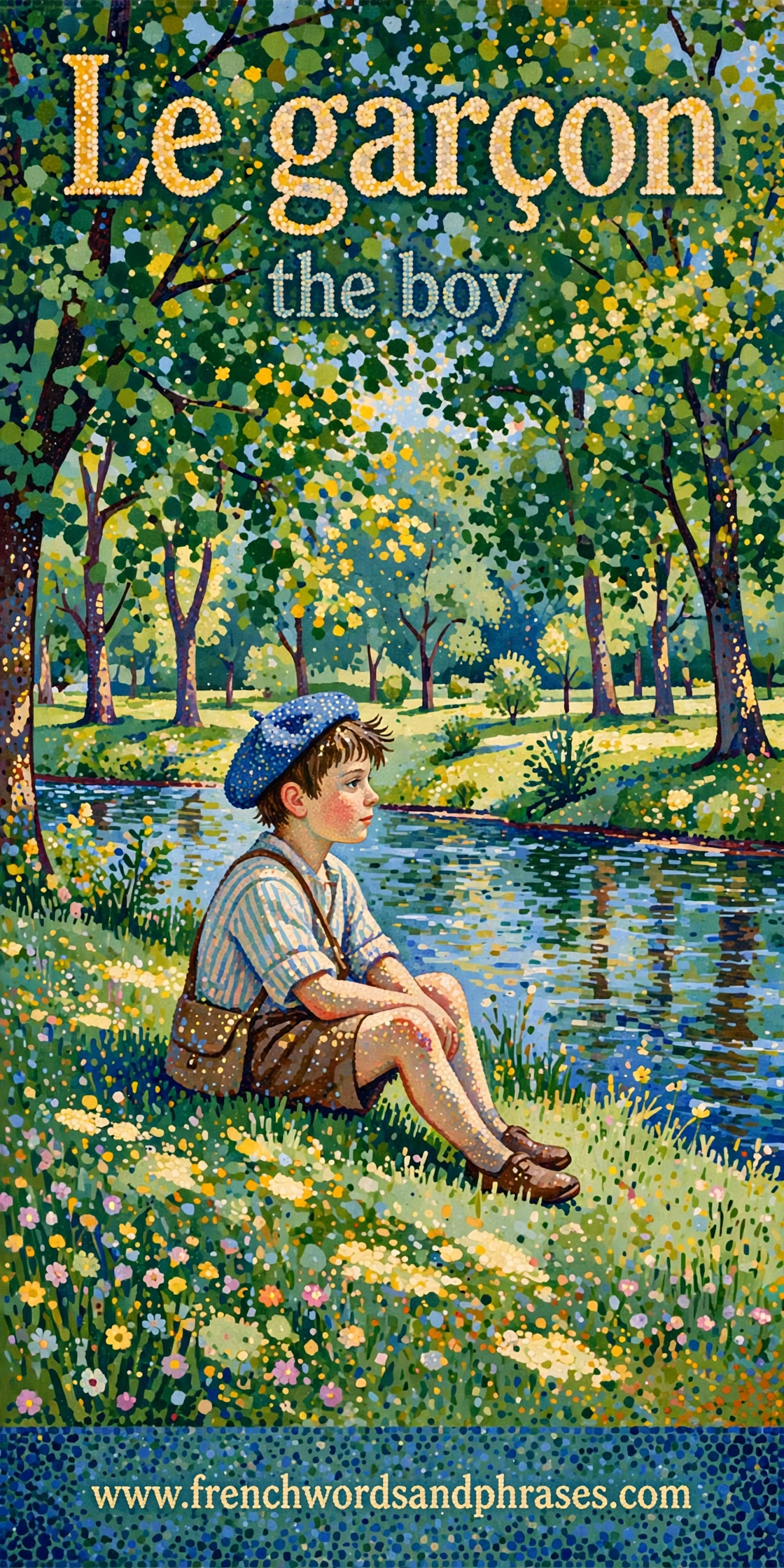
Le garçon means the boy.
School is out, satchels bounce, and a small figure races down the street with a football under one arm — le garçon, the boy, first citizen of every playground in France.
In this guide, you’ll learn what garçon means in English, how to use it with its articles, how to form its plural, and how it appears in everyday French. Explore French examples, English translations, and practice quizzes.
Understanding the French Noun Garçon
Garçon is a masculine French noun, learned with its article: le garçon, un garçon. It carries the famous cedilla under the c — gar-çon — the little hook that keeps the c soft before the o: garçon sounds like « gar-son », never « gar-kon ».
It means the boy — a male child, from the toddler to the teenager. It also means a young man in some set phrases, and waiters were once summoned with a bare « Garçon ! » in cafés — a call now considered old-fashioned and a little rude. A bridegroom’s best man is le garçon d’honneur.
Gender: Masculine — le garçon
Definite article: le — le garçon (the boy)
Indefinite article: un — un garçon (a boy)
Plural: les garçons
Spelling note: the cedilla under the c keeps it soft: gar-çon
Its opposite number: la fille (the girl)
English equivalents: The boy.
Order in a café with s’il vous plaît and a smile, not with the old cry of « Garçon ! » — the word for the waiter himself, le serveur, is the polite modern choice. But garçon keeps its honourable posts: le garçon d’honneur stands beside the groom, and un garçon de café remains the classic name of the trade.
Experience the Word
Garçon is the sound of the school gate at four o’clock: scooters, footballs, and a hundred plans for the evening made in thirty seconds.
Imagine a village wedding: the garçon d’honneur, twelve years old and bursting with pride, carries the rings on a cushion as if they were the crown jewels.
You have not just named a child. You have met half of every French childhood — le garçon, satchel on his back.
How to Use Garçon in French: Complete Guide
Let’s explore how garçon works in French, beginning with its articles — le garçon, un garçon, des garçons.
Garçon with the Definite Article (Le, Les)
Used for a specific boy — the one at the gate, the one with the football.
| Form | French |
|---|---|
| Masculine singular | le garçon |
| Plural | les garçons |
Example
Le garçon attend son ami devant l’école.
The boy is waiting for his friend in front of the school.
Garçon with the Indefinite Article (Un, Des)
Used for a boy in general — any boy of the class, the street, the story.
| Form | French |
|---|---|
| Masculine singular | un garçon |
| Plural | des garçons |
Example
Un garçon distribue les journaux du quartier.
A boy delivers the neighbourhood newspapers.
Garçon with the Partitive and Quantities (Un garçon de…)
Boys are counted by age and by classroom — the quantities of childhood.
| Quantity | French |
|---|---|
| a little boy | un petit garçon |
| a boy of ten | un garçon de dix ans |
| the boys of the class | les garçons de la classe |
| a group of boys | un groupe de garçons |
| the eldest boy | le garçon aîné |
Example
Un garçon de dix ans garde le but.
A boy of ten is keeping goal.
Quick Quiz 1
Complete the sentence:
______ garçon joue dans la cour. (the)
Reveal the answer
Le
Le garçon joue dans la cour.
The boy is playing in the yard — garçon is masculine, so le.
The Plural of Garçon
Garçon adds an -s in the plural — les garçons, the whole team of them.
| Number | French |
|---|---|
| Singular | le garçon |
| Plural | les garçons |
Example
Les garçons de l’équipe portent des maillots bleus.
The boys of the team wear blue shirts.
Garçon with Possessive Adjectives (Mon, Ton, Son…)
Possessives agree with the noun: garçon is masculine, so mon, ton, son in the singular.
| Owner | French |
|---|---|
| my | mon garçon |
| your (tu) | ton garçon |
| his / her | son garçon |
| our | notre garçon |
| your (vous) | votre garçon |
| their | leur garçon |
Example
Mon garçon commence l’école en septembre.
My boy starts school in September.
Quick Quiz 2
Complete the sentence:
Elle appelle ______ garçon pour le dîner. (her)
Reveal the answer
son
Elle appelle son garçon pour le dîner.
She calls her boy for dinner — son, because garçon is masculine.
Garçon with Demonstrative Adjectives (Ce, Ces)
Used to point: ce garçon, this boy.
| Form | French |
|---|---|
| Masculine singular | ce garçon |
| Plural | ces garçons |
Example
Ce garçon dessine remarquablement bien.
This boy draws remarkably well.
Garçon with Adjectives
Adjectives agree with garçon — masculine singular: un garçon sage, un grand garçon.
| Adjective | With Garçon |
|---|---|
| petit (little) | un petit garçon |
| grand (big, tall) | un grand garçon |
| sage (good, well-behaved) | un garçon sage |
| gentil (kind) | un garçon gentil |
| curieux (curious) | un garçon curieux |
Example
C’est un garçon gentil et curieux.
He is a kind, curious boy.
Quick Quiz 3
Complete the sentence:
C’est un ______ garçon, il aide tout le monde. (kind)
Reveal the answer
gentil
C’est un garçon gentil, il aide tout le monde.
He is a kind boy, he helps everyone.
Everyday Expressions with Garçon
Best men, waiters of legend and good boys — the garçon phrases of daily life.
| Expression | In English |
|---|---|
| le garçon d’honneur | the best man, the groomsman |
| un garçon de café | a café waiter (classic term) |
| un petit garçon | a little boy |
| un garçon manqué | a tomboy (literally a missed boy — said of a girl) |
| les garçons et les filles | the boys and the girls |
| un brave garçon | a good lad |
Example
Le garçon d’honneur garde les alliances.
The best man is looking after the rings.
Words from the Same Family as Garçon
Girls, children and brothers — the words that travel with garçon.
| French | In English |
|---|---|
| la fille | the girl |
| l’enfant | the child |
| le fils | the son |
| le frère | the brother |
| l’homme | the man — what the garçon becomes |
Example
Le garçon deviendra un homme, comme son frère avant lui.
The boy will become a man, like his brother before him.
Quick Quiz 4
What does le garçon d’honneur mean?
Reveal the answer
The best man — the groom’s attendant at a wedding.
Son frère sera son garçon d’honneur.
His brother will be his best man.
Garçon in Everyday French: Real-Life Examples
Now that you know the word, let’s see how garçon appears in everyday French.
Example 1 — At school
Le garçon lève la main pour répondre.
The boy raises his hand to answer.
Example 2 — In the street
Un petit garçon promène son chien.
A little boy is walking his dog.
Example 3 — A compliment
Quel garçon sage et poli !
What a good, polite boy!
Example 4 — The team
Les garçons s’entraînent le mercredi après-midi.
The boys train on Wednesday afternoons.
Example 5 — A wedding
Le garçon d’honneur porte un costume bleu.
The best man is wearing a blue suit.
Example 6 — Growing up
À quinze ans, le garçon rêve déjà de conduire.
At fifteen, the boy already dreams of driving.
Beyond Translation: The Meaning of Garçon
Garçon began life humbly — in old French it meant a servant lad — and climbed the world: schoolboy, waiter, best man. Its cedilla is one of the first ornaments French children learn to draw, the little hook that turns a hard c into a soft s-sound. And the language is honest about the word’s café past: « Garçon ! » survives in old films and jokes, a fossil of the age when waiters were summoned like bells.
To say garçon is to open the school gate at the end of the day.
It evokes the satchel and the football, the small best man with the rings — childhood, in its masculine half.
How to Remember the French Noun Garçon
Remember it this way: Garçon is the boy — masculine, with a cedilla that keeps its c soft: le garçon, un petit garçon.
- Always masculine — le garçon, un garçon, mon garçon ; the girl is la fille.
- The little hook — la cédille de garçon adoucit le c : gar-son, jamais gar-kon.
- The wedding post — le garçon d’honneur, the best man.
The key idea is le garçon — the boy, masculine; ç keeps the c soft.
Test Your Knowledge of Garçon
Let’s see how much you’ve learned. Try answering these questions before revealing the answers.
Question 1
Is garçon masculine or feminine?
Reveal the answer
Masculine — le garçon, un garçon.
Question 2
What does the cedilla do in garçon?
Reveal the answer
It keeps the c soft — garçon sounds like gar-son, not gar-kon.
Question 3
Translate: The boy is waiting for his friend.
Reveal the answer
Le garçon attend son ami.
Question 4
What is the opposite number of le garçon?
Reveal the answer
La fille — the girl.
Question 5
Complete the sentence:
______ garçons jouent au football. (the)
Reveal the answer
Les
Les garçons jouent au football.
The boys are playing football.
Your Final Challenge
Can You Use It?
How would you say this in French?
“The boy plays in the garden.”
Reveal the answer
Le garçon joue dans le jardin.
The boy plays in the garden.
A little French. A little curiosity. A richer everyday life.
LEARN FRENCH ONE WORD AT A TIME