A French Word to Live By
Translate Leçon to English
/lə.sɔ̃/
La leçon means the lesson.
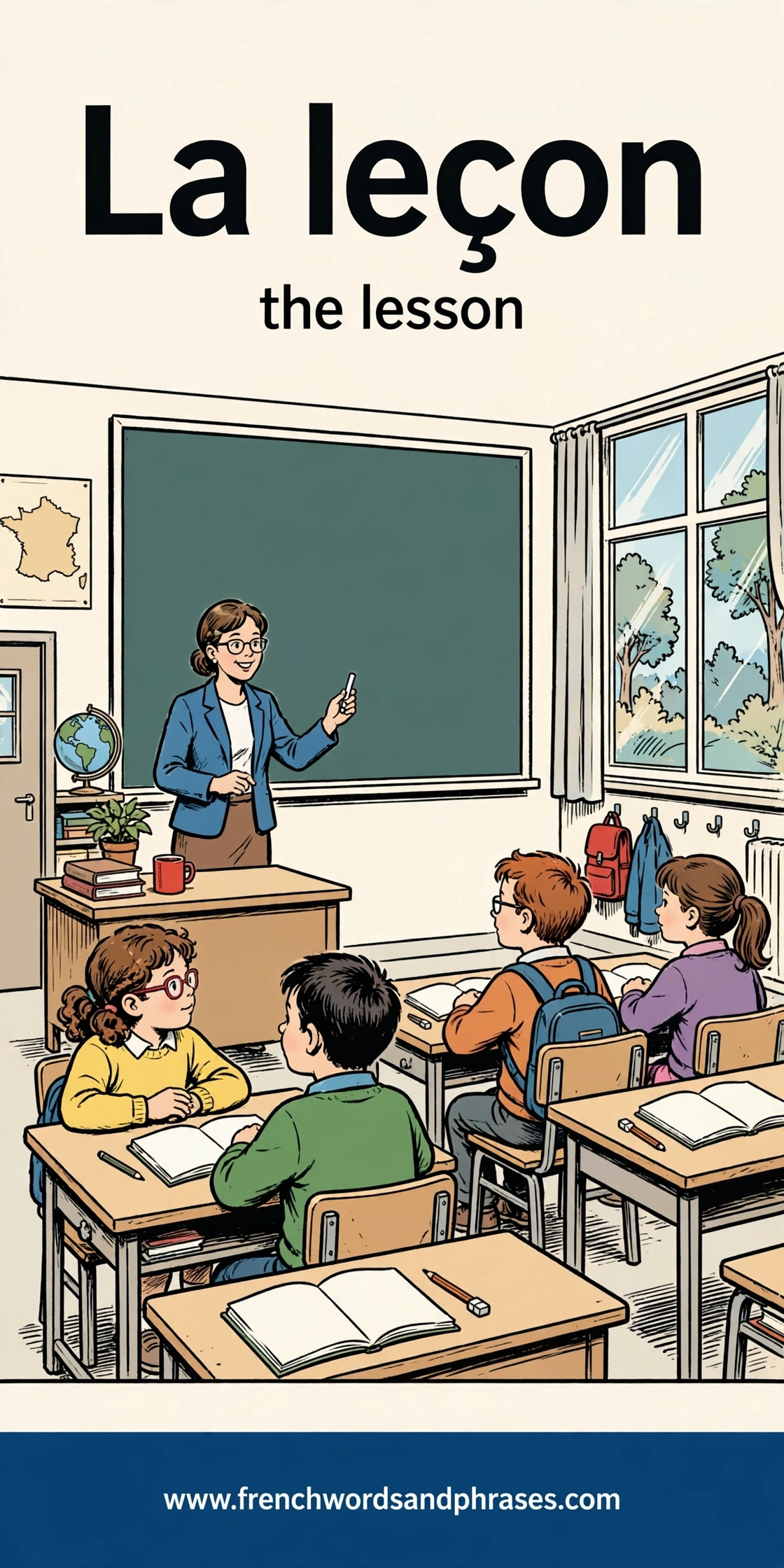
The classroom is quiet, the blackboard is full, and thirty notebooks open at the same page — la leçon, the lesson, the hour when knowledge changes hands.
In this guide, you’ll learn what leçon means in English, how to use it with its articles, how to form its plural, and how it appears in everyday French. Explore French examples, English translations, and practice quizzes.
Understanding the French Noun Leçon
Leçon is a feminine French noun, learned with its article: la leçon, une leçon. Like its cousin garçon, it carries a cedilla under the c — le-çon — the little hook that keeps the c soft before the o.
It means the lesson — the teaching you receive at school, at the piano, at the wheel of a car: une leçon de piano, une leçon de conduite. It also means the moral drawn from experience — retenir la leçon, to learn the lesson — and, turned around, the telling-off itself: faire la leçon à quelqu’un is to lecture them.
Gender: Feminine — la leçon
Definite article: la — la leçon (the lesson)
Indefinite article: une — une leçon (a lesson)
Plural: les leçons
Spelling note: the cedilla under the c keeps it soft: le-çon
Two faces: the lesson you receive — and the lecture you give (faire la leçon)
English equivalents: The lesson.
Lessons attach with de: une leçon de français, une leçon de natation, une leçon de piano. And when life teaches instead of the teacher, French keeps the same word: ça te servira de leçon — that will teach you a lesson, said with a shrug that is half sympathy, half warning.
Experience the Word
Leçon is the word of blackboards and second chances: every leçon is knowledge offered, and every mistake a leçon in disguise.
Imagine the little music room above the shop: scales rising and falling behind the door, a metronome ticking like a patient heart — la leçon de piano, Tuesday’s appointment with beauty.
You have not just named a class. You have named the way anything is ever learned — la leçon, received, repeated, retained.
How to Use Leçon in French: Complete Guide
Let’s explore how leçon works in French, beginning with its articles — la leçon, une leçon, des leçons.
Leçon with the Definite Article (La, Les)
Used for a specific lesson — today’s, the one in the book.
| Form | French |
|---|---|
| Feminine singular | la leçon |
| Plural | les leçons |
Example
La leçon d’aujourd’hui porte sur les verbes.
Today’s lesson is about verbs.
Leçon with the Indefinite Article (Une, Des)
Used for a lesson in general — and for booking one.
| Form | French |
|---|---|
| Feminine singular | une leçon |
| Plural | des leçons |
Example
Elle prend une leçon de chant chaque semaine.
She takes a singing lesson every week.
Leçon with the Partitive and Quantities (Une leçon de…)
Lessons are named by their subject — the de construction does the work.
| Quantity | French |
|---|---|
| a French lesson | une leçon de français |
| a piano lesson | une leçon de piano |
| a driving lesson | une leçon de conduite |
| a swimming lesson | une leçon de natation |
| an hour’s lesson | une heure de leçon |
Example
Il donne une leçon de piano à sa nièce.
He gives a piano lesson to his niece.
Quick Quiz 1
Complete the sentence:
______ leçon commence à neuf heures. (the)
Reveal the answer
La
La leçon commence à neuf heures.
The lesson begins at nine o’clock — leçon is feminine, so la.
The Plural of Leçon
Leçon adds an -s in the plural — les leçons, the whole term of them.
| Number | French |
|---|---|
| Singular | la leçon |
| Plural | les leçons |
Example
Les leçons de la semaine sont dans ce cahier.
The week’s lessons are in this notebook.
Leçon with Possessive Adjectives (Ma, Ta, Sa…)
Possessives agree with the noun: leçon is feminine, so ma, ta, sa in the singular.
| Owner | French |
|---|---|
| my | ma leçon |
| your (tu) | ta leçon |
| his / her | sa leçon |
| our | notre leçon |
| your (vous) | votre leçon |
| their | leur leçon |
Example
J’ai recopié ma leçon dans un cahier propre.
I copied my lesson into a clean notebook.
Quick Quiz 2
Complete the sentence:
Il a bien appris ______ leçon. (his)
Reveal the answer
sa
Il a bien appris sa leçon.
He has learned his lesson well — sa, because leçon is feminine.
Leçon with Demonstrative Adjectives (Cette, Ces)
Used to point: cette leçon, this lesson.
| Form | French |
|---|---|
| Feminine singular | cette leçon |
| Plural | ces leçons |
Example
Cette leçon est la plus difficile du livre.
This lesson is the hardest in the book.
Leçon with Adjectives
Adjectives agree with leçon — feminine singular: une leçon intéressante, une première leçon.
| Adjective | With Leçon |
|---|---|
| première (first) | la première leçon |
| intéressante (interesting) | une leçon intéressante |
| difficile (difficult) | une leçon difficile |
| courte (short) | une leçon courte |
| nouvelle (new) | une nouvelle leçon |
Example
La première leçon est toujours la plus facile.
The first lesson is always the easiest.
Quick Quiz 3
Complete the sentence:
Cette leçon est vraiment ______. (interesting)
Reveal the answer
intéressante
Cette leçon est vraiment intéressante.
This lesson is really interesting — intéressante, feminine, to agree with leçon.
Everyday Expressions with Leçon
Lectures given and lessons learned the hard way — the leçon phrases of daily life.
| Expression | In English |
|---|---|
| une leçon de piano | a piano lesson |
| faire la leçon à quelqu’un | to lecture someone, to tell someone off |
| retenir la leçon | to learn the lesson, to take it on board |
| ça te servira de leçon | that will teach you a lesson |
| apprendre sa leçon | to learn one’s lesson (the schoolwork) |
| une leçon de vie | a life lesson |
Example
Il a oublié son parapluie trois fois ; ça lui servira de leçon.
He forgot his umbrella three times; that will teach him a lesson.
Words from the Same Family as Leçon
Teachers, pupils and homework — the words that travel with leçon.
| French | In English |
|---|---|
| le professeur | the teacher |
| l’élève | the pupil, the student |
| le cours | the class, the course |
| le devoir | the homework |
| l’école | the school |
Example
Le professeur prépare la leçon du lendemain.
The teacher prepares the next day’s lesson.
Quick Quiz 4
What does faire la leçon à quelqu’un mean?
Reveal the answer
To lecture someone — to give them a telling-off, a moral lesson they did not ask for.
Elle lui a fait la leçon après son retard.
She lectured him after his lateness.
Leçon in Everyday French: Real-Life Examples
Now that you know the word, let’s see how leçon appears in everyday French.
Example 1 — At school
La leçon de mathématiques commence.
The mathematics lesson is beginning.
Example 2 — Music
Elle prend des leçons de violon depuis un an.
She has been taking violin lessons for a year.
Example 3 — Homework
Apprends ta leçon pour demain.
Learn your lesson for tomorrow.
Example 4 — Driving
Sa première leçon de conduite s’est bien passée.
Her first driving lesson went well.
Example 5 — A telling-off
Son père lui a fait la leçon hier soir.
His father lectured him last night.
Example 6 — Life
Cet échec lui a servi de leçon.
That failure taught him a lesson.
Beyond Translation: The Meaning of Leçon
Leçon is the honest word of every classroom and every mistake: the leçon de piano and the leçon de vie are the same word because French believes teaching and experience are one trade. Its cedilla, shared with garçon, is among the first decorations a French schoolchild learns to write — a lesson inside the lesson.
To say leçon is to admit that everything teaches — the teacher, the piano, and the rain on the forgotten umbrella.
It evokes the open notebook and the raised hand, the lecture received with bowed head and the wisdom kept for life.
How to Remember the French Noun Leçon
Remember it this way: Leçon is the lesson — feminine, with a cedilla under its c: la leçon, une leçon de piano, and the lecture you give is faire la leçon.
- Always feminine — la leçon, une leçon, ma leçon.
- The subjects attach with de — une leçon de piano, une leçon de conduite.
- The two faces — recevoir une leçon, ou faire la leçon à quelqu’un, to lecture them.
The key idea is la leçon — the lesson, feminine; faire la leçon = to lecture someone.
Test Your Knowledge of Leçon
Let’s see how much you’ve learned. Try answering these questions before revealing the answers.
Question 1
Is leçon masculine or feminine?
Reveal the answer
Feminine — la leçon, une leçon.
Question 2
How do you say a piano lesson?
Reveal the answer
Une leçon de piano.
Question 3
Translate: She takes singing lessons.
Reveal the answer
Elle prend des leçons de chant.
Question 4
What does ça te servira de leçon mean?
Reveal the answer
That will teach you a lesson — experience as the teacher.
Question 5
Complete the sentence:
J’ai appris ______ leçon par cœur. (my)
Reveal the answer
ma
J’ai appris ma leçon par cœur.
I learned my lesson by heart.
Your Final Challenge
Can You Use It?
How would you say this in French?
“The lesson begins at nine o’clock.”
Reveal the answer
La leçon commence à neuf heures.
The lesson begins at nine o’clock.
A little French. A little curiosity. A richer everyday life.
LEARN FRENCH ONE WORD AT A TIME