A French Word to Live By
Translate Bruit to English
/bʁɥi/
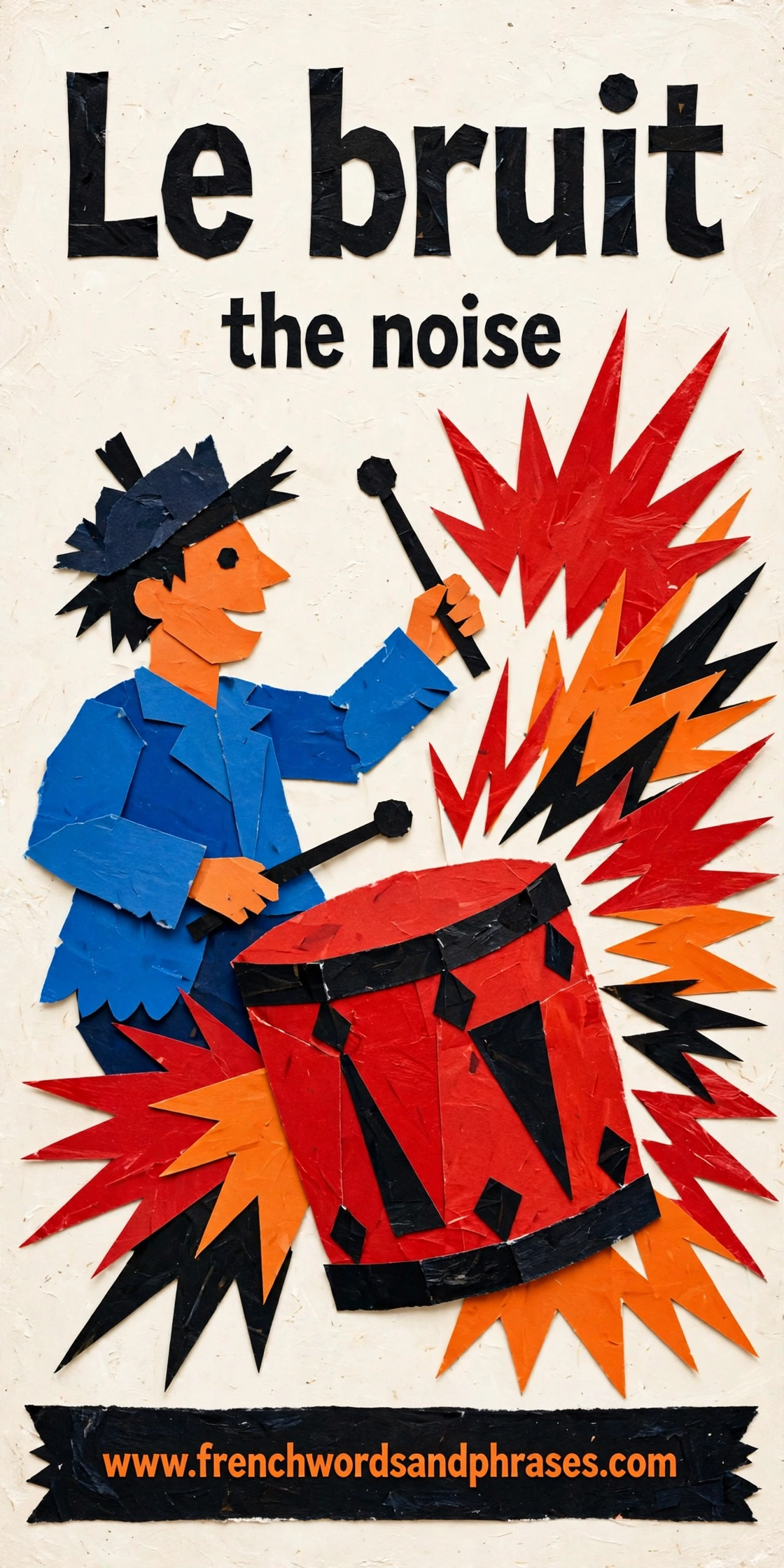
Le bruit means the noise.
A door slamming, a scooter at midnight, the neighbour’s radio through the wall: le bruit, the noise — the sound nobody ordered, the word French reaches for whenever the world’s volume rises without permission.
In this guide, you’ll learn what bruit means in English, how to use it with its articles, how to form its plural, and how it appears in everyday French. Explore French examples, English translations, and practice quizzes.
Understanding the French Noun Bruit
Bruit is a masculine French noun, learned with its article: le bruit, un bruit. It comes from the old verb bruire, to rumble and murmur — a word that sounds like what it means. Its oldest sense survives in le bruit court que…, the rumour going round: before bruit was a noise in the ear, it was a noise in the town.
It means a noise, a sound — usually an unwanted or noticeable one: un bruit bizarre, a strange noise, le bruit de la circulation, the noise of the traffic, faire du bruit, to make noise. Where English separates sound from noise, French lets context decide: le bruit des vagues, the sound of the waves, is poetry; trop de bruit, too much noise, is a complaint. Its quiet twin is le silence, and its rumour sense lives on in un bruit de couloir, an office rumour.
Gender: Masculine — le bruit
Definite article: le — le bruit (the noise)
Indefinite article: un — un bruit (a noise)
Plural: les bruits — regular, with a simple -s
Spelling note: from bruire, to rumble — the word rumbles as it is read
Old sense alive: le bruit court que… — rumour has it that…; un bruit de couloir, an office rumour
English equivalents: The noise, the sound.
The verb phrase is faire du bruit, to make noise — les enfants font du bruit. To complain, French reaches for trop de bruit and the law itself speaks of troubles du voisinage and tapage nocturne, night-time noise disturbance. For gentle sounds French often prefers le son or names the source: le bruit de la pluie, the sound of the rain, keeps bruit musical.
Experience the Word
Bruit is sound with an opinion attached: the same rain is musique on a tent canvas and bruit on a tin roof at 3 a.m.
Imagine the first night in a new flat — every pipe, stair and neighbour is an unknown bruit, until a week later the same sounds have become the house’s breathing and you sleep through them all.
You have not just named a sound. You have named the world’s volume — le bruit, the noise, and every ear’s negotiation with it.
How to Use Bruit in French: Complete Guide
Let’s explore how bruit works in French, beginning with its articles — le bruit, un bruit, faire du bruit.
Bruit with the Definite Article (Le, Les)
Used for a specific noise — the traffic, the waves, the one keeping you awake.
| Form | French |
|---|---|
| Masculine singular | le bruit |
| Plural | les bruits |
Example
Le bruit de la circulation m’empêche de dormir.
The noise of the traffic stops me sleeping.
Bruit with the Indefinite Article (Un, Des)
Used for a noise in general — a bang, a rumble, a sound in the night.
| Form | French |
|---|---|
| Masculine singular | un bruit |
| Plural | des bruits |
Example
J’ai entendu un bruit bizarre dans le grenier.
I heard a strange noise in the attic.
Bruit with the Partitive (Du bruit…)
Noise as a quantity takes the partitive: du bruit, trop de bruit, pas de bruit.
| Quantity | French |
|---|---|
| some noise | du bruit |
| too much noise | trop de bruit |
| a lot of noise | beaucoup de bruit |
| no noise | pas de bruit |
| a background noise | un bruit de fond |
Example
Les voisins font trop de bruit le soir.
The neighbours make too much noise in the evening.
Quick Quiz 1
Complete the sentence:
______ bruit des vagues berce les enfants. (the)
Reveal the answer
Le
Le bruit des vagues berce les enfants.
The sound of the waves lulls the children — bruit is masculine, so le.
The Plural of Bruit
Bruit takes a regular plural in -s — the -t stays silent, plural as singular.
| Number | French |
|---|---|
| Singular | le bruit |
| Plural | les bruits |
Example
Les bruits de la maison la nuit ne me font plus peur.
The noises of the house at night no longer frighten me.
Bruit with Possessive Adjectives (Mon, Ton, Son…)
Possessives agree with the noun: bruit is masculine, so mon, ton, son in the singular.
| Owner | French |
|---|---|
| my | mon bruit |
| your (tu) | ton bruit |
| his / her | son bruit |
| our | notre bruit |
| your (vous) | votre bruit |
| their | leur bruit |
Example
Excusez mon bruit, je range la vaisselle.
Sorry for my noise, I’m putting the dishes away.
Quick Quiz 2
Complete the sentence:
Le moteur fait ______ bruit habituel. (its)
Reveal the answer
son
Le moteur fait son bruit habituel.
The engine is making its usual noise — son, because bruit is masculine.
Bruit with Demonstrative Adjectives (Ce, Ces)
Used to point: ce bruit, this noise — usually the one everyone just heard.
| Form | French |
|---|---|
| Masculine singular | ce bruit |
| Plural | ces bruits |
Example
Ce bruit vient de la machine à laver.
This noise comes from the washing machine.
Bruit with Adjectives
Adjectives agree with bruit — masculine singular: un bruit fort, un bruit sourd.
| Adjective | With Bruit |
|---|---|
| fort (loud) | un bruit fort |
| sourd (muffled) | un bruit sourd |
| bizarre (strange) | un bruit bizarre |
| constant (constant) | un bruit constant |
| infernal (hellish) | un bruit infernal |
Example
Un bruit sourd monte de la cave.
A muffled noise rises from the cellar.
Quick Quiz 3
Complete the sentence:
On entend un bruit très ______ dans la rue. (loud)
Reveal the answer
fort
On entend un bruit très fort dans la rue.
You can hear a very loud noise in the street — fort, masculine, to agree with bruit.
Everyday Expressions with Bruit
Complaints, rumours and lullabies — the bruit phrases of daily life.
| Expression | In English |
|---|---|
| faire du bruit | to make noise |
| le bruit de fond | the background noise |
| le bruit court que… | rumour has it that… |
| un bruit de couloir | an office rumour, corridor talk |
| sans bruit | noiselessly, without a sound |
Example
Le bruit court que le directeur va partir.
Rumour has it that the director is leaving.
Words from the Same Family as Bruit
Sound and hearing — the words that travel with bruit.
| French | In English |
|---|---|
| bruyant | noisy (the adjective) |
| le silence | the silence — bruit’s opposite |
| le son | the sound (neutral, musical) |
| entendre | to hear (the verb) |
| le tapage nocturne | night-time noise disturbance (the legal term) |
Example
Cette rue est trop bruyante pour dormir.
This street is too noisy for sleeping.
Quick Quiz 4
What does faire du bruit mean?
Reveal the answer
To make noise — the phrase every French parent uses daily.
Les enfants, ne faites pas de bruit !
Children, don’t make noise!
Bruit in Everyday French: Real-Life Examples
Now that you know the word, let’s see how bruit appears in everyday French.
Example 1 — At home
Ne fais pas de bruit, le bébé dort.
Don’t make noise, the baby is sleeping.
Example 2 — The complaint
Il y a trop de bruit dans cet immeuble.
There is too much noise in this building.
Example 3 — The seaside
J’adore le bruit des vagues.
I love the sound of the waves.
Example 4 — In the night
Un bruit m’a réveillé à trois heures.
A noise woke me at three o’clock.
Example 5 — The rumour
Le bruit court qu’elle se marie en juin.
Rumour has it she’s getting married in June.
Example 6 — The workshop
Le bruit des machines couvre les voix.
The noise of the machines drowns out the voices.
Beyond Translation: The Meaning of Bruit
Bruit began as a word for fame and rumour — le bruit d’une victoire was the news of it spreading from mouth to mouth — before it settled on the ear. The rumour never quite left: le bruit court que…, un bruit de couloir, keep the old sense alive in every office. And French law took the word seriously enough to name crimes with it: tapage nocturne, the night-time racket, is the charge behind a thousand neighbourly feuds.
To say bruit is to judge a sound, not just hear it.
It evokes the thin wall, the summer window left open, and the sea doing the same sound beautifully — the whole politics of the ear in one syllable.
How to Remember the French Noun Bruit
Remember it this way: Bruit is the noise — masculine: le bruit, faire du bruit, and le bruit court que… for a rumour.
- Always masculine — le bruit, un bruit, mon bruit.
- The verb phrase — faire du bruit, to make noise.
- The old sense — le bruit court que…, rumour has it that…
The key idea is le bruit — the noise, masculine; faire du bruit = to make noise.
Test Your Knowledge of Bruit
Let’s see how much you’ve learned. Try answering these questions before revealing the answers.
Question 1
Is bruit masculine or feminine?
Reveal the answer
Masculine — le bruit, un bruit.
Question 2
How do you say to make noise?
Reveal the answer
Faire du bruit.
Question 3
Translate: The noise of the traffic stops me sleeping.
Reveal the answer
Le bruit de la circulation m’empêche de dormir.
Question 4
What does le bruit court que… mean?
Reveal the answer
Rumour has it that… — bruit’s oldest sense, news spreading.
Question 5
Complete the sentence:
______ bruits de la nuit me réveillent. (the)
Reveal the answer
Les
Les bruits de la nuit me réveillent.
The noises of the night wake me.
Your Final Challenge
Can You Use It?
How would you say this in French?
“Don’t make noise, the baby is sleeping.”
Reveal the answer
Ne fais pas de bruit, le bébé dort.
Don’t make noise, the baby is sleeping.
A little French. A little curiosity. A richer everyday life.
LEARN FRENCH ONE WORD AT A TIME