A French Word to Live By
Translate Ça to English
/sa/
Ça means that — the everyday demonstrative pronoun, short for cela.
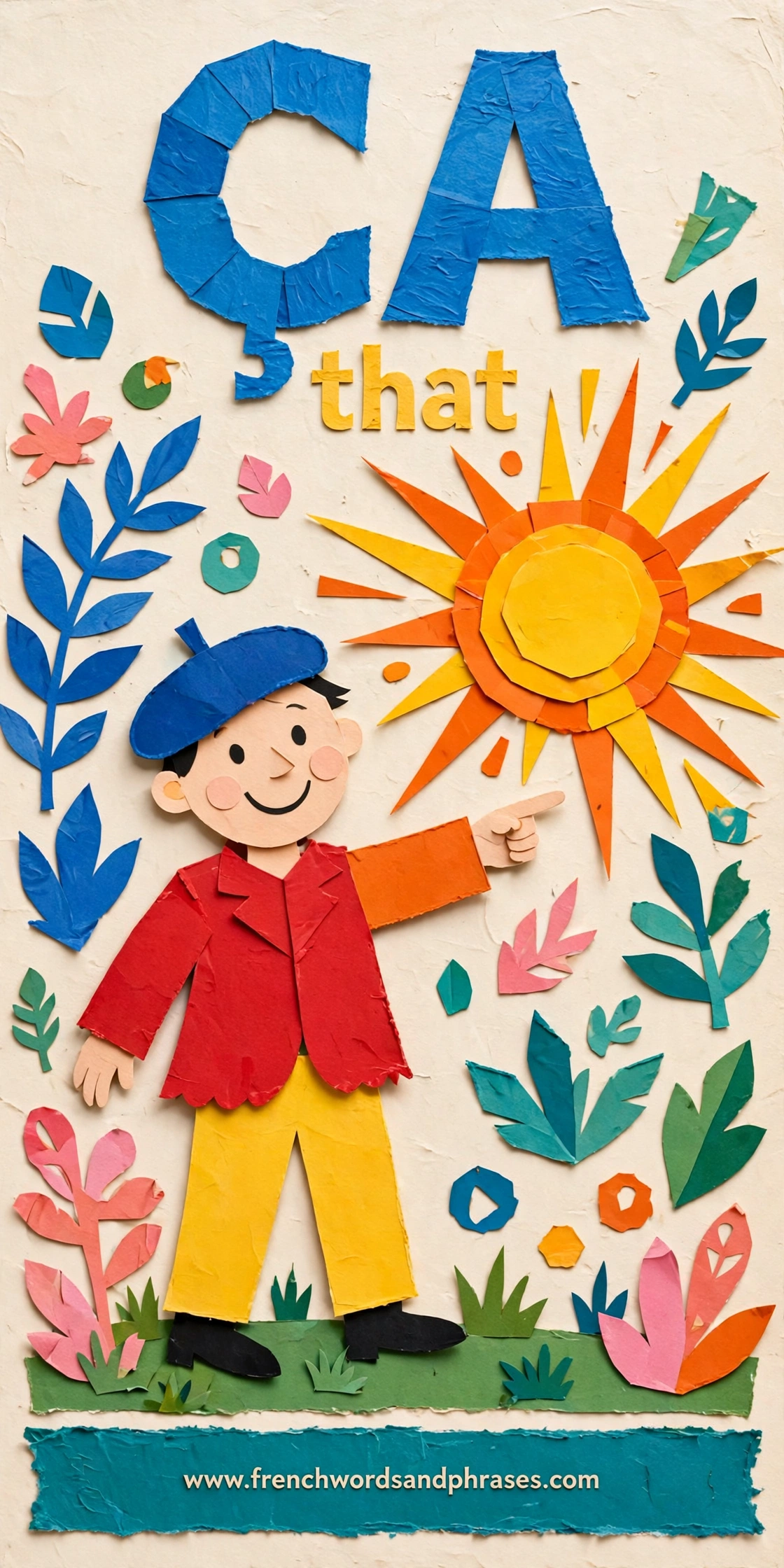
A market stall in Provence, a hand waving at a crate of figs, a wheel of cheese, the whole shining morning: « Ça, c’est bon, ça ! » — That, that’s good, that! Ça is the little word French points with: two letters, a cedilla, and the whole world within reach.
Let’s explore how ça works in French, beginning with the whole word on one card.
Understanding the French Pronoun Ça
Ça is a French demonstrative pronoun — the short, spoken form of cela (that). It points at things, ideas, situations and whole events rather than at named nouns: ça va (that’s going well), c’est ça (that’s it), qu’est-ce que c’est que ça ? (what is that?). It carries a cedilla under the c, and that little hook is what keeps it soft: ça sounds like « sa », never « ka ».
It means that — and often it, this, or the whole situation rolled into one syllable. Tu aimes ça ? — do you like that? Ça ne fait rien — it doesn’t matter. Where English reaches for a flat it, French very often reaches for ça, warmer and more pointed: ça alors ! — well, I never!
Type: Demonstrative pronoun — informal short form of cela
Answers the question: Quoi ? — What? (pointing at a thing, an idea or a situation)
Agreement: No gender, no plural — ça never changes: ça va, ça vient
Watch the pair: ça (that) vs sa (her/his/its) — same sound, different words: ça is a pronoun, sa is a possessive
One important usage detail: ça is the spoken, everyday form; its long twin cela belongs to formal writing and careful speech. In conversation, cela sounds stiff — everyone says ça. And after a preposition, ça stands strong where English might weaken: avec ça (with that), sans ça (without that), malgré ça (in spite of that).
Experience the Word
Ça is the pronoun of pointing fingers and raised eyebrows — the word for everything you can see, hear or feel happening around you.
Imagine a grandmother tasting the soup, spoon paused in mid-air: « Ça, c’est bon ! » She does not name the soup, the recipe or the cook — ça holds the whole delicious moment in one small word, and everyone at the table understands.
You have not found a lazy shortcut. You have picked up the most spoken pronoun in France — ça, the sound of everyday life being pointed at.
How to Use Ça in French: Complete Guide
Let’s explore how ça works in French, beginning with the whole word on one card.
Ça at a Glance
The Whole Word on One Card
Meaning, job, agreement and family — ça in four lines.
| Point | Ça |
|---|---|
| Meaning | that — also it or this, for things and situations |
| Job | points at a thing, an idea or a whole situation instead of naming it |
| Agreement | never changes: ça va, ça suffit, ça alors |
| Its family | cela (its formal twin), ceci (this), ce (this/that before a noun) |
Example
Ça, c’est une bonne idée.
That is a good idea.
The Pattern in Action: Pointing at the World
Ça slots into the sentence wherever the pointed-at thing belongs — subject, object, or after a preposition.
| Pattern | Example |
|---|---|
| as the subject | ça marche — that works, it works |
| as the object | je veux ça — I want that |
| after c’est | c’est ça — that’s it, that’s right |
| after a preposition | sans ça, je ne viens pas — without that, I’m not coming |
Example
Tu as vu ça ? C’est incroyable !
Did you see that? It’s incredible!
Quick Quiz 1
What is the formal, written twin of ça?
Reveal the answer
cela — ça is its short everyday form.
Cela est vrai, mais on dit plutôt : ça, c’est vrai.
That is true, but people rather say: now that is true.
Ça at Work: The Little Verbs It Lives With
Ça spends its days glued to a handful of hardworking verbs — learn these pairs and you own half of spoken French.
| Pattern | Example |
|---|---|
| ça va | how are you? / I’m fine — the greeting itself |
| ça marche | that works — also: OK, agreed |
| ça suffit | that’s enough |
| ça dépend | it depends |
| ça vaut la peine | it is worth it |
Example
Ça va ? — Oui, ça va, merci.
How are you? — Yes, I’m fine, thank you.
Ça or Cela? The Spoken Twin and the Written Twin
Same meaning, different clothes: ça for the street and the kitchen table, cela for the essay and the official letter.
| Situation | Example |
|---|---|
| everyday speech | ça, c’est génial ! — that’s great! |
| formal writing | cela est regrettable — that is regrettable |
| the set exception | cela dit — that said (cela survives in this phrase) |
| after tout | tout ça — all that, all of that |
Example
Cela dit, tout ça me plaît beaucoup.
That said, I like all of that a lot.
Quick Quiz 2
How do you say « that’s enough » — cela suffit in conversation, or ça suffit?
Reveal the answer
Ça suffit — in everyday speech, ça replaces cela.
Ça suffit, les enfants !
That’s enough, children!
Everyday Expressions with Ça
Ça turns up in the phrases French speakers say a hundred times a week.
| Expression | In English |
|---|---|
| ça va ? | how are you? — and also the answer: ça va, I’m fine |
| comment ça ? | how come? / what do you mean? — the surprised echo |
| c’est ça | that’s it, that’s right, exactly |
| ça y est ! | that’s it! — done, finished, it has happened |
| comme ci, comme ça | so-so — literally like this, like that |
| ça alors ! | well I never! — amazement in two words |
Example
Ça y est, j’ai fini !
That’s it, I’ve finished!
Close Cousins: Cela, Ceci, Ce
The pointing family: the formal that, the rarer this, and the little word that stands before nouns.
| Word | The difference |
|---|---|
| ça | that — the everyday pronoun, for speech |
| cela | that — the same pronoun in formal dress |
| ceci | this — the near twin, mostly in writing and set phrases: ceci dit, this said |
| ce / cet / cette | this, that — before a noun: ce livre, this book (not a pronoun) |
Example
Ceci dit, ça ne change rien à ce projet.
This said, that changes nothing about this project.
Quick Quiz 3
In the sentence c’est ça, what does ça point at?
Reveal the answer
At what was just said or shown — the idea, the answer, the thing itself.
Oui, c’est ça, exactement.
Yes, that’s it, exactly.
Ça and Its Neighbours
The demonstrative shelf: the everyday that, its formal twin, its near cousin and the ones that pick a person or thing out of a group.
| French | In English |
|---|---|
| cela | that (formal) |
| ceci | this (formal, written) |
| celui-ci / celle-ci | this one (masculine / feminine) |
| celui-là / celle-là | that one (masculine / feminine) |
| tout ça | all that, all of that |
Example
Pas celui-ci, celui-là — et avec ça, tout ira bien.
Not this one, that one — and with that, all will be well.
Watch Out: The Traps Around Ça
The traps: its sound-alike sa, a missing cedilla, and cela where ça belongs.
| Trap | The truth |
|---|---|
| ça vs sa | sa is a possessive (sa maison, her house) — ça is the pronoun (ça va). Same sound, different job |
| the cedilla | without its hook, ca is not a French word — the ç keeps the c soft before a |
| cela in conversation | cela is correct but stiff — everyday French says ça |
| ça for a named person | for people, French prefers il/elle or celui-là: not « ça » for your teacher — say elle or celle-là |
Example
Sa sœur dit que ça va mieux.
Her sister says that things are better.
Quick Quiz 4
Complete: ______ alors ! Je ne m’attendais pas à ça ! (Well I never!)
Reveal the answer
Ça — the exclamation is ça alors !
Ça alors ! Je ne m’attendais pas à ça !
Well I never! I wasn’t expecting that!
Ça in Everyday French: Real-Life Examples
Now that you know the word, let’s see how ça appears in everyday French.
Example 1 — A greeting
Ça va ? Tu as l’air fatigué.
How are you? You look tired.
Example 2 — Agreement
D’accord, ça marche pour moi.
All right, that works for me.
Example 3 — At the market
Je prends ça, et ça aussi, s’il vous plaît.
I’ll take that, and that too, please.
Example 4 — Surprise
Ça alors ! Quelle bonne surprise !
Well I never! What a lovely surprise!
Example 5 — So-so
Comment va le travail ? — Comme ci, comme ça.
How is work going? — So-so.
Example 6 — Finished
Ça y est, la valise est prête.
That’s it, the suitcase is ready.
Beyond Translation: The Meaning of Ça
English that points politely from a distance. French ça points with its whole hand — at the cheese, at the news, at the situation, at life itself. It began as the grand word cela, and the street wore it down to two letters and a cedilla, the way a coin is worn smooth by a million pockets.
To say ça is to speak French the way France actually speaks it.
Master ça and its little family — ça va, c’est ça, ça y est, ça alors — and whole conversations open up: greetings, agreements, surprises and farewells all pass through this one small word.
How to Remember the French Pronoun Ça
Remember it this way: Ça means that — the spoken form of cela, unchanged in every sentence, with a cedilla that keeps it soft.
- You say ça, you write cela — ça va, ça marche, ça suffit.
- You keep the cedilla — sans la cédille, pas de ça : the hook makes the c soft.
- You never confuse it with sa — sa maison (her house), mais ça va (that’s fine).
The key idea is ça means that — everyday form of cela; never changes; not to be confused with the possessive sa.
Test Your Knowledge of Ça
Let’s see how much you’ve learned. Try answering these questions before revealing the answers.
Question 1
What does ça mean?
Reveal the answer
That — and often it or this, for things, ideas and situations.
Question 2
What is the formal written form of ça?
Reveal the answer
Cela — ça is its short, spoken twin.
Question 3
Translate: That works for me.
Reveal the answer
Ça marche pour moi.
Question 4
What is the difference between ça and sa?
Reveal the answer
Ça is a pronoun (that); sa is a possessive (her/his/its) — sa maison, her house; ça va, that’s fine.
Question 5
Complete the sentence:
______ y est, j’ai terminé ! (That’s it)
Reveal the answer
Ça
Ça y est, j’ai terminé !
That’s it, I’ve finished!
Your Final Challenge
Can You Use It?
How would you say this in French?
“That is a good idea.”
Reveal the answer
Ça, c’est une bonne idée.
That is a good idea.
A little French. A little curiosity. A richer everyday life.
LEARN FRENCH ONE WORD AT A TIME