A French Word to Live By
How to Conjugate Se effiler in French
/se.fi.le/
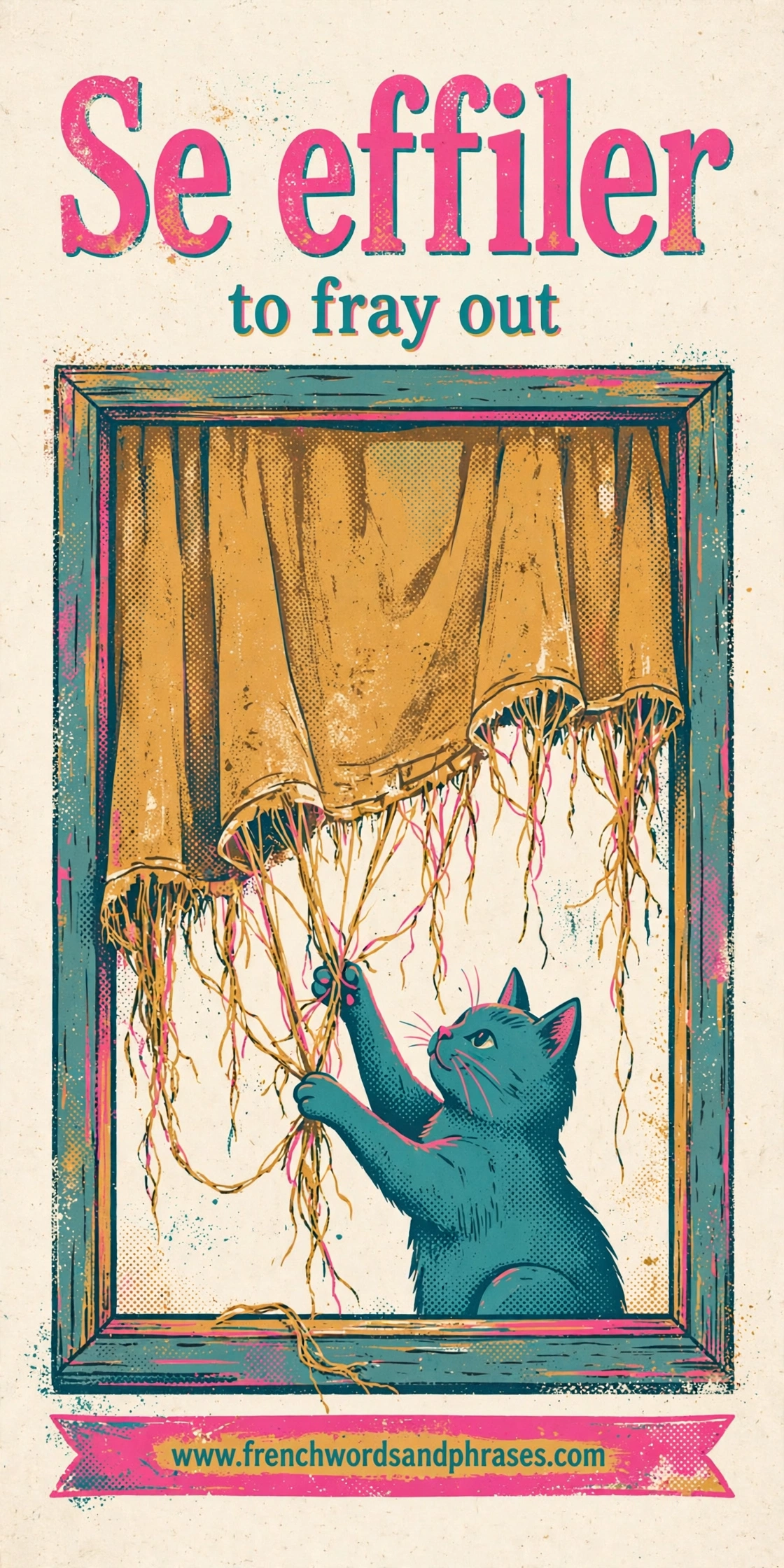
Se effiler means to fray out — to come apart into threads at the edge, the way an old rope, a cuff or a flag slowly unravels.
The end of a rope aboard a fishing boat, opening like a brush; the cuff of a much-washed shirt, dissolving into threads — se effiler is what woven things do when their edges give up: they do not tear, they unthread themselves, fibre by fibre.
In this guide, you’ll learn how to conjugate se effiler in all the major French tenses and moods. Explore complete conjugation tables, French examples, English translations, and practice quizzes.
Understanding the French Verb Se effiler
Se effiler is a regular French verb belonging to the first group of verbs, those ending in-er.
It means to fray out. It is commonly used of ropes, cords, cables, hems and cuffs whose ends open into separate threads, and figuratively of anything that thins out and comes apart at its edges — a procession, a crowd, a argument losing its thread.
Verb classification: First group (-er), reflexive
Auxiliary verb: Être
Past participle: effilé
Present participle: effilant
English equivalents: To fray out, to unravel at the edge; la corde s’effile — the rope is fraying; un tissu qui s’effile — a fabric that frays; les bords s’effilent — the edges are coming apart into threads; un câble effilé — a frayed cable end.
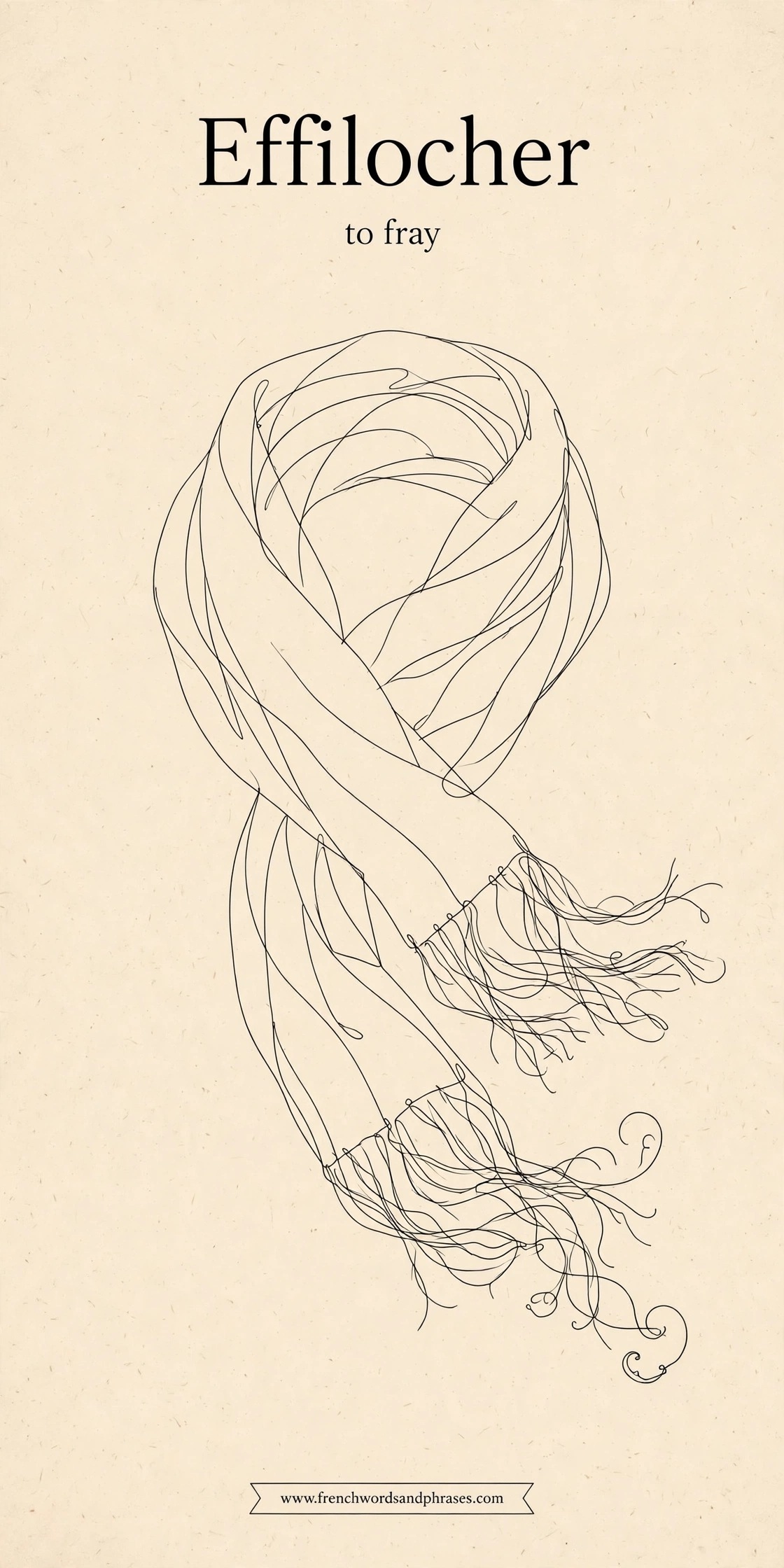
One important detail: se effiler is the quiet undoing of woven things — the threads at the edge loosen and separate, fil by fil, thread by thread. Being reflexive, it takes être and the participle agrees: la corde s’est effilée, les manches se sont effilées. Its close cousin s’effilocher says the same for cloth that frays into fluff; s’effiler is the rope, cord and hem version, the one sailors and tailors reach for.
Experience the Word
Se effiler is the verb of the edge giving up — nothing breaks; the threads simply stop holding together.
Imagine the mooring rope of an old fishing boat. Every tide rubs it against the stone quay, and one morning its end has opened like a little brush, a hundred threads where one rope used to be — la corde s’est effilée.
No storm tore it. It frayed — effilée, thread by patient thread.
How to Conjugate Se effiler: Complete French Conjugation Guide
Let’s explore every major conjugation of se effiler, beginning with the indicative mood.
How to Conjugate Se effiler in the Indicative Mood
The indicative mood is used to express facts, observations, actions, and events.
How to Conjugate Se effiler in the Present Tense (Présent)
Used for actions happening now, habitual actions, and general truths.
| Subject | Conjugation |
|---|---|
| je | m’effile |
| tu | t’effiles |
| il / elle | s’effile |
| nous | nous effilons |
| vous | vous effilez |
| ils / elles | s’effilent |
Example
La corde s’effile à force de frotter contre le quai.
The rope is fraying from rubbing against the quay.
Quick Quiz 1
Complete the sentence:
Les manches de cette chemise ______ déjà.
Reveal the answer
s’effilent
Les manches de cette chemise s’effilent déjà.
This shirt’s sleeves are already fraying.
How to Conjugate Se effiler in the Passé Composé
Used for completed actions in the past. Se effiler takes the auxiliary verb être.
| Subject | Conjugation |
|---|---|
| je | me suis effilé / me suis effilée |
| tu | t’es effilé / t’es effilée |
| il / elle | s’est effilé / s’est effilée |
| nous | nous sommes effilés / nous sommes effilées |
| vous | vous êtes effilés / vous êtes effilées / vous êtes effilé / vous êtes effilée |
| ils / elles | se sont effilés / se sont effilées |
Example
Le bas de son pantalon s’est effilé en quelques mois.
The bottom of his trousers frayed within a few months.
How to Conjugate Se effiler in the Imparfait (Imperfect Tense)
Used for habitual past actions, descriptions, and ongoing situations in the past.
| Subject | Conjugation |
|---|---|
| je | m’effilais |
| tu | t’effilais |
| il / elle | s’effilait |
| nous | nous effilions |
| vous | vous effiliez |
| ils / elles | s’effilaient |
Example
Les manches de sa vieille chemise s’effilaient.
The sleeves of his old shirt were fraying out.
Quick Quiz 2
Choose the correct form:
The rope frayed against the quay.
La corde ______ contre le quai. (s’est effilée / a effilé)
Reveal the answer
s’est effilée
La corde s’est effilée contre le quai.
Se effiler is reflexive, takes être, and the participle agrees: effilée.
How to Conjugate Se effiler in the Plus-que-parfait
Used to describe an action that had already been completed before another past event.
| Subject | Conjugation |
|---|---|
| je | m’étais effilé / m’étais effilée |
| tu | t’étais effilé / t’étais effilée |
| il / elle | s’était effilé / s’était effilée |
| nous | nous étions effilés / nous étions effilées |
| vous | vous étiez effilés / vous étiez effilées / vous étiez effilé / vous étiez effilée |
| ils / elles | s’étaient effilés / s’étaient effilées |
Example
Le drapeau s’était effilé pendant tout l’hiver.
The flag had frayed throughout the winter.
How to Conjugate Se effiler in the Passé Simple
Primarily used in formal writing, literature, and historical narratives. It is rarely used in everyday conversation.
| Subject | Conjugation |
|---|---|
| je | m’effilai |
| tu | t’effilas |
| il / elle | s’effila |
| nous | nous effilâmes |
| vous | vous effilâtes |
| ils / elles | s’effilèrent |
Example
Le câble s’effila lentement sous la friction.
The cable slowly frayed under the friction.
How to Conjugate Se effiler in the Passé Antérieur
A literary tense used to express an action completed immediately before another past action, generally in the passé simple.
| Subject | Conjugation |
|---|---|
| je | me fus effilé / me fus effilée |
| tu | te fus effilé / te fus effilée |
| il / elle | se fut effilé / se fut effilée |
| nous | nous fûmes effilés / nous fûmes effilées |
| vous | vous fûtes effilés / vous fûtes effilées / vous fûtes effilé / vous fûtes effilée |
| ils / elles | se furent effilés / se furent effilées |
Example
Quand la corde se fut effilée, le marin la coupa net.
When the rope had frayed out, the sailor cut it clean.
How to Conjugate Se effiler in the Future Tense (Futur Simple)
Used to describe actions that will take place in the future.
| Subject | Conjugation |
|---|---|
| je | m’effilerai |
| tu | t’effileras |
| il / elle | s’effilera |
| nous | nous effilerons |
| vous | vous effilerez |
| ils / elles | s’effileront |
Example
Ce tissu s’effilera si tu ne fais pas d’ourlet.
This fabric will fray if you do not hem it.
How to Conjugate Se effiler in the Futur Antérieur (Future Perfect)
Used for an action that will have been completed before a particular point in the future.
| Subject | Conjugation |
|---|---|
| je | me serai effilé / me serai effilée |
| tu | te seras effilé / te seras effilée |
| il / elle | se sera effilé / se sera effilée |
| nous | nous serons effilés / nous serons effilées |
| vous | vous serez effilés / vous serez effilées / vous serez effilé / vous serez effilée |
| ils / elles | se seront effilés / se seront effilées |
Example
À la fin de la saison, le drapeau se sera effilé.
By the end of the season, the flag will have frayed.
How to Conjugate Se effiler in the Near Future (Futur Proche)
Used to describe something that is going to happen soon. Formed with aller + infinitive.
| Subject | Conjugation |
|---|---|
| je | vais m’effiler |
| tu | vas t’effiler |
| il / elle | va s’effiler |
| nous | allons nous effiler |
| vous | allez vous effiler |
| ils / elles | vont s’effiler |
Example
Regarde, le bas de ta robe va s’effiler.
Look, the hem of your dress is going to fray.
How to Conjugate Se effiler in the Conditional Mood
The conditional mood expresses what would happen under certain circumstances. It is also frequently used to make polite requests or express wishes.
How to Conjugate Se effiler in the Present Conditional
| Subject | Conjugation |
|---|---|
| je | m’effilerais |
| tu | t’effilerais |
| il / elle | s’effilerait |
| nous | nous effilerions |
| vous | vous effileriez |
| ils / elles | s’effileraient |
Example
La corde s’effilerait moins avec une protection en cuir.
The rope would fray less with a leather guard.
How to Conjugate Se effiler in the Past Conditional
| Subject | Conjugation |
|---|---|
| je | me serais effilé / me serais effilée |
| tu | te serais effilé / te serais effilée |
| il / elle | se serait effilé / se serait effilée |
| nous | nous serions effilés / nous serions effilées |
| vous | vous seriez effilés / vous seriez effilées / vous seriez effilé / vous seriez effilée |
| ils / elles | se seraient effilés / se seraient effilées |
Example
Le tissu se serait effilé sans l’ourlet de la couturière.
The fabric would have frayed without the seamstress’s hem.
Se effiler in the Literary Past Conditional Form
This less common literary form uses the imperfect subjunctive of être.
| Subject | Conjugation |
|---|---|
| je | me fusse effilé / me fusse effilée |
| tu | te fusses effilé / te fusses effilée |
| il / elle | se fût effilé / se fût effilée |
| nous | nous fussions effilés / nous fussions effilées |
| vous | vous fussiez effilés / vous fussiez effilées / vous fussiez effilé / vous fussiez effilée |
| ils / elles | se fussent effilés / se fussent effilées |
Example
Le câble se fût effilé en une semaine sans la gaine.
The cable would have frayed within a week without the sheath.
How to Conjugate Se effiler in the Subjunctive Mood
The subjunctive is used to express wishes, emotions, doubts, necessity, and uncertainty. It frequently follows expressions such as il faut que (it is necessary that) or bien que (although).
How to Conjugate Se effiler in the Present Subjunctive
| Subject | Conjugation |
|---|---|
| que je | m’effile |
| que tu | t’effiles |
| qu’il / qu’elle | s’effile |
| que nous | nous effilions |
| que vous | vous effiliez |
| qu’ils / qu’elles | s’effilent |
Example
Je crains que le bas du rideau s’effile.
I fear the bottom of the curtain is fraying.
Quick Quiz 3
Complete the sentence using the subjunctive:
Je crains que ces rideaux ______ au soleil.
Reveal the answer
s’effilent
Je crains que ces rideaux s’effilent au soleil.
I fear these curtains are fraying in the sun.
How to Conjugate Se effiler in the Imperfect Subjunctive
A literary tense, rarely encountered in modern spoken French.
| Subject | Conjugation |
|---|---|
| que je | m’effilasse |
| que tu | t’effilasses |
| qu’il / qu’elle | s’effilât |
| que nous | nous effilassions |
| que vous | vous effilassiez |
| qu’ils / qu’elles | s’effilassent |
Example
Il fallait couper le câble avant qu’il s’effilât complètement.
The cable had to be cut before it frayed completely.
How to Conjugate Se effiler in the Pluperfect Subjunctive
A literary construction used to express an action completed before another past action.
| Subject | Conjugation |
|---|---|
| que je | me fusse effilé / me fusse effilée |
| que tu | te fusses effilé / te fusses effilée |
| qu’il / qu’elle | se fût effilé / se fût effilée |
| que nous | nous fussions effilés / nous fussions effilées |
| que vous | vous fussiez effilés / vous fussiez effilées / vous fussiez effilé / vous fussiez effilée |
| qu’ils / qu’elles | se fussent effilés / se fussent effilées |
Example
On disait que la corde se fût effilée dès le premier mois.
People said the rope had frayed as early as the first month.
How to Conjugate Se effiler in the Past Subjunctive
| Subject | Conjugation |
|---|---|
| que je | me sois effilé / me sois effilée |
| que tu | te sois effilé / te sois effilée |
| qu’il / qu’elle | se soit effilé / se soit effilée |
| que nous | nous soyons effilés / nous soyons effilées |
| que vous | vous soyez effilés / vous soyez effilées / vous soyez effilé / vous soyez effilée |
| qu’ils / qu’elles | se soient effilés / se soient effilées |
Example
Je suis étonné que ta chemise se soit effilée si vite.
I am surprised your shirt frayed so quickly.
How to Conjugate Se effiler in the Imperative
The imperative is used to give commands, instructions, invitations, or suggestions. Subject pronouns are omitted.
How to Conjugate Se effiler in the Present Imperative
| Person | Conjugation |
|---|---|
| (tu) | effile-toi |
| (nous) | effilons-nous |
| (vous) | effilez-vous |
Example
Ne t’effile pas, petit cordage, tiens bon !
Do not fray out, little rope, hold on!
Quick Quiz 4
How would you say Do not fray out (tu form)?
Reveal the answer
Ne t’effile pas !
French Participles of Se effiler
Participles are verb forms that can be used in compound tenses and other grammatical constructions.
Present Participle of Se effiler
effilant
En s’effilant, la corde perd sa force.
As it frays, the rope loses its strength.
Past Participle of Se effiler
effilé
Effilée au bout, la corde forme une petite brosse.
Frayed at the end, the rope forms a little brush.
Se effiler in Everyday French: Real-Life Examples
Now that you know the conjugations, let’s see how se effiler appears in everyday French.
Example 1 — Present
La corde s’effile contre le quai.
The rope is fraying against the quay.
Example 2 — Passé composé
Le bas de son pantalon s’est effilé.
The bottom of his trousers has frayed.
Example 3 — Imparfait
Les manches de sa chemise s’effilaient.
His shirt sleeves were fraying out.
Example 4 — Future
Ce tissu s’effilera sans ourlet.
This fabric will fray without a hem.
Example 5 — Conditional
La corde s’effilerait moins avec une gaine.
The rope would fray less with a sheath.
Example 6 — Imperative
Ne t’effile pas, petit cordage !
Do not fray out, little rope!
Beyond Translation: The Meaning of Se effiler
Once again the family word is fil, the thread — and s’effiler is a thing returning to its threads.
Sailors fight it with needle and twine.
A rope’s end is whipped — bound tight with cord — precisely so it will not s’effiler; left to itself, every woven and twisted thing in the world is slowly on its way back to separate threads.
How to Remember the French Verb Se effiler
Remember it this way: Se effiler is about the mooring rope’s end opened like a brush against the stone quay.
- The thing unravels itself: la corde s’effile — être, and the participle agrees (la corde s’est effilée).
- Think fil, thread: fraying is a woven thing going back to threads at the edge.
- Regular -er underneath: je m’effile, nous nous effilons, past participle effilé.
The key idea is the mooring rope’s end opened like a brush against the stone quay.
Test Your Knowledge of Se effiler
Let’s see how much you’ve learned. Try answering these questions before revealing the answers.
Question 1
Which auxiliary does se effiler use, and why?
Reveal the answer
Être — it is a reflexive verb: la corde s’est effilée contre le quai.
Question 2
How do you say The bottom of his trousers has frayed in French?
Reveal the answer
Le bas de son pantalon s’est effilé.
Question 3
Translate: The sleeves of his old shirt were fraying out.
Reveal the answer
Les manches de sa vieille chemise s’effilaient.
Question 4
What is the past participle of se effiler?
Reveal the answer
Effilé — agreeing: effilée, effilés, effilées.
Question 5
Complete the sentence:
Je crains que le bas du rideau ______.
Reveal the answer
s’effile
Je crains que le bas du rideau s’effile.
I fear the bottom of the curtain is fraying.
Your Final Challenge
Can You Use It?
How would you say this in French?
After ten winters against the quay’s stone, the rope is fraying and begging for mercy.
Reveal the answer
Après dix hivers contre la pierre du quai, la corde s’effile et demande grâce.
After ten winters against the quay’s stone, the rope is fraying and begging for mercy.
A little French. A little curiosity. A richer everyday life.
LEARN FRENCH ONE WORD AT A TIME