A French Word to Live By
How to Conjugate Effiler in French
/e.fi.le/
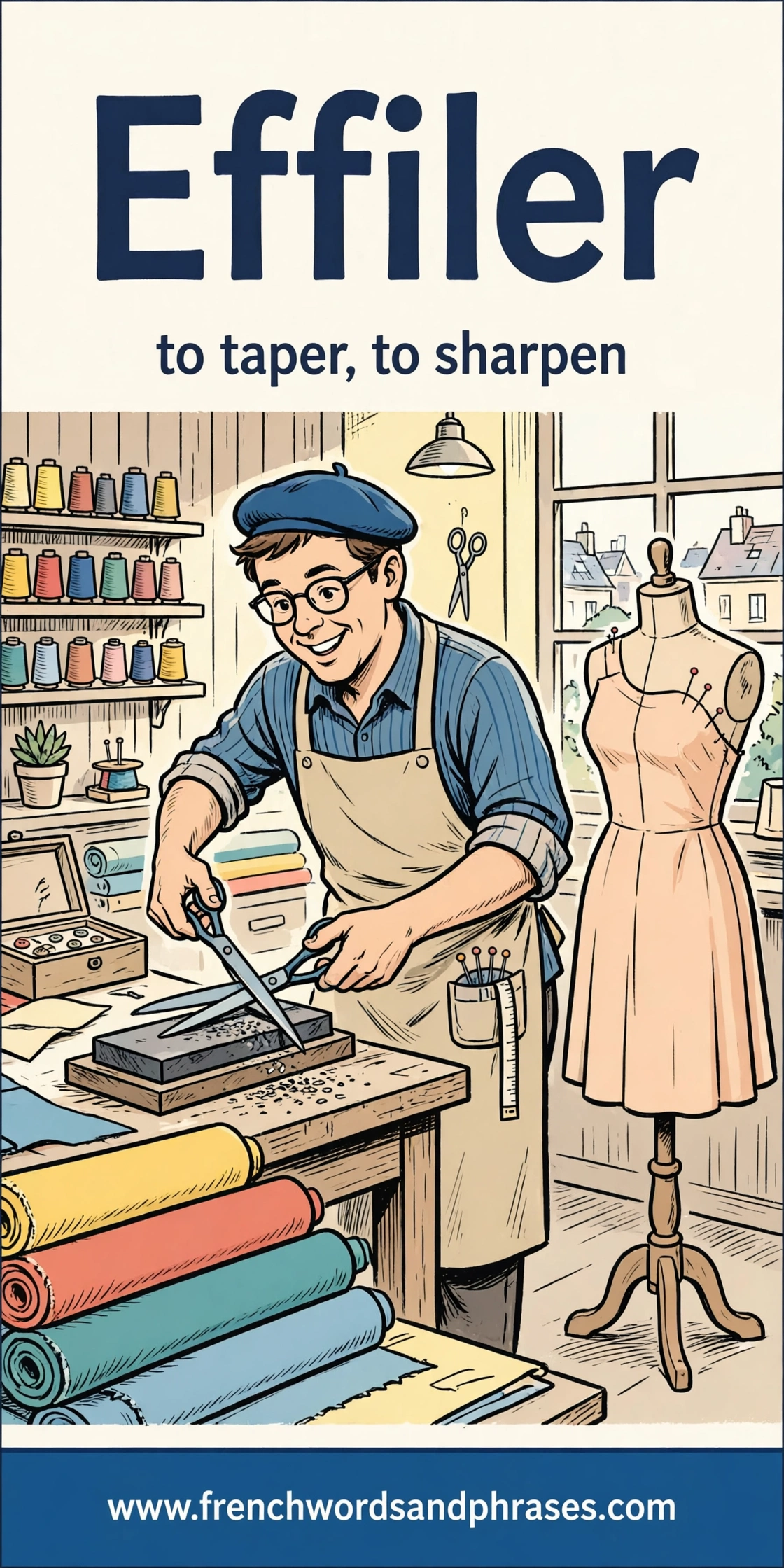
Effiler means to taper, to sharpen — to draw something out to a fine point or edge: a blade, a silhouette, a pencil of wood.
A cutler at his wheel, drawing a kitchen knife out to a hair-fine edge; a tailor pinching a waist until the silhouette narrows to a line — effiler is the verb of making things slim, pointed and sharp, of taking the thickness away until only the edge remains.
In this guide, you’ll learn how to conjugate effiler in all the major French tenses and moods. Explore complete conjugation tables, French examples, English translations, and practice quizzes.
Understanding the French Verb Effiler
Effiler is a regular French verb belonging to the first group of verbs, those ending in-er.
It means to taper, to sharpen. It is commonly used of knives and tools being ground to a fine edge, of fingers, faces and silhouettes drawn out long and thin (des doigts effilés is a compliment to a pianist’s hands), and in cooking, where effiler means removing the string from green beans before they go in the pot.
Verb classification: First group (-er)
Auxiliary verb: Avoir
Past participle: effilé
Present participle: effilant
English equivalents: To taper, to sharpen, to make pointed; effiler un couteau — to sharpen a knife; effiler la taille — to slim the waist; des doigts effilés — tapering fingers; une silhouette effilée — a slender, tapered silhouette; effiler des haricots — to string green beans (in the kitchen).
One important detail: effiler is built on fil — a thread, and also the edge of a blade (le fil du rasoir) — and the verb means to draw out to that fineness: j’effile, nous effilons, ils effilent, regular -er throughout. Do not confuse it with its neighbours: affiler is the commoner word for sharpening a blade, effilocher is to fray cloth into threads, and in the kitchen effiler les haricots verts means pulling the stringy fibre off green beans.
Experience the Word
Effiler is the verb of the vanishing thickness — everything it touches ends in a point or an edge.
Imagine the cutler’s workshop before dawn. The old man takes a blunt farmhouse knife, leans it to the turning stone, and draws it back, forth, back — until the fat old blade is effilé, thin as a leaf and twice as dangerous.
The knife has lost almost nothing. It has been tapered — effilé — until only the edge matters.
How to Conjugate Effiler: Complete French Conjugation Guide
Let’s explore every major conjugation of effiler, beginning with the indicative mood.
How to Conjugate Effiler in the Indicative Mood
The indicative mood is used to express facts, observations, actions, and events.
How to Conjugate Effiler in the Present Tense (Présent)
Used for actions happening now, habitual actions, and general truths.
| Subject | Conjugation |
|---|---|
| je | effile |
| tu | effiles |
| il / elle | effile |
| nous | effilons |
| vous | effilez |
| ils / elles | effilent |
Example
Le coutelier effile la lame sur sa meule.
The cutler sharpens the blade on his grinding wheel.
Quick Quiz 1
Complete the sentence:
Nous ______ les haricots avant de les cuire.
Reveal the answer
effilons
Nous effilons les haricots avant de les cuire.
We are stringing the beans before cooking them.
How to Conjugate Effiler in the Passé Composé
Used for completed actions in the past. Effiler takes the auxiliary verb avoir.
| Subject | Conjugation |
|---|---|
| j’ | ai effilé |
| tu | as effilé |
| il / elle | a effilé |
| nous | avons effilé |
| vous | avez effilé |
| ils / elles | ont effilé |
Example
Elle a effilé les haricots avant de les cuire.
She strung the green beans before cooking them.
How to Conjugate Effiler in the Imparfait (Imperfect Tense)
Used for habitual past actions, descriptions, and ongoing situations in the past.
| Subject | Conjugation |
|---|---|
| je | effilais |
| tu | effilais |
| il / elle | effilait |
| nous | effilions |
| vous | effiliez |
| ils / elles | effilaient |
Example
Il effilait ses couteaux chaque dimanche matin.
He used to sharpen his knives every Sunday morning.
Quick Quiz 2
Choose the correct form:
She strung the beans.
Elle ______ les haricots. (a effilé / est effilée)
Reveal the answer
a effilé
Elle a effilé les haricots.
Effiler takes avoir.
How to Conjugate Effiler in the Plus-que-parfait
Used to describe an action that had already been completed before another past event.
| Subject | Conjugation |
|---|---|
| j’ | avais effilé |
| tu | avais effilé |
| il / elle | avait effilé |
| nous | avions effilé |
| vous | aviez effilé |
| ils / elles | avaient effilé |
Example
Le tailleur avait effilé la silhouette du manteau.
The tailor had tapered the coat’s silhouette.
How to Conjugate Effiler in the Passé Simple
Primarily used in formal writing, literature, and historical narratives. It is rarely used in everyday conversation.
| Subject | Conjugation |
|---|---|
| je | effilai |
| tu | effilas |
| il / elle | effila |
| nous | effilâmes |
| vous | effilâtes |
| ils / elles | effilèrent |
Example
L’artisan effila le fer de la hache en une heure.
The craftsman sharpened the axe head in an hour.
How to Conjugate Effiler in the Passé Antérieur
A literary tense used to express an action completed immediately before another past action, generally in the passé simple.
| Subject | Conjugation |
|---|---|
| j’ | eus effilé |
| tu | eus effilé |
| il / elle | eut effilé |
| nous | eûmes effilé |
| vous | eûtes effilé |
| ils / elles | eurent effilé |
Example
Quand il eut effilé la lame, il la rangea dans son étui.
When he had sharpened the blade, he put it away in its case.
How to Conjugate Effiler in the Future Tense (Futur Simple)
Used to describe actions that will take place in the future.
| Subject | Conjugation |
|---|---|
| je | effilerai |
| tu | effileras |
| il / elle | effilera |
| nous | effilerons |
| vous | effilerez |
| ils / elles | effileront |
Example
Demain, j’effilerai ce couteau de cuisine.
Tomorrow, I will sharpen this kitchen knife.
How to Conjugate Effiler in the Futur Antérieur (Future Perfect)
Used for an action that will have been completed before a particular point in the future.
| Subject | Conjugation |
|---|---|
| j’ | aurai effilé |
| tu | auras effilé |
| il / elle | aura effilé |
| nous | aurons effilé |
| vous | aurez effilé |
| ils / elles | auront effilé |
Example
À midi, elle aura effilé tous les haricots du panier.
By noon, she will have strung all the beans in the basket.
How to Conjugate Effiler in the Near Future (Futur Proche)
Used to describe something that is going to happen soon. Formed with aller + infinitive.
| Subject | Conjugation |
|---|---|
| je | vais effiler |
| tu | vas effiler |
| il / elle | va effiler |
| nous | allons effiler |
| vous | allez effiler |
| ils / elles | vont effiler |
Example
Je vais effiler la pointe de cette aiguille.
I am going to taper the point of this needle.
How to Conjugate Effiler in the Conditional Mood
The conditional mood expresses what would happen under certain circumstances. It is also frequently used to make polite requests or express wishes.
How to Conjugate Effiler in the Present Conditional
| Subject | Conjugation |
|---|---|
| je | effilerais |
| tu | effilerais |
| il / elle | effilerait |
| nous | effilerions |
| vous | effileriez |
| ils / elles | effileraient |
Example
Avec une meilleure meule, il effilerait plus vite.
With a better wheel, he would sharpen faster.
How to Conjugate Effiler in the Past Conditional
| Subject | Conjugation |
|---|---|
| j’ | aurais effilé |
| tu | aurais effilé |
| il / elle | aurait effilé |
| nous | aurions effilé |
| vous | auriez effilé |
| ils / elles | auraient effilé |
Example
Elle aurait effilé la taille du manteau sans ces coutures.
She would have tapered the coat’s waist without those seams.
Effiler in the Literary Past Conditional Form
This less common literary form uses the imperfect subjunctive of avoir.
| Subject | Conjugation |
|---|---|
| j’ | eusse effilé |
| tu | eusses effilé |
| il / elle | eût effilé |
| nous | eussions effilé |
| vous | eussiez effilé |
| ils / elles | eussent effilé |
Example
Le coutelier eût effilé la lame sans la commande urgente.
The cutler would have sharpened the blade without the urgent order.
How to Conjugate Effiler in the Subjunctive Mood
The subjunctive is used to express wishes, emotions, doubts, necessity, and uncertainty. It frequently follows expressions such as il faut que (it is necessary that) or bien que (although).
How to Conjugate Effiler in the Present Subjunctive
| Subject | Conjugation |
|---|---|
| que je | effile |
| que tu | effiles |
| qu’il / qu’elle | effile |
| que nous | effilions |
| que vous | effiliez |
| qu’ils / qu’elles | effilent |
Example
Il faut que tu effiles ce couteau avant le dîner.
You must sharpen this knife before dinner.
Quick Quiz 3
Complete the sentence using the subjunctive:
Il faut que vous ______ cette lame.
Reveal the answer
effiliez
Il faut que vous effiliez cette lame.
You must sharpen this blade.
How to Conjugate Effiler in the Imperfect Subjunctive
A literary tense, rarely encountered in modern spoken French.
| Subject | Conjugation |
|---|---|
| que je | effilasse |
| que tu | effilasses |
| qu’il / qu’elle | effilât |
| que nous | effilassions |
| que vous | effilassiez |
| qu’ils / qu’elles | effilassent |
Example
Je voulais qu’il effilât les haricots à ma place.
I wanted him to string the beans in my place.
How to Conjugate Effiler in the Pluperfect Subjunctive
A literary construction used to express an action completed before another past action.
| Subject | Conjugation |
|---|---|
| que j’ | eusse effilé |
| que tu | eusses effilé |
| qu’il / qu’elle | eût effilé |
| que nous | eussions effilé |
| que vous | eussiez effilé |
| qu’ils / qu’elles | eussent effilé |
Example
On disait qu’il eût effilé la lame comme un rasoir.
People said he had sharpened the blade like a razor.
How to Conjugate Effiler in the Past Subjunctive
| Subject | Conjugation |
|---|---|
| que j’ | aie effilé |
| que tu | aies effilé |
| qu’il / qu’elle | ait effilé |
| que nous | ayons effilé |
| que vous | ayez effilé |
| qu’ils / qu’elles | aient effilé |
Example
Je suis content que tu aies effilé les couteaux.
I am glad you sharpened the knives.
How to Conjugate Effiler in the Imperative
The imperative is used to give commands, instructions, invitations, or suggestions. Subject pronouns are omitted.
How to Conjugate Effiler in the Present Imperative
| Person | Conjugation |
|---|---|
| (tu) | effile |
| (nous) | effilons |
| (vous) | effilez |
Example
Effile ce couteau, il ne coupe plus rien !
Sharpen this knife, it cuts nothing any more!
Quick Quiz 4
How would you say Sharpen this knife (tu form)?
Reveal the answer
Effile ce couteau !
French Participles of Effiler
Participles are verb forms that can be used in compound tenses and other grammatical constructions.
Present Participle of Effiler
effilant
En effilant la lame, il s’est coupé le pouce.
While sharpening the blade, he cut his thumb.
Past Participle of Effiler
effilé
Effilée comme un rasoir, la lame tranche sans effort.
Sharpened like a razor, the blade slices effortlessly.
Effiler in Everyday French: Real-Life Examples
Now that you know the conjugations, let’s see how effiler appears in everyday French.
Example 1 — Present
Le coutelier effile la lame sur sa meule.
The cutler sharpens the blade on his wheel.
Example 2 — Passé composé
Elle a effilé les haricots ce matin.
She strung the green beans this morning.
Example 3 — Imparfait
Il effilait ses couteaux chaque dimanche.
He used to sharpen his knives every Sunday.
Example 4 — Future
J’effilerai ce couteau demain.
I will sharpen this knife tomorrow.
Example 5 — Conditional
Il effilerait plus vite avec une meilleure meule.
He would sharpen faster with a better wheel.
Example 6 — Imperative
Effilez les haricots avant de les cuire !
String the beans before cooking them!
Beyond Translation: The Meaning of Effiler
The heart of the word is fil — thread, wire, and the cutting edge of a blade, all fineness in one syllable.
French keeps the whole family in the workshop.
Un profil effilé is a face drawn out long and fine, des doigts effilés are a pianist’s tapered fingers, and a racing car is effilée when its nose narrows to slice the air.
How to Remember the French Verb Effiler
Remember it this way: Effiler is about the cutler at his wheel, drawing the fat old blade out thin as a leaf.
- Fil is inside it — a thread, a blade’s edge: to effiler is to draw a thing out to that fineness.
- Three worlds: the cutler’s blade, the tailor’s silhouette, the cook’s green beans (effiler les haricots).
- Regular -er: j’effile, nous effilons, past participle effilé.
The key idea is the cutler at his wheel, drawing the fat old blade out thin as a leaf.
Test Your Knowledge of Effiler
Let’s see how much you’ve learned. Try answering these questions before revealing the answers.
Question 1
What word hides inside effiler, and what does it explain?
Reveal the answer
Fil — a thread, and a blade’s edge: effiler means drawing something out to that fineness.
Question 2
How do you say She strung the green beans before cooking them in French?
Reveal the answer
Elle a effilé les haricots avant de les cuire.
Question 3
Translate: The cutler sharpens the blade on his grinding wheel.
Reveal the answer
Le coutelier effile la lame sur sa meule.
Question 4
What is the past participle of effiler?
Reveal the answer
Effilé.
Question 5
Complete the sentence:
Il faut que tu ______ ce couteau avant le dîner.
Reveal the answer
effiles
Il faut que tu effiles ce couteau avant le dîner.
You must sharpen this knife before dinner.
Your Final Challenge
Can You Use It?
How would you say this in French?
The old knife, sharpened on the morning wheel, slices the bread as on the first day.
Reveal the answer
Le vieux couteau, effilé sur la meule du matin, tranche le pain comme au premier jour.
The old knife, sharpened on the morning wheel, slices the bread as on the first day.
A little French. A little curiosity. A richer everyday life.
LEARN FRENCH ONE WORD AT A TIME