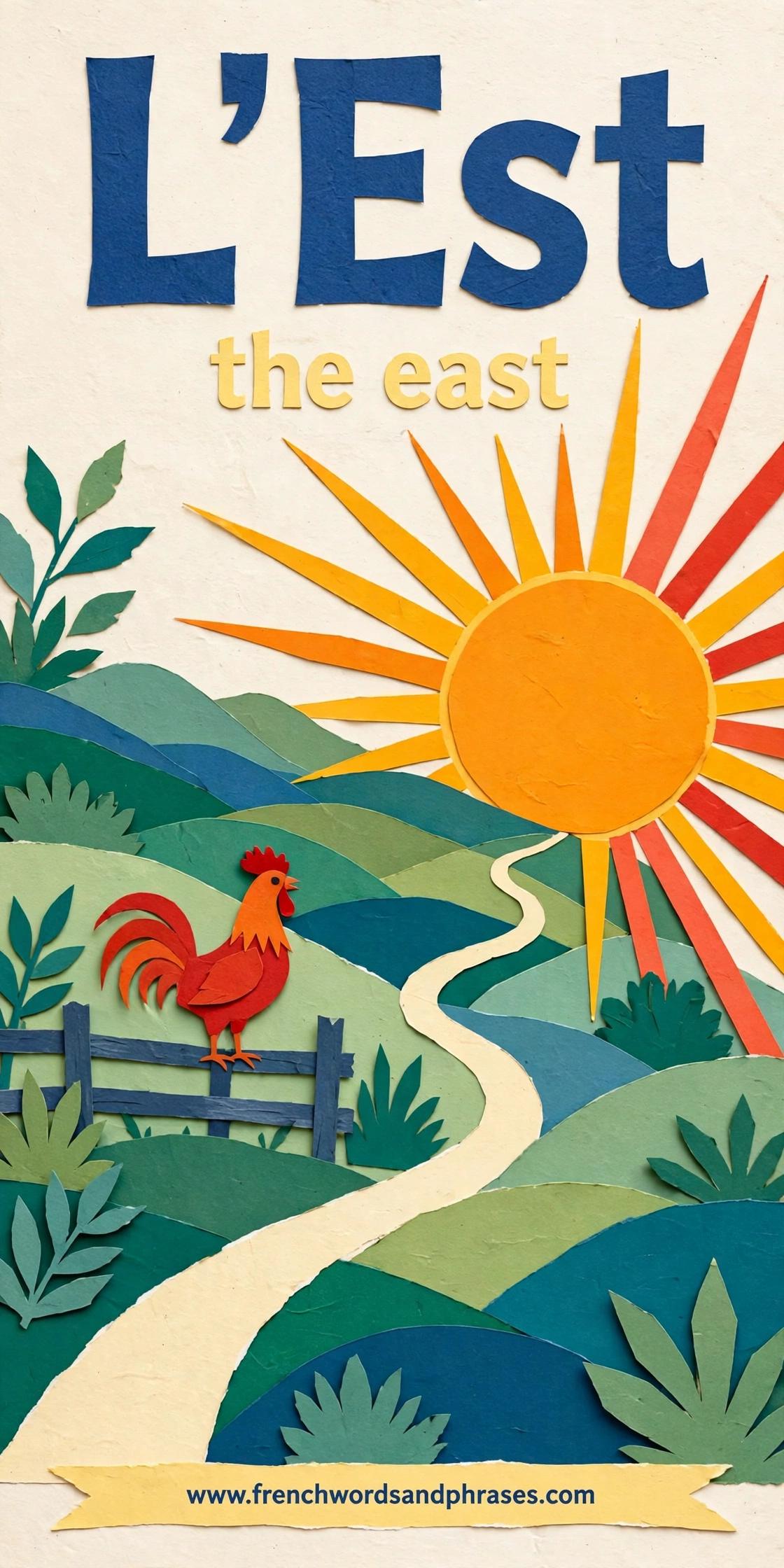
A French Word to Live By
Translate Est to English
/ɛst/
L’Est means the east.
Where the sun climbs out of the sea and the day begins: l’est, the east — the compass point of sunrise, of morning light and of everything that lies toward the dawn. (This page is about the direction, not the verb être!)
In this guide, you’ll learn what est means in English, how to use it with its articles, how to form its plural, and how it appears in everyday French. Explore French examples, English translations, and practice quizzes.
Understanding the French Noun Est
Est is a masculine French noun, learned with its article: l’est, un est — the article melts before the vowel. It names one of the four cardinal points, les quatre points cardinaux: le nord, le sud, l’est, l’ouest. Do not confuse it with its famous homonym: est is also the present tense of être — il est, he is. Same letters, two different words; the noun is the one that travels with à l’est de, east of.
It means the east — the direction where the sun rises: le soleil se lève à l’est, the sun rises in the east. It places things on the map: à l’est de Paris, east of Paris, la côte est, the east coast, le vent d’est, the east wind. With a capital in set phrases it names whole regions: l’Europe de l’Est, Eastern Europe, les pays de l’Est, the countries of the East. As an adjective it stays invariable: la façade est, the east-facing side.
Gender: Masculine — l’est
Definite article: l’ — l’est (the east), melted before the vowel
Indefinite article: un — un est (an east, in compass lists)
Plural: les ests — almost never used; directions live in the singular
Spelling note: a homonym of est (he/she is) — the noun is the compass point
The family: le nord, le sud, l’est, l’ouest — the four cardinal points
English equivalents: The east.
Directions in French are masculine nouns with l’ before est and ouest: le nord, le sud, l’est, l’ouest. To place something, use à l’est de plus the place: Strasbourg est à l’est de la France. Winds and coasts take it as a fixed partner: un vent d’est, la côte est. And when the word means the geopolitical East, it dresses in a capital: les pays de l’Est.
Experience the Word
Est is the direction of beginnings: every sunrise is a small daily promise that the world starts again, and it always starts à l’est.
Imagine the fisherman on the Brittany coast at dawn, watching the light come up behind him over the land while the sea still sleeps in shadow — l’est is at his back, and the whole day is in front of him.
You have not just named a point on the compass. You have named the direction of the dawn — l’est, the east, where the sun gets up.
How to Use Est in French: Complete Guide
Let’s explore how est works in French, beginning with its articles — l’est, à l’est, à l’est de.
Est with the Definite Article (L’)
Used for the direction itself — the vowel opening makes le melt into l’.
| Form | French |
|---|---|
| Masculine singular | l’est |
| The four points together | le nord, le sud, l’est, l’ouest |
Example
Le soleil se lève à l’est.
The sun rises in the east.
Est with the Indefinite Article (Un)
Used when the compass point is counted or qualified — rare, but the form exists.
| Form | French |
|---|---|
| Masculine singular | un est |
| In a compass list | un nord, un sud, un est, un ouest |
Example
Sur la boussole, un est se trouve à droite.
On the compass, east is on the right.
Est in Its Compass Phrases (À l’est de, Vers l’est…)
Est lives in fixed phrases of place and movement — east of, towards the east.
| Expression | French |
|---|---|
| east of Paris | à l’est de Paris |
| towards the east | vers l’est |
| in the east of France | dans l’est de la France |
| the east wind | le vent d’est |
| the east coast | la côte est |
Example
Lyon est à l’est de la France, presque.
Lyon is in the east of France, more or less.
Quick Quiz 1
Complete the sentence:
Le soleil se lève ______ est. (in the)
Reveal the answer
à l’
Le soleil se lève à l’est.
The sun rises in the east — the article melts into l’ before the vowel.
The Plural of Est
Directions almost never pluralise — but geography can speak of several easts, and the form is ready.
| Number | French |
|---|---|
| Singular | l’est |
| Plural | les ests (rare) |
Example
Les ests du monde se rencontrent au pôle.
The easts of the world meet at the pole.
Est with Possessive Adjectives
Directions are rarely possessed — but travellers speak of their own east, the side of their own horizon.
| Owner | French |
|---|---|
| my | mon est — le côté de mon horizon |
| your (tu) | ton est |
| his / her | son est |
| our | notre est |
| their | leur est |
Example
De sa fenêtre, son est est la mer.
From his window, his east is the sea.
Quick Quiz 2
Complete the sentence:
Strasbourg est ______ de la France. (east)
Reveal the answer
à l’est
Strasbourg est à l’est de la France.
Strasbourg is in the east of France.
Est with Demonstrative Adjectives (Cet, Ces)
Used to point: cet est, this east — this side, this direction on the map.
| Form | French |
|---|---|
| Masculine singular | cet est |
| Plural | ces ests (rare) |
Example
Cet est-là, sur la carte, c’est l’Asie.
That east, on the map, is Asia.
Est with Adjectives
As an adjective, est is invariable — it never changes form: la côte est, les vents est.
| Adjective | With Est |
|---|---|
| oriental (eastern) | la partie orientale — the learned word |
| lointain (far) | l’Extrême-Orient — the Far East |
| proche (near) | le Proche-Orient — the Near East |
| moyen (middle) | le Moyen-Orient — the Middle East |
Example
Le Proche-Orient est une région du monde.
The Near East is a region of the world.
Quick Quiz 3
Complete the sentence:
Un vent ______ froid arrive demain. (east, invariable)
Reveal the answer
d’est
Un vent d’est froid arrive demain.
A cold east wind arrives tomorrow — le vent d’est is the fixed phrase.
Everyday Expressions with Est
Sunrises, winds and world regions — the est phrases of daily life.
| Expression | In English |
|---|---|
| à l’est de | east of |
| le soleil se lève à l’est | the sun rises in the east |
| l’Europe de l’Est | Eastern Europe |
| les pays de l’Est | the countries of the East |
| le vent d’est | the east wind |
Example
Un vent d’est froid souffle aujourd’hui.
A cold east wind is blowing today.
Words from the Same Family as Est
Directions and dawns — the words that travel with est.
| French | In English |
|---|---|
| le nord | the north |
| le sud | the south |
| l’ouest | the west |
| l’orient | the Orient, the east (poetic) |
| le lever du soleil | sunrise |
Example
Le nord, le sud, l’est et l’ouest sont les quatre points cardinaux.
North, south, east and west are the four cardinal points.
Quick Quiz 4
What are les pays de l’Est?
Reveal the answer
The countries of the East — Eastern Europe and beyond, in the language of geography and history.
Les pays de l’Est ont beaucoup changé depuis 1989.
The countries of the East have changed a lot since 1989.
Est in Everyday French: Real-Life Examples
Now that you know the word, let’s see how est appears in everyday French.
Example 1 — Sunrise
Le soleil se lève à l’est.
The sun rises in the east.
Example 2 — Geography
Strasbourg est à l’est de la France.
Strasbourg is in the east of France.
Example 3 — Weather
Le vent d’est apporte le froid.
The east wind brings the cold.
Example 4 — Travel
Nous roulons vers l’est toute la journée.
We drive east all day.
Example 5 — Coasts
La côte est des États-Unis est célèbre.
The east coast of the United States is famous.
Example 6 — History
Les pays de l’Est ont changé depuis 1989.
The countries of the East have changed since 1989.
Beyond Translation: The Meaning of Est
Est is the compass point of poetry: the sun’s daily resurrection happens there, and French names whole civilisations from it — l’Orient, the Levant (where the sun levant, rises), le Proche-Orient, le Moyen-Orient, l’Extrême-Orient, a whole staircase of easts measured from Paris. The word’s double life with the verb être is a schoolchild’s trap and a poet’s gift: le soleil est à l’est — the sun IS in the east — one sentence holding both words at once.
To say est is to face the sunrise.
It evokes dawn light, cold winds and the long road toward Asia — the east, where every day is born.
How to Remember the French Noun Est
Remember it this way: Est is the compass point — masculine with a melted article: l’est, à l’est de. Not the verb être!
- Masculine, vowel first — l’est, never le est.
- The placing phrase — à l’est de Paris, east of Paris.
- The trap — est the noun is a direction; il est is the verb to be.
The key idea is l’est — the east, masculine; à l’est de = east of.
Test Your Knowledge of Est
Let’s see how much you’ve learned. Try answering these questions before revealing the answers.
Question 1
Is est (the direction) masculine or feminine?
Reveal the answer
Masculine — l’est, like le nord, le sud and l’ouest.
Question 2
How do you say east of Paris?
Reveal the answer
À l’est de Paris.
Question 3
Translate: The sun rises in the east.
Reveal the answer
Le soleil se lève à l’est.
Question 4
What are the four cardinal points in French?
Reveal the answer
Le nord, le sud, l’est et l’ouest.
Question 5
Complete the sentence:
Nous roulons vers ______ toute la matinée. (the east)
Reveal the answer
l’est
Nous roulons vers l’est toute la matinée.
We drive east all morning.
Your Final Challenge
Can You Use It?
How would you say this in French?
“The sun rises in the east.”
Reveal the answer
Le soleil se lève à l’est.
The sun rises in the east.
A little French. A little curiosity. A richer everyday life.
LEARN FRENCH ONE WORD AT A TIME