A French Word to Live By
How to Conjugate Effilocher in French
/e.fi.lɔ.ʃe/
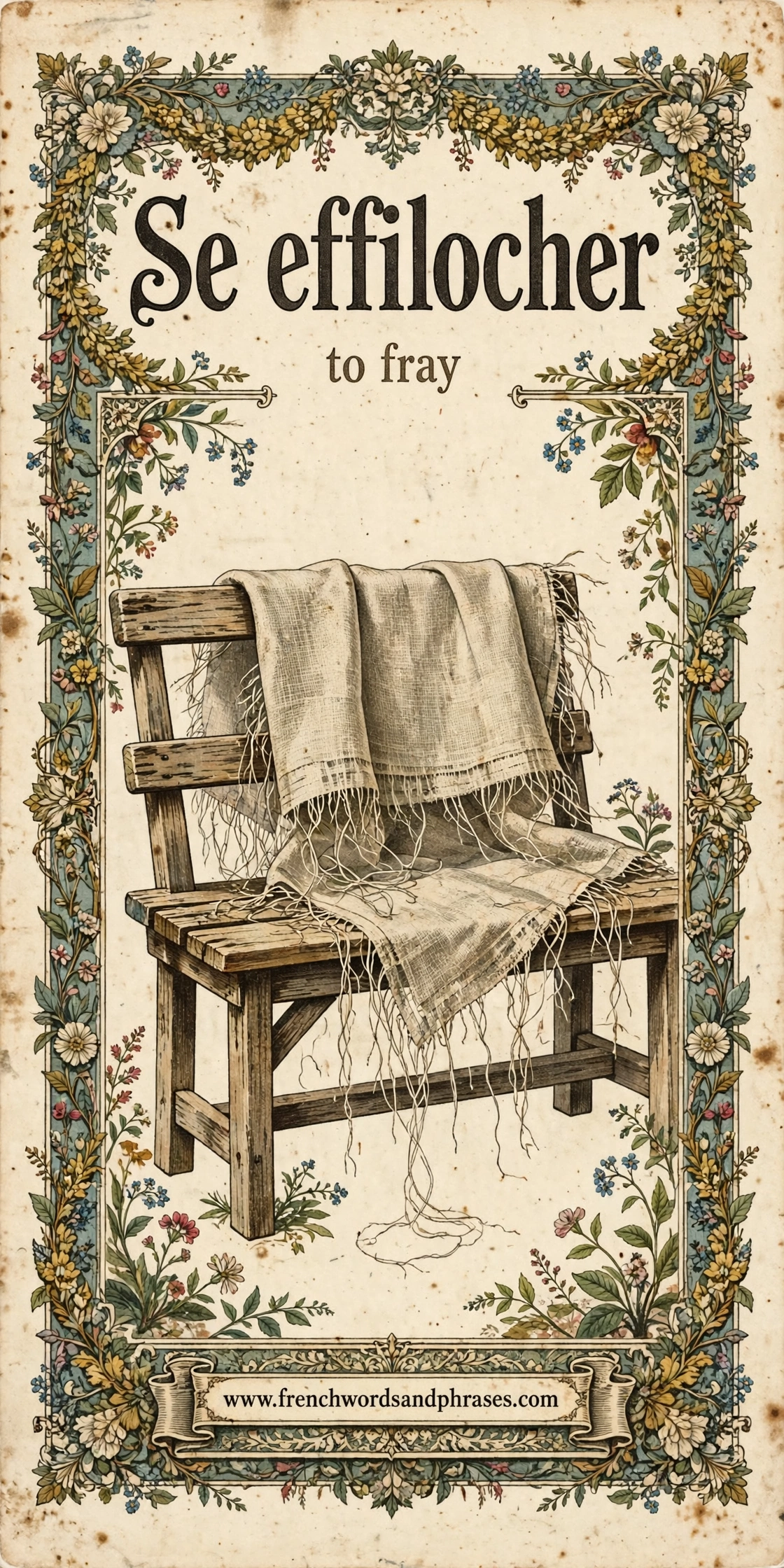
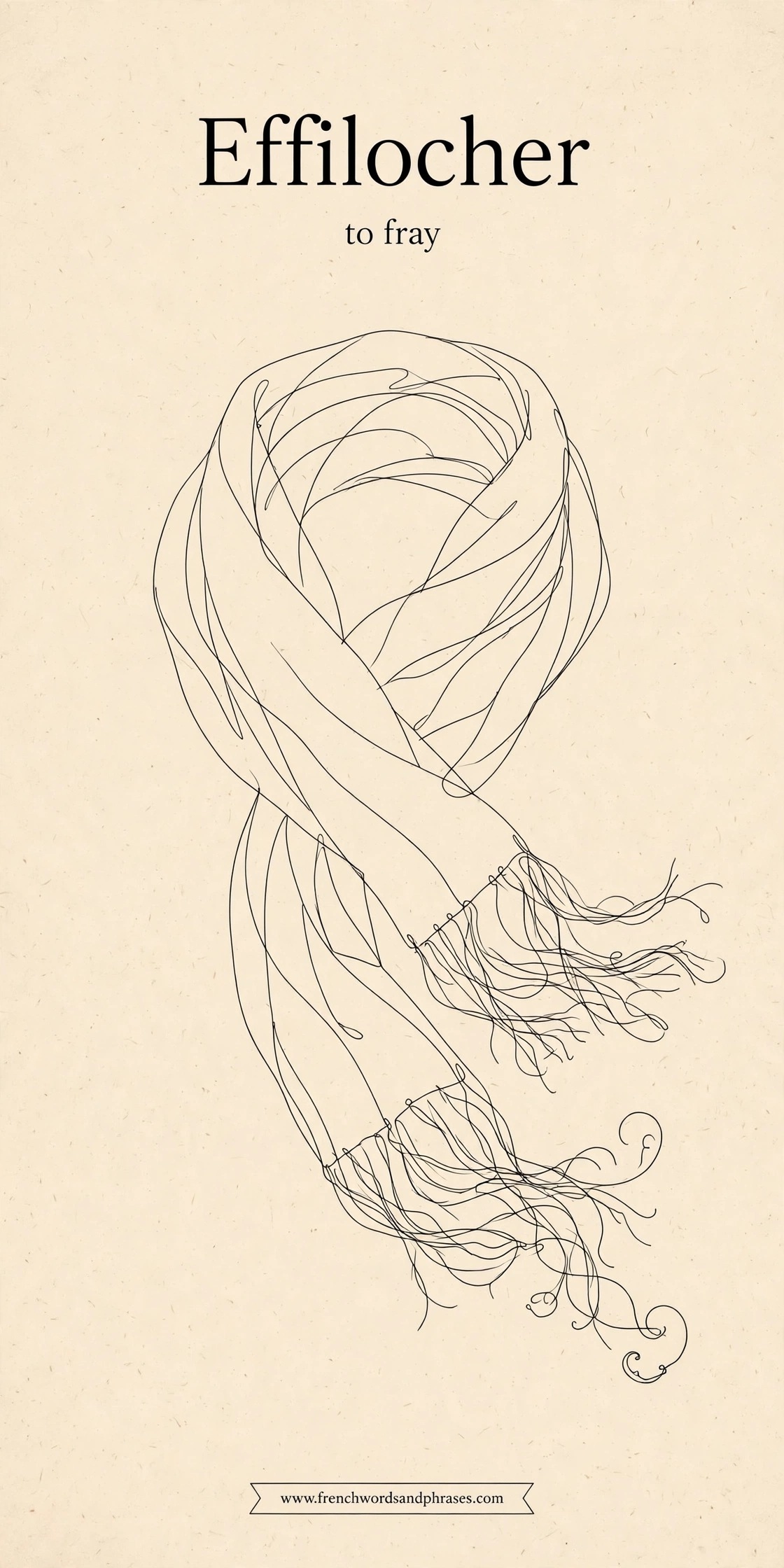
Effilocher means to fray — to pull woven cloth apart into its threads, or to tease something fibrous into loose strands.
An old linen sheet being torn into strips and unpicked thread by thread for bandages; a ball of wool worried by a cat into a cloud — effilocher is the deliberate unweaving of cloth: taking the fabric back to the threads it was made from.
In this guide, you’ll learn how to conjugate effilocher in all the major French tenses and moods. Explore complete conjugation tables, French examples, English translations, and practice quizzes.
Understanding the French Verb Effilocher
Effilocher is a regular French verb belonging to the first group of verbs, those ending in-er.
It means to fray. It is commonly used in sewing and textile work for edges deliberately frayed (a fashion finish on denim and linen), for old cloth being unpicked for reuse, and figuratively for anything fibrous or woven — an argument, a plot — being picked apart strand by strand.
Verb classification: First group (-er)
Auxiliary verb: Avoir
Past participle: effiloché
Present participle: effilochant
English equivalents: To fray, to unravel (cloth), to pull to threads; effilocher un tissu — to fray a fabric; effilocher un vieux drap — to pull an old sheet to threads; des bords effilochés — frayed edges; effilocher de la laine — to tease wool apart.
One important detail: effilocher is the cloth-worker’s fraying verb — where effiler draws a thing out fine, effilocher pulls a woven thing apart, thread from thread: j’effiloche, nous effilochons, ils effilochent, regular -er throughout. The work was once thrift, not damage: old sheets were effilochés to make la charpie, the lint used for dressing wounds, and unravelled cloth gave thread for mending.
Experience the Word
Effilocher is the verb of unweaving — the cloth going home to its threads.
Imagine a farmhouse kitchen in wartime. Nothing is wasted: the grandmother takes a worn-out sheet, cuts it into squares and, square by square, pulls the threads free with her nails — elle effiloche, building a soft pile of lint for the doctor’s bag.
The sheet is not destroyed. It is frayed — effiloché — into something that can heal.
How to Conjugate Effilocher: Complete French Conjugation Guide
Let’s explore every major conjugation of effilocher, beginning with the indicative mood.
How to Conjugate Effilocher in the Indicative Mood
The indicative mood is used to express facts, observations, actions, and events.
How to Conjugate Effilocher in the Present Tense (Présent)
Used for actions happening now, habitual actions, and general truths.
| Subject | Conjugation |
|---|---|
| je | effiloche |
| tu | effiloches |
| il / elle | effiloche |
| nous | effilochons |
| vous | effilochez |
| ils / elles | effilochent |
Example
Elle effiloche les bords du tissu pour la finition.
She is fraying the edges of the fabric for the finish.
Quick Quiz 1
Complete the sentence:
Nous ______ de vieux draps pour la charpie.
Reveal the answer
effilochons
Nous effilochons de vieux draps pour la charpie.
We are pulling old sheets to threads for lint.
How to Conjugate Effilocher in the Passé Composé
Used for completed actions in the past. Effilocher takes the auxiliary verb avoir.
| Subject | Conjugation |
|---|---|
| j’ | ai effiloché |
| tu | as effiloché |
| il / elle | a effiloché |
| nous | avons effiloché |
| vous | avez effiloché |
| ils / elles | ont effiloché |
Example
Nous avons effiloché de vieux draps pour faire de la charpie.
We pulled old sheets to threads to make lint.
How to Conjugate Effilocher in the Imparfait (Imperfect Tense)
Used for habitual past actions, descriptions, and ongoing situations in the past.
| Subject | Conjugation |
|---|---|
| je | effilochais |
| tu | effilochais |
| il / elle | effilochait |
| nous | effilochions |
| vous | effilochiez |
| ils / elles | effilochaient |
Example
Les religieuses effilochaient des linges pour les blessés.
The nuns used to unravel cloths for the wounded.
Quick Quiz 2
Choose the correct form:
We unravelled the old cloths.
Nous ______ les vieux linges. (avons effiloché / sommes effilochés)
Reveal the answer
avons effiloché
Nous avons effiloché les vieux linges.
Effilocher takes avoir.
How to Conjugate Effilocher in the Plus-que-parfait
Used to describe an action that had already been completed before another past event.
| Subject | Conjugation |
|---|---|
| j’ | avais effiloché |
| tu | avais effiloché |
| il / elle | avait effiloché |
| nous | avions effiloché |
| vous | aviez effiloché |
| ils / elles | avaient effiloché |
Example
Il avait effiloché la corde pour en faire une mèche.
He had frayed the rope to make a wick from it.
How to Conjugate Effilocher in the Passé Simple
Primarily used in formal writing, literature, and historical narratives. It is rarely used in everyday conversation.
| Subject | Conjugation |
|---|---|
| je | effilochai |
| tu | effilochas |
| il / elle | effilocha |
| nous | effilochâmes |
| vous | effilochâtes |
| ils / elles | effilochèrent |
Example
La couturière effilocha le bas de la jupe en une heure.
The seamstress frayed the hem of the skirt in an hour.
How to Conjugate Effilocher in the Passé Antérieur
A literary tense used to express an action completed immediately before another past action, generally in the passé simple.
| Subject | Conjugation |
|---|---|
| j’ | eus effiloché |
| tu | eus effiloché |
| il / elle | eut effiloché |
| nous | eûmes effiloché |
| vous | eûtes effiloché |
| ils / elles | eurent effiloché |
Example
Quand elle eut effiloché le drap, elle rangea les fils.
When she had unravelled the sheet, she put the threads away.
How to Conjugate Effilocher in the Future Tense (Futur Simple)
Used to describe actions that will take place in the future.
| Subject | Conjugation |
|---|---|
| je | effilocherai |
| tu | effilocheras |
| il / elle | effilochera |
| nous | effilocherons |
| vous | effilocherez |
| ils / elles | effilocheront |
Example
Demain, j’effilocherai les bords de ce jean.
Tomorrow, I will fray the edges of these jeans.
How to Conjugate Effilocher in the Futur Antérieur (Future Perfect)
Used for an action that will have been completed before a particular point in the future.
| Subject | Conjugation |
|---|---|
| j’ | aurai effiloché |
| tu | auras effiloché |
| il / elle | aura effiloché |
| nous | aurons effiloché |
| vous | aurez effiloché |
| ils / elles | auront effiloché |
Example
À midi, ils auront effiloché tous les vieux linges.
By noon, they will have unravelled all the old cloths.
How to Conjugate Effilocher in the Near Future (Futur Proche)
Used to describe something that is going to happen soon. Formed with aller + infinitive.
| Subject | Conjugation |
|---|---|
| je | vais effilocher |
| tu | vas effilocher |
| il / elle | va effilocher |
| nous | allons effilocher |
| vous | allez effilocher |
| ils / elles | vont effilocher |
Example
Je vais effilocher ce tissu pour l’ourlet décoratif.
I am going to fray this fabric for the decorative hem.
How to Conjugate Effilocher in the Conditional Mood
The conditional mood expresses what would happen under certain circumstances. It is also frequently used to make polite requests or express wishes.
How to Conjugate Effilocher in the Present Conditional
| Subject | Conjugation |
|---|---|
| je | effilocherais |
| tu | effilocherais |
| il / elle | effilocherait |
| nous | effilocherions |
| vous | effilocheriez |
| ils / elles | effilocheraient |
Example
Avec de la patience, on effilocherait ce drap en une matinée.
With patience, we would unravel this sheet in one morning.
How to Conjugate Effilocher in the Past Conditional
| Subject | Conjugation |
|---|---|
| j’ | aurais effiloché |
| tu | aurais effiloché |
| il / elle | aurait effiloché |
| nous | aurions effiloché |
| vous | auriez effiloché |
| ils / elles | auraient effiloché |
Example
Elle aurait effiloché plus de linges avec de l’aide.
She would have unravelled more cloths with some help.
Effilocher in the Literary Past Conditional Form
This less common literary form uses the imperfect subjunctive of avoir.
| Subject | Conjugation |
|---|---|
| j’ | eusse effiloché |
| tu | eusses effiloché |
| il / elle | eût effiloché |
| nous | eussions effiloché |
| vous | eussiez effiloché |
| ils / elles | eussent effiloché |
Example
La religieuse eût effiloché des draps entiers sans la nuit qui tombait.
The nun would have unravelled whole sheets if night had not fallen.
How to Conjugate Effilocher in the Subjunctive Mood
The subjunctive is used to express wishes, emotions, doubts, necessity, and uncertainty. It frequently follows expressions such as il faut que (it is necessary that) or bien que (although).
How to Conjugate Effilocher in the Present Subjunctive
| Subject | Conjugation |
|---|---|
| que je | effiloche |
| que tu | effiloches |
| qu’il / qu’elle | effiloche |
| que nous | effilochions |
| que vous | effilochiez |
| qu’ils / qu’elles | effilochent |
Example
Il faut que tu effiloches les bords régulièrement.
You must fray the edges evenly.
Quick Quiz 3
Complete the sentence using the subjunctive:
Il faut que vous ______ les bords du jean.
Reveal the answer
effilochiez
Il faut que vous effilochiez les bords du jean.
You must fray the edges of the jeans.
How to Conjugate Effilocher in the Imperfect Subjunctive
A literary tense, rarely encountered in modern spoken French.
| Subject | Conjugation |
|---|---|
| que je | effilochasse |
| que tu | effilochasses |
| qu’il / qu’elle | effilochât |
| que nous | effilochassions |
| que vous | effilochassiez |
| qu’ils / qu’elles | effilochassent |
Example
Je voulais qu’elle effilochât le vieux drap elle-même.
I wanted her to unravel the old sheet herself.
How to Conjugate Effilocher in the Pluperfect Subjunctive
A literary construction used to express an action completed before another past action.
| Subject | Conjugation |
|---|---|
| que j’ | eusse effiloché |
| que tu | eusses effiloché |
| qu’il / qu’elle | eût effiloché |
| que nous | eussions effiloché |
| que vous | eussiez effiloché |
| qu’ils / qu’elles | eussent effiloché |
Example
On racontait qu’elles eussent effiloché des centaines de draps.
People said they had unravelled hundreds of sheets.
How to Conjugate Effilocher in the Past Subjunctive
| Subject | Conjugation |
|---|---|
| que j’ | aie effiloché |
| que tu | aies effiloché |
| qu’il / qu’elle | ait effiloché |
| que nous | ayons effiloché |
| que vous | ayez effiloché |
| qu’ils / qu’elles | aient effiloché |
Example
Je suis content que vous ayez effiloché ces linges.
I am glad you unravelled these cloths.
How to Conjugate Effilocher in the Imperative
The imperative is used to give commands, instructions, invitations, or suggestions. Subject pronouns are omitted.
How to Conjugate Effilocher in the Present Imperative
| Person | Conjugation |
|---|---|
| (tu) | effiloche |
| (nous) | effilochons |
| (vous) | effilochez |
Example
Effiloche les bords, mais pas trop loin !
Fray the edges, but not too far!
Quick Quiz 4
How would you say Fray the edges (tu form)?
Reveal the answer
Effiloche les bords !
French Participles of Effilocher
Participles are verb forms that can be used in compound tenses and other grammatical constructions.
Present Participle of Effilocher
effilochant
En effilochant le tissu, elle prépare la frange.
By fraying the fabric, she is preparing the fringe.
Past Participle of Effilocher
effiloché
Effiloché avec soin, le lin devient une frange douce.
Carefully frayed, the linen becomes a soft fringe.
Effilocher in Everyday French: Real-Life Examples
Now that you know the conjugations, let’s see how effilocher appears in everyday French.
Example 1 — Present
Elle effiloche les bords du tissu.
She is fraying the edges of the fabric.
Example 2 — Passé composé
Nous avons effiloché de vieux draps.
We pulled old sheets to threads.
Example 3 — Imparfait
Les religieuses effilochaient des linges pour les blessés.
The nuns used to unravel cloths for the wounded.
Example 4 — Future
J’effilocherai les bords de ce jean.
I will fray the edges of these jeans.
Example 5 — Conditional
On effilocherait ce drap en une matinée.
We would unravel this sheet in one morning.
Example 6 — Imperative
Effilochez les bords régulièrement !
Fray the edges evenly!
Beyond Translation: The Meaning of Effilocher
The word joins ef- (out) to a cousin of fil, the thread — to thread-out a woven thing.
For centuries it was hospital work.
Before sterile dressings, wounds were packed with charpie — soft lint made by effilochant old linen — so generations of hands knew this verb as an act of care, not destruction.
How to Remember the French Verb Effilocher
Remember it this way: Effilocher is about the grandmother’s hands unpicking an old sheet into soft lint for the doctor’s bag.
- Unweaving, not tearing: effilocher takes cloth back to its threads, strand by strand.
- Its historic product is la charpie — lint for wounds, made from effiloché old sheets.
- Regular -er: j’effiloche, nous effilochons, past participle effiloché.
The key idea is the grandmother’s hands unpicking an old sheet into soft lint for the doctor’s bag.
Test Your Knowledge of Effilocher
Let’s see how much you’ve learned. Try answering these questions before revealing the answers.
Question 1
What was la charpie, and how was it made?
Reveal the answer
Lint for dressing wounds — made by effilochant old linen sheets, pulling them apart into soft threads.
Question 2
How do you say We pulled old sheets to threads in French?
Reveal the answer
Nous avons effiloché de vieux draps.
Question 3
Translate: She is fraying the edges of the fabric.
Reveal the answer
Elle effiloche les bords du tissu.
Question 4
What is the past participle of effilocher?
Reveal the answer
Effiloché.
Question 5
Complete the sentence:
Il faut que tu ______ les bords régulièrement.
Reveal the answer
effiloches
Il faut que tu effiloches les bords régulièrement.
You must fray the edges evenly.
Your Final Challenge
Can You Use It?
How would you say this in French?
The old sheet, unravelled thread by thread, will end up as dressings for the whole village.
Reveal the answer
Le vieux drap, effiloché fil par fil, finira en pansements pour tout le village.
The old sheet, unravelled thread by thread, will end up as dressings for the whole village.
A little French. A little curiosity. A richer everyday life.
LEARN FRENCH ONE WORD AT A TIME