A French Word to Live By
Translate Odeur to English
/ɔ.dœʁ/
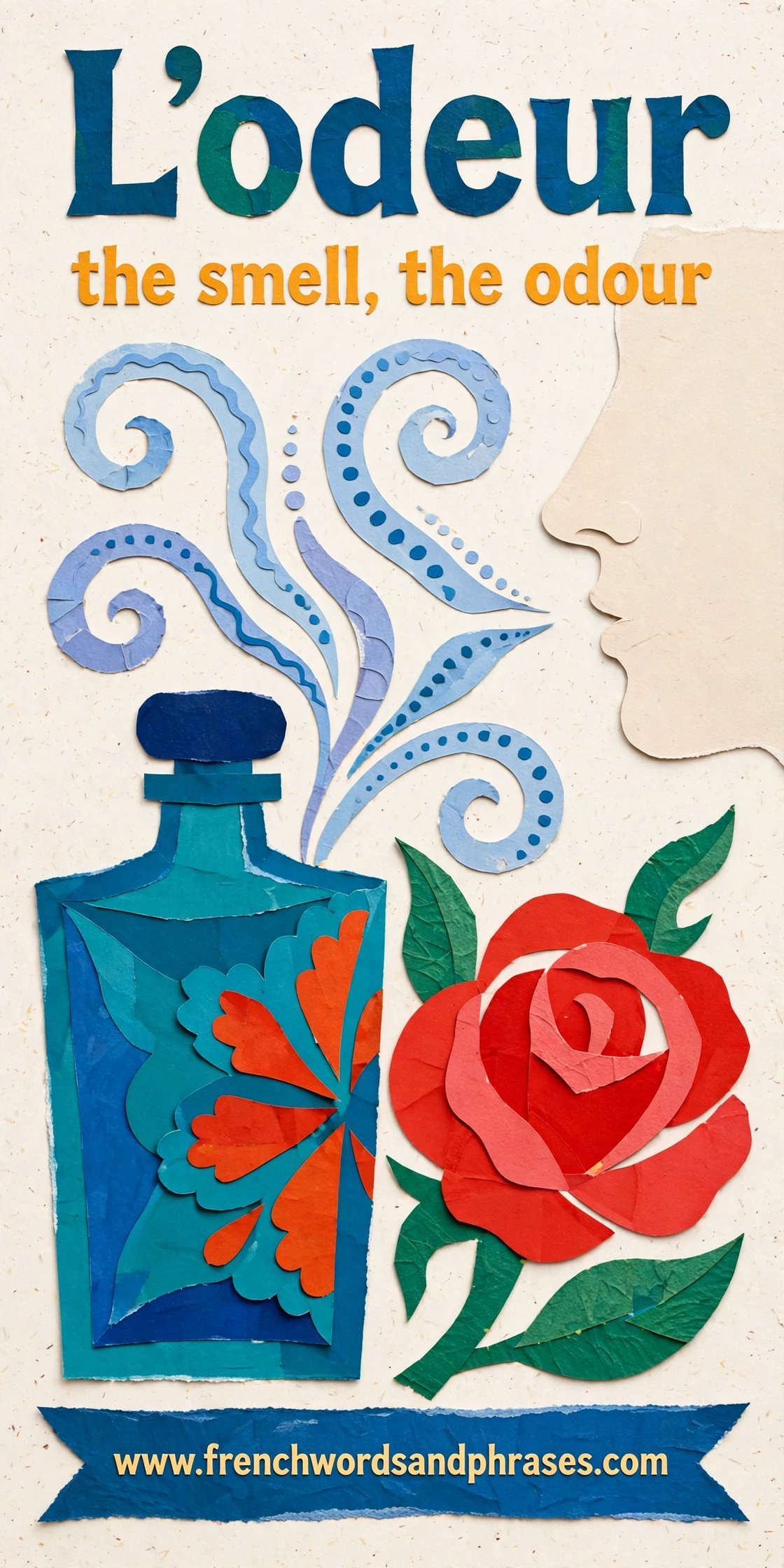
L’odeur means the smell, the odour.
Warm bread drifting from the bakery door, rain on hot pavement, the sea arriving before the coast appears: l’odeur, the smell — French’s word for everything the nose knows first, sweet or dreadful, the messenger that enters the room before its owner.
In this guide, you’ll learn what odeur means in English, how to use it with its articles, how to form its plural, and how it appears in everyday French. Explore French examples, English translations, and practice quizzes.
Understanding the French Noun Odeur
Odeur is a feminine French noun, learned with its article: l’odeur, une odeur. It begins with a vowel, so la melts into l’ before it. It comes straight from the Latin odor — the same root English kept in odour, and in deodorant, the smell-remover.
It means a smell, an odour — of anything, pleasant or not: l’odeur du café, the smell of coffee, une bonne odeur, a nice smell, une mauvaise odeur, a bad smell. French grades its smells carefully: un parfum is a chosen fragrance, une odeur is simply what reaches the nose, and un fumet is the delicious smell of cooking. The verb is sentir — je sens une odeur, I can smell something.
Gender: Feminine — l’odeur
Definite article: l’ — l’odeur (the smell), melted before the vowel
Indefinite article: une — une odeur (a smell)
Plural: les odeurs — regular, with a simple -s
Spelling note: from Latin odor — the root English kept in odour and deodorant
Close neighbour: un parfum — a fragrance, chosen and pleasant; une odeur is any smell at all
English equivalents: The smell, the odour.
Watch the possessives: odeur is feminine but begins with a vowel, so the singular possessives borrow the masculine forms — mon odeur, ton odeur, son odeur — never ma odeur. And when something smells strongly in a bad way, French turns blunt: ça pue, it stinks — the everyday opposite of une bonne odeur.
Experience the Word
Odeur is memory’s fastest road: one breath of it and a kitchen, a person or a whole summer is standing in front of you.
Imagine the traveller coming home after ten years abroad. The taxi door opens, and before the house, before the faces — l’odeur de la pluie sur la terre chaude, the smell of rain on warm earth, and he is seven years old again.
You have not just named a scent. You have named the invisible that arrives first — l’odeur, the smell.
How to Use Odeur in French: Complete Guide
Let’s explore how odeur works in French, beginning with its articles — l’odeur, une odeur, une bonne odeur.
Odeur with the Definite Article (L’, Les)
Used for a specific smell — the one in the kitchen, the one following you.
| Form | French |
|---|---|
| Feminine singular | l’odeur |
| Plural | les odeurs |
Example
L’odeur du café remplit la cuisine.
The smell of coffee fills the kitchen.
Odeur with the Indefinite Article (Une, Des)
Used for a smell in general — any odour the nose meets.
| Form | French |
|---|---|
| Feminine singular | une odeur |
| Plural | des odeurs |
Example
Une odeur de brûlé vient de la cuisine.
A smell of burning comes from the kitchen.
Odeur with Quantities (Une, Deux, Assez de…)
Smells are rarely counted — but they are graded, mixed and compared.
| Quantity | French |
|---|---|
| a smell | une odeur |
| a good smell | une bonne odeur |
| a bad smell | une mauvaise odeur |
| too many smells | trop d’odeurs |
| no smell | aucune odeur |
Example
Trop d’odeurs se mélangent dans ce marché.
Too many smells mix in this market.
Quick Quiz 1
Complete the sentence:
______ odeur des fleurs entre par la fenêtre. (the)
Reveal the answer
L’
L’odeur des fleurs entre par la fenêtre.
The smell of the flowers comes in through the window — la melts into l’ before the vowel.
The Plural of Odeur
Odeur takes a regular plural in -s — the smells of markets, gardens and ports.
| Number | French |
|---|---|
| Singular | l’odeur |
| Plural | les odeurs |
Example
Les odeurs du marché éveillent l’appétit.
The smells of the market awaken the appetite.
Odeur with Possessive Adjectives (Mon, Ton, Son…)
Odeur is feminine but begins with a vowel, so the singular possessives borrow the masculine forms: mon, ton, son.
| Owner | French |
|---|---|
| my | mon odeur |
| your (tu) | ton odeur |
| his / her | son odeur |
| our | notre odeur |
| your (vous) | votre odeur |
| their | leur odeur |
Example
Le chien reconnaît son odeur entre mille.
The dog recognises its smell among a thousand.
Quick Quiz 2
Complete the sentence:
Le chat suit ______ odeur préférée. (its)
Reveal the answer
son
Le chat suit son odeur préférée.
The cat follows its favourite smell — son, because odeur begins with a vowel.
Odeur with Demonstrative Adjectives (Cette, Ces)
Used to point: cette odeur, this smell — usually the one nobody can identify.
| Form | French |
|---|---|
| Feminine singular | cette odeur |
| Plural | ces odeurs |
Example
Cette odeur me rappelle la maison de ma grand-mère.
This smell reminds me of my grandmother’s house.
Odeur with Adjectives
Adjectives agree with odeur — feminine singular: une odeur douce, une odeur forte.
| Adjective | With Odeur |
|---|---|
| douce (sweet, gentle) | une odeur douce |
| forte (strong) | une odeur forte |
| bonne (good) | une bonne odeur |
| mauvaise (bad) | une mauvaise odeur |
| agréable (pleasant) | une odeur agréable |
Example
Une odeur douce de vanille flotte dans la pâtisserie.
A sweet smell of vanilla floats in the cake shop.
Quick Quiz 3
Complete the sentence:
C’est une odeur très ______. (strong)
Reveal the answer
forte
C’est une odeur très forte.
It is a very strong smell — forte, feminine, to agree with odeur.
Everyday Expressions with Odeur
Kitchens, gardens and harbours — the odeur phrases of daily life.
| Expression | In English |
|---|---|
| une bonne odeur | a nice smell |
| une mauvaise odeur | a bad smell |
| l’odeur du café | the smell of coffee |
| sentir une odeur | to smell something (with the nose) |
| être en odeur de sainteté | to be in good odour — in favour (the ironic idiom) |
Example
Une bonne odeur de pain chaud sort de la boulangerie.
A lovely smell of warm bread comes out of the bakery.
Words from the Same Family as Odeur
The nose’s vocabulary — the words that travel with odeur.
| French | In English |
|---|---|
| un parfum | a fragrance, a perfume |
| sentir | to smell, to feel (the verb) |
| un fumet | the delicious smell of cooking |
| le nez | the nose |
| odorant | fragrant, sweet-smelling (the adjective) |
Example
Le fumet du rôti attire tout le monde à la cuisine.
The delicious smell of the roast draws everyone to the kitchen.
Quick Quiz 4
What is the difference between une odeur and un parfum?
Reveal the answer
Un parfum is chosen and pleasant — a fragrance; une odeur is any smell at all, good or bad.
Son parfum laisse une odeur douce dans la pièce.
Her perfume leaves a sweet smell in the room.
Odeur in Everyday French: Real-Life Examples
Now that you know the word, let’s see how odeur appears in everyday French.
Example 1 — At the bakery
L’odeur du pain chaud donne faim.
The smell of warm bread makes you hungry.
Example 2 — In the garden
Une odeur douce monte des roses.
A sweet smell rises from the roses.
Example 3 — A warning
Une mauvaise odeur vient de la cave.
A bad smell is coming from the cellar.
Example 4 — At the sea
L’odeur de la mer annonce la côte.
The smell of the sea announces the coast.
Example 5 — Memory
Cette odeur me rappelle mon enfance.
This smell reminds me of my childhood.
Example 6 — In the kitchen
Quelle est cette odeur délicieuse ?
What is that delicious smell?
Beyond Translation: The Meaning of Odeur
Odeur is the most Proustian word in French: it was a smell-and-taste, the madeleine in tea, that unlocked the whole of À la recherche du temps perdu. French trusts the nose as memory’s archivist, and its language grades smells with a cook’s precision — parfum for the chosen, fumet for the delicious, odeur for everything, and the blunt ça pue for what must be said plainly.
To say odeur is to name the sense that remembers fastest.
It evokes bakery doors and sea air, grandmothers’ kitchens and harbour mud — wherever French breathes in and knows where it is.
How to Remember the French Noun Odeur
Remember it this way: Odeur is the smell — feminine with a melted article: l’odeur, and its possessives borrow mon, ton, son before the vowel.
- Feminine, vowel first — l’odeur, une odeur; never la odeur in speech.
- The possessive trick — mon odeur, son odeur, because the vowel smooths the way.
- Not every smell is a parfum — une odeur can be mauvaise; le parfum is chosen.
The key idea is l’odeur — the smell, the odour, feminine; une bonne odeur = a nice smell.
Test Your Knowledge of Odeur
Let’s see how much you’ve learned. Try answering these questions before revealing the answers.
Question 1
Is odeur masculine or feminine?
Reveal the answer
Feminine — l’odeur, une odeur (the article melts before the vowel).
Question 2
How do you say a bad smell in French?
Reveal the answer
Une mauvaise odeur.
Question 3
Translate: The smell of coffee fills the kitchen.
Reveal the answer
L’odeur du café remplit la cuisine.
Question 4
Why do we say mon odeur and not ma odeur?
Reveal the answer
Because odeur begins with a vowel — the singular possessives borrow the masculine forms mon, ton, son to keep the words flowing.
Question 5
Complete the sentence:
______ odeurs du marché sont merveilleuses. (the)
Reveal the answer
Les
Les odeurs du marché sont merveilleuses.
The smells of the market are wonderful.
Your Final Challenge
Can You Use It?
How would you say this in French?
“The smell of warm bread makes you hungry.”
Reveal the answer
L’odeur du pain chaud donne faim.
The smell of warm bread makes you hungry.
A little French. A little curiosity. A richer everyday life.
LEARN FRENCH ONE WORD AT A TIME