A French Word to Live By
Translate Violet to English
/vjɔlɛ/
Violet means purple.
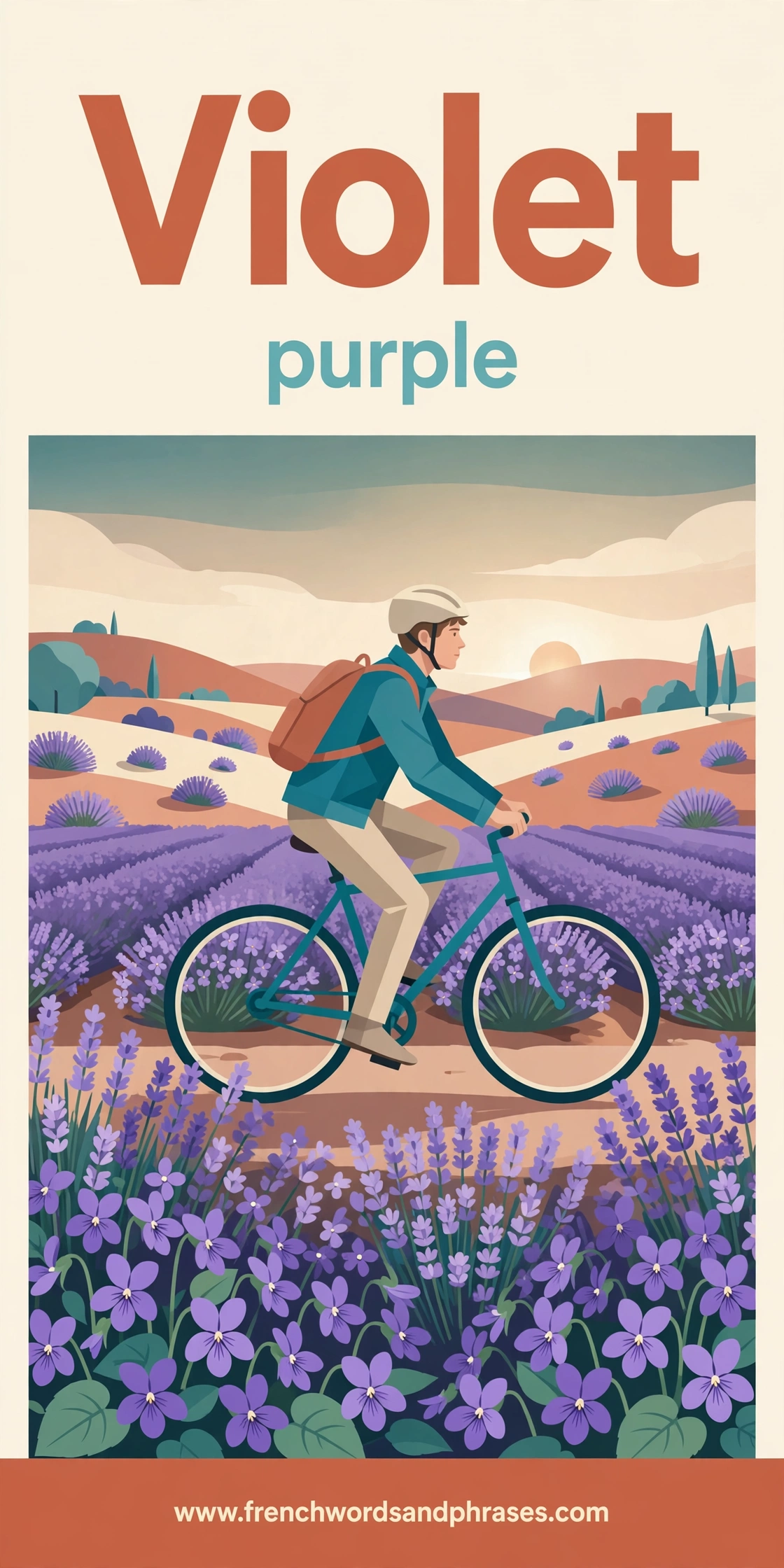
A hillside in Provence in late June: row after row of lavender rolling down to the valley, the air itself smelling of the colour. A child runs her hand over the flower heads and holds up purple fingers, delighted. French names that deep, scented colour after a smaller, shyer flower: violet.
In this guide, you’ll learn what violet means in English, why its feminine violette doubles the t, where it stands in the sentence, and how it shades from lilac fields to the last stripe of the rainbow. Explore French examples, English translations, and practice quizzes.
Understanding the French Adjective Violet
Violet is a French colour adjective — purple. It agrees with the noun it describes, and its feminine doubles the t: violet becomes violette. The four forms are violet, violette, violets, violettes. Like most colour adjectives, it stands after the noun.
It means purple — the colour of lavender fields, plums and the last band of the rainbow. It describes clothes (une robe violette, a purple dress), flowers (des iris violets, purple irises) and skies at dusk (un ciel violet). English splits this range into ‘purple’ and ‘violet’; French covers both with violet, using pourpre for a deep, royal purple-red.
Type: Colour adjective
Answers the question: What colour is it? — purple
Changes form: Yes — violet / violette / violets / violettes; the feminine doubles the t
English equivalents: Purple; violet.
One important usage detail: the feminine of violet is violette, with a double t — and the sound changes: violet ends in a quiet /ɛ/, violette pronounces the t clearly, /vjɔlɛt/. Violet stands AFTER the noun — une robe violette, un chapeau violet.
Experience the Word
Violet is the adjective of dusk and lavender — the colour the sky turns for ten minutes every evening, and the colour of fields that perfume a whole valley.
Imagine a grandmother’s garden in April, where the violets come up uninvited under the hedge, small and low and easy to miss. You have to kneel to see them properly. Some colours shout; violet rewards the people who kneel.
You have not just named a colour. You have named the colour of evenings and hidden flowers.
How to Use Violet in French: Complete Guide
Let’s explore how violet works in French, beginning with the whole word on one card.
Violet at a Glance
Before the details, here is the whole word on one card.
The Whole Word on One Card
Meaning, type, position and forms — violet in four lines.
| Point | Violet |
|---|---|
| Meaning | purple |
| Type | colour adjective |
| Usual position | after the noun — une robe violette |
| Form | violet / violette / violets / violettes |
Example
Elle porte une robe violette.
She is wearing a purple dress.
The Four Forms of Violet
Violet agrees with the noun it describes. The feminine doubles the t before adding the e: violet becomes violette — and suddenly the t is heard.
| Form | Violet | Example |
|---|---|---|
| Masculine singular | violet | un chapeau violet — a purple hat |
| Feminine singular | violette | une robe violette — a purple dress |
| Masculine plural | violets | des chapeaux violets — purple hats |
| Feminine plural | violettes | des robes violettes — purple dresses |
Example
Son chapeau est violet et sa robe est violette.
His hat is purple and her dress is purple.
Quick Quiz 1
What is the feminine of violet?
Reveal the answer
violette
Une robe violette.
A purple dress.
Violette: The Feminine Doubles the T
Adjectives ending in -et build their feminine by doubling the t and adding an e: violet, violette. The spelling change wakes the t up — you can hear the difference between the two forms.
| Situation | Example |
|---|---|
| The rule | double the t, add -e — violet → violette |
| The sound | violet /vjɔlɛ/ but violette /vjɔlɛt/ — the t is pronounced |
| Masculine plural | violets — des iris violets, purple irises |
| Feminine plural | violettes — des fleurs violettes, purple flowers |
Example
Elle a les yeux violets et une écharpe violette.
She has purple eyes and a purple scarf.
Where Violet Goes: After the Noun
Violet follows the noun it describes, like most colour adjectives, and it sits comfortably after être. Shade words like clair and foncé follow it to lighten or deepen the purple.
| Pattern | Example |
|---|---|
| After the noun | une robe violette — a purple dress |
| After être | le ciel est violet — the sky is purple |
| With a shade | violet foncé — dark purple |
| Before the noun | une violette robe — not in everyday French |
Example
Le ciel est violet ce soir, presque rose.
The sky is purple this evening, almost pink.
Quick Quiz 2
How do you say ‘a purple dress’ — une violette robe or une robe violette?
Reveal the answer
une robe violette
Violet stands after the noun, and its feminine doubles the t.
A purple dress.
More Purple: Comparing with Violet
Violet compares the regular way, with plus, moins and aussi — and the superlative agrees as usual: le plus violet, la plus violette.
| Degree | Example |
|---|---|
| As purple as | aussi violet que — as purple as |
| More purple | plus violet — plus violet que l’autre |
| Less purple | moins violet — moins violet qu’hier |
| The most purple (masc.) | le plus violet — le plus violet des couchers de soleil |
| The most purple (fem.) | la plus violette — la plus violette des robes |
Example
Cette robe est plus violette que l’autre.
This dress is more purple than the other one.
Everyday Expressions with Violet
Violet borrows its name from a modest flower and lends it to fields, bruises and the far end of the spectrum.
| Expression | In English |
|---|---|
| une violette | a violet — the small purple flower |
| les rayons ultraviolets | ultraviolet rays |
| violet foncé | dark purple |
| violet clair | light purple, lilac-purple |
| un champ de lavande violet | a purple lavender field |
| être violet de froid | to be purple with cold |
Example
Les enfants étaient violets de froid après la baignade.
The children were purple with cold after the swim.
Quick Quiz 3
What does être violet de froid mean?
Reveal the answer
To be purple with cold
Le bébé est violet de froid.
The baby is purple with cold.
Violet and Its Neighbours
Violet lives in a rich family of purples — from pale lilas to the deep, royal pourpre that English calls crimson-purple.
| French | In English |
|---|---|
| lilas | lilac — a pale purple |
| mauve | mauve |
| pourpre | deep purple, crimson-purple — the colour of royalty |
| prune | plum (colour) |
| lavande | lavender (colour) |
| aubergine | aubergine — a very dark purple |
Example
Elle hésite entre le lilas et le violet foncé.
She is hesitating between lilac and dark purple.
Watch Out: The Traps Around Violet
The traps here are the single t that sneaks into the feminine, and the English word ‘violet’ that covers only half the French colour.
| Trap | The truth |
|---|---|
| The feminine spelling | violette with double t — never ‘violete’ |
| Purple vs violet | French violet covers both English ‘purple’ and ‘violet’ |
| The flower | une violette is the flower; la lavande is lavender, a different plant |
| The sound | in violet the final t is silent; in violette it is pronounced |
Example
Ces violettes sont violettes.
These violets are purple.
Quick Quiz 4
How do you say ‘purple dresses’?
Reveal the answer
des robes violettes
The feminine plural doubles the t and adds s.
Purple dresses.
Violet in Everyday French: Real-Life Examples
Now that you know the word, let’s see how violet appears in everyday French.
Example 1 — Shopping
Je cherche une écharpe violette pour l’hiver.
I’m looking for a purple scarf for the winter.
Example 2 — In Provence
Les champs de lavande sont violets en juin.
The lavender fields are purple in June.
Example 3 — The sky
Le ciel devient violet après le coucher du soleil.
The sky turns purple after sunset.
Example 4 — Flowers
Elle a planté des iris violets dans le jardin.
She planted purple irises in the garden.
Example 5 — Clothes
Sa robe violette est parfaite pour la soirée.
Her purple dress is perfect for the evening.
Example 6 — Cold
Les enfants sont violets de froid, vite, des serviettes !
The children are purple with cold, quick, towels!
Beyond Translation: The Meaning of Violet
English divides this corner of the rainbow in two — purple for the deep shade, violet for the flower’s own tint. French keeps one word for the whole family and names it, simply, after the flower itself.
To say violet in French is to cover lavender fields, dusk skies and royal robes with a single, modest flower’s name.
And the word hides a small lesson in sound: say violet and the t sleeps; say violette and it wakes — French spelling and French sound, holding hands.
How to Remember the French Adjective Violet
Remember it this way: Violet is the lavender-purple adjective — after the noun, with a feminine that doubles the t and wakes it up.
- You double the t for the feminine — une robe violette.
- You hear the difference — violet ends quietly, violette pronounces the t.
- You cover two English words with one — violet is both purple and violet.
The key idea is violet becomes violette in the feminine — double the t, and pronounce it.
Test Your Knowledge of Violet
Let’s see how much you’ve learned. Try answering these questions before revealing the answers.
Question 1
What does violet mean?
Reveal the answer
Purple — it covers both English ‘purple’ and ‘violet’.
Question 2
What is the feminine of violet?
Reveal the answer
violette — double the t and add e.
Question 3
Translate: a purple dress.
Reveal the answer
Une robe violette.
Question 4
Complete the sentence:
Les champs de lavande sont ______ en juin.
Reveal the answer
violets
Les champs de lavande sont violets en juin.
The lavender fields are purple in June.
Question 5
How is violette pronounced differently from violet?
Reveal the answer
The t is heard — violet /vjɔlɛ/, violette /vjɔlɛt/.
Your Final Challenge
Can You Use It?
How would you say this in French?
“Her dress is purple and the sky is purple too.”
Reveal the answer
Sa robe est violette et le ciel est violet aussi.
Her dress is purple and the sky is purple too.
A little French. A little curiosity. A richer everyday life.
LEARN FRENCH ONE WORD AT A TIME