A French Word to Live By
Translate Rose to English
/ʁoz/
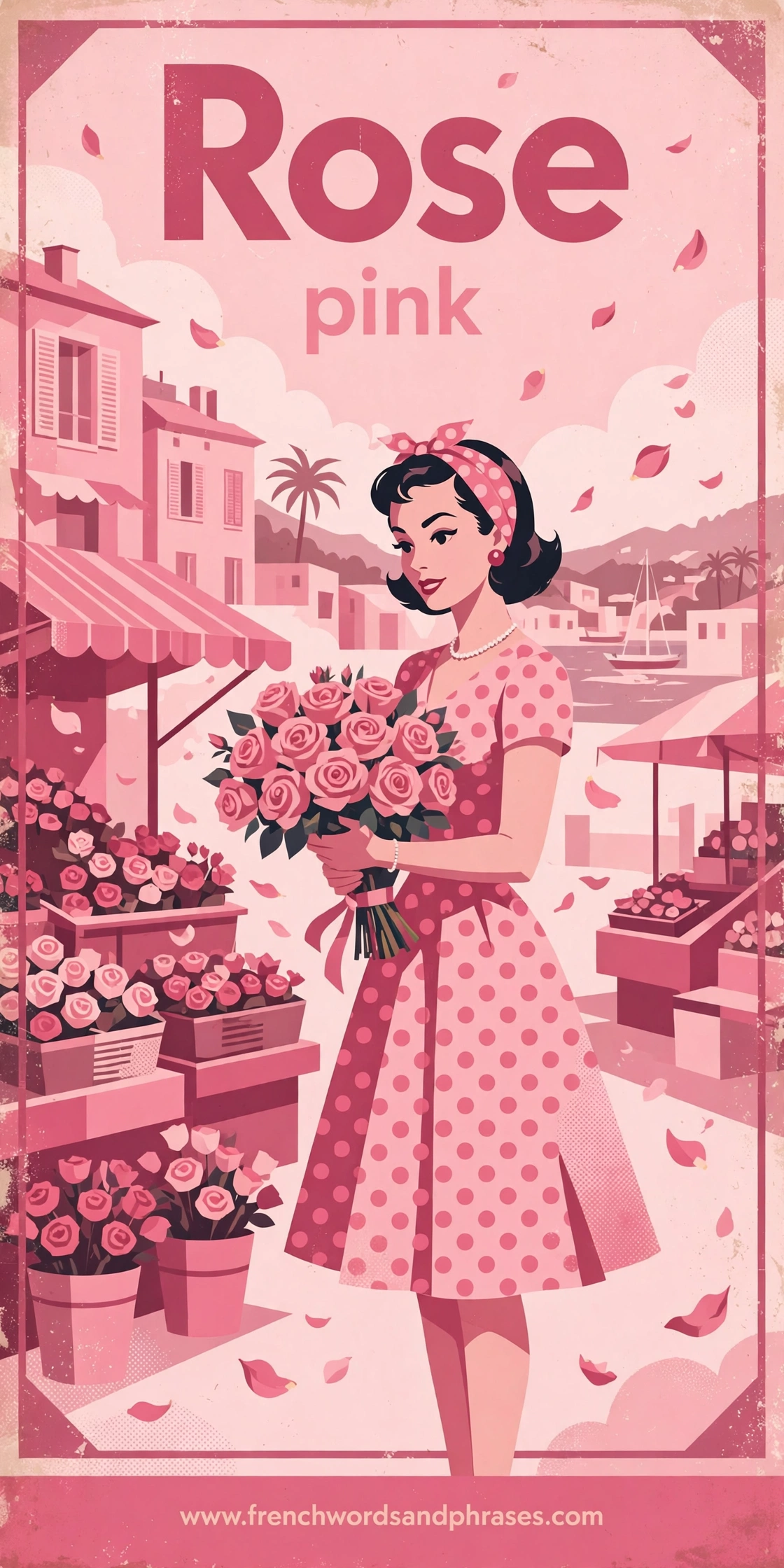
Rose means pink.
A florist’s stall at dawn: buckets of peonies, a child’s bicycle with ribbons on the handles, and the sky itself still flushed from sunrise. Between red and white there is a colour that belongs to spring mornings and first bicycles — and in French it borrows its name from the flower in the bucket: rose.
In this guide, you’ll learn what rose means in English, why it is one of the easiest colour adjectives in French, where it stands in the sentence, and how it colours everything from cheeks to world views. Explore French examples, English translations, and practice quizzes.
Understanding the French Adjective Rose
Rose is a French colour adjective — pink. It already ends in -e, so masculine and feminine are identical: rose for both. Only the plural adds an s: roses. It takes its name from the flower, la rose, and like most colour adjectives it stands after the noun.
It means pink — the colour between red and white. It describes clothes (une robe rose, a pink dress), flowers (des tulipes roses, pink tulips), cheeks flushed with cold or embarrassment (des joues roses) and even moods: voir la vie en rose is to see life through rose-tinted glasses.
Type: Colour adjective
Answers the question: What colour is it? — pink
Changes form: Only in the plural — rose / roses, the same for masculine and feminine
English equivalents: Pink.
One important usage detail: rose stands AFTER the noun — une robe rose. Do not confuse the adjective with the noun: une rose is the flower, a rose; the colour borrows the flower’s name. And the wine is le rosé, with an accent — a different word.
Experience the Word
Rose is the adjective of spring and good humour — the colour of cherry blossom, of healthy cheeks, of the sky deciding to be kind for an hour.
Imagine a little girl choosing her first bicycle, walking straight past the red ones and the blue ones to the one with ribbons on the handles. She is not being difficult. She knows exactly which colour the world should be this year.
You have not just named a colour. You have named the colour of optimism.
How to Use Rose in French: Complete Guide
Let’s explore how rose works in French, beginning with the whole word on one card.
Rose at a Glance
Before the details, here is the whole word on one card.
The Whole Word on One Card
Meaning, type, position and forms — rose in four lines.
| Point | Rose |
|---|---|
| Meaning | pink |
| Type | colour adjective |
| Usual position | after the noun — une robe rose |
| Form | rose for everyone — roses in the plural |
Example
Elle porte une robe rose.
She is wearing a pink dress.
The Four Forms of Rose
Here is one of the easiest agreements in French: rose already ends in -e, so the feminine changes nothing. Only the plural adds an s.
| Form | Rose | Example |
|---|---|---|
| Masculine singular | rose | un ruban rose — a pink ribbon |
| Feminine singular | rose | une fleur rose — a pink flower |
| Masculine plural | roses | des rubans roses — pink ribbons |
| Feminine plural | roses | des fleurs roses — pink flowers |
Example
Il a un ruban rose et elle a une fleur rose.
He has a pink ribbon and she has a pink flower.
Quick Quiz 1
Does rose change for a feminine noun?
Reveal the answer
No
Un ruban rose, une fleur rose — the form is identical.
A pink ribbon, a pink flower.
The Feminine of Rose: Nothing Changes
Most adjectives build their feminine by adding an e. Rose was born with one, so the feminine has nothing to add — the only change French asks of it is the plural s.
| Situation | Example |
|---|---|
| Masculine | un ciel rose — a pink sky |
| Feminine | une écharpe rose — identical |
| Why | rose already ends in -e, so the feminine adds nothing |
| The plural | add s — des écharpes roses, pink scarves |
Example
Ses joues sont roses après la course.
Her cheeks are pink after the run.
Where Rose Goes: After the Noun
Rose follows the noun it describes, like most colour adjectives, and it sits comfortably after être. Shade words like bonbon or saumon can follow it to fine-tune the pink.
| Pattern | Example |
|---|---|
| After the noun | une robe rose — a pink dress |
| After être | le ciel est rose — the sky is pink |
| With a shade | rose bonbon — candy pink |
| Before the noun | une rose robe — not in everyday French |
Example
Le ciel est rose ce soir.
The sky is pink this evening.
Quick Quiz 2
How do you say ‘a pink dress’ — une rose robe or une robe rose?
Reveal the answer
une robe rose
Rose stands after the noun and does not change for the feminine.
A pink dress.
Pinker: Comparing with Rose
Rose compares the regular way, with plus, moins and aussi — and the superlative keeps the same single form: le plus rose, la plus rose.
| Degree | Example |
|---|---|
| As pink as | aussi rose que — as pink as |
| More pink | plus rose — plus rose que l’autre |
| Less pink | moins rose — moins rose qu’hier |
| The pinkest (masc.) | le plus rose — le plus rose des couchers de soleil |
| The pinkest (fem.) | la plus rose — la plus rose des robes |
Example
Cette robe est plus rose que l’autre.
This dress is pinker than the other one.
Everyday Expressions with Rose
Rose colours some of the most charming expressions in French — above all the famous one about how you choose to look at life.
| Expression | In English |
|---|---|
| voir la vie en rose | to see life through rose-tinted glasses |
| rose bonbon | candy pink, sugary pink |
| des joues roses | rosy cheeks |
| la rose des vents | the compass rose |
| un roman à l’eau de rose | a sentimental, soppy novel |
| rose saumon | salmon pink |
Example
Depuis son mariage, elle voit la vie en rose.
Since her wedding, she sees life through rose-tinted glasses.
Quick Quiz 3
What does voir la vie en rose mean?
Reveal the answer
To see life through rose-tinted glasses
Il voit toujours la vie en rose.
He always sees life through rose-tinted glasses.
Rose and Its Neighbours
Rose sits between rouge and blanc on the colour wheel, with a family of shades around it and fuchsia waiting at the loud end.
| French | In English |
|---|---|
| rose pâle | pale pink |
| rose vif | bright pink, hot pink |
| fuchsia | fuchsia — a vivid purplish pink |
| saumon | salmon (colour) |
| rouge | red — the deeper neighbour |
| magenta | magenta |
Example
Elle hésite entre le rose pâle et le fuchsia.
She is hesitating between pale pink and fuchsia.
Watch Out: The Traps Around Rose
The traps here are the flower that shares the name, and the wine that nearly does.
| Trap | The truth |
|---|---|
| The flower | une rose is also a rose (the flower) — context decides which rose you mean |
| The wine | rosé wine is le rosé, with an accent — not rose |
| Agreement | rose agrees in the plural (des robes roses) — it is not invariable like marron |
| English ‘rose’ | English ‘rose-coloured’ is rose in French; plain ‘a rose’ the flower is une rose too |
Example
Il lui offre une rose rose.
He gives her a pink rose.
Quick Quiz 4
How do you say ‘pink flowers’?
Reveal the answer
des fleurs roses
The plural adds an s, the feminine adds nothing.
Pink flowers.
Rose in Everyday French: Real-Life Examples
Now that you know the word, let’s see how rose appears in everyday French.
Example 1 — Shopping
Je cherche un pull rose pour ma fille.
I’m looking for a pink jumper for my daughter.
Example 2 — The garden
Les tulipes roses sont magnifiques cette année.
The pink tulips are magnificent this year.
Example 3 — The sky
Regarde, le ciel est tout rose ce soir.
Look, the sky is all pink this evening.
Example 4 — Health
Le bébé a les joues roses, il va très bien.
The baby has rosy cheeks, he is very well.
Example 5 — A bicycle
Elle veut un vélo rose avec des rubans.
She wants a pink bicycle with ribbons.
Example 6 — Mood
Depuis ses vacances, il voit la vie en rose.
Since his holiday, he sees life through rose-tinted glasses.
Beyond Translation: The Meaning of Rose
English says pink for the meaning of rose — English invented a fresh word from a different flower, but French simply promoted its most famous bloom: the colour is the flower, and the flower is the colour.
To say rose in French is to name a colour and a rose in the same breath.
That double life gave French its most optimistic idiom: voir la vie en rose — to look at the world the colour of roses, and find it beautiful.
How to Remember the French Adjective Rose
Remember it this way: Rose is the easy colour adjective — one form for him and her, an s for the plural, and its place quietly behind the noun.
- You use one form for everyone — un ruban rose, une fleur rose.
- You add only an s in the plural — des robes roses, des rubans roses.
- You borrow the flower’s optimism — voir la vie en rose.
The key idea is rose never changes except in the plural, and it is named after the flower.
Test Your Knowledge of Rose
Let’s see how much you’ve learned. Try answering these questions before revealing the answers.
Question 1
What does rose mean?
Reveal the answer
Pink — the colour between red and white.
Question 2
What is the feminine of rose?
Reveal the answer
rose — identical. The word already ends in -e.
Question 3
Translate: a pink dress.
Reveal the answer
Une robe rose.
Question 4
Complete the sentence:
Ses joues sont ______ après la course.
Reveal the answer
roses
Ses joues sont roses après la course.
Her cheeks are pink after the run.
Question 5
What does ‘voir la vie en rose’ mean?
Reveal the answer
To see life through rose-tinted glasses — to look on the bright side.
Your Final Challenge
Can You Use It?
How would you say this in French?
“The sky is pink and her dress is pink too.”
Reveal the answer
Le ciel est rose et sa robe est rose aussi.
The sky is pink and her dress is pink too.
A little French. A little curiosity. A richer everyday life.
LEARN FRENCH ONE WORD AT A TIME