A French Word to Live By
Translate Marron to English
/maʁɔ̃/
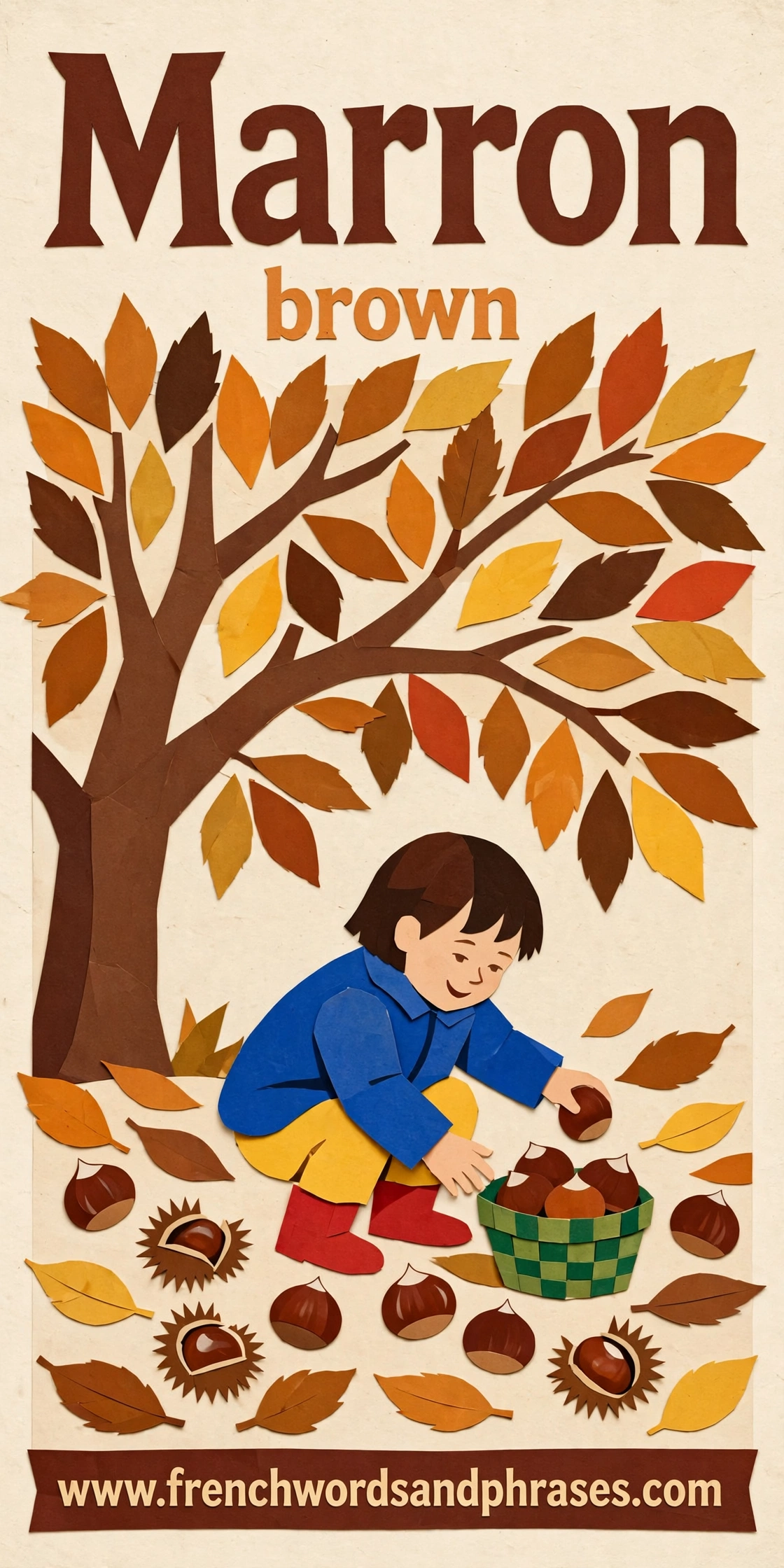
Marron means brown.
An October wood after rain: wet leaves underfoot, a basket filling with mushrooms, and a stall at the edge of the market selling hot chestnuts in paper cones. The colour is everywhere — in the earth, the bark, the steaming chestnuts — and French names it after the chestnut itself: marron.
In this guide, you’ll learn what marron means in English, why this colour adjective never changes its form — not for feminine, not for plural — where it stands in the sentence, and how French separates it from brun. Explore French examples, English translations, and practice quizzes.
Understanding the French Adjective Marron
Marron is a French colour adjective — brown. It is INVARIABLE: it never changes its form. There is no feminine marronne and no plural marrons for the colour — un manteau marron, une veste marron, des chaussures marron, des ceintures marron. One form does everything, because marron is really the name of a thing — the chestnut — borrowed as a colour.
It means brown — the colour of earth, wood, chocolate and chestnuts. It describes clothes (des chaussures marron, brown shoes), eyes and hair in everyday French (des yeux marron, brown eyes) and food (une sauce marron). Where English has one everyday word, French has two: marron for the colour of things, brun more often for hair and as a slightly more formal shade.
Type: Colour adjective — borrowed from a noun (the chestnut)
Answers the question: What colour is it? — brown
Changes form: Never — marron is invariable: no feminine, no plural change
English equivalents: Brown.
One important usage detail: marron NEVER agrees — des chaussures marron, une ceinture marron, always marron, never marrons or marronne. It stands AFTER the noun. Colour adjectives taken from things (a chestnut, an orange) keep the thing’s name unchanged, and marron is the classic example.
Experience the Word
Marron is the adjective of autumn and earth — the colour of the woodpile, the ploughed field and the paper cone of hot chestnuts warming your hands.
Imagine a shoemaker’s window in November: boots in every shade of the season, polished until they shine like conkers. The card in the window does not list four forms of the colour. It doesn’t need to. In French, this colour has only ever had one name, and it fits every boot in the row.
You have not just named a colour. You have named the colour that refuses all grammar — one word, unchanged, for everything brown.
How to Use Marron in French: Complete Guide
Let’s explore how marron works in French, beginning with the whole word on one card.
Marron at a Glance
Before the details, here is the whole word on one card.
The Whole Word on One Card
Meaning, type, position and forms — marron in four lines.
| Point | Marron |
|---|---|
| Meaning | brown |
| Type | colour adjective — invariable |
| Usual position | after the noun — des chaussures marron |
| Form | marron — always, for every noun |
Example
Elle porte des chaussures marron.
She is wearing brown shoes.
The Four Forms of Marron: One Form for All
Here is the whole point of marron: there are not four forms. Masculine, feminine, singular, plural — the word stays exactly the same, because it is the name of a chestnut doing duty as a colour.
| Form | Marron | Example |
|---|---|---|
| Masculine singular | marron | un manteau marron — a brown coat |
| Feminine singular | marron | une veste marron — a brown jacket |
| Masculine plural | marron | des pantalons marron — brown trousers |
| Feminine plural | marron | des chaussures marron — brown shoes |
Example
Il a un manteau marron et des chaussures marron.
He has a brown coat and brown shoes.
Quick Quiz 1
What is the feminine plural of marron?
Reveal the answer
marron
Des chaussures marron — marron never changes.
Brown shoes.
Marron Never Changes: The Invariable Colour
Say it plainly, because every learner tries to change it: marron has no feminine and no plural. Not marrons, not marronne, not marronnes — just marron, every time, for every noun.
| Situation | Example |
|---|---|
| The rule | marron is invariable — it never agrees |
| Not this | des chaussures marrons — wrong, no s |
| Not that either | une veste marronne — wrong, no feminine |
| Why | marron is a noun (a chestnut) used as a colour — borrowed words keep their form |
Example
Elle a une ceinture marron et des bottes marron.
She has a brown belt and brown boots.
Where Marron Goes: After the Noun
Marron follows the noun it describes, like most colour adjectives, and it sits comfortably after être. Shade words like clair and foncé can follow it — and they do not make it agree either.
| Pattern | Example |
|---|---|
| After the noun | des chaussures marron — brown shoes |
| After être | ses yeux sont marron — her eyes are brown |
| With a shade | marron clair — light brown |
| Before the noun | des marron chaussures — not in French |
Example
Ses yeux sont marron et ses cheveux aussi.
Her eyes are brown and her hair too.
Quick Quiz 2
How do you say ‘brown shoes’ (chaussures is feminine plural)?
Reveal the answer
des chaussures marron
Marron is invariable — no s, no feminine, ever.
Brown shoes.
More Brown: Comparing with Marron
Marron compares with plus, moins and aussi like other adjectives — but even in the superlative it keeps its single form: le plus marron, la plus marron, les plus marron.
| Degree | Example |
|---|---|
| As brown as | aussi marron que — as brown as |
| More brown | plus marron — plus marron que l’autre |
| Less brown | moins marron — moins marron qu’avant |
| The most brown (masc.) | le plus marron — le plus marron des manteaux |
| The most brown (fem.) | la plus marron — la plus marron des vestes |
Example
Ce manteau est plus marron que l’autre.
This coat is browner than the other one.
Everyday Expressions with Marron
Marron begins life as a chestnut, and the chestnut is still there behind the colour — in markets, in desserts and in one famous glance.
| Expression | In English |
|---|---|
| un marron | a chestnut — the noun behind the colour |
| des yeux marron | brown eyes |
| marron glacé | a candied chestnut |
| marron clair / marron foncé | light brown / dark brown |
| être marron (familiar) | to be caught out, to be done for |
| un marron d’Inde | a horse chestnut, a conker |
Example
Elle a de beaux yeux marron.
She has beautiful brown eyes.
Quick Quiz 3
What is un marron (the noun)?
Reveal the answer
A chestnut
On vend des marrons chauds au marché.
They sell hot chestnuts at the market.
Marron and Its Neighbours
French has a second brown — brun — and a ring of earthy shades around them both. Marron is the everyday word for things; brun leans towards hair and formality.
| French | In English |
|---|---|
| brun | brown, dark — especially of hair: elle est brune |
| marron clair | light brown |
| marron foncé | dark brown |
| beige | beige |
| noisette | hazel — of eyes |
| châtain | chestnut-brown — of hair |
Example
Elle est brune avec des yeux noisette.
She has dark brown hair with hazel eyes.
Watch Out: The Traps Around Marron
One trap towers over the others: the urge to make marron agree. Resist it — and keep brun in its own territory.
| Trap | The truth |
|---|---|
| Agreement | marron never changes — des chaussures marron, une veste marron; ‘marrons’ and ‘marronne’ do not exist for the colour |
| marron vs brun | marron for things and eyes; brun (brune) more for hair and in formal descriptions |
| The noun | un marron is a chestnut; une châtaigne is the other chestnut word, for the sweet chestnut tree’s fruit |
| Compounds | marron clair and marron foncé stay invariable too |
Example
Des gants marron foncé, s’il vous plaît.
Dark brown gloves, please.
Quick Quiz 4
Which is correct — des bottes marrons or des bottes marron?
Reveal the answer
des bottes marron
Marron is invariable — it never takes an s.
Brown boots.
Marron in Everyday French: Real-Life Examples
Now that you know the word, let’s see how marron appears in everyday French.
Example 1 — Shopping
Je cherche des chaussures marron en cuir.
I’m looking for brown leather shoes.
Example 2 — Describing someone
Elle a les yeux marron et les cheveux châtain.
She has brown eyes and chestnut-brown hair.
Example 3 — Clothes
Ce pantalon marron va bien avec ta veste.
These brown trousers go well with your jacket.
Example 4 — At the market
Les marrons chauds sont arrivés, c’est l’automne !
The hot chestnuts are here, it’s autumn!
Example 5 — Furniture
Nous avons acheté une table marron en bois.
We bought a brown wooden table.
Example 6 — A dog
Leur chien est marron avec des taches blanches.
Their dog is brown with white patches.
Beyond Translation: The Meaning of Marron
English says brown for the meaning of marron — a plain colour word with no story attached. French marron still carries its chestnut inside it: every brown coat and pair of brown eyes is named after the nut that falls from the tree in October.
Marron is a thing first and a colour second — and that is exactly why it never agrees.
French borrows colours from things more often than English does, and the borrowed ones — marron, orange — stand still while all the native adjectives around them change. Learn to spot them, and a whole corner of French grammar goes quiet.
How to Remember the French Adjective Marron
Remember it this way: Marron is the chestnut-brown adjective — invariable, always after the noun, always exactly the same word.
- You never change it — un manteau marron, une veste marron, des chaussures marron.
- You remember why — marron is a chestnut, a thing borrowed as a colour, and borrowed colours keep their form.
- You keep brun for hair — elle est brune — and marron for things, eyes and shoes.
The key idea is marron is invariable — no feminine, no plural, ever.
Test Your Knowledge of Marron
Let’s see how much you’ve learned. Try answering these questions before revealing the answers.
Question 1
What does marron mean?
Reveal the answer
Brown — the colour of earth, wood and chestnuts.
Question 2
What is the feminine plural of marron?
Reveal the answer
marron — it is invariable; it never changes.
Question 3
Translate: brown shoes.
Reveal the answer
Des chaussures marron.
Question 4
Complete the sentence:
Elle a une ceinture ______ .
Reveal the answer
marron
Elle a une ceinture marron.
She has a brown belt.
Question 5
Why does marron never change?
Reveal the answer
Because it is a noun — a chestnut — borrowed as a colour, and borrowed colour words keep their form.
Your Final Challenge
Can You Use It?
How would you say this in French?
“She is wearing brown shoes and a brown jacket.”
Reveal the answer
Elle porte des chaussures marron et une veste marron.
She is wearing brown shoes and a brown jacket.
A little French. A little curiosity. A richer everyday life.
LEARN FRENCH ONE WORD AT A TIME