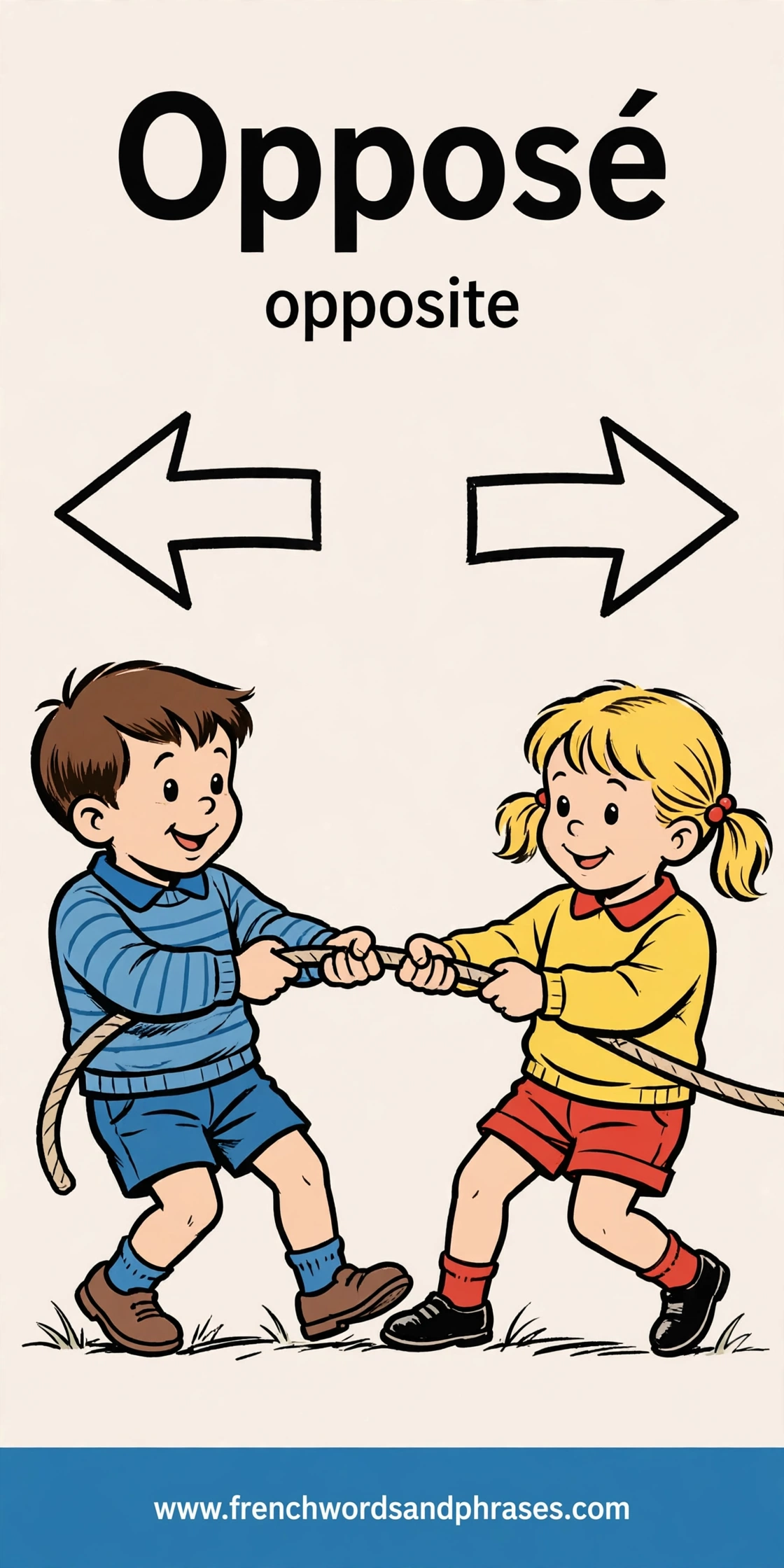
A French Word to Live By
Translate Opposé to English
/ɔ.po.ze/
Opposé means opposite.
Two houses face each other across the lane; two brothers argue the same question from its two ends; the wind drops and turns to blow from the north. « Le sens opposé », dit le conducteur en regardant le panneau. Opposé is the adjective of facing and contrary — the other side, the other direction, the other view.
In this guide, you’ll learn what opposé means in English, how its feminine opposée works, and how it serves for directions, positions and disagreements alike. Explore French examples, English translations, and practice quizzes.
Understanding the French Adjective Opposé
Opposé is a French adjective of position and contrariety — in form, the past participle of the verb opposer, to set against. It agrees regularly: opposé, opposée, opposés, opposées. With à it builds its most useful frame: opposé à, opposed to, facing — la maison opposée à la nôtre, the house opposite ours.
It means opposite in all its French lives: spatial — la rive opposée, the opposite bank; directional — le sens opposé, the opposite direction; contrary — des avis opposés, opposing views; and personal — être opposé à quelque chose, to be opposed to something. As a noun it names the thing itself: l’opposé, the opposite — le chaud est l’opposé du froid. English speakers can trust it almost everywhere; only remember that French says au contraire for the discourse sense ‘on the contrary’.
Type: Adjective of position and contrariety — facing, contrary, against
Answers the question: Which side, which view? — the other one, the facing one
Changes form: opposé / opposée / opposés / opposées — regular agreement
English equivalents: Opposite; opposing; opposed (to); facing.
One important usage detail: opposé loves the preposition à — opposé à la guerre, opposed to the war; le mur opposé à la fenêtre, the wall opposite the window. And for the pure noun use, French puts the article on it: l’opposé de plus a noun — l’opposé du vrai est le faux, the opposite of true is false.
Experience the Word
Opposé is the adjective of the far bank and the other mind: whatever stands across from you, looking back.
Imagine the two cafés at the crossroads, one in sun, one in shade, their terraces face to face for a hundred years — le café d’en face et son opposé, each convinced the other has the worse view of the square.
You have not just said different. You have placed the thing across from you — opposé.
How to Use Opposé in French: Complete Guide
Let’s explore how opposé works in French, beginning with the whole word on one card.
Opposé at a Glance
Before the details, here is the whole word on one card.
The Whole Word on One Card
Meaning, type, position and forms — opposé in four lines.
| Point | Opposé |
|---|---|
| Meaning | opposite — facing, contrary, opposed |
| Type | adjective of position and opinion |
| Usual position | after the noun — la rive opposée |
| Form | opposée in the feminine; plurals opposés, opposées |
Example
Le village est sur la rive opposée du fleuve.
The village is on the opposite bank of the river.
The Four Forms of Opposé
Opposé agrees like a past participle: add -e for the feminine, -s for the plurals.
| Form | Opposé | Example |
|---|---|---|
| Masculine singular | opposé | le sens opposé — the opposite direction |
| Feminine singular | opposée | la rive opposée — the opposite bank |
| Masculine plural | opposés | des avis opposés — opposing views |
| Feminine plural | opposées | des maisons opposées — houses facing each other |
Example
Les deux maisons opposées se regardent depuis un siècle.
The two houses facing each other have looked at each other for a century.
Quick Quiz 1
What is the feminine of opposé?
Reveal the answer
opposée
La rive opposée — add -e, as for a past participle.
The opposite bank.
The Feminine of Opposé: Opposée
Opposé is a participle at heart, so its feminine simply adds -e: opposée, and opposées in the plural.
| Situation | Example |
|---|---|
| Masculine | un avis opposé — an opposing view |
| Feminine | une direction opposée — an opposite direction |
| Why | the participle pattern: -é becomes -ée in the feminine |
| The plural | des directions opposées, des avis opposés |
Example
Elle marche dans la direction opposée.
She is walking in the opposite direction.
Where Opposé Goes: After the Noun
Opposé follows the noun it describes, and with à it points at what it faces or fights.
| Pattern | Example |
|---|---|
| After the noun | la rive opposée — the opposite bank |
| After être + à | être opposé à la guerre — to be opposed to the war |
| Facing + à | la maison opposée à la nôtre — the house opposite ours |
| As a noun | l’opposé du froid — the opposite of cold |
Example
Il est opposé à ce projet depuis le début.
He has been opposed to this project from the start.
Quick Quiz 2
How do you say ‘opposed to the war’ — opposé la guerre or opposé à la guerre?
Reveal the answer
opposé à la guerre
Opposé takes the preposition à before what it faces or rejects.
Opposed to the war.
More Opposé: Comparing with Opposé
Opposé is nearly absolute — two sides, no middle — so comparison is rare; French grades disagreement with adverbs instead.
| Degree | Example |
|---|---|
| Completely opposed | totalement opposé — totally opposed |
| Firmly opposed | fermement opposé — firmly opposed |
| Rather opposed | plutôt opposé — rather opposed |
| The exact opposite | l’exact opposé — the noun, for things |
Example
Elle est totalement opposée à cette idée.
She is totally opposed to this idea.
Everyday Expressions with Opposé
Rivers, roads and arguments — opposé at work in daily French.
| Expression | In English |
|---|---|
| la rive opposée | the opposite bank |
| le sens opposé | the opposite direction |
| être opposé à | to be opposed to |
| des avis opposés | opposing views |
| l’opposé de | the opposite of |
| au sens opposé | in the opposite direction (of traffic) |
Example
Le bus part dans le sens opposé.
The bus leaves in the opposite direction.
Quick Quiz 3
What does l’opposé du chaud mean?
Reveal the answer
The opposite of hot — l’opposé as a noun is the contrary thing itself: cold.
L’opposé du chaud, c’est le froid.
The opposite of hot is cold.
Opposé and Its Neighbours
Opposé keeps company with the other words of sides and stances — and faces its agreeing opposites.
| French | In English |
|---|---|
| contraire | contrary — le sens contraire, l’avis contraire |
| inverse | inverse, reverse — l’ordre inverse |
| d’en face | opposite, across the way — le café d’en face |
| contre | against — être contre un projet |
| favorable | in favour — the stance opposite to opposé |
Example
Le café d’en face vend le contraire de ce qu’il faut.
The café opposite sells the opposite of what is needed.
Watch Out: The Traps Around Opposé
The traps: the missing à, the discourse phrase that belongs to contraire, and the participle agreement.
| Trap | The truth |
|---|---|
| The preposition | opposé à — never opposé de for people and stances |
| On the contrary | for the discourse sense say au contraire, not à l’opposé |
| Agreement | la rive opposée, des rives opposées — the participle agrees fully |
| The verb | s’opposer à is to oppose, to object — je m’oppose à cette décision |
Example
Au contraire, elle est favorable au projet ; c’est lui qui y est opposé.
On the contrary, she is in favour of the project; it is he who is opposed to it.
Quick Quiz 4
How do you say ‘the opposite direction’?
Reveal the answer
le sens opposé
Opposé follows the noun: le sens opposé, la direction opposée.
The opposite direction.
Opposé in Everyday French: Real-Life Examples
Now that you know the word, let’s see how opposé appears in everyday French.
Example 1 — The river
Le village est sur la rive opposée.
The village is on the opposite bank.
Example 2 — Traffic
Attention, une voiture arrive en sens opposé.
Careful, a car is coming in the opposite direction.
Example 3 — Opinion
Il est opposé à la nouvelle loi.
He is opposed to the new law.
Example 4 — Houses
La maison opposée à la nôtre est à vendre.
The house opposite ours is for sale.
Example 5 — Views
Ils ont des avis opposés sur tout.
They have opposing views on everything.
Example 6 — The noun
L’opposé du noir est le blanc.
The opposite of black is white.
Beyond Translation: The Meaning of Opposé
Opposé is geometry turned into character: two banks, two directions, two minds, each defined by standing across from the other. French debates run on it — des avis opposés are the raw material of every editorial — and French roads sign it, sens opposé, wherever two flows must pass without meeting.
Opposé is the adjective of the other side — near enough to see, far enough to disagree.
Learn it beside contraire and d’en face, and you can place anything in French space or argument: across the river, against the plan, or simply opposite the café.
How to Remember the French Adjective Opposé
Remember it this way: Opposé is the opposite adjective — opposée in the feminine, and it takes à before what it faces or rejects.
- You agree it fully — le sens opposé, la rive opposée.
- You give it its preposition — être opposé à quelque chose.
- You know its noun — l’opposé du chaud, c’est le froid.
The key idea is opposé means opposite, opposed; feminine opposée; opposé à = opposed to.
Test Your Knowledge of Opposé
Let’s see how much you’ve learned. Try answering these questions before revealing the answers.
Question 1
What does opposé mean?
Reveal the answer
Opposite — facing, contrary, or opposed to.
Question 2
What is the feminine of opposé?
Reveal the answer
Opposée — la rive opposée.
Question 3
Translate: the opposite bank.
Reveal the answer
La rive opposée.
Question 4
Complete the sentence:
Elle est ______ à cette idée. (opposed)
Reveal the answer
opposée
Elle est opposée à cette idée.
She is opposed to this idea.
Question 5
What is l’opposé du noir?
Reveal the answer
Le blanc — white, the opposite of black.
Your Final Challenge
Can You Use It?
How would you say this in French?
“The village is on the opposite bank of the river.”
Reveal the answer
Le village est sur la rive opposée du fleuve.
The village is on the opposite bank of the river.
A little French. A little curiosity. A richer everyday life.
LEARN FRENCH ONE WORD AT A TIME