A French Word to Live By
Translate Tu to English
/ty/
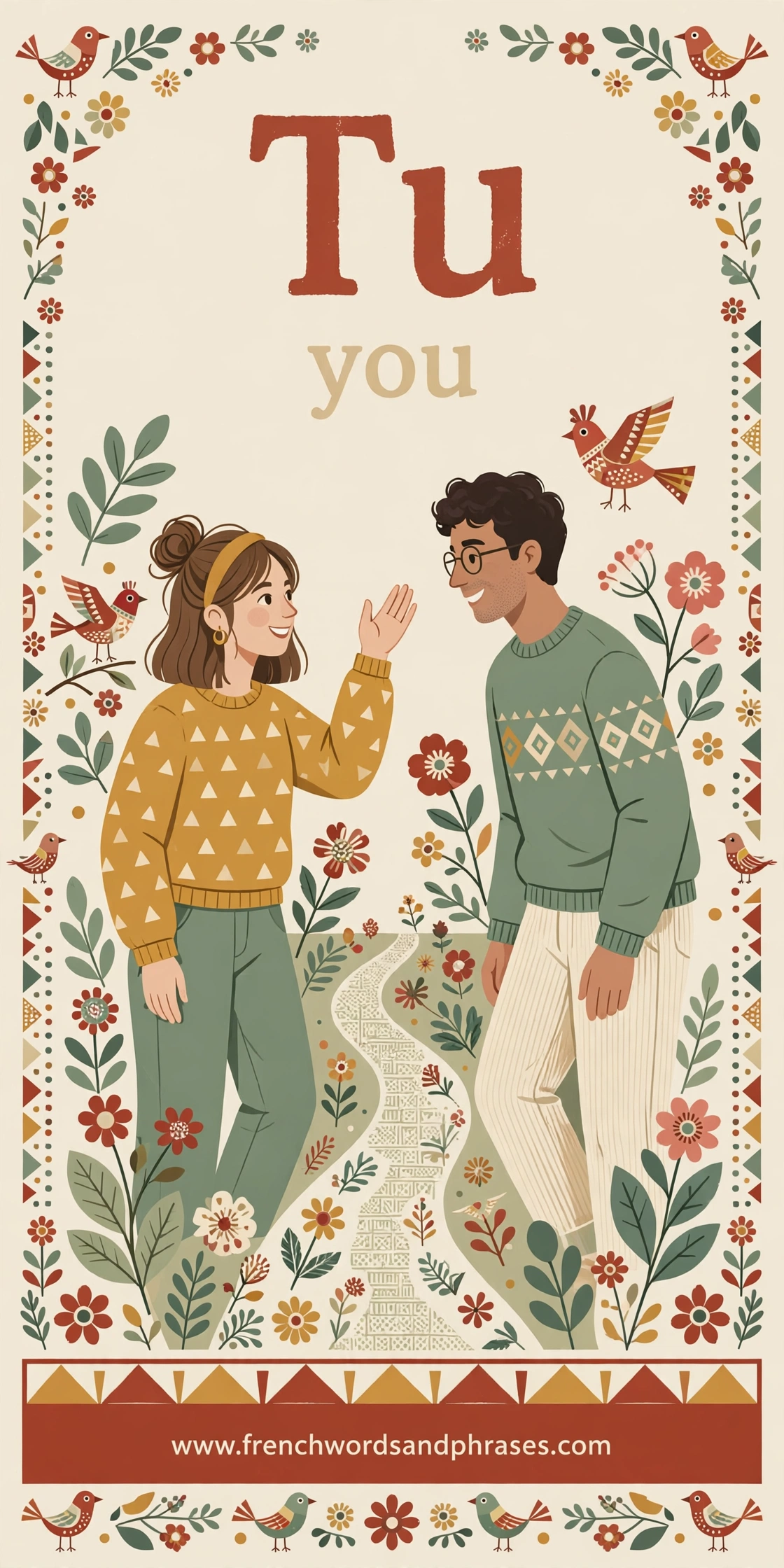
Tu means you.
Two children race down a garden path, laughing, and the faster one turns around at the gate. « Tu viens ? Tu es trop lent ! » — are you coming? You are too slow! Tu is the warm, familiar ‘you’ of French: one person, well known and well loved — a friend, a sister, a child — never a crowd and never a stranger.
Let’s explore how tu works in French, beginning with the whole word on one card.
Understanding the French Pronoun Tu
Tu is a French subject pronoun — the second person singular, informal. It addresses exactly one person, someone you know well, and it drives its own verb endings: tu parles (you speak), tu finis (you finish), tu es (you are).
It means you — but only the friendly, singular you. The picture it paints is two people close enough to drop every formality: a mother to her child, a friend to a friend. For a stranger, an official, or more than one person, French switches to vous; tu is a small word with a guest list.
Type: Subject pronoun — second person singular, informal
Answers the question: Qui ? — Who? (Answer: you, the one friend I am talking to)
What follows it: A verb in the tu form: tu parles, tu écoutes, tu viens
Watch the pair: tu (one person, informal) vs vous (formal, or several people): tu viens ? for a friend, vous venez ? for the boss
One important usage detail: the verb after tu almost always ends in -s in the present tense — tu parles, tu finis, tu dors, tu lis. That little -s is the fingerprint of tu; if you hear it, a friend is being spoken to.
Experience the Word
Tu is the pronoun of the inner circle — it only exists where formality has been left at the door.
Imagine the first day at a new job in Lyon: all morning it is vous with the director, polite and careful. Then a colleague smiles over coffee — on se dit tu ? — shall we use tu? And just like that, the office becomes a friendlier place.
You have not just addressed a person. You have declared the relationship: close enough, trusted enough, for tu.
How to Use Tu in French: Complete Guide
Let’s explore how tu works in French, beginning with the whole word on one card.
Tu at a Glance
The Whole Word on One Card
Meaning, job, endings and pair — tu in four lines.
| Point | Tu |
|---|---|
| Meaning | you — one person, informal |
| Job | subject pronoun: the friend doing the action |
| Its verb endings | present tense mostly -s: tu parles, tu finis, tu dors; tu es is irregular |
| Who receives it | friends, family, children, classmates — people you know well |
Example
Tu parles très bien français.
You speak French very well.
The Pattern in Action: Talking to a Friend
Tu connects a friend to every kind of action — and the verb changes its ending to match.
| Pattern | Example |
|---|---|
| tu + -er verb | tu regardes la mer — you are looking at the sea |
| tu + -ir verb | tu finis ton travail — you are finishing your work |
| tu + être (irregular) | tu es prêt ? — are you ready? |
| tu + a question | tu viens avec nous ? — are you coming with us? |
Example
Tu écoutes toujours de la musique le matin.
You always listen to music in the morning.
Quick Quiz 1
Your new teacher walks in. Do you greet her with tu or vous?
Reveal the answer
vous — a teacher is an authority, not (yet) a friend; tu would be far too familiar.
Vous êtes notre nouveau professeur ?
Are you our new teacher?
The Tricky Bit: Tu or Vous?
The most social decision in French grammar: choosing tu is choosing a relationship, and French speakers feel the difference instantly.
| Situation | What happens |
|---|---|
| friends, family, children: tu | tu viens, tu veux, tu sais — warmth and habit |
| strangers, officials, elders: vous | vous venez, vous voulez — respect and distance |
| several people, even friends: vous | vous venez tous les deux ? — plural is always vous |
| the invitation ‘on se dit tu ?’ | the moment formality drops — after it, tu for ever |
Example
Avec Léa, je dis tu ; avec son directeur, je dis vous.
With Léa, I use tu; with her boss, I use vous.
Where It Goes: Before the Verb, Like Every Subject
Tu stands where je stands — at the head of the verb — and turns around in questions just the same.
| Position / pattern | Example |
|---|---|
| at the head of the sentence | tu comprends vite — you understand quickly |
| in the negative, tu … ne + verb | tu ne comprends pas ? — do you not understand? |
| in questions, rising voice | tu viens ? — are you coming? (the everyday question form) |
| after a preposition, tu becomes toi | chez toi, pour toi, avec toi — never ‘chez tu’ |
Example
Tu ne manges pas ? Tu es malade ?
Are you not eating? Are you ill?
Quick Quiz 2
“At your place” — speaking to a friend: chez tu or chez toi?
Reveal the answer
chez toi — after a preposition, tu hands over to its stressed form toi.
Je viens chez toi ce soir.
I am coming to your place this evening.
Everyday Expressions with Tu
Tu fills the questions and remarks that friends trade from morning to night.
| Expression | In English |
|---|---|
| tu sais | you know |
| tu as raison | you are right |
| tu viens ? | are you coming? |
| tu te souviens ? | do you remember? |
| tu as quel âge ? | how old are you? |
Example
Tu as raison, ce restaurant est excellent.
You are right, this restaurant is excellent.
Close Cousins: Tu, Vous, Toi
Three forms of ‘you’ — the difference is the relationship, and the place in the sentence.
| Word | The difference |
|---|---|
| tu | the subject form for one friend: tu parles (you speak) |
| vous | formal singular, or any plural: vous parlez, Monsieur |
| toi | the stressed form of tu — after prepositions, alone, in comparisons: avec toi, et toi ? |
| je | the other chair at the table: je parle, tu écoutes — I speak, you listen |
Example
Je te parle, tu m’écoutes — c’est simple.
I am talking to you, you are listening to me — it is simple.
Quick Quiz 3
Which cousin do you use for TWO friends together — tu or vous?
Reveal the answer
vous — tu is strictly singular; the moment there are two people, vous takes over, friends or not.
Vous venez tous les deux demain ?
Are you both coming tomorrow?
Tu and Its Neighbours
The subject shelf: the whole family of people who can drive a verb.
| French | In English |
|---|---|
| je | I |
| tu | you (one friend) |
| il / elle | he / she |
| nous | we |
| vous | you (formal or plural) |
| ils / elles | they |
Example
Tu chantes, je danse, et nous rions ensemble.
You sing, I dance, and we laugh together.
Watch Out: The Traps Around Tu
The traps: tu in the wrong company, the missing -s, and tu where toi belongs.
| Trap | The truth |
|---|---|
| using tu with a stranger or an official | first meetings, offices and officials take vous — tu can sound rude |
| forgetting the tu ending -s | tu parle is wrong: tu parles, tu finis, tu dors — the -s is tu’s fingerprint |
| saying ‘avec tu’ or ‘chez tu’ | after prepositions it is toi: avec toi, chez toi, pour toi |
| using tu for several people | two friends together are vous: vous venez, vous êtes |
Example
Tu parles trop vite, répète plus lentement.
You speak too fast, say it again more slowly.
Quick Quiz 4
Complete: ______ écoutes la radio le matin. (You listen to the radio in the morning — to a friend)
Reveal the answer
Tu — one friend, subject position, and the verb takes the tu ending -s.
Tu écoutes la radio le matin.
You listen to the radio in the morning.
Tu in Everyday French: Real-Life Examples
Now that you know the word, let’s see how tu appears in everyday French.
Example Example 1 — Greetings
Tu es en forme ce matin !
You are full of energy this morning!
Example Example 2 — Plans
Tu fais quoi ce week-end ?
What are you doing this weekend?
Example Example 3 — At table
Tu veux encore du pain ?
Do you want more bread?
Example Example 4 — School
Tu as fini tes devoirs ?
Have you finished your homework?
Example Example 5 — Feelings
Tu me manques beaucoup.
I miss you a lot.
Example Example 6 — An invitation
Tu viens à la fête samedi ?
Are you coming to the party on Saturday?
Beyond Translation: The Meaning of Tu
English lost its friendly ‘you’ centuries ago — thou vanished, and one flat ‘you’ now serves the beloved and the bank manager alike. French kept the distinction alive: tu for the inner circle, vous for the world outside it.
To say tu is to open a door — you are not a stranger any more.
That is why the little question ‘on se dit tu ?’ matters so much in France. It is grammar, yes — but it is also a small ceremony of friendship, performed in two words.
How to Remember the French Pronoun Tu
Remember it this way: Remember it this way: Tu is the pronoun of the inner circle — one person, well known, and its verb almost always ends in -s.
- You count the people — one friend is tu; a stranger, an official or any group is vous.
- You listen for the -s — tu parles, tu finis, tu dors: the ending is tu’s fingerprint.
- You switch to toi under stress — chez toi, avec toi, et toi ? — never after a preposition with tu itself.
The key idea is tu means you for one person you know well — its verbs end in -s, vous covers formality and plurals, and toi is its stressed form.
Test Your Knowledge of Tu
Let’s see how much you’ve learned. Try answering these questions before revealing the answers.
Question 1
What does tu mean?
Reveal the answer
You — the subject pronoun for one person addressed informally.
Question 2
Who do you address as tu?
Reveal the answer
One person you know well — friends, family, children, classmates. Strangers and officials get vous.
Question 3
Translate: Are you ready? (to a friend)
Reveal the answer
Tu es prêt ?
Question 4
What ending do most present-tense verbs take after tu?
Reveal the answer
-s — tu parles, tu finis, tu dors, tu lis.
Question 5
Complete the sentence:
______ viens à la maison ce soir ? (Are you coming home this evening? — to a friend)
Reveal the answer
Tu
Tu viens à la maison ce soir ?
Are you coming home this evening?
Your Final Challenge
Can You Use It?
How would you say this in French?
“How would you say this in French?”
Reveal the answer
Tu parles français avec tes amis.
You speak French with your friends.
A little French. A little curiosity. A richer everyday life.
LEARN FRENCH ONE WORD AT A TIME