A French Word to Live By
Translate Touristique to English
/tuʁistik/
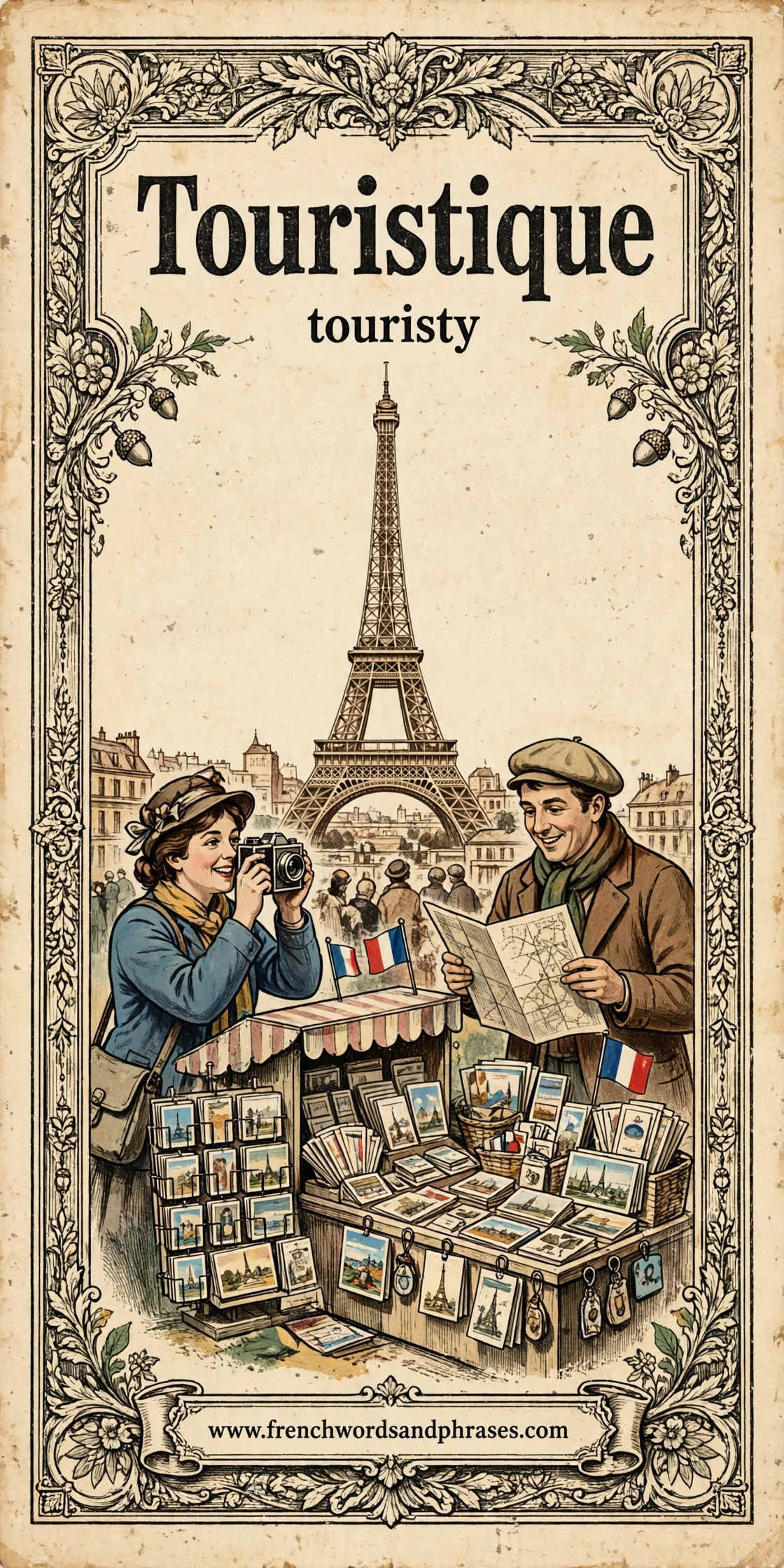
Touristique means touristy.
The main street of a famous old town in August: menus in five languages, a shop selling nothing but postcards, and a queue of visitors photographing the same fountain. The locals do their shopping two streets away, where the town still belongs to them. French sums up that main street in one word: touristique.
In this guide, you’ll learn what touristique means in English, why it never changes between masculine and feminine, where it stands in the sentence, and when the word is praise and when it is a gentle complaint. Explore French examples, English translations, and practice quizzes.
Understanding the French Adjective Touristique
Touristique is a French adjective of quality — the adjective of visitors and holidays. It already ends in -e, so masculine and feminine are identical: only the plural adds an s. Un lieu touristique, une ville touristique — one form does almost all the work.
It means touristy — made for visitors, full of visitors, or worth visiting. It describes towns (une ville touristique, a tourist town), places (un lieu touristique, a tourist spot), streets and seasons. Said with a smile it means popular; said with a sigh it means spoiled by the crowds.
Type: Adjective of quality — visitors and holidays
Answers the question: What is the place like? — touristy
Changes form: Only in the plural — touristique / touristiques, the same for masculine and feminine
English equivalents: Touristy; tourist (as in a tourist town); popular with visitors.
One important usage detail: touristique stands AFTER the noun — un lieu touristique, une rue touristique. Tone matters: un site touristique is neutral praise, but trop touristique is a complaint — too touristy, made for visitors and no longer for living in.
Experience the Word
Touristique is the adjective of the street where every shop sells the same souvenir — delightful in July, when the town glows with visitors, and a little sad in January, when the shutters close and the street waits for summer.
Imagine a village that appears in every guidebook. The bakery now sells more postcards than bread, and the mayor is proud and worried in the same breath: the visitors keep the town alive, and the town must stay alive for the visitors to keep coming.
You have not just described a popular place. You have described a place living between its residents and its guests.
How to Use Touristique in French: Complete Guide
Let’s explore how touristique works in French, beginning with the whole word on one card.
Touristique at a Glance
Before the details, here is the whole word on one card.
The Whole Word on One Card
Meaning, type, position and forms — touristique in four lines.
| Point | Touristique |
|---|---|
| Meaning | touristy |
| Type | adjective of quality — visitors and holidays |
| Usual position | after the noun — un lieu touristique |
| Form | touristique for everyone — touristiques in the plural |
Example
C’est une ville touristique.
It’s a tourist town.
The Four Forms of Touristique
Here is one of the easiest agreements in French: touristique already ends in -e, so the feminine changes nothing. Only the plural adds an s.
| Form | Touristique | Example |
|---|---|---|
| Masculine singular | touristique | un lieu touristique — a tourist spot |
| Feminine singular | touristique | une ville touristique — a tourist town |
| Masculine plural | touristiques | des lieux touristiques — tourist spots |
| Feminine plural | touristiques | des rues touristiques — touristy streets |
Example
Un lieu touristique et des rues touristiques.
A tourist spot and touristy streets.
Quick Quiz 1
Does touristique change for a feminine noun?
Reveal the answer
No
Un lieu touristique, une ville touristique — the form is identical.
A tourist spot, a tourist town.
The Feminine of Touristique: Nothing Changes
Most adjectives build their feminine by adding an e. Touristique was born with one, so the feminine has nothing to add — a small holiday for learners.
| Situation | Example |
|---|---|
| Masculine | un site touristique — a tourist site |
| Feminine | une région touristique — identical |
| Why | touristique already ends in -e, so the feminine adds nothing |
| The plural | add s — des villes touristiques, tourist towns |
Example
C’est une région touristique, célèbre pour ses plages.
It’s a tourist region, famous for its beaches.
Where Touristique Goes: After the Noun
Touristique follows the noun it describes, like most French adjectives, and it sits comfortably after être. Adverbs slide in front of it without moving it.
| Pattern | Example |
|---|---|
| After the noun | une rue touristique — a touristy street |
| After être | cette ville est touristique — this town is touristy |
| With an adverb | un lieu très touristique — a very touristy place |
| Before the noun | une touristique rue — not in everyday French |
Example
Le vieux port est très touristique en été.
The old port is very touristy in summer.
Quick Quiz 2
How do you say ‘a tourist town’ — une touristique ville or une ville touristique?
Reveal the answer
une ville touristique
Touristique stands after the noun.
A tourist town.
More Touristy: Comparing with Touristique
Touristique compares the regular way, with plus, moins and aussi — and the superlative keeps the same single form: le plus touristique, la plus touristique.
| Degree | Example |
|---|---|
| As touristy as | aussi touristique que — as touristy as |
| More touristy | plus touristique — more touristy |
| Less touristy | moins touristique — less touristy |
| The most touristy (masc.) | le plus touristique — le plus touristique des lieux |
| The most touristy (fem.) | la plus touristique — la plus touristique des villes |
Example
Cette ville est plus touristique que sa voisine.
This town is more touristy than its neighbour.
Everyday Expressions with Touristique
Touristique is the word of guidebooks and tourist offices — and of locals deciding whether the crowds are a blessing or a burden.
| Expression | In English |
|---|---|
| un lieu touristique | a tourist spot, a place of interest |
| une ville touristique | a tourist town |
| l’office de tourisme | the tourist office — where the maps live |
| la saison touristique | the tourist season |
| un guide touristique | a guidebook — or a tour guide |
| trop touristique | too touristy — the gentle complaint |
Example
La saison touristique commence en juin.
The tourist season starts in June.
Quick Quiz 3
What does trop touristique suggest?
Reveal the answer
Too touristy
It is the gentle complaint: made for visitors, no longer for living in.
Too touristy.
Touristique and Its Neighbours
Touristique shares its crowds with célèbre and fréquenté; at the other end, méconnu and préservé describe the places the guidebooks have not found yet.
| French | In English |
|---|---|
| célèbre | famous — known by everyone |
| fréquenté | busy, well-frequented — people actually go there |
| populaire | popular — loved by many |
| bondé | packed, crowded — full to bursting |
| méconnu | little-known, overlooked — the happy opposite |
| préservé | unspoiled, preserved — kept safe from the crowds |
Example
Le village est célèbre mais pas bondé : il reste préservé.
The village is famous but not packed: it stays unspoiled.
Watch Out: The Traps Around Touristique
The traps here are a question of tone, and a noun that looks like the adjective’s twin.
| Trap | The truth |
|---|---|
| Tone | touristique can praise or complain — très touristique often means too touristy |
| un touriste | the visitor is un touriste (masculine) or une touriste (feminine) — the noun, not the adjective |
| Not ‘touristic’ | English says touristy or tourist — une ville touristique is a tourist town |
| Agreement | do not add a second e — une rue touristique, never ‘touristiquée’ |
Example
Chaque touriste cherche le lieu touristique le plus célèbre.
Every tourist looks for the most famous tourist spot.
Quick Quiz 4
How do you say ‘a tourist spot’?
Reveal the answer
un lieu touristique
Touristique follows the noun and does not change.
A tourist spot.
Touristique in Everyday French: Real-Life Examples
Now that you know the word, let’s see how touristique appears in everyday French.
Example 1 — A town
C’est une ville touristique, surtout en été.
It’s a tourist town, especially in summer.
Example 2 — A street
La rue principale est touristique et chère.
The main street is touristy and expensive.
Example 3 — A spot
Le château est le lieu touristique de la région.
The castle is the tourist spot of the region.
Example 4 — The season
Pendant la saison touristique, les hôtels sont pleins.
During the tourist season, the hotels are full.
Example 5 — A complaint
Ce quartier est devenu trop touristique.
This district has become too touristy.
Example 6 — A contrast
Le port est touristique, mais les faubourgs sont calmes.
The port is touristy, but the suburbs are quiet.
Beyond Translation: The Meaning of Touristique
English says touristy for the meaning of touristique — and the French word carries the same double edge. It can crown a town (une ville touristique earns its living from its guests) or sigh over it (trop touristique: the bakery became a souvenir shop).
Touristique measures a town by its visitors.
Between the proud mayor and the nostalgic local, the word holds the whole modern question of travel: how a place can welcome the world and still belong to the people who live there.
How to Remember the French Adjective Touristique
Remember it this way: Touristique is the visitors’ adjective — one form for him and her, an s for the plural, its place behind the noun, and a tone that can praise or complain.
- You see one form for everyone — un lieu touristique, une ville touristique.
- You add only an s in the plural — des rues touristiques.
- You watch the tone — trop touristique is a complaint, not a compliment.
The key idea is touristique never changes except in the plural, stands after the noun, and trop touristique means too touristy.
Test Your Knowledge of Touristique
Let’s see how much you’ve learned. Try answering these questions before revealing the answers.
Question 1
What does touristique mean?
Reveal the answer
Touristy — made for visitors, full of visitors, worth visiting.
Question 2
What is the feminine of touristique?
Reveal the answer
touristique — identical. The word already ends in -e.
Question 3
Translate: a tourist town.
Reveal the answer
Une ville touristique.
Question 4
Complete the sentence:
Les lieux ______ sont fermés en hiver.
Reveal the answer
touristiques
Les lieux touristiques sont fermés en hiver.
Tourist spots are closed in winter.
Question 5
What is the visitor himself called?
Reveal the answer
un touriste (or une touriste) — the noun; touristique is the adjective.
Your Final Challenge
Can You Use It?
How would you say this in French?
“It’s a tourist town in summer, but quiet and calm in winter.”
Reveal the answer
C’est une ville touristique en été, mais tranquille et calme en hiver.
It’s a tourist town in summer, but quiet and calm in winter.
A little French. A little curiosity. A richer everyday life.
LEARN FRENCH ONE WORD AT A TIME