A French Word to Live By
Translate Pittoresque to English
/pitɔʁɛsk/
Pittoresque means picturesque.
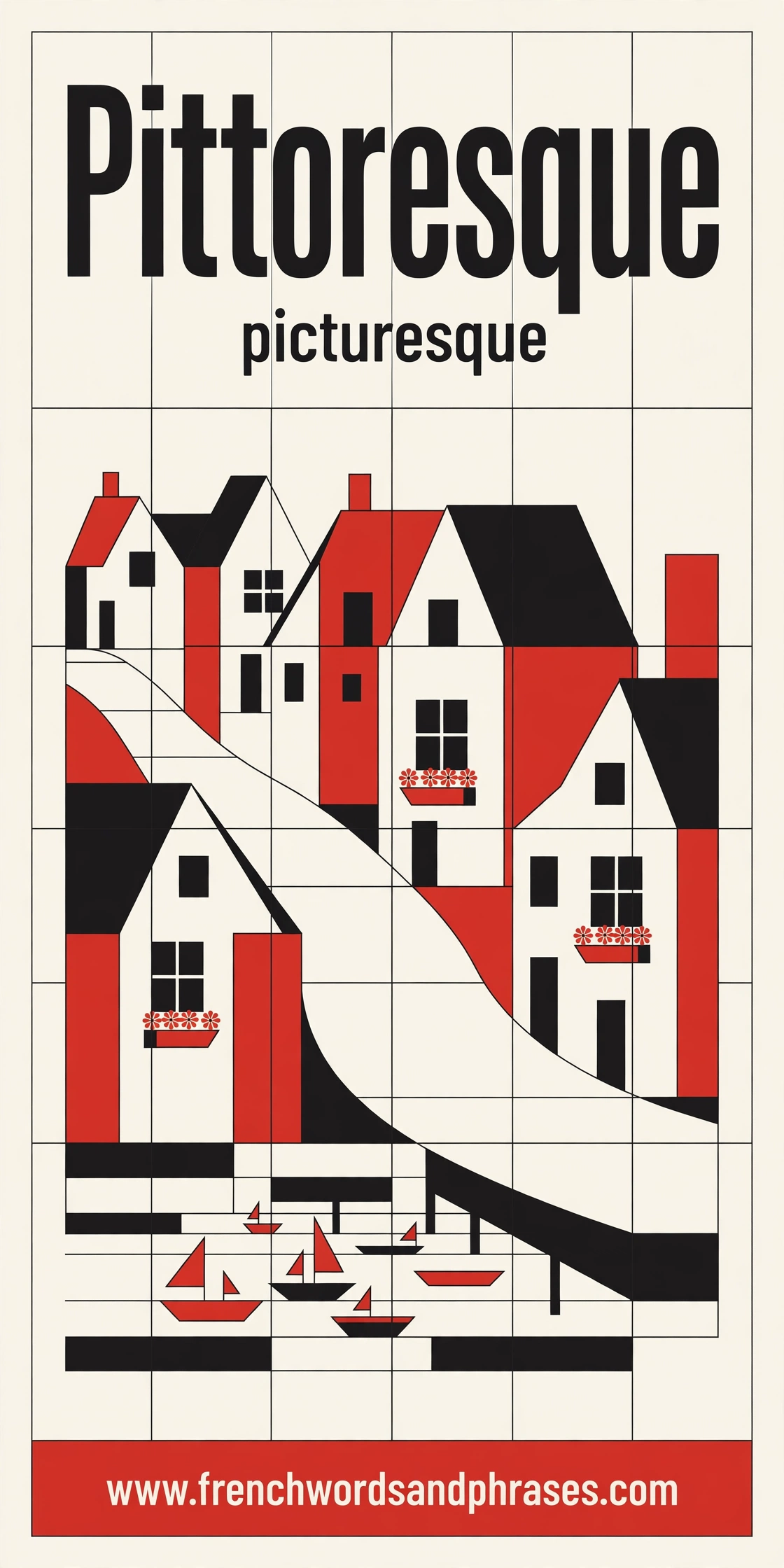
A lane too narrow for cars, climbing between stone houses: geraniums on every windowsill, a cat asleep on a doorstep worn smooth, washing strung overhead like flags. A painter coming round the corner stops, sets down his bag, and sighs happily. French has a word made for this lane: pittoresque.
In this guide, you’ll learn what pittoresque means in English, why it never changes between masculine and feminine, where it stands in the sentence, and how it carries a painter inside it. Explore French examples, English translations, and practice quizzes.
Understanding the French Adjective Pittoresque
Pittoresque is a French adjective of quality — the adjective of scenes that deserve a painting. It already ends in -e, so masculine and feminine are identical: only the plural adds an s. Un village pittoresque, une rue pittoresque — one form does almost all the work.
It means picturesque — charmingly pretty in an old-fashioned, paintable way. It describes villages (un village pittoresque, a picturesque village), streets, lanes, ports and quarters. It never means grand or modern: pittoresque is beauty with crooked lines and flowers on the sill.
Type: Adjective of quality — charm and paintability
Answers the question: What is the place like? — picturesque
Changes form: Only in the plural — pittoresque / pittoresques, the same for masculine and feminine
English equivalents: Picturesque; quaint and charming.
One important usage detail: pittoresque stands AFTER the noun — un village pittoresque, une rue pittoresque. It comes from the Italian pittoresco, ‘in the manner of a painter’: a pittoresque place is one a painter would choose.
Experience the Word
Pittoresque is the adjective of the lane the tour buses cannot enter — the crooked street, the leaning house, the little port where the boats are painted the colours of their owners’ doors.
Imagine an artist who comes to the village for one weekend and stays for thirty years. Every corner, she says, is a painting already composed: the light does the framing, the flowers do the colour, and all she has to do is look.
You have not just described a pretty place. You have described a place that looks like a painting of itself.
How to Use Pittoresque in French: Complete Guide
Let’s explore how pittoresque works in French, beginning with the whole word on one card.
Pittoresque at a Glance
Before the details, here is the whole word on one card.
The Whole Word on One Card
Meaning, type, position and forms — pittoresque in four lines.
| Point | Pittoresque |
|---|---|
| Meaning | picturesque |
| Type | adjective of quality — charm and paintability |
| Usual position | after the noun — un village pittoresque |
| Form | pittoresque for everyone — pittoresques in the plural |
Example
C’est un village pittoresque.
It’s a picturesque village.
The Four Forms of Pittoresque
Here is one of the easiest agreements in French: pittoresque already ends in -e, so the feminine changes nothing. Only the plural adds an s.
| Form | Pittoresque | Example |
|---|---|---|
| Masculine singular | pittoresque | un village pittoresque — a picturesque village |
| Feminine singular | pittoresque | une rue pittoresque — a picturesque street |
| Masculine plural | pittoresques | des villages pittoresques — picturesque villages |
| Feminine plural | pittoresques | des rues pittoresques — picturesque streets |
Example
Un village pittoresque et des rues pittoresques.
A picturesque village and picturesque streets.
Quick Quiz 1
Does pittoresque change for a feminine noun?
Reveal the answer
No
Un village pittoresque, une rue pittoresque — the form is identical.
A picturesque village, a picturesque street.
The Feminine of Pittoresque: Nothing Changes
Most adjectives build their feminine by adding an e. Pittoresque was born with one, so the feminine has nothing to add — a small holiday for learners.
| Situation | Example |
|---|---|
| Masculine | un port pittoresque — a picturesque harbour |
| Feminine | une ruelle pittoresque — identical |
| Why | pittoresque already ends in -e, so the feminine adds nothing |
| The plural | add s — des villages pittoresques, picturesque villages |
Example
C’est une ruelle pittoresque, pleine de fleurs.
It’s a picturesque lane, full of flowers.
Where Pittoresque Goes: After the Noun
Pittoresque follows the noun it describes, like most French adjectives, and it sits comfortably after être. Adverbs slide in front of it without moving it.
| Pattern | Example |
|---|---|
| After the noun | une rue pittoresque — a picturesque street |
| After être | ce village est pittoresque — this village is picturesque |
| With an adverb | un port très pittoresque — a very picturesque harbour |
| Before the noun | une pittoresque rue — not in everyday French |
Example
Le petit port est très pittoresque le matin.
The little harbour is very picturesque in the morning.
Quick Quiz 2
How do you say ‘a picturesque village’ — un pittoresque village or un village pittoresque?
Reveal the answer
un village pittoresque
Pittoresque stands after the noun.
A picturesque village.
More Picturesque: Comparing with Pittoresque
Pittoresque compares the regular way, with plus, moins and aussi — and the superlative keeps the same single form: le plus pittoresque, la plus pittoresque.
| Degree | Example |
|---|---|
| As picturesque as | aussi pittoresque que — as picturesque as |
| More picturesque | plus pittoresque — more picturesque |
| Less picturesque | moins pittoresque — less picturesque |
| The most picturesque (masc.) | le plus pittoresque — le plus pittoresque des villages |
| The most picturesque (fem.) | la plus pittoresque — la plus pittoresque des rues |
Example
Cette rue est plus pittoresque que la place.
This street is more picturesque than the square.
Everyday Expressions with Pittoresque
Pittoresque is the word of travel writers and painters — it follows the crooked lanes and little harbours of France wherever they survive.
| Expression | In English |
|---|---|
| un village pittoresque | a picturesque village |
| une rue pittoresque | a picturesque street |
| un petit port pittoresque | a picturesque little harbour |
| un quartier pittoresque | a picturesque, characterful quarter |
| un paysage pittoresque | a picturesque landscape |
| un charme pittoresque | a quaint, painterly charm |
Example
Ce paysage pittoresque attire les peintres.
This picturesque landscape attracts painters.
Quick Quiz 3
What does un paysage pittoresque mean?
Reveal the answer
A picturesque landscape
A landscape beautiful enough to paint.
A picturesque landscape.
Pittoresque and Its Neighbours
Pittoresque shares its charm with charmant and typique; at the other end, moderne and quelconque describe places no painter would stop for.
| French | In English |
|---|---|
| charmant | charming — the closest everyday neighbour |
| typique | typical, characteristic — full of local character |
| fleuri | flowery — covered in flowers |
| ancien | old, historic — pittoresque places usually are |
| quelconque | ordinary, nothing special — the opposite |
| moderne | modern — straight lines, no crooked lanes |
Example
Le village est charmant et typique, vraiment pittoresque.
The village is charming and typical, truly picturesque.
Watch Out: The Traps Around Pittoresque
The traps here are a double t to spell, and a meaning narrower than pretty.
| Trap | The truth |
|---|---|
| Spelling | double t at the start — pittoresque, from the Italian pittore, painter |
| Not just pretty | pittoresque means pretty in an old, paintable way — a glass tower is belle, never pittoresque |
| Not ‘picturesque’ people | for people and language, pittoresque means colourful, vivid — un personnage pittoresque |
| Agreement | do not add a second e — une rue pittoresque, never ‘pittoresquée’ |
Example
Ce personnage pittoresque habite la rue la plus pittoresque du village.
This colourful character lives in the most picturesque street of the village.
Quick Quiz 4
How do you say ‘a picturesque street’?
Reveal the answer
une rue pittoresque
Pittoresque follows the noun and does not change.
A picturesque street.
Pittoresque in Everyday French: Real-Life Examples
Now that you know the word, let’s see how pittoresque appears in everyday French.
Example 1 — A village
Nous visitons un village pittoresque en Provence.
We’re visiting a picturesque village in Provence.
Example 2 — A street
Cette rue pittoresque monte vers le château.
This picturesque street climbs towards the castle.
Example 3 — A harbour
Le petit port est pittoresque, avec ses bateaux colorés.
The little harbour is picturesque, with its colourful boats.
Example 4 — A quarter
Le quartier pittoresque attire les photographes.
The picturesque quarter attracts photographers.
Example 5 — A lane
J’adore cette ruelle pittoresque et ses fleurs.
I love this picturesque lane and its flowers.
Example 6 — A contrast
Le centre est pittoresque, mais les faubourgs sont modernes.
The centre is picturesque, but the suburbs are modern.
Beyond Translation: The Meaning of Pittoresque
English borrowed picturesque for the meaning of pittoresque — and both words carry a painter inside them: Italian pittore, a painter, gives pittoresco, ‘in a painter’s manner’. A pittoresque village is a village already framed.
Pittoresque is beauty that asks to be painted.
That is why the word refuses straight lines and new glass. It belongs to the crooked lane, the leaning shutter, the harbour at dawn — the places where a town, without trying, composes its own portrait.
How to Remember the French Adjective Pittoresque
Remember it this way: Pittoresque is the painter’s adjective — one form for him and her, an s for the plural, its place behind the noun, and a double t at its head.
- You see one form for everyone — un village pittoresque, une rue pittoresque.
- You add only an s in the plural — des rues pittoresques.
- You picture the painter inside it — pittoresque is a scene ready for a canvas.
The key idea is pittoresque never changes except in the plural, stands after the noun, and means beautiful enough to paint.
Test Your Knowledge of Pittoresque
Let’s see how much you’ve learned. Try answering these questions before revealing the answers.
Question 1
What does pittoresque mean?
Reveal the answer
Picturesque — charmingly pretty in an old, paintable way.
Question 2
What is the feminine of pittoresque?
Reveal the answer
pittoresque — identical. The word already ends in -e.
Question 3
Translate: a picturesque village.
Reveal the answer
Un village pittoresque.
Question 4
Complete the sentence:
Ces rues ______ attirent les peintres.
Reveal the answer
pittoresques
Ces rues pittoresques attirent les peintres.
These picturesque streets attract painters.
Question 5
What art is hidden inside pittoresque?
Reveal the answer
Painting — from the Italian pittore, a painter: pittoresque means worthy of a painting.
Your Final Challenge
Can You Use It?
How would you say this in French?
“It’s a picturesque village, with narrow streets and flower-covered houses.”
Reveal the answer
C’est un village pittoresque, avec des rues étroites et des maisons couvertes de fleurs.
It’s a picturesque village, with narrow streets and flower-covered houses.
A little French. A little curiosity. A richer everyday life.
LEARN FRENCH ONE WORD AT A TIME