A French Word to Live By
Translate Ma to English
/ma/
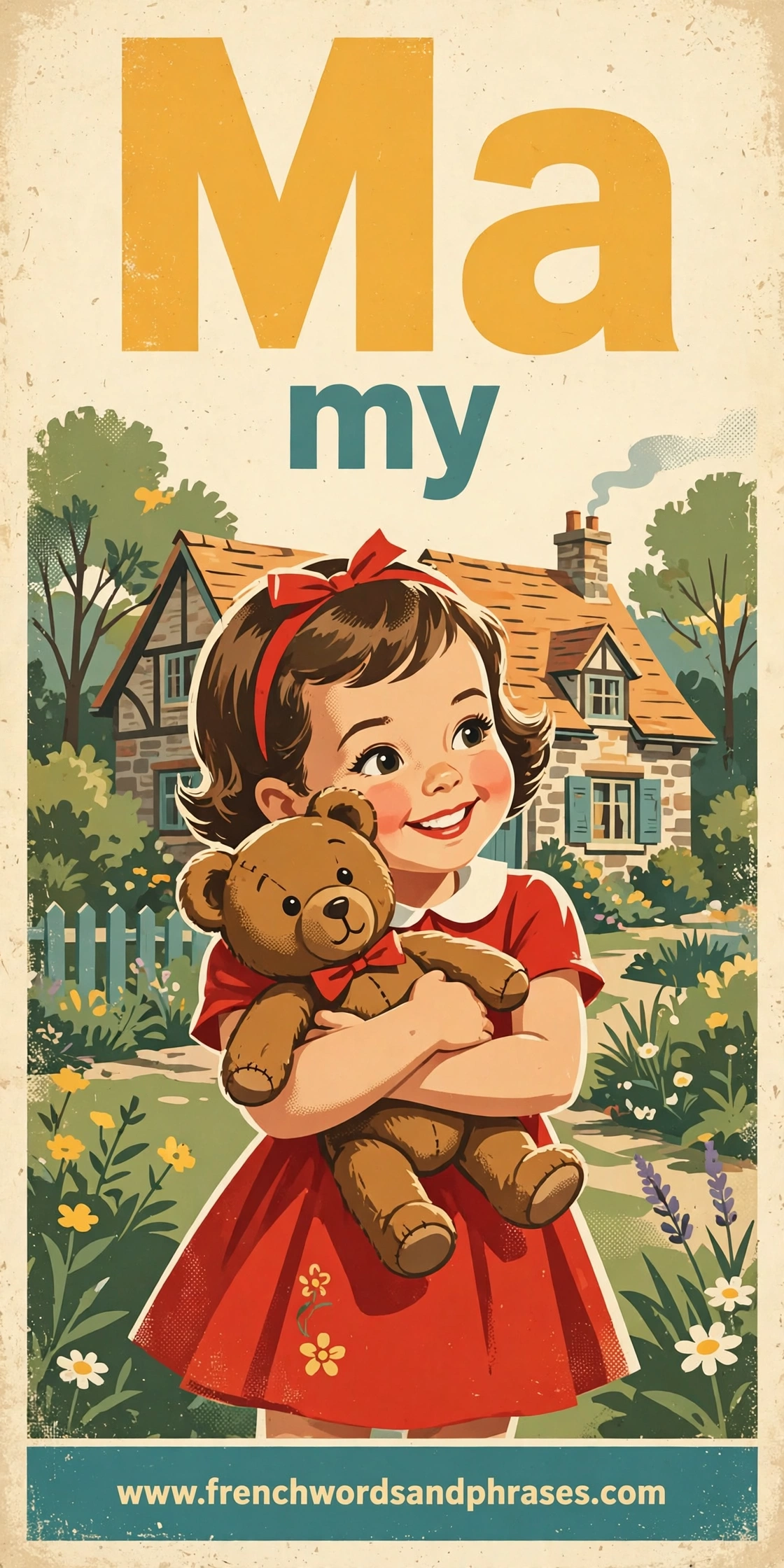
Ma means my.
A little girl at the market holds up a red ribbon and announces to the whole stall: « C’est ma couleur préférée ! » — It is my favourite colour. Ma is the possessive word a speaker puts before a feminine thing that belongs to her or to him: my — with the gender of the thing owned, not of the owner.
Let’s explore how ma works in French, beginning with the whole word on one card.
Understanding the French Determiner Ma
Ma is a French possessive adjective — a determiner. It is the feminine singular form of « my »: ma mère (my mother), ma maison (my house). It agrees with the thing owned, never with the owner: a man and a woman both say ma sœur, my sister, because sœur is feminine.
It means my, before a feminine singular noun. The picture it paints is a hand laid gently on a thing: ma place, my place; ma parole, my word. English « my » never changes; French gives the job to a small family — mon, ma, mes — because the possessive must match the gender and number of the possession.
Type: Possessive adjective (determiner) — first person singular, feminine
Answers the question: À qui ? — Whose? (Answer: mine — my)
What follows it: A feminine singular noun: ma mère, ma maison, ma voiture
Watch the pair: ma (my, before a feminine noun) vs mon (my, before a masculine noun) — the owner does not matter, the noun does
One important usage detail: before a feminine noun beginning with a vowel or a mute h, ma steps aside for mon, so the words can flow — mon amie (my friend), mon école (my school), never « ma amie ». The noun stays feminine; only the little word changes its coat. The plural of ma is mes: mes sœurs, my sisters.
Experience the Word
Ma is the determiner of belonging spoken softly — the word of grandmothers, letters home and things kept in a drawer for years.
Imagine an old lady showing a photograph album: ma première école, ma meilleure amie, ma maison là-bas — every page carries a ma, and every ma is a small act of claiming a life as her own.
You have not just said whose it is. You have said: this one is part of my story.
How to Use Ma in French: Complete Guide
Let’s explore how ma works in French, beginning with the whole word on one card.
Ma at a Glance
The Whole Word on One Card
Meaning, job, family and signal — ma in four lines.
| Point | Ma |
|---|---|
| Meaning | my — before a feminine singular noun |
| Job | possessive determiner: it claims the noun for the speaker |
| The family | mon (masc. sg.), ma (fem. sg.), mes (plural) |
| What it signals | the noun is feminine and singular, and it is mine |
Example
Ma sœur habite à Paris.
My sister lives in Paris.
The Pattern in Action: The Gender of the Thing Owned
Ma connects the speaker to a possession — and it is the possession’s gender that chooses between mon and ma.
| Pattern | Example |
|---|---|
| before a feminine noun | ma mère, ma maison, ma voiture — my mother, my house, my car |
| said by a man | ma femme, ma sœur — a man says ma too: the noun is feminine |
| said by a woman | ma mère, ma fille — the same ma: the owner changes nothing |
| the plural | mes sœurs, mes clés — mes for all plurals |
Example
Ma grand-mère fait les meilleures soupes.
My grandmother makes the best soups.
Quick Quiz 1
A man says « my sister » — mon sœur or ma sœur?
Reveal the answer
ma sœur — the possessive matches the noun (sœur is feminine), not the owner.
Ma sœur est médecin.
My sister is a doctor.
The Tricky Bit: When Ma Becomes Mon
Before a vowel or a mute h, ma would crash into the noun — so French swaps in mon, purely for the sound. The noun stays feminine.
| Situation | What happens |
|---|---|
| feminine noun + consonant | ma amie is wrong by sound only before vowels — with a consonant, ma stands: ma camarade |
| feminine noun + vowel | mon amie, mon école, mon adresse — mon steps in |
| feminine noun + mute h | mon habitude, mon histoire — mon steps in again |
| the adjective test | mon amie est gentille — gentille stays feminine: the noun never changed |
Example
Mon école est loin de ma maison.
My school is far from my house.
Where It Goes: Stuck to the Front of the Noun
Ma leads its little parade: possessive first, then any adjective, then the noun — and each new noun takes its own possessive.
| Position / pattern | Example |
|---|---|
| directly before the noun | ma chambre, ma rue, ma ville — the possessive leads |
| before an adjective + noun | ma petite sœur, ma vieille maison — ma still stands first |
| repeated before each noun | ma mère et ma sœur — my mother and my sister (each noun gets its own) |
| never with an article | ma maison, never « la ma maison » — the possessive replaces the article |
Example
Ma vieille bicyclette est dans le garage.
My old bicycle is in the garage.
Quick Quiz 2
« My friend (a girl) » — ma amie or mon amie?
Reveal the answer
mon amie — amie begins with a vowel, so mon steps in for the sound; amie stays feminine.
Mon amie s’appelle Claire.
My friend is called Claire.
Everyday Expressions with Ma
Ma lives in the warm, everyday claims of family, home and honour.
| Expression | In English |
|---|---|
| ma parole ! | my word! (I promise / upon my word) |
| ma chérie | my darling (to a woman or girl) |
| ma foi | well, honestly (an old-fashioned softener) |
| de ma part | from me, on my behalf |
| maison — ma maison | my house, my home |
Example
Donne-lui le bonjour de ma part.
Give him my regards (say hello from me).
Close Cousins: Mon, Ta, Sa
The possessive family works in rows: one row per owner, and the columns are the noun’s gender and number.
| Word | The difference |
|---|---|
| mon | my — before a masculine noun (mon père) or a feminine noun starting with a vowel (mon amie) |
| mes | my — before any plural noun (mes livres, mes sœurs) |
| ta | your — the same feminine pattern for tu: ta mère |
| sa | his / her — sa mère can be his mother or her mother: the noun decides the form, the story decides whose |
Example
Mon père, ma mère et mes frères arrivent demain.
My father, my mother and my brothers are arriving tomorrow.
Quick Quiz 3
« My sisters » — ma sœurs or mes sœurs?
Reveal the answer
mes sœurs — the plural of both mon and ma is mes.
Mes sœurs habitent à Lyon.
My sisters live in Lyon.
Ma and Its Neighbours
The possessive shelf for one owner: the three forms of « my » and their neighbours for you and for him or her.
| French | In English |
|---|---|
| mon | my (masculine singular, or before a vowel) |
| ma | my (feminine singular) |
| mes | my (plural) |
| ta / ton / tes | your (the tu family, same pattern) |
| sa / son / ses | his, her (the same pattern again) |
Example
Ma mère et son mari habitent près de ma maison.
My mother and her husband live near my house.
Watch Out: The Traps Around Ma
The traps: matching the owner instead of the noun, and forgetting the vowel swap.
| Trap | The truth |
|---|---|
| a woman says « mon mère » because she owns it | the noun rules: mère is feminine — ma mère, whoever speaks |
| ma amie, ma école | before a vowel, mon steps in: mon amie, mon école |
| translating « his mother » word by word with a gender for the owner | sa mère serves his mother and her mother alike — context tells |
| adding an article | the possessive replaces the article: ma maison, never « la ma maison » |
Example
Ma mère et mon amie se connaissent bien.
My mother and my friend know each other well.
Quick Quiz 4
Complete: ______ adresse est dans mon carnet. (My address — adresse is feminine and starts with a vowel.)
Reveal the answer
Mon — adresse begins with a vowel, so mon steps in, though adresse is feminine.
Mon adresse est dans mon carnet.
My address is in my notebook.
Ma in Everyday French: Real-Life Examples
Now that you know the word, let’s see how ma appears in everyday French.
Example 1 — Family
Ma sœur arrive ce soir.
My sister is arriving this evening.
Example 2 — Home
Ma maison est au bout de la rue.
My house is at the end of the street.
Example 3 — A promise
Tu as ma parole, je serai là.
You have my word, I will be there.
Example 4 — A friend
Mon amie Claire adore la musique.
My friend Claire loves music.
Example 5 — Regards
Dis bonjour à Paul de ma part.
Say hello to Paul from me.
Example 6 — A favourite
La soupe est ma spécialité.
Soup is my speciality.
Beyond Translation: The Meaning of Ma
English « my » is a single, unchanging word — it tells you the owner and nothing else. French splits the job three ways — mon, ma and mes — because in French, even a possessive must bow to the noun it touches: its gender, its number, even its first sound.
To say ma is to announce: the thing is feminine, it is one, and it is mine.
That is why ma feels so personal in letters and songs — ma mère, ma maison, ma patrie — the little word that turns the world into belongings.
How to Remember the French Determiner Ma
Remember it this way: Ma means my before a feminine singular noun — the noun’s gender rules, and mon steps in before a vowel.
- You match the noun, not yourself — ma sœur, ma mère, whoever is speaking.
- You swap for sound — mon amie, mon école, before a vowel or mute h.
- You pluralise with mes — mes sœurs, mes clés, for every plural.
The key idea is ma = my (feminine singular noun); mon before a vowel (mon amie); plural mes; the noun’s gender decides.
Test Your Knowledge of Ma
Let’s see how much you’ve learned. Try answering these questions before revealing the answers.
Question 1
What does ma mean?
Reveal the answer
My — the possessive adjective before a feminine singular noun.
Question 2
What are the three forms of « my » in French?
Reveal the answer
Mon, ma and mes — mon (masculine singular), ma (feminine singular), mes (plural).
Question 3
Translate: My mother is kind.
Reveal the answer
Ma mère est gentille.
Question 4
Why do we say mon amie and not ma amie?
Reveal the answer
Because amie begins with a vowel — mon steps in for the sound; the noun stays feminine.
Question 5
Complete the sentence:
______ maison est petite, mais ______ jardin est grand. (My house… my garden — jardin is masculine)
Reveal the answer
Ma, mon
Ma maison est petite, mais mon jardin est grand.
My house is small, but my garden is big.
Your Final Challenge
Can You Use It?
How would you say this in French?
“My sister lives in Paris.”
Reveal the answer
Ma sœur habite à Paris.
My sister lives in Paris.
A little French. A little curiosity. A richer everyday life.
LEARN FRENCH ONE WORD AT A TIME