A French Word to Live By
How to Conjugate Sucrer in French
/sy.kʁe/
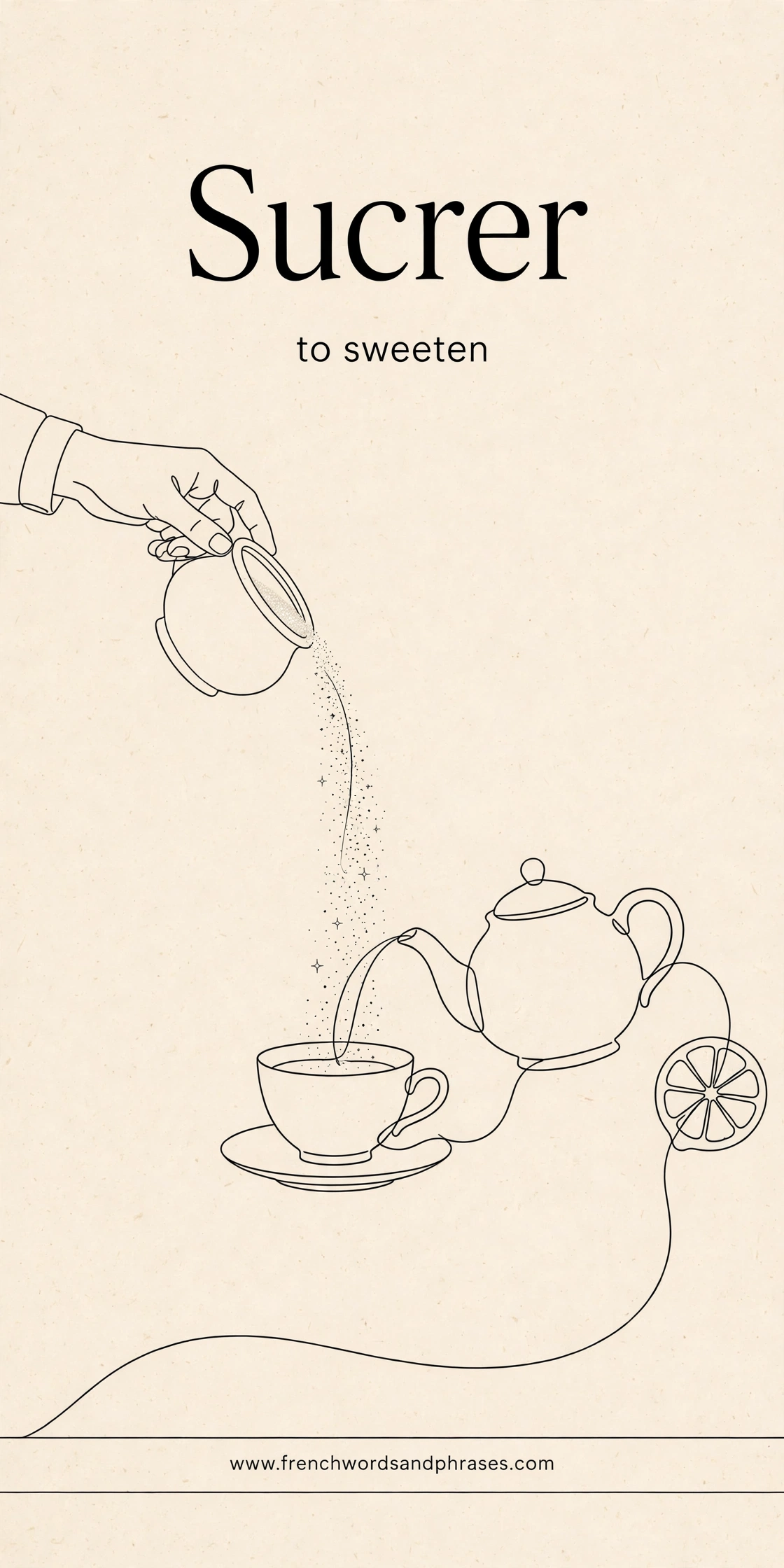
Sucrer means to sweeten — to put sugar into coffee, tea or strawberries, and make the sour world a little gentler.
Two lumps dropping into a café crème, a spoon of honey over strawberries, a grandmother quietly sugaring the children’s tisane — sucrer is the small daily gesture of adding sugar, and with it, sweetness.
In this guide, you’ll learn how to conjugate sucrer in all the major French tenses and moods. Explore complete conjugation tables, French examples, English translations, and practice quizzes.
Understanding the French Verb Sucrer
Sucrer is a regular French verb belonging to the first group of verbs, those ending in-er.
It means to sweeten. It is used in the kitchen and at the café table for coffee, tea, yoghurt, fruit and desserts, and figuratively of anything made pleasanter or milder — sucrer une pilule is to sugar the pill. The adjective sucré also describes a voice or a person who is sweet, sometimes suspiciously so.
Verb classification: First group (-er)
Auxiliary verb: Avoir
Past participle: sucré
Present participle: sucrant
English equivalents: To sweeten, to put sugar in; sucrer son café — to sweeten one’s coffee; sucrer les fraises — to put sugar on the strawberries (and, of a shaky old person, to have trembling hands); sucré — sweet, sugary; le sucre — sugar.
One important detail: sucrer is simply the verb of le sucre, sugar — to sucrer something is to put sucre into it, and the verb is perfectly regular: je sucre, nous sucrons, ils sucrent, past participle sucré, which doubles as the adjective ‘sweet’. Watch the idiom hiding in the fruit bowl: sucrer les fraises, said of an elderly person whose hands shake, as if they were forever sprinkling sugar over strawberries — affectionate, a little teasing, and never said to their face.
Experience the Word
Sucrer is the verb of the sugar bowl — a tiny act of kindness performed with a spoon.
Imagine a farmhouse breakfast in June. The strawberries have just come in from the garden, still warm from the sun, and grandmother, without asking anyone, sucres them lightly — sucre, un peu de crème — while the children’s hands hover like bees over the bowl.
The berries were already sweet. She sweetened them — elle les a sucrées — because sweetness, in her house, was a habit of love.
How to Conjugate Sucrer: Complete French Conjugation Guide
Let’s explore every major conjugation of sucrer, beginning with the indicative mood.
How to Conjugate Sucrer in the Indicative Mood
The indicative mood is used to express facts, observations, actions, and events.
How to Conjugate Sucrer in the Present Tense (Présent)
Used for actions happening now, habitual actions, and general truths.
| Subject | Conjugation |
|---|---|
| je | sucre |
| tu | sucres |
| il / elle | sucre |
| nous | sucrons |
| vous | sucrez |
| ils / elles | sucrent |
Example
Elle sucre son café avec deux morceaux.
She sweetens her coffee with two sugar lumps.
Quick Quiz 1
Complete the sentence:
Nous ______ le thé pour les invités.
Reveal the answer
sucrons
Nous sucrons le thé pour les invités.
We are sweetening the tea for the guests.
How to Conjugate Sucrer in the Passé Composé
Used for completed actions in the past. Sucrer takes the auxiliary verb avoir.
| Subject | Conjugation |
|---|---|
| j’ | ai sucré |
| tu | as sucré |
| il / elle | a sucré |
| nous | avons sucré |
| vous | avez sucré |
| ils / elles | ont sucré |
Example
Tu as trop sucré la tisane des enfants.
You put too much sugar in the children’s herbal tea.
How to Conjugate Sucrer in the Imparfait (Imperfect Tense)
Used for habitual past actions, descriptions, and ongoing situations in the past.
| Subject | Conjugation |
|---|---|
| je | sucrais |
| tu | sucrais |
| il / elle | sucrait |
| nous | sucrions |
| vous | sucriez |
| ils / elles | sucraient |
Example
Ma grand-mère sucrait ses fraises avec du miel.
My grandmother used to sweeten her strawberries with honey.
Quick Quiz 2
Choose the correct form:
You put too much sugar in the tea.
Tu ______ trop le thé. (a sucré / est sucré)
Reveal the answer
a sucré
Tu as trop sucré le thé.
Sucrer takes avoir.
How to Conjugate Sucrer in the Plus-que-parfait
Used to describe an action that had already been completed before another past event.
| Subject | Conjugation |
|---|---|
| j’ | avais sucré |
| tu | avais sucré |
| il / elle | avait sucré |
| nous | avions sucré |
| vous | aviez sucré |
| ils / elles | avaient sucré |
Example
Il avait déjà sucré le thé quand les invités sont arrivés.
He had already sweetened the tea when the guests arrived.
How to Conjugate Sucrer in the Passé Simple
Primarily used in formal writing, literature, and historical narratives. It is rarely used in everyday conversation.
| Subject | Conjugation |
|---|---|
| je | sucrai |
| tu | sucras |
| il / elle | sucra |
| nous | sucrâmes |
| vous | sucrâtes |
| ils / elles | sucrèrent |
Example
La cuisinière sucra légèrement la compote de pommes.
The cook lightly sweetened the apple compote.
How to Conjugate Sucrer in the Passé Antérieur
A literary tense used to express an action completed immediately before another past action, generally in the passé simple.
| Subject | Conjugation |
|---|---|
| j’ | eus sucré |
| tu | eus sucré |
| il / elle | eut sucré |
| nous | eûmes sucré |
| vous | eûtes sucré |
| ils / elles | eurent sucré |
Example
Quand il eut sucré son café, il le goûta enfin.
When he had sweetened his coffee, he finally tasted it.
How to Conjugate Sucrer in the Future Tense (Futur Simple)
Used to describe actions that will take place in the future.
| Subject | Conjugation |
|---|---|
| je | sucrerai |
| tu | sucreras |
| il / elle | sucrera |
| nous | sucrerons |
| vous | sucrerez |
| ils / elles | sucreront |
Example
Je ne sucrerai plus mes yaourts, promis.
I will not sweeten my yoghurts any more, I promise.
How to Conjugate Sucrer in the Futur Antérieur (Future Perfect)
Used for an action that will have been completed before a particular point in the future.
| Subject | Conjugation |
|---|---|
| j’ | aurai sucré |
| tu | auras sucré |
| il / elle | aura sucré |
| nous | aurons sucré |
| vous | aurez sucré |
| ils / elles | auront sucré |
Example
À la fin du repas, vous aurez sucré trois cafés.
By the end of the meal, you will have sweetened three coffees.
How to Conjugate Sucrer in the Near Future (Futur Proche)
Used to describe something that is going to happen soon. Formed with aller + infinitive.
| Subject | Conjugation |
|---|---|
| je | vais sucrer |
| tu | vas sucrer |
| il / elle | va sucrer |
| nous | allons sucrer |
| vous | allez sucrer |
| ils / elles | vont sucrer |
Example
Attention, tu vas sucrer deux fois le même verre !
Careful, you are going to put sugar in the same glass twice!
How to Conjugate Sucrer in the Conditional Mood
The conditional mood expresses what would happen under certain circumstances. It is also frequently used to make polite requests or express wishes.
How to Conjugate Sucrer in the Present Conditional
| Subject | Conjugation |
|---|---|
| je | sucrerais |
| tu | sucrerais |
| il / elle | sucrerait |
| nous | sucrerions |
| vous | sucreriez |
| ils / elles | sucreraient |
Example
Sans les enfants, je sucrerais moins les desserts.
Without the children, I would sweeten the desserts less.
How to Conjugate Sucrer in the Past Conditional
| Subject | Conjugation |
|---|---|
| j’ | aurais sucré |
| tu | aurais sucré |
| il / elle | aurait sucré |
| nous | aurions sucré |
| vous | auriez sucré |
| ils / elles | auraient sucré |
Example
Elle aurait moins sucré la tarte si elle avait goûté la pâte.
She would have sweetened the tart less if she had tasted the pastry.
Sucrer in the Literary Past Conditional Form
This less common literary form uses the imperfect subjunctive of avoir.
| Subject | Conjugation |
|---|---|
| j’ | eusse sucré |
| tu | eusses sucré |
| il / elle | eût sucré |
| nous | eussions sucré |
| vous | eussiez sucré |
| ils / elles | eussent sucré |
Example
Il eût sucré son café sans ce régime strict.
He would have sweetened his coffee without that strict diet.
How to Conjugate Sucrer in the Subjunctive Mood
The subjunctive is used to express wishes, emotions, doubts, necessity, and uncertainty. It frequently follows expressions such as il faut que (it is necessary that) or bien que (although).
How to Conjugate Sucrer in the Present Subjunctive
| Subject | Conjugation |
|---|---|
| que je | sucre |
| que tu | sucres |
| qu’il / qu’elle | sucre |
| que nous | sucrions |
| que vous | sucriez |
| qu’ils / qu’elles | sucrent |
Example
Il faut que tu sucres moins ton thé.
You must put less sugar in your tea.
Quick Quiz 3
Complete the sentence using the subjunctive:
Il faut que vous ______ moins les desserts.
Reveal the answer
sucriez
Il faut que vous sucriez moins les desserts.
You must sweeten the desserts less.
How to Conjugate Sucrer in the Imperfect Subjunctive
A literary tense, rarely encountered in modern spoken French.
| Subject | Conjugation |
|---|---|
| que je | sucrasse |
| que tu | sucrasses |
| qu’il / qu’elle | sucrât |
| que nous | sucrassions |
| que vous | sucrassiez |
| qu’ils / qu’elles | sucrassent |
Example
Je doutais qu’elle sucrât encore son café à son âge.
I doubted she still sweetened her coffee at her age.
How to Conjugate Sucrer in the Pluperfect Subjunctive
A literary construction used to express an action completed before another past action.
| Subject | Conjugation |
|---|---|
| que j’ | eusse sucré |
| que tu | eusses sucré |
| qu’il / qu’elle | eût sucré |
| que nous | eussions sucré |
| que vous | eussiez sucré |
| qu’ils / qu’elles | eussent sucré |
Example
On disait qu’il eût sucré la tisane pour les enfants.
People said he had sweetened the herbal tea for the children.
How to Conjugate Sucrer in the Past Subjunctive
| Subject | Conjugation |
|---|---|
| que j’ | aie sucré |
| que tu | aies sucré |
| qu’il / qu’elle | ait sucré |
| que nous | ayons sucré |
| que vous | ayez sucré |
| qu’ils / qu’elles | aient sucré |
Example
Je suis surpris qu’elle ait sucré la soupe.
I am surprised she put sugar in the soup.
How to Conjugate Sucrer in the Imperative
The imperative is used to give commands, instructions, invitations, or suggestions. Subject pronouns are omitted.
How to Conjugate Sucrer in the Present Imperative
| Person | Conjugation |
|---|---|
| (tu) | sucre |
| (nous) | sucrons |
| (vous) | sucrez |
Example
Sucrez légèrement, les fruits sont déjà doux !
Sweeten lightly, the fruit is already sweet!
Quick Quiz 4
How would you say Sweeten your tea (tu form)?
Reveal the answer
Sucre ton thé !
French Participles of Sucrer
Participles are verb forms that can be used in compound tenses and other grammatical constructions.
Present Participle of Sucrer
sucrant
En sucrant le thé, elle a renversé le sucrier.
While sweetening the tea, she knocked over the sugar bowl.
Past Participle of Sucrer
sucré
Sucrées au miel, les fraises du jardin sont un délice.
Sweetened with honey, the garden strawberries are a delight.
Sucrer in Everyday French: Real-Life Examples
Now that you know the conjugations, let’s see how sucrer appears in everyday French.
Example 1 — Present
Elle sucre son café avec deux morceaux.
She sweetens her coffee with two sugar lumps.
Example 2 — Passé composé
Tu as trop sucré la tisane.
You put too much sugar in the herbal tea.
Example 3 — Imparfait
Ma grand-mère sucrait ses fraises avec du miel.
My grandmother used to sweeten her strawberries with honey.
Example 4 — Future
Je ne sucrerai plus mes yaourts.
I will not sweeten my yoghurts any more.
Example 5 — Conditional
Je sucrerais moins les desserts sans les enfants.
I would sweeten the desserts less without the children.
Example 6 — Imperative
Sucre ton thé et bois-le chaud !
Sweeten your tea and drink it hot!
Beyond Translation: The Meaning of Sucrer
Sucrer is built straight onto le sucre, and the family is large: un sucrier is the sugar bowl, une sucrerie a sweet or a sugar factory, and sucré-salé is the sweet-and-savoury pairing French cooks love.
And then there are the strawberries.
Sucrer les fraises — to sugar the strawberries — is what French says, with a smile, of an old person whose hands tremble: all day long, whether they want to or not, their shaking hands seem to be sprinkling sugar over an invisible bowl of fruit.
How to Remember the French Verb Sucrer
Remember it this way: Sucrer is about two lumps in the coffee — and grandmother’s trembling hands over the strawberries.
- Le sucre is sugar; sucrer is simply putting it in — je sucre mon café.
- Perfectly regular -er: je sucre, nous sucrons, past participle sucré — which is also the adjective ‘sweet’.
- Sucrer les fraises: shaky old hands, forever sugaring invisible strawberries.
The key idea is two lumps in the coffee — and grandmother’s trembling hands over the strawberries.
Test Your Knowledge of Sucrer
Let’s see how much you’ve learned. Try answering these questions before revealing the answers.
Question 1
What is the everyday meaning of sucrer, and what does sucrer les fraises mean of a person?
Reveal the answer
To sweeten, to put sugar in; of a person, sucrer les fraises means their hands shake with age, as if sprinkling sugar on strawberries.
Question 2
How do you say She sweetens her coffee with two sugar lumps in French?
Reveal the answer
Elle sucre son café avec deux morceaux.
Question 3
Translate: You put too much sugar in the herbal tea.
Reveal the answer
Tu as trop sucré la tisane.
Question 4
What is the past participle of sucrer?
Reveal the answer
Sucré — also the adjective meaning sweet.
Question 5
Complete the sentence:
Il faut que tu ______ moins ton thé.
Reveal the answer
sucres
Il faut que tu sucres moins ton thé.
You must put less sugar in your tea.
Your Final Challenge
Can You Use It?
How would you say this in French?
She sweetens the garden strawberries, and suddenly breakfast becomes a celebration.
Reveal the answer
Elle sucre les fraises du jardin, et soudain le petit déjeuner devient une fête.
She sweetens the garden strawberries, and suddenly breakfast becomes a celebration.
A little French. A little curiosity. A richer everyday life.
LEARN FRENCH ONE WORD AT A TIME