A French Word to Live By
How to Conjugate Tirer in French
/ti.ʁe/
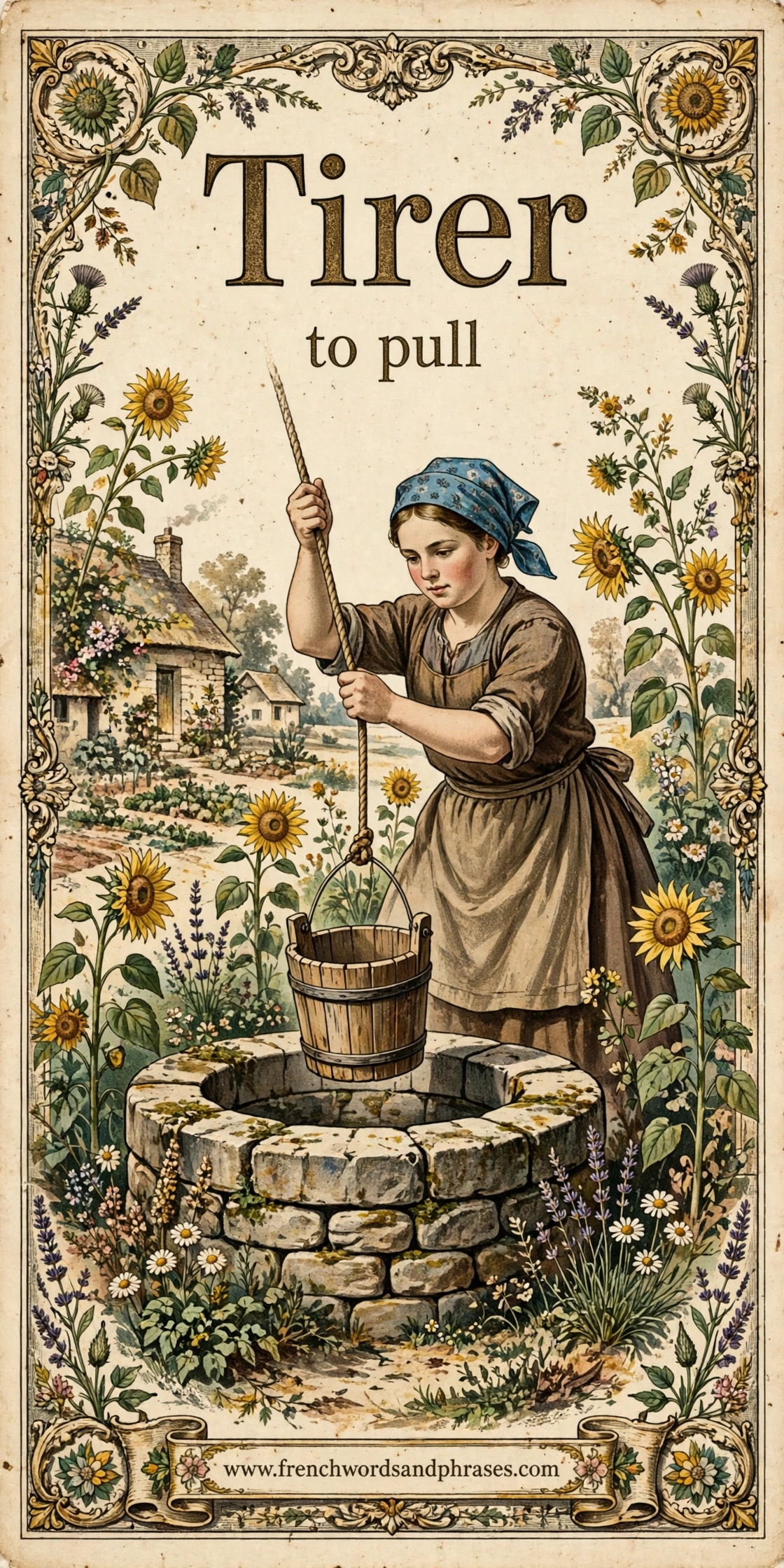
Tirer means to pull — to draw something towards you: a door, a rope, a curtain, a cart, or a whole hard life behind you.
A horse pulling a cart up a village street, a child pulling a sledge through the snow, a hand pulling a door quietly shut — tirer is the verb of traction: ropes, curtains, carts and triggers all answer to it.
In this guide, you’ll learn how to conjugate tirer in all the major French tenses and moods. Explore complete conjugation tables, French examples, English translations, and practice quizzes.
Understanding the French Verb Tirer
Tirer is a regular French verb belonging to the first group of verbs, those ending in-er.
It means to pull. It is one of the hardest-working verbs in French: horses and engines pull loads, hands pull doors, ropes and curtains, shooters fire, printers pull proofs, kings are drawn at Epiphany, and the poor, in the idiom tirer le diable par la queue, drag the devil himself by the tail — pulling a living out of nothing, month after month.
Verb classification: First group (-er)
Auxiliary verb: Avoir
Past participle: tiré
Present participle: tirant
English equivalents: To pull, to draw, to drag; tirer la porte — to pull the door to; tirer les rideaux — to draw the curtains; tirer sur une corde — to pull on a rope; tirer les rois — to draw the kings (the Epiphany galette custom); tirer le diable par la queue — to struggle to make ends meet; tirer les ficelles — to pull the strings.
One important detail: tirer is a perfectly regular -er verb — je tire, nous tirons, ils tirent, past participle tiré — and its whole art lies in its partners. With sur, it is pulling on something: tirer sur la corde. Without a preposition it draws things closed or along: tirer la porte, tirer les rideaux, tirer une charrette. It also fires weapons (tirer un coup de feu), prints and draws lots (tirer au sort), and in the reflexive se tirer it means to slip away or to get out of a scrape — il s’en est bien tiré, he got out of it nicely.
Experience the Word
Tirer is the verb of effort in a straight line — something resists, and you pull it, patiently, towards you.
Imagine a January morning in the mountains. Two children in red hats are pulling a wooden sledge up the slope, one at the rope, one pushing from behind — ils tirent, ils soufflent, ils rient — and at the top, the whole descent is their reward.
The sledge did not climb by itself. They pulled it — ils l’ont tiré — one metre of rope at a time.
How to Conjugate Tirer: Complete French Conjugation Guide
Let’s explore every major conjugation of tirer, beginning with the indicative mood.
How to Conjugate Tirer in the Indicative Mood
The indicative mood is used to express facts, observations, actions, and events.
How to Conjugate Tirer in the Present Tense (Présent)
Used for actions happening now, habitual actions, and general truths.
| Subject | Conjugation |
|---|---|
| je | tire |
| tu | tires |
| il / elle | tire |
| nous | tirons |
| vous | tirez |
| ils / elles | tirent |
Example
Le cheval tire la charrette jusqu’au village.
The horse pulls the cart as far as the village.
Quick Quiz 1
Complete the sentence:
Nous ______ les rideaux avant de dormir.
Reveal the answer
tirons
Nous tirons les rideaux avant de dormir.
We draw the curtains before sleeping.
How to Conjugate Tirer in the Passé Composé
Used for completed actions in the past. Tirer takes the auxiliary verb avoir.
| Subject | Conjugation |
|---|---|
| j’ | ai tiré |
| tu | as tiré |
| il / elle | a tiré |
| nous | avons tiré |
| vous | avez tiré |
| ils / elles | ont tiré |
Example
Elle a tiré la porte derrière elle sans un mot.
She pulled the door shut behind her without a word.
How to Conjugate Tirer in the Imparfait (Imperfect Tense)
Used for habitual past actions, descriptions, and ongoing situations in the past.
| Subject | Conjugation |
|---|---|
| je | tirais |
| tu | tirais |
| il / elle | tirait |
| nous | tirions |
| vous | tiriez |
| ils / elles | tiraient |
Example
Les enfants tiraient le traîneau dans la neige.
The children used to pull the sledge through the snow.
Quick Quiz 2
Choose the correct form:
She drew the curtains.
Elle ______ les rideaux. (a tiré / est tirée)
Reveal the answer
a tiré
Elle a tiré les rideaux.
Tirer takes avoir.
How to Conjugate Tirer in the Plus-que-parfait
Used to describe an action that had already been completed before another past event.
| Subject | Conjugation |
|---|---|
| j’ | avais tiré |
| tu | avais tiré |
| il / elle | avait tiré |
| nous | avions tiré |
| vous | aviez tiré |
| ils / elles | avaient tiré |
Example
Il avait tiré les rideaux avant de s’endormir.
He had drawn the curtains before falling asleep.
How to Conjugate Tirer in the Passé Simple
Primarily used in formal writing, literature, and historical narratives. It is rarely used in everyday conversation.
| Subject | Conjugation |
|---|---|
| je | tirai |
| tu | tiras |
| il / elle | tira |
| nous | tirâmes |
| vous | tirâtes |
| ils / elles | tirèrent |
Example
Le soldat tira trois coups de feu dans le ciel.
The soldier fired three shots into the sky.
How to Conjugate Tirer in the Passé Antérieur
A literary tense used to express an action completed immediately before another past action, generally in the passé simple.
| Subject | Conjugation |
|---|---|
| j’ | eus tiré |
| tu | eus tiré |
| il / elle | eut tiré |
| nous | eûmes tiré |
| vous | eûtes tiré |
| ils / elles | eurent tiré |
Example
Quand il eut tiré le verrou, la maison fut enfin silencieuse.
When he had drawn the bolt, the house was finally quiet.
How to Conjugate Tirer in the Future Tense (Futur Simple)
Used to describe actions that will take place in the future.
| Subject | Conjugation |
|---|---|
| je | tirerai |
| tu | tireras |
| il / elle | tirera |
| nous | tirerons |
| vous | tirerez |
| ils / elles | tireront |
Example
Demain, nous tirerons les rois pour la galette.
Tomorrow, we will draw the kings for the galette.
How to Conjugate Tirer in the Futur Antérieur (Future Perfect)
Used for an action that will have been completed before a particular point in the future.
| Subject | Conjugation |
|---|---|
| j’ | aurai tiré |
| tu | auras tiré |
| il / elle | aura tiré |
| nous | aurons tiré |
| vous | aurez tiré |
| ils / elles | auront tiré |
Example
Quand tu arriveras, on aura déjà tiré le feu d’artifice.
When you arrive, they will already have set off the fireworks.
How to Conjugate Tirer in the Near Future (Futur Proche)
Used to describe something that is going to happen soon. Formed with aller + infinitive.
| Subject | Conjugation |
|---|---|
| je | vais tirer |
| tu | vas tirer |
| il / elle | va tirer |
| nous | allons tirer |
| vous | allez tirer |
| ils / elles | vont tirer |
Example
Le chien va tirer sur sa laisse, tiens-la bien !
The dog is going to pull on his lead, hold it tight!
How to Conjugate Tirer in the Conditional Mood
The conditional mood expresses what would happen under certain circumstances. It is also frequently used to make polite requests or express wishes.
How to Conjugate Tirer in the Present Conditional
| Subject | Conjugation |
|---|---|
| je | tirerais |
| tu | tirerais |
| il / elle | tirerait |
| nous | tirerions |
| vous | tireriez |
| ils / elles | tireraient |
Example
Sans ton aide, je tirerais la remorque tout seul.
Without your help, I would pull the trailer all by myself.
How to Conjugate Tirer in the Past Conditional
| Subject | Conjugation |
|---|---|
| j’ | aurais tiré |
| tu | aurais tiré |
| il / elle | aurait tiré |
| nous | aurions tiré |
| vous | auriez tiré |
| ils / elles | auraient tiré |
Example
Elle aurait tiré la sonnette d’alarme si elle avait vu la fumée.
She would have pulled the alarm bell if she had seen the smoke.
Tirer in the Literary Past Conditional Form
This less common literary form uses the imperfect subjunctive of avoir.
| Subject | Conjugation |
|---|---|
| j’ | eusse tiré |
| tu | eusses tiré |
| il / elle | eût tiré |
| nous | eussions tiré |
| vous | eussiez tiré |
| ils / elles | eussent tiré |
Example
Il eût tiré l’épée pour défendre son honneur.
He would have drawn his sword to defend his honour.
How to Conjugate Tirer in the Subjunctive Mood
The subjunctive is used to express wishes, emotions, doubts, necessity, and uncertainty. It frequently follows expressions such as il faut que (it is necessary that) or bien que (although).
How to Conjugate Tirer in the Present Subjunctive
| Subject | Conjugation |
|---|---|
| que je | tire |
| que tu | tires |
| qu’il / qu’elle | tire |
| que nous | tirions |
| que vous | tiriez |
| qu’ils / qu’elles | tirent |
Example
Il faut que tu tires doucement sur la corde.
You must pull gently on the rope.
Quick Quiz 3
Complete the sentence using the subjunctive:
Il faut que vous ______ la porte en sortant.
Reveal the answer
tiriez
Il faut que vous tiriez la porte en sortant.
You must pull the door to as you go out.
How to Conjugate Tirer in the Imperfect Subjunctive
A literary tense, rarely encountered in modern spoken French.
| Subject | Conjugation |
|---|---|
| que je | tirasse |
| que tu | tirasses |
| qu’il / qu’elle | tirât |
| que nous | tirassions |
| que vous | tirassiez |
| qu’ils / qu’elles | tirassent |
Example
Je ne voulais pas qu’il tirât sur la nappe.
I did not want him to pull at the tablecloth.
How to Conjugate Tirer in the Pluperfect Subjunctive
A literary construction used to express an action completed before another past action.
| Subject | Conjugation |
|---|---|
| que j’ | eusse tiré |
| que tu | eusses tiré |
| qu’il / qu’elle | eût tiré |
| que nous | eussions tiré |
| que vous | eussiez tiré |
| qu’ils / qu’elles | eussent tiré |
Example
On prétendait qu’il eût tiré les ficelles de toute l’affaire.
People claimed he had pulled the strings of the whole affair.
How to Conjugate Tirer in the Past Subjunctive
| Subject | Conjugation |
|---|---|
| que j’ | aie tiré |
| que tu | aies tiré |
| qu’il / qu’elle | ait tiré |
| que nous | ayons tiré |
| que vous | ayez tiré |
| qu’ils / qu’elles | aient tiré |
Example
Je suis étonné qu’elle ait tiré si fort sur la porte.
I am surprised she pulled the door so hard.
How to Conjugate Tirer in the Imperative
The imperative is used to give commands, instructions, invitations, or suggestions. Subject pronouns are omitted.
How to Conjugate Tirer in the Present Imperative
| Person | Conjugation |
|---|---|
| (tu) | tire |
| (nous) | tirons |
| (vous) | tirez |
Example
Tirez la porte en entrant, merci !
Pull the door to as you come in, thank you!
Quick Quiz 4
How would you say Pull gently on the rope (tu form)?
Reveal the answer
Tire doucement sur la corde !
French Participles of Tirer
Participles are verb forms that can be used in compound tenses and other grammatical constructions.
Present Participle of Tirer
tirant
En tirant sur la corde, il a fait sonner la cloche.
By pulling on the rope, he made the bell ring.
Past Participle of Tirer
tiré
Tirée par deux chevaux, la calèche avançait lentement.
Pulled by two horses, the carriage moved slowly forward.
Tirer in Everyday French: Real-Life Examples
Now that you know the conjugations, let’s see how tirer appears in everyday French.
Example 1 — Present
Le cheval tire la charrette.
The horse pulls the cart.
Example 2 — Passé composé
Elle a tiré les rideaux.
She drew the curtains.
Example 3 — Imparfait
Les enfants tiraient le traîneau.
The children used to pull the sledge.
Example 4 — Future
Nous tirerons les rois demain.
We will draw the kings tomorrow.
Example 5 — Conditional
Je tirerais la remorque tout seul.
I would pull the trailer all by myself.
Example 6 — Imperative
Tire doucement sur la corde !
Pull gently on the rope!
Beyond Translation: The Meaning of Tirer
Tirer is probably Germanic in origin — a cousin of the old words for tearing and dragging — and it has kept that honest, physical feel in all its French lives.
Its finest hour is an idiom of poverty.
Tirer le diable par la queue — to pull the devil by the tail — is to live hand to mouth, dragging each month’s money behind you like a reluctant demon. The image is pure tirer: effort, resistance, and a load that does not want to follow.
How to Remember the French Verb Tirer
Remember it this way: Tirer is about the horse and the cart, the rope and the bell — and the devil dragged by his tail.
- Regular -er: je tire, nous tirons, past participle tiré — the difficulty is the partners, not the endings.
- Tirer sur = pull on (la corde); tirer alone = pull shut, draw along (la porte, les rideaux, une charrette).
- Tirer le diable par la queue: dragging the devil by the tail — struggling to make ends meet.
The key idea is the horse and the cart, the rope and the bell — and the devil dragged by his tail.
Test Your Knowledge of Tirer
Let’s see how much you’ve learned. Try answering these questions before revealing the answers.
Question 1
What is the difference between tirer la porte and tirer sur la corde?
Reveal the answer
Tirer la porte is to pull the door shut; tirer sur la corde is to pull on the rope — sur marks pulling on a thing.
Question 2
How do you say The horse pulls the cart in French?
Reveal the answer
Le cheval tire la charrette.
Question 3
Translate: She drew the curtains.
Reveal the answer
Elle a tiré les rideaux.
Question 4
What is the past participle of tirer?
Reveal the answer
Tiré.
Question 5
Complete the sentence:
Il faut que tu ______ doucement sur la corde.
Reveal the answer
tires
Il faut que tu tires doucement sur la corde.
You must pull gently on the rope.
Your Final Challenge
Can You Use It?
How would you say this in French?
The horse pulls the cart through the rain, and the whole village seems to move forward with him.
Reveal the answer
Le cheval tire la charrette sous la pluie, et le village entier semble avancer avec lui.
The horse pulls the cart through the rain, and the whole village seems to move forward with him.
A little French. A little curiosity. A richer everyday life.
LEARN FRENCH ONE WORD AT A TIME